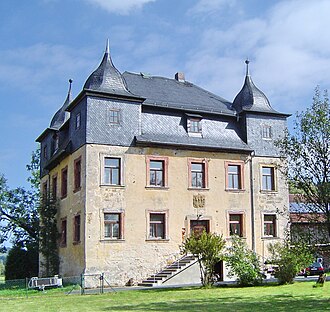
Hidden within the quiet, forested valleys of Upper Franconia lies a lesser-known yet historically evocative site: Burg Truppach. Unlike the grand and widely recognized castles of Bavaria, Burg Truppach belongs to a category of medieval fortifications that are more subtle in their presence but equally rich in historical meaning. Today, only fragments and traces remain, yet these remnants tell a story of feudal authority, regional conflict, and the gradual transformation of the Franconian landscape.
Located near the small settlement of Truppach, which is part of Hollfeld, the site occupies a strategic position within the broader region of Upper Franconia. This area, known for its dense network of castles and noble residences, reflects a historical period when political power was fragmented and local lords maintained control over relatively small territories.
Burg Truppach may not possess the towering walls or restored halls of more famous castles, but its significance lies in its authenticity and its connection to the everyday realities of medieval life. It represents a form of fortification that was deeply integrated into its environment and closely tied to the local community. This article explores the history, architecture, cultural context, and legacy of Burg Truppach, offering a comprehensive and detailed account of a site that deserves greater recognition.
Geographic Setting and Landscape Context
The site of Burg Truppach is situated within a gently undulating landscape characterized by forests, agricultural fields, and small streams. This environment differs from the dramatic rock formations of nearby Franconian Switzerland, yet it still provided strategic advantages for medieval builders.
The castle was likely constructed on a modest elevation overlooking the surrounding valley. This position allowed for a degree of natural defense while maintaining accessibility to nearby settlements and farmland. The proximity to water sources would have been an important factor in the site’s selection, ensuring a reliable supply for both domestic use and defensive purposes.
The surrounding landscape played a crucial role in the castle’s function. Agricultural land supported the local economy, while forests provided timber and hunting opportunities. The integration of these elements reflects a broader pattern in medieval castle construction, where sites were chosen not only for their defensive qualities but also for their ability to sustain a self-sufficient community.
Today, the remains of Burg Truppach are partially obscured by vegetation, blending into the natural environment. This integration enhances the site’s atmosphere, creating a sense of continuity between the past and the present.
Origins and Early Development
The origins of Burg Truppach can be traced back to the High Middle Ages, likely in the 12th or 13th century. This period was marked by the proliferation of small castles and fortified residences throughout Franconia, as local lords sought to establish and defend their territories.
The castle was probably founded by a minor noble family, whose identity may have been tied to the name “Truppach.” Such families often derived their names from the lands they controlled, reinforcing their connection to the territory.
In its earliest form, Burg Truppach would have been a relatively simple structure, consisting of a fortified residence surrounded by defensive features such as a ditch or palisade. Over time, these initial constructions were typically replaced or supplemented by stone buildings, reflecting advancements in construction techniques and the increasing importance of durability.
The early development of the castle was closely linked to the feudal system, in which land ownership and military service were interconnected. As a fortified seat, Burg Truppach served as both a home and a center of authority, overseeing the surrounding lands and population.
The Feudal Context and Local Power Structures
To understand Burg Truppach, it is essential to consider the broader feudal context in which it was built. During the medieval period, Franconia was part of the Holy Roman Empire, a decentralized political entity characterized by a complex hierarchy of lords, bishops, and imperial authorities.
In this system, castles like Burg Truppach played a crucial role in maintaining local control. They served as administrative centers where taxes were collected, disputes were resolved, and military forces were organized. The presence of a castle reinforced the authority of its मालिक and provided a visible symbol of power.
The region around Hollfeld was particularly fragmented, with numerous small territories controlled by different noble families. This fragmentation often led to conflicts, as neighboring lords competed for resources and influence.
Burg Truppach would have been part of this network of power, interacting with other castles and settlements in the region. Its role may have been relatively modest compared to larger fortresses, but it was nonetheless an important component of the local political landscape.
Architectural Characteristics
Although Burg Truppach does not survive as a fully intact structure, it is possible to reconstruct its architectural characteristics based on typical features of similar castles in the region.
Layout and Structure
The castle likely followed a compact layout, with a central residential building surrounded by defensive elements. This arrangement was common for smaller castles, where space and resources were limited.
Defensive Features
Defensive features would have included a ditch or moat, possibly accompanied by an earthen rampart or stone wall. A gatehouse would have controlled access to the site, while elevated positions provided vantage points for monitoring the surrounding area.
Residential Elements
The residential building would have included living quarters, storage areas, and possibly a hall for gatherings and administrative functions. These spaces were designed to accommodate both the दैनिक needs of the السكان and the requirements of governance.
Construction Materials
Local stone and timber were the primary materials used in construction. The use of locally available resources reflects both practical considerations and the integration of the castle into its environment.
Decline and Abandonment
Like many smaller castles, Burg Truppach experienced a gradual decline as the medieval period gave way to the early modern era. Several factors contributed to this process, including changes in military technology, shifts in political power, and economic transformations.
The development of artillery reduced the effectiveness of traditional fortifications, making many castles obsolete as defensive structures. At the same time, the consolidation of political power into larger states diminished the importance of small, locally controlled strongholds.
As a result, Burg Truppach may have been abandoned or repurposed, with its materials reused for other البناء projects. This process of dismantling was common, as stone from पुराने castles was often used in the construction of नई buildings.
Over time, the site fell into ruin, with natural processes further contributing to its decay. Vegetation grew over the remains, and the castle gradually became part of the landscape.
Archaeological and Historical Significance
Despite its fragmentary state, Burg Truppach holds significant value for historians and archaeologists. The site provides insight into the structure and function of smaller medieval castles, which are often less well-documented than their larger counterparts.
Archaeological investigations can reveal information about construction techniques, daily life, and the economic activities associated with the castle. Artifacts such as pottery, tools, and строительные remains contribute to a deeper understanding of the site.
The study of Burg Truppach also contributes to a broader understanding of regional history. By examining how this castle fits into the network of fortifications in Upper Franconia, researchers can gain insights into patterns of settlement, conflict, and governance.
Cultural Landscape and Memory
Burg Truppach is an integral part of the cultural landscape of Upper Franconia. Even in its ruined state, it contributes to the region’s identity and sense of history.
The presence of the castle influences local memory, serving as a reminder of the area’s medieval past. Stories, legends, and traditions associated with the site may persist, adding a layer of intangible heritage to its physical remains.
The integration of the ruins into the natural environment also enhances their cultural significance. The site becomes a place where history and nature intersect, offering a unique experience for visitors and жителей alike.
Modern Perception and Tourism
While Burg Truppach is not a major tourist destination, it holds potential for those interested in exploring lesser-known historical sites. Its शांत setting and атмосферic ruins provide an альтернатив to more crowded attractions.
Visitors can appreciate the site for its историческая authenticity and its connection to the landscape. Hiking trails and local маршруты may include the castle, allowing for a deeper exploration of the region.
Efforts to preserve and interpret the site can enhance its accessibility and educational value, ensuring that it remains a part of the cultural heritage of Upper Franconia.
Preservation Challenges
The preservation of Burg Truppach presents several challenges, particularly due to its состояние as a ruin. Exposure to weather, vegetation growth, and human activity can all contribute to further deterioration.
Conservation efforts must balance the need to stabilize the remains with the desire to maintain their authenticity. In some cases, minimal intervention may be preferred, allowing the site to retain its natural and historical character.
Collaboration between local authorities, historians, and conservationists is essential for ensuring the long-term preservation of the site.
Burg Truppach in the Context of Franconian Castles
Within the broader context of Franconian castles, Burg Truppach represents a category of smaller, less prominent fortifications that were nonetheless vital to the functioning of the medieval landscape.
These castles may lack the grandeur of larger sites, but they offer valuable insights into the everyday realities of feudal society. Their study complements that of more famous castles, providing a more complete picture of the region’s history.
Technical Specifications
| Feature | Description |
|---|---|
| Name | Burg Truppach |
| Location | Near Truppach, Hollfeld, Upper Franconia, Bavaria, Germany |
| Type | Small medieval castle / fortified residence |
| Construction Period | Likely 12th–13th century |
| Architectural Style | Medieval |
| Layout | Compact structure with defensive perimeter |
| Defensive Features | Ditch or moat, possible ramparts |
| Materials | Local stone and timber |
| Current Condition | Ruins |
| Elevation | Modest hill or elevation above valley |
| Historical Function | Local noble residence and administrative center |
| Region | Upper Franconia |
| Nearest Town | Hollfeld |
| Preservation Status | Partially preserved ruins |
Conclusion
Burg Truppach may not stand among the most famous castles of Bavaria, but its importance lies in its representation of a broader historical reality. As a smaller fortified residence, it offers a glimpse into the everyday workings of the medieval world, where local lords governed their territories and communities lived under their protection.
.jpg)