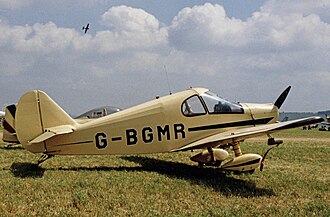
The history of aviation is filled with aircraft that have achieved worldwide recognition through speed, technological innovation, or extraordinary military accomplishments. However, some of the most interesting aircraft are those developed with a much simpler ambition: making flying accessible to ordinary people. The CAB Minicab, also known as the GY-20 Minicab, is an excellent example of this philosophy. Designed in France in the years immediately following the Second World War, this compact two-seat aircraft combined practical engineering, economical operation, and enjoyable flying characteristics in a design that would go on to inspire amateur aircraft builders around the world.
Created by French aircraft designer Yves Gardan and manufactured by Constructions Aéronautiques du Béarn (CAB), the Minicab first flew on February 1, 1949. Its development came at a time when recreational aviation was gaining renewed importance in Europe, as pilots, engineers, and aviation enthusiasts sought affordable ways to return to the skies. Instead of designing a complicated aircraft with expensive systems, Gardan concentrated on a relatively lightweight, low-wing monoplane that could be built and maintained without excessive expense.
The Minicab quickly demonstrated that a small aircraft did not necessarily have to sacrifice performance or handling quality. Its responsive controls, efficient aerodynamic layout, and modest engine power helped it establish an impressive reputation, including success in French aviation competitions and notable distance and speed records for its class. Equally important was its potential for amateur construction, which allowed the design to survive beyond the original manufacturer’s production period.
Today, the CAB Minicab remains an interesting chapter in the development of European general aviation. Its history illustrates the value of intelligent lightweight engineering, the importance of the homebuilt aircraft movement, and the enduring appeal of simple, economical flying.
The Origins and History of the CAB Minicab
Yves Gardan and the Birth of a New Aircraft
The story of the CAB Minicab begins with Yves Gardan, a French aircraft designer who was interested in developing compact, affordable aircraft for private pilots and amateur builders. During the late 1940s, Europe was experiencing a renewed interest in civilian aviation, but the high cost and complexity of many aircraft remained significant barriers to ownership. Gardan recognized an opportunity to develop a two-seat aircraft that could offer useful performance while remaining relatively inexpensive to construct and operate.
Gardan’s early work on the GY-20 design eventually led to the creation of Constructions Aéronautiques du Béarn in 1948, in partnership with Max Laporte and M. Dubouts. Based in the Béarn region of southwestern France, the company was established to turn Gardan’s ideas into a practical aircraft. The resulting design was influenced by his earlier work on the SIPA S.90, but the Minicab was conceived as a smaller, economical aircraft with particular emphasis on recreational use and amateur construction.
The prototype was completed in early 1949 and made its maiden flight at Pau-Idron on February 1, with Max Fischl at the controls. The aircraft successfully completed its initial flight testing, and type certification followed in April of the same year. This rapid progression from design to certification demonstrated the practicality of the concept and provided the foundation for the Minicab’s subsequent production.
Production and International Popularity
CAB began manufacturing the Minicab in France shortly after its successful introduction. Approximately 65 factory-built examples were produced before manufacturing ended in 1955. Although this was a relatively small production run compared with that of major aircraft manufacturers, the Minicab’s influence extended considerably further through its amateur-built versions.
After CAB ceased production, the rights to the aircraft plans were acquired by British aviation enthusiast and author Arthur Ord-Hume. He redrew the plans, introduced several refinements, and made them more suitable for amateur construction. These plans were marketed internationally, allowing builders in the United Kingdom, France, Canada, New Zealand, and other countries to construct their own Minicabs.
The aircraft’s relatively simple design and established performance made it particularly attractive to the homebuilt aviation community. Rather than disappearing when the original production line closed, the Minicab continued to evolve through privately constructed examples and subsequent modifications.
Design and Engineering of the GY-20 Minicab
A Conventional Low-Wing Monoplane
The CAB Minicab features a conventional low-wing cantilever monoplane configuration, with a fixed tailwheel landing gear and a single engine mounted at the front of the fuselage. Its clean aerodynamic layout reflects the design priorities of its era, when reducing structural weight and aerodynamic drag was essential for achieving good performance from relatively low-powered engines.
The low-mounted wings provide a compact, streamlined appearance, while the cantilever construction eliminates the need for external wing-support struts. This arrangement contributes to aerodynamic efficiency and gives the aircraft a relatively uncluttered profile. Its conventional tail assembly provides the directional and longitudinal stability required for normal flight operations.
The GY-20 was also designed to be practical on the ground. Its fixed tailwheel landing gear avoids the complexity and weight associated with retractable landing systems, while providing a familiar arrangement for pilots experienced with conventional light aircraft. Although tailwheel aircraft require careful directional control during taxiing, takeoff, and landing, their simple mechanical layout is consistent with the Minicab’s economical design philosophy.
Wooden Construction and Fabric Covering
One of the defining characteristics of the Minicab is its traditional wooden airframe construction. The wings use a wooden structural framework, including a main spar and supporting ribs, while the fuselage is constructed around a lightweight framework. Aircraft fabric covering forms the outer aerodynamic surfaces, producing a relatively light structure without requiring extensive metal fabrication.
Wood was a particularly suitable material for this type of aircraft during the late 1940s. It was widely available, comparatively inexpensive, and familiar to skilled craftsmen. For amateur builders, wooden construction also offered the possibility of carrying out much of the work using conventional woodworking tools, provided that the builder possessed the necessary knowledge and followed the approved plans carefully.
The use of fabric covering helped reduce structural weight while creating smooth external surfaces. However, wooden aircraft require appropriate protection against moisture, deterioration, and structural damage. Regular inspections and suitable storage are therefore important for preserving the airworthiness of surviving Minicabs.
Cockpit and Pilot Accommodation
The Minicab was designed to carry two occupants seated side by side, making it a practical aircraft for recreational flights and basic flight instruction. The cockpit is enclosed by a one-piece transparent canopy that hinges forward to provide access. This arrangement offers occupants useful visibility while giving the aircraft a distinctive appearance.
The side-by-side seating configuration is particularly valuable for an aircraft of this size because it allows the pilot and passenger to share the same general field of view. With dual controls installed, the aircraft can also be used for instructional purposes, allowing an appropriately qualified instructor to demonstrate control movements and supervise a student during flight.
Despite its compact dimensions, the Minicab provides a functional cockpit layout intended to accommodate the essential flight instruments and controls without unnecessary complexity. Its design emphasizes the direct flying experience, with conventional instruments and straightforward aircraft systems rather than advanced electronic equipment.
Engine and Flight Performance
The Continental A65 Engine
The original CAB GY-20 Minicab was powered by the Continental A65, a four-cylinder, air-cooled, horizontally opposed piston engine producing approximately 65 horsepower. This engine was a natural choice for a lightweight two-seat aircraft because it offered a relatively favorable balance of power, weight, mechanical simplicity, and fuel consumption.
Mounted in a tractor configuration at the front of the fuselage, the engine drives a two-bladed propeller, traditionally made from wood. Its modest output is sufficient to provide the Minicab with useful performance while keeping operating costs manageable. The air-cooled arrangement also avoids the additional weight and mechanical complexity of a liquid-cooling system.
Some later Minicabs and amateur-built examples received alternative engines, including the Continental C85 and C90. These more powerful installations can improve certain performance characteristics, but they may also require structural adjustments, changes to the propeller, and revised weight-and-balance calculations. Consequently, the precise performance of an individual Minicab depends heavily on its particular engine and configuration.
Speed, Range, and Climb Performance
For an aircraft developed primarily for recreational aviation, the Minicab offers respectable performance. Published specifications for the original GY-20 indicate a maximum speed of approximately 110 mph (180 km/h) and a cruising speed of around 105 mph (170 km/h). These figures make it suitable for local recreational flights and short cross-country journeys, although it is not intended to compete with faster touring aircraft.
The original aircraft has a reported service ceiling of approximately 13,000 feet (4,000 metres) and a rate of climb of around 590 feet per minute (3 metres per second). Its relatively low empty weight helps the aircraft make effective use of its modest engine power. Actual climb performance, however, varies with aircraft loading, air temperature, altitude, engine condition, and other operating factors.
With a published fuel capacity of approximately 50 litres, the original GY-20 offers useful endurance for its class. Its practical range depends on fuel consumption, reserve requirements, weather, and the particular aircraft’s equipment. These characteristics make the Minicab an appealing option for pilots who value economical recreational flying over high-speed transportation.
Flight Characteristics and Operational History
Responsive Handling and Recreational Flying
The CAB Minicab gained a reputation for responsive handling and harmonious flight controls. Its lightweight airframe and conventional aerodynamic configuration contribute to a flying experience that rewards smooth, deliberate pilot inputs. This characteristic was highlighted by former RAF fighter pilot and test pilot Roland Beamont, who flew a Minicab in 1969 and described its controls as light and responsive, drawing comparisons with the handling qualities of the famous Supermarine Spitfire.
Such comparisons should be understood as observations about control response rather than claims of equivalent performance. The Minicab is a small, low-powered light aircraft, but its handling characteristics helped establish its reputation among pilots who appreciate direct control feedback and a close connection with the aircraft.
The fixed tailwheel landing gear adds another dimension to the flying experience. Tailwheel aircraft can be more demanding during ground operations than comparable nosewheel designs, especially in crosswinds. For experienced pilots, however, the arrangement is a familiar and practical feature of traditional light aircraft.
Competition Success and Aviation Records
The Minicab demonstrated its capabilities soon after entering service. By the end of 1950, it had won the Coupe de Vitesse de Deauville and the Grand Prix Aérien de Vichy, two notable achievements that helped bring attention to the design.
Its accomplishments continued in 1951, when a Minicab established a distance record for its aircraft class with a flight of approximately 1,825 kilometres (1,138 miles). In 1952, the aircraft also achieved an average speed of approximately 183 km/h (114 mph) over a 2,000-kilometre circuit, setting another record for its category.
These achievements were especially significant for a compact aircraft powered by a relatively modest engine. They demonstrated the importance of aerodynamic efficiency, low structural weight, and careful aircraft design in achieving impressive results without relying on substantial engine power.
Variants and Further Development
The GY-201 Minicab
The GY-201 was a refined development of the original GY-20 and became the principal version associated with later production and amateur construction. Its improvements included increased fuel capacity, a slightly reduced wingspan, a strengthened landing gear arrangement, split flaps, and a castoring tailwheel.
These refinements were intended to improve practicality, low-speed handling, and operational flexibility while retaining the fundamental characteristics of the original design. The GY-201 also provided a foundation for many of the homebuilt Minicabs produced after the closure of CAB.
The Barritault JB.01 and Other Derivatives
Jean Barritault developed modifications to the Minicab that became known as the JB.01. His improvements influenced later construction plans and helped extend the aircraft’s development beyond its original factory-built form.
Other related designs included the Falconar Hawk and MiniHawk, as well as the MacFam Cavalier, which was developed from a substantially revised interpretation of the Minicab. The Cavalier incorporated changes that included alternative landing gear arrangements and modified tail surfaces, demonstrating how the original design could serve as a foundation for further engineering experimentation.
Another important development was the CAB GY-30 Supercab, which first flew in 1954. Although closely related to the Minicab, it featured a more powerful engine, a larger wingspan, manually retractable landing gear, and slotted flaps. Only seven Supercabs were built before the design rights were transferred to SIPA, illustrating both the potential and the commercial challenges of developing small aircraft during this period.
Maintenance, Ownership, and the Homebuilt Aviation Community
The Minicab’s traditional construction is an important consideration for anyone interested in owning or building one. Wooden structures and fabric-covered surfaces can be maintained successfully for many years, but they require careful inspection and protection against moisture, aging, and material deterioration. The condition of the main spar, wing attachments, fuselage structure, control linkages, and landing gear should be evaluated as part of a thorough airworthiness assessment.
For amateur builders, the availability of construction plans helped make the aircraft accessible to aviation enthusiasts who wanted to participate directly in the manufacturing process. Building an aircraft, however, demands technical knowledge, patience, suitable workshop facilities, and strict adherence to approved construction and inspection requirements. The experience can be rewarding, but the finished aircraft must still satisfy the applicable airworthiness regulations.
The worldwide homebuilt community has played an essential role in preserving the Minicab. Privately constructed and modified examples have kept the design active long after the original production line closed. This continuing interest is part of the aircraft’s wider historical importance: it demonstrates how an effective design can outlive its original manufacturer through the dedication of individual builders and owners.
CAB Minicab Technical Specifications
The following table presents the published specifications for the original GY-20 Minicab. Later GY-201 aircraft and homebuilt derivatives may have different dimensions, weights, engines, and performance figures.
| Technical specification | CAB GY-20 Minicab |
|---|---|
| Aircraft category | Two-seat light aircraft |
| Manufacturer | Constructions Aéronautiques du Béarn |
| Country of origin | France |
| Designer | Yves Gardan |
| First flight | February 1, 1949 |
| Production period | 1949–1955 |
| Number of factory-built aircraft | Approximately 65 |
| Crew | 1 pilot |
| Passenger capacity | 1 |
| Configuration | Low-wing cantilever monoplane |
| Fuselage construction | Wooden structure |
| Wing construction | Wooden structure |
| Covering | Aircraft fabric |
| Landing gear | Fixed tailwheel |
| Length | 5.45 m (17 ft 11 in) |
| Wingspan | 8.14 m (26 ft 8 in) |
| Height | 1.65 m (5 ft 5 in) |
| Wing area | 10.15 m² (109.3 sq ft) |
| Empty weight | 270 kg (595 lb) |
| Maximum gross weight | 485 kg (1,069 lb) |
| Fuel capacity | 50 litres (13 US gal) |
| Standard engine | Continental A65 |
| Engine configuration | Four-cylinder, air-cooled, horizontally opposed |
| Engine power | 65 hp (48 kW) |
| Propeller | Two-bladed wooden propeller |
| Maximum speed | 180 km/h (110 mph) |
| Cruising speed | 170 km/h (105 mph) |
| Rate of climb | 590 ft/min (3 m/s) |
| Service ceiling | 4,000 m (13,000 ft) |
| Takeoff run to 20 m | 370 m (1,210 ft) |
| Landing run from 20 m | 343 m (1,125 ft) |
| Typical applications | Recreational flying, touring, amateur construction |
Figures refer to the original GY-20 specification and may vary among individual aircraft. Performance and operating limitations should always be verified against the documentation for the specific aircraft.
Conclusion: The Enduring Legacy of the CAB Minicab
The CAB Minicab is a compelling example of how thoughtful engineering can create an aircraft that remains relevant long after its original production has ended. Designed by Yves Gardan in postwar France, it combined a lightweight wooden airframe, efficient low-wing configuration, straightforward mechanical systems, and economical engine power to deliver an enjoyable and practical flying experience.
Its competition victories and aviation records demonstrated that a small, modestly powered aircraft could achieve impressive results when its structure and aerodynamics were carefully balanced. Meanwhile, the subsequent availability of construction plans allowed the Minicab to develop an international following among amateur builders, ensuring that the design would continue to evolve beyond its original manufacturing period.
Although modern light aircraft may offer advanced avionics, composite construction, and greater performance, the Minicab retains a special appeal for enthusiasts of traditional aviation. Its simple engineering, responsive handling, and strong connection to the homebuilt aircraft movement make it an enduring example of accessible personal flight.
More than simply a small French aircraft from the late 1940s, the CAB Minicab represents an era when ingenuity, craftsmanship, and a passion for flying could transform a modest design into an internationally recognized aviation success.
