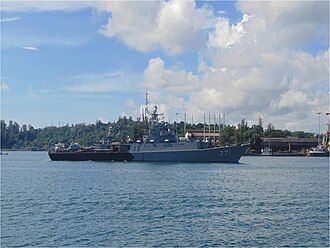
KRI Kapitan Pattimura (371): History, Specifications, Weapons, and Role in the Indonesian Navy
KRI Kapitan Pattimura (371) is an Indonesian Navy corvette associated with the Kapitan Pattimura class, a group of warships derived from the Parchim-class corvettes originally developed for the East German Navy during the Cold War. Built in East Germany and later transferred to Indonesia, the vessel represents an important chapter in the development of Indonesia’s maritime defense capabilities and the international transfer of naval equipment following the end of the Cold War. Designed primarily for anti-submarine warfare in coastal waters, ships of this class combine a compact hull, diesel-powered propulsion, naval guns, and specialized underwater-warfare equipment. Their design reflects a period when protecting coastal approaches from submarines was a major concern for European navies, while their later service in Southeast Asia demonstrates how naval platforms can acquire new strategic purposes when they enter a different operating environment. KRI Kapitan Pattimura’s story therefore connects shipbuilding history, Indonesian naval modernization, Cold War military technology, and the continuing importance of maritime security in an archipelagic nation.
The ship is especially notable because its history began under a different name and national flag. Before entering Indonesian service, it was known as Prenzlau, with the pennant number 231, and served in the Volksmarine, the naval force of the former German Democratic Republic, commonly known as East Germany. Following German reunification and the restructuring of East Germany’s armed forces, a number of former Volksmarine vessels became available for transfer or sale. Indonesia acquired a substantial group of these ships during the 1990s, including the Parchim-class anti-submarine corvettes that subsequently became known as the Kapitan Pattimura class. The former Prenzlau entered Indonesian service as KRI Kapitan Pattimura, receiving pennant number 371 and becoming part of a fleet intended to support patrol, maritime defense, and anti-submarine operations across Indonesia’s extensive waters.
The Origins and Historical Background of KRI Kapitan Pattimura
Construction in East Germany
KRI Kapitan Pattimura began its operational life as Prenzlau, a Parchim-class corvette constructed by Peene-Werft in Wolgast, East Germany. The ship was launched in 1981 and commissioned into East German naval service on 11 May 1983. Its construction took place during the Cold War, when the Baltic Sea and nearby coastal regions were strategically important to both NATO and the Warsaw Pact. Naval planners on the Eastern side of Europe needed relatively small but capable warships that could operate close to shore, monitor maritime approaches, and counter enemy submarines in waters where larger surface combatants might not always be the most practical choice. The Parchim design emerged from these requirements, prioritizing anti-submarine capabilities, maneuverability, and a weapons fit suited to operations in relatively confined seas. Instead of being conceived as a large ocean-going frigate, the vessel was built as a compact combatant intended to contribute to coastal defense and the protection of nearby naval forces.
The shipyard at Wolgast was part of the industrial system that supported East Germany’s naval ambitions. Building a series of similar corvettes allowed the shipbuilding industry to apply a common design across multiple vessels, simplifying production and providing the navy with ships that shared broadly similar equipment and operational characteristics. The Parchim class was also associated with Soviet naval requirements and technology, reflecting the close military relationship between East Germany and the Soviet Union during the Cold War. These ships were designed around the demands of anti-submarine warfare rather than around the long-range power projection associated with larger fleets. Their compact size and dedicated underwater-warfare equipment made them useful for protecting coastal approaches, escorting other vessels, and responding to submarine threats in areas where the local geography and water depth shaped the conduct of naval operations.
Service as Prenzlau in the Volksmarine
During its East German service, Prenzlau operated under pennant number 231. Its role was shaped by the security environment of the Cold War, when the navies of the Warsaw Pact maintained forces intended to protect their own coastlines and challenge the activities of opposing fleets. Anti-submarine warfare was an important element of that strategy because submarines could threaten surface ships, shipping routes, and naval facilities without being easily detected. A vessel such as Prenzlau was therefore designed to work with sensors, weapons, and other naval units to search for and counter underwater threats. Its guns provided additional defensive and surface-combat capability, while its anti-submarine equipment gave the ship a more specialized mission than that of a conventional patrol boat. Although the corvette was smaller than a destroyer or frigate, it could still make a meaningful contribution to a layered coastal defense system when operating alongside other vessels and supported by shore-based surveillance and command networks.
Prenzlau’s East German career ended as the political and military structures of Europe changed dramatically at the beginning of the 1990s. German reunification in 1990 led to the absorption or dissolution of many East German state institutions, including the Volksmarine. Former East German warships were assessed for continued use, disposal, or transfer, creating an opportunity for other countries to acquire relatively capable vessels at a time when building new warships could be considerably more expensive. For Indonesia, the availability of these ships offered a way to expand its naval inventory without relying exclusively on new construction. However, transferring a warship between countries involves much more than changing its flag and name: maintenance, crew training, communications, accommodation, logistics, spare parts, and adaptation to a different operating climate all influence whether a vessel can be used effectively over the long term.
Transfer to Indonesia and Commissioning as KRI Kapitan Pattimura
Indonesia’s acquisition of former East German warships
Indonesia acquired a large group of former East German naval vessels during the 1990s, including 16 Parchim-class anti-submarine corvettes. This procurement was part of a broader effort to obtain maritime platforms for a country whose territory consists of thousands of islands connected by strategically important seas and straits. Indonesia’s geographic circumstances make naval forces important for a wide range of tasks, from safeguarding maritime approaches and supporting patrol operations to maintaining a visible state presence across distant island groups. A corvette is not a substitute for every type of warship, but it can provide a useful balance between size, endurance, weapons, and operating cost. Acquiring a series of similar vessels also offers potential benefits in fleet organization and crew training, because ships built to a common design can share procedures, maintenance practices, and many aspects of their logistical support.
The transfer of the Parchim-class vessels was not without challenges. These ships had been designed for European coastal operations, and their systems had to be assessed for continued service in the different environmental conditions of Southeast Asia. Tropical temperatures, humidity, salt exposure, operating tempo, and the availability of suitable replacement parts can all affect the reliability of a warship acquired second-hand. Reporting on Indonesia’s former East German vessels has also noted public debate about procurement costs, technical condition, and their suitability for tropical service. Such considerations illustrate an important principle of naval modernization: the initial purchase price is only one part of the total cost of ownership. A vessel’s practical value depends on how consistently it can be maintained, how effectively its crew can operate it, whether its sensors and weapons remain supportable, and how well it fits the wider fleet’s missions.
Commissioning and the name Kapitan Pattimura
Prenzlau entered Indonesian Navy service as KRI Kapitan Pattimura on 23 September 1993, receiving the pennant number 371. The ship’s new name refers to Pattimura, the historical name associated with Thomas Matulessy, a Maluku resistance leader who fought against Dutch colonial rule in the early nineteenth century. Naming a naval vessel after a figure associated with resistance and regional history connects the ship to Indonesia’s wider national narrative and gives it an identity distinct from its earlier Cold War service. The prefix KRI, short for Kapal Perang Republik Indonesia, identifies it as a warship of the Republic of Indonesia. Its pennant number, 371, is the key identifier used to distinguish the vessel within the navy’s inventory and in naval references.
The commissioning of KRI Kapitan Pattimura was part of a larger transition in which vessels designed for one country’s strategic environment were incorporated into another country’s maritime forces. For Indonesia, the former Parchim-class corvettes offered a way to build up anti-submarine and patrol capacity relatively quickly, while continuing to use established ship designs rather than waiting for a new class to be developed and built. Nevertheless, the ship’s entry into service should not be understood as the end of the acquisition process. The integration of a foreign-built warship requires training, documentation, technical inspections, and a sustainable supply of maintenance support. Any changes to communications, accommodation, cooling systems, or weapon installations must also be considered in relation to the ship’s intended missions. The history of KRI Kapitan Pattimura is consequently not just a story about buying a vessel; it is also an example of the work required to make a transferred naval platform useful within a new fleet.
Design and Physical Characteristics
Hull dimensions and displacement
KRI Kapitan Pattimura has the proportions of a compact anti-submarine corvette, with a reported length of approximately 75.2 metres, a beam of 9.78 metres, and a draft of about 2.65 metres. These dimensions provide enough internal volume for machinery, crew accommodation, combat systems, sensors, weapons, and the support equipment needed for sustained naval operations, while keeping the ship smaller than a conventional frigate or destroyer. Its relatively narrow beam in relation to its length gives the vessel a recognizably elongated profile, and its hull was developed for operations in coastal waters rather than for the heavy weapons loads and extensive aviation facilities associated with larger surface combatants. Published references commonly give a standard displacement of approximately 865 tonnes and a fully loaded displacement of around 935 tonnes, although figures can differ depending on the source, measurement conventions, and the configuration being described.
Displacement is an important measure because it describes the mass of water displaced by the vessel and provides a useful indication of its overall size. Standard displacement and full-load displacement are not interchangeable: the latter accounts for the ship in a more fully equipped and supplied condition, including fuel, ammunition, provisions, and other stores. For a naval vessel, these figures help explain the balance between endurance, payload, and compact design. A smaller warship has less internal space than a large frigate, so its designers must allocate room carefully among propulsion machinery, sensors, weapons, living spaces, and maintenance access. The Parchim-class design represents one approach to that challenge, placing considerable emphasis on anti-submarine capability within a hull intended to remain economical and practical for coastal operations.
Structure and operational environment
A corvette’s practical effectiveness depends not only on its dimensions but also on the relationship between hull design, machinery, sensors, and the environment in which it operates. The Parchim-class ships were developed for the coastal waters of northern Europe, where the strategic problem included detecting and countering submarines operating near important maritime routes and naval bases. Indonesian waters present a different set of conditions, including warm temperatures, high humidity, heavy rainfall in some regions, strong local currents, and long distances between islands. The basic hull can still serve in this environment, but long-term effectiveness depends on maintenance and the condition of the equipment installed aboard each vessel. Corrosion prevention, cooling and ventilation, machinery servicing, and the availability of replacement components can be particularly important when an older ship is expected to remain in regular service in a tropical climate.
The vessel’s size also helps define the type of missions for which it is most appropriate. Compared with a large frigate, a corvette generally has less space for command facilities, stores, and complex weapon systems, but it may be less demanding to deploy for routine patrols and operations near the coast. The combination of a relatively compact hull and anti-submarine equipment gives KRI Kapitan Pattimura a design heritage suited to coastal defense and support for wider naval operations. In practice, however, no ship can perform every task equally well. Its utility depends on the condition of its machinery, the availability and performance of its sensors, the training of its crew, and the extent to which it can coordinate with other vessels, aircraft, and shore-based command systems.
Propulsion, Speed, and Endurance
Three-diesel-engine propulsion system
Published specifications for KRI Kapitan Pattimura’s class list a propulsion arrangement consisting of three M-504A diesel engines, each rated at approximately 4,750 horsepower, for a combined nominal output of around 14,250 horsepower. The engines drive three fixed-pitch propellers, providing the thrust needed to move the ship through the water. Diesel propulsion is well suited to many small and medium-sized naval vessels because it can deliver substantial power without the complexity of a large steam plant, while allowing a ship to operate at different speeds according to its mission. For a corvette tasked with patrol and anti-submarine operations, propulsion must support both economical cruising and the ability to increase speed when responding to a developing situation. The published figures describe the general class configuration; the exact condition and performance of an individual ship depend on its machinery, maintenance history, and any subsequent refits.
The three-propeller arrangement is part of the ship’s original mechanical design and must be considered together with the engines, transmission systems, steering equipment, and hull characteristics. Propulsion performance is not determined by engine horsepower alone: the state of the machinery, propeller condition, loading, sea conditions, and hull cleanliness all influence actual speed and fuel consumption. A ship that has been in service for several decades may also perform differently from its original design specifications if its machinery has experienced wear or has undergone modifications. For this reason, published maximum-speed figures should be treated as design or reference values rather than as proof of the vessel’s current operational performance.
Maximum speed and cruising range
KRI Kapitan Pattimura’s class is commonly credited with a maximum speed of approximately 24.5 knots, equivalent to about 45.4 kilometres per hour under suitable conditions. Its reported range is approximately 2,100 nautical miles at 14 knots, although real-world endurance varies with the amount of fuel carried, engine condition, sea state, weather, and the amount of time spent operating at higher speeds. A nautical mile is used in maritime navigation and equals approximately 1.852 kilometres, making 2,100 nautical miles roughly 3,889 kilometres. Range at a stated cruising speed is more useful for understanding practical endurance than maximum speed alone, because ships generally consume fuel differently when cruising steadily than when operating at high power.
These characteristics provide a useful balance for a vessel designed to conduct patrols and anti-submarine missions, but range should not be confused with unlimited independence from shore support. Naval deployments also require food, drinking water, spare parts, ammunition, technical servicing, and access to facilities for repairs. If the ship spends extended periods at high speed or carries out demanding combat-system exercises, its practical endurance may differ substantially from the published cruising-range figure. Similarly, operating in challenging weather or conducting repeated maneuvering can affect fuel consumption. A corvette’s sustained contribution to maritime security therefore depends on a combination of speed, range, reliable machinery, crew readiness, and the support infrastructure available to the navy.
Weapons and Combat Systems
Main gun: twin 57 mm AK-725
One of the most prominent weapons associated with the Parchim/Kapitan Pattimura class is the AK-725 twin 57 mm naval gun mount. The weapon provides a surface-combat capability and can be used against suitable targets within its effective engagement envelope. A medium-calibre naval gun offers flexibility because it can support warning and deterrence, engage certain surface threats, and provide gunfire when appropriate to the mission. Unlike a missile system, a gun relies on ammunition carried aboard the vessel and can be used for a range of tasks without requiring the ship to deploy a dedicated guided missile for every engagement. The AK-725 is a legacy Soviet-designed system, reflecting the technological environment in which the original Parchim-class corvettes were built.
The presence of a twin-barrel mount does not by itself determine the ship’s combat effectiveness. The condition of the gun, the availability of ammunition, the reliability of the fire-control system, the crew’s training, and the ability to detect and identify targets all affect how useful the weapon is in practice. Naval guns are also only one part of a ship’s defensive system. A corvette must coordinate its weapons with its sensors, communications, navigation equipment, and the wider operational picture supplied by other naval units. For that reason, the AK-725 is best understood as one component of the ship’s overall combat capability rather than as a standalone measure of its strength.
Secondary gun: twin 30 mm AK-230
The class is also commonly associated with a twin 30 mm AK-230 automatic cannon mount, which provides a lighter-calibre gun capability alongside the larger 57 mm weapon. The AK-230 was developed as a rapid-firing naval gun system and is associated with close-range defense against suitable surface and aerial targets. Its smaller calibre complements the main gun by providing a different combination of projectile size, firing characteristics, and engagement role. In naval service, such a weapon may contribute to local defense and close-range engagements, but its effectiveness depends on the sensor and fire-control arrangements available to the ship and on the nature of the threat. It should not be confused with a modern missile-defense system or assumed to provide comprehensive protection against every type of contemporary weapon.
The AK-230 is part of the class’s original weapons heritage, but details of individual ships can vary after modernization, repairs, or other changes. Some vessels in the broader Indonesian fleet have reportedly received different close-in weapon arrangements, so a generic class description should not automatically be treated as a precise inventory of every ship at every point in its career. When documenting KRI Kapitan Pattimura specifically, it is therefore useful to distinguish between armament listed for the class and equipment independently confirmed aboard the individual vessel at a particular date.
Additional light guns and air-defense equipment
References describing the Indonesian configuration of KRI Kapitan Pattimura also list two 20 mm Denel GI-2 guns. These are lighter weapons that can provide additional close-range capability. Their inclusion illustrates how a warship may be adapted after transfer to a new navy, with changes made to suit local requirements, available equipment, and maintenance considerations. The original Parchim-class configuration included short-range air-defense equipment, including SA-N-5 missile positions on some descriptions of the ships. However, equipment can be removed, replaced, or reconfigured over time, and the presence of a system in the original design does not establish that it remains fitted or operational today.
This distinction matters because a ship’s combat capability can change significantly during its service life. A vessel may retain its original main gun while receiving new communications equipment, different light weapons, updated navigation systems, or changes to its sensors. Conversely, a weapon may remain physically installed but have reduced practical value if its ammunition supply, maintenance support, or associated electronics are no longer adequate. A responsible description of the ship should therefore avoid treating all published weapon lists as a single definitive configuration. For KRI Kapitan Pattimura, the most reliable general description is that it belongs to a class built around a medium-calibre naval gun, a secondary automatic gun, and specialized anti-submarine equipment, with additional systems depending on the vessel’s configuration and refit history.
RBU-6000 anti-submarine rocket launchers
Anti-submarine warfare is central to the Parchim-class design, and class references list two RBU-6000 anti-submarine rocket launchers. The RBU-6000 is a naval launcher system designed to fire salvos of unguided rockets carrying anti-submarine warheads. Such systems are intended to engage underwater threats within their specified operating envelope, using information obtained through the ship’s detection and fire-control process. Their effectiveness depends on the quality of the initial submarine contact, the accuracy of the estimated target position, the ship’s ability to track the contact, and coordination between sonar information and weapon employment. The system’s presence reflects the original design priority placed on detecting and countering submarines in coastal waters.
An anti-submarine launcher is only one part of a broader sequence of operations. A warship first needs to obtain information that suggests a submarine may be present, determine whether the contact is credible, track its movement as effectively as possible, and then decide how to respond. Sonar equipment, crew experience, tactical coordination, and the surrounding acoustic environment can all influence this process. Shallow water, seabed characteristics, commercial shipping, weather, and other sources of underwater noise may complicate detection. The RBU-6000 should therefore be understood as a specialized weapon within an integrated anti-submarine system, not as a device that independently detects submarines or guarantees a successful engagement.
Torpedo systems and configuration differences
Four 400 mm torpedo tubes are listed in descriptions of the original Parchim-class armament, while references to later Indonesian configurations show that weapons fits can vary between ships and over time. Some accounts of the broader class describe subsequent changes to torpedo installations, including replacement arrangements on certain vessels. However, the availability of a particular torpedo system aboard KRI Kapitan Pattimura at a specific date should not be assumed without a reliable ship-specific source. The distinction is important for technical writing: the original class specification provides valuable historical context, but it is not always a complete inventory of the equipment currently carried by an individual ship.
In anti-submarine warfare, torpedoes and rocket-launched anti-submarine weapons serve related but different functions. Their use depends on the type of weapon carried, the method by which it is delivered, the quality of target information, and the tactical circumstances. A corvette may also work with other vessels or aircraft to establish a more complete picture of underwater activity. The practical strength of an anti-submarine platform is therefore measured not only by the number or type of weapons installed, but also by its ability to detect, classify, track, communicate, and respond to underwater threats within a coordinated naval operation.
Sensors, Radar, and Electronic Equipment
Radar and surface surveillance
Radar is an essential part of a warship’s ability to maintain awareness of its surroundings. Class references associate the Parchim/Kapitan Pattimura design with the MR-302 radar, which is commonly identified as a surveillance radar, and the MR-123 Vympel fire-control radar, associated with the control of certain gun systems. These systems serve different but complementary purposes: surveillance radar helps the ship detect and track contacts around it, while a fire-control radar supports more precise tracking for weapon engagement. Their usefulness depends on the condition of the equipment, the quality of the data it provides, the crew’s ability to interpret contacts, and the integration of radar information with the ship’s other systems. As with armament, class-level equipment listings should be treated as a reference rather than a guarantee that every original system remains installed and fully operational aboard KRI Kapitan Pattimura today.
Radar is especially important for a vessel operating in busy archipelagic waters, where naval ships may encounter merchant vessels, fishing boats, small craft, and other traffic. A ship’s crew needs to distinguish relevant contacts from the general maritime picture and maintain awareness of navigational hazards while carrying out its mission. Radar can assist with detecting vessels and monitoring their movements, but it does not replace visual observation, navigation systems, communications, or the judgment of trained personnel. Coastal geography, rainfall, sea clutter, and other environmental factors can affect the quality of radar information. Consequently, the ship’s overall awareness depends on the combined use of available sensors and the crew’s ability to interpret them in context.
Sonar and underwater detection
The class is also associated with the MG-322T sonar system, which is relevant to its original anti-submarine warfare mission. Sonar uses sound to obtain information about objects or activity underwater, where ordinary optical observation and conventional surface-surveillance radar cannot directly locate submerged submarines. In principle, sonar information can help a ship detect possible underwater contacts, assess their characteristics, and track changes in their position. The actual performance of any sonar system depends on factors such as water depth, temperature layers, seabed conditions, background noise, the characteristics of the target, and the equipment’s condition. These variables are particularly important in an archipelagic region, where shallow seas, narrow straits, and deeper channels can create very different acoustic environments.
Anti-submarine warfare is a demanding discipline because a sonar contact is not automatically a confirmed submarine. Operators must assess the information available, compare it with other observations, and determine whether the contact warrants further tracking or a response. Commercial shipping, fishing activity, natural sounds, and the surrounding environment can complicate interpretation. The ship’s ability to use sonar effectively therefore depends on trained operators, well-maintained equipment, established procedures, and the availability of supporting information from other naval assets. For a corvette such as KRI Kapitan Pattimura, sonar is a particularly important element of its historical design because it connects the ship’s sensors directly to the mission for which the Parchim class was originally developed.
Communications and electronic support
Communications are another essential part of a warship’s operational capability. A corvette rarely operates in complete isolation: it may need to exchange information with naval headquarters, other surface ships, maritime surveillance units, and shore facilities. Reliable communications support tasking, coordination, navigation, reporting, and the transfer of information gathered by onboard sensors. When a vessel changes operators, its communications equipment may require adaptation to meet the procedures and technical standards of its new navy. The transfer and refit of the former East German corvettes included modifications in areas such as communications, accommodation, and environmental systems, illustrating that the integration process extended beyond weapons alone.
Electronic equipment also requires a long-term support plan. Naval electronics can become difficult to sustain when original manufacturers discontinue parts, technical documentation is incomplete, or newer systems no longer interface easily with older equipment. A successful refit may extend a ship’s useful life, but modernization decisions must balance cost, operational benefit, compatibility, and the availability of trained technicians. For an older corvette, preserving reliable core functions may be as important as adding new capabilities. Its value to the fleet depends on whether the ship can consistently perform assigned missions and communicate effectively with the other elements of Indonesia’s maritime security network.
Operational Role in the Indonesian Navy
Coastal patrol and maritime security
Indonesia’s geography makes maritime security a complex national responsibility. The country stretches across a large archipelago, with busy shipping routes, fishing grounds, narrow maritime passages, and distant islands that require attention from naval and other maritime agencies. A corvette can contribute to this environment by conducting patrols, maintaining a naval presence, supporting surveillance activities, and participating in coordinated maritime operations. KRI Kapitan Pattimura’s size and design heritage make it representative of the kind of platform that can perform several tasks without requiring the resources associated with a large destroyer or frigate. Nevertheless, its exact assignment at any given time depends on the Indonesian Navy’s operational plans, the vessel’s material condition, and the availability of other forces.
Maritime security involves more than responding to military threats. Regular patrols can help maintain a visible presence in areas of national interest, while coordination with other agencies may support broader efforts to protect maritime approaches and uphold laws at sea. A warship can also take part in training activities and exercises designed to maintain the readiness of its crew. These functions require navigation, communications, seamanship, and the ability to operate safely around civilian traffic. While KRI Kapitan Pattimura was designed primarily for combat, its contribution to the fleet should be understood within the wider context of routine naval operations, readiness, and the maintenance of Indonesia’s maritime presence.
Anti-submarine warfare
The ship’s most distinctive inherited mission is anti-submarine warfare, commonly abbreviated as ASW. This role involves detecting, tracking, classifying, and, where necessary, countering underwater threats. The Parchim class was designed around this mission during the Cold War, when coastal submarines were considered significant threats to surface ships and maritime routes. Its combination of sonar, anti-submarine rocket launchers, and other combat systems reflects an integrated approach in which sensors provide information that can guide a ship’s response. The platform is not simply a gunboat with a submarine weapon added to it; its original design reflects the importance of underwater detection and engagement as a specialized naval task.
The effectiveness of anti-submarine warfare depends on coordination among platforms and personnel, not just on the equipment aboard one ship. Submarines are difficult targets because they operate beneath the surface and may attempt to avoid detection. A corvette’s sonar and weapons can contribute to an ASW effort, but the quality of the result depends on the operating environment, crew training, system condition, and the availability of information from other assets. For Indonesia, a vessel with this design heritage represents one component of a wider maritime force rather than a complete solution to every underwater-security challenge. Its role is best understood as contributing a specialized capability within a coordinated naval system.
Training, exercises, and fleet cooperation
A ship’s military value also depends on how well its crew can operate it as a team. Training includes seamanship, navigation, engineering, communications, damage control, and the safe operation of weapons and sensors. Exercises can help personnel practise procedures and develop the coordination needed for operations with other vessels. On an older ship, training is particularly important because the crew must understand both the equipment’s intended capabilities and its limitations. Regular maintenance and technical inspections are equally necessary: a warship’s published specifications mean little if its machinery, sensors, or weapons cannot be relied upon when required.
Fleet cooperation is important because individual ships possess different strengths and weaknesses. A corvette may contribute anti-submarine equipment and surface combat capability, while other vessels or aircraft provide different sensors, greater endurance, or specialized support. Communications allow these elements to exchange information and coordinate their actions. In this context, KRI Kapitan Pattimura is part of a broader naval structure whose effectiveness depends on readiness, logistics, command arrangements, and the ability to combine multiple capabilities into a coherent operation.
Refits, Maintenance, and Service-Life Challenges
Adapting a Cold War vessel to tropical service
The transfer of KRI Kapitan Pattimura and its sister ships from East Germany to Indonesia involved adapting vessels designed for a different operating environment. Technical reporting on the acquisition notes that the corvettes underwent refits and received modifications involving accommodation, communications, and environmental systems before or during their transition to Indonesian service. Such work is common when naval equipment is transferred between countries, because crew requirements, technical standards, climate, and operating practices differ. In a tropical environment, cooling, ventilation, corrosion prevention, and the reliability of electrical equipment become particularly important. The extent to which those measures succeed influences not only comfort aboard ship but also the reliability and longevity of the machinery and combat systems.
Adapting an older ship is not necessarily a simple or inexpensive process. Engineers must assess the condition of its structure and machinery, determine which components can be retained, and identify parts that need repair or replacement. Equipment designed decades earlier may have become difficult to support, especially if original suppliers no longer manufacture the relevant components. A navy must therefore decide whether to maintain an existing system, modernize it, or replace it with a newer alternative. Each choice has implications for cost, compatibility, crew training, and future maintenance. For a vessel such as KRI Kapitan Pattimura, long-term value depends on whether the navy can sustain the ship’s core capabilities while keeping its systems appropriate for the missions it is expected to perform.
The importance of modernization
Modernization can involve more than installing a new weapon or radar. It may include improvements to communications, navigation, electrical systems, environmental controls, machinery, and the equipment used to support day-to-day operations. Changes to one system can also affect others: new electronics may require additional electrical power or different cooling arrangements, while replacement weapons may need compatible sensors and fire-control equipment. A well-planned modernization program considers the entire vessel rather than treating each component as an independent upgrade. This is especially relevant for ships built during the Cold War, when advances in electronics and maritime surveillance have changed the demands placed on naval platforms.
It is important, however, not to assume that every ship in a class receives the same modernization package. Refits can differ according to budget, maintenance history, operational priorities, and the availability of parts. Public descriptions of the Kapitan Pattimura class provide useful background, but the current equipment fit of KRI Kapitan Pattimura should be confirmed through recent, ship-specific official information before making detailed claims about its operational readiness. This distinction is essential when writing about military equipment, because a ship’s historical configuration may not accurately reflect its present condition.
Operational status and remaining service life
Some published reference pages list KRI Kapitan Pattimura as active, but status information can become outdated, and a ship being listed as active does not necessarily mean it is at sea or fully mission-ready at a particular moment. A vessel may be in port, undergoing maintenance, awaiting repairs, or preparing for a future deployment while remaining part of the navy’s inventory. For an accurate current assessment, recent official Indonesian Navy announcements or other reliable, dated reporting should take precedence over undated summaries. The ship’s age also makes it important to distinguish between its original design performance and its actual condition after decades of service.
The decision to retain an older warship depends on several factors: the cost of repairs, the reliability of its machinery, the availability of ammunition and spare parts, the effectiveness of its sensors, and the missions that the navy needs it to carry out. Replacing a vessel may provide improved capabilities, but new construction requires investment, time, and the development of supporting infrastructure. Keeping an older ship in service may preserve useful capacity in the short term, provided maintenance remains affordable and the vessel can still meet operational requirements. KRI Kapitan Pattimura therefore illustrates a wider issue faced by many navies: how to balance the value of established platforms with the benefits of modernization and replacement.
KRI Kapitan Pattimura and Indonesia’s Naval History
The significance of the Kapitan Pattimura class
The Kapitan Pattimura class is important in Indonesian naval history because it reflects a major post-Cold War transfer of naval equipment. By acquiring a group of former East German corvettes, Indonesia gained access to a common family of ships with established anti-submarine design characteristics. The procurement expanded the fleet’s inventory while also creating responsibilities for refitting, training, technical support, and long-term maintenance. The experience demonstrates that naval modernization is not simply a question of purchasing vessels: it involves building the organizational and technical capacity needed to operate them over many years.
The ships also illustrate the way naval technology can outlive the political circumstances that originally shaped it. The Parchim class was designed during the confrontation between the Warsaw Pact and NATO, but after entering Indonesian service its vessels became part of a different national strategy and operated in a different maritime environment. Their purpose was no longer defined by the Baltic Sea and the Cold War alone. Instead, the ships became part of Indonesia’s broader effort to maintain a capable navy across an archipelago with diverse geographic and security demands. KRI Kapitan Pattimura is therefore an example of how the history of a warship can span different countries, strategic eras, and operational priorities.
The historical identity behind the ship’s name
The name Kapitan Pattimura links the vessel to Pattimura, the celebrated Maluku resistance leader associated with the struggle against Dutch colonial rule in 1817. Such names are meaningful within a national navy because they connect modern military institutions to historical figures and events. A warship’s name serves as more than a label: it helps distinguish the vessel while giving it a symbolic identity that can be understood by the public and the crew. In this case, the ship’s Indonesian name contrasts with its former identity as Prenzlau, reflecting the change in national ownership and the transformation of its role after the Cold War.
The vessel’s story thus has two distinct historical dimensions. Its technical design belongs to the naval-industrial environment of Cold War Europe, while its Indonesian name situates it within the history and national identity of Indonesia. Both dimensions are relevant to understanding the ship. The former explains why it was built with a strong emphasis on anti-submarine warfare, while the latter explains how the ship became part of a different navy with different geographic responsibilities and strategic priorities.
Conclusion
KRI Kapitan Pattimura (371) is a notable example of a warship whose career crossed national and historical boundaries. Originally commissioned as Prenzlau in the East German Volksmarine in 1983, it entered Indonesian Navy service in September 1993 and became part of the Kapitan Pattimura class of corvettes derived from the Parchim design. Its reported specifications—including a length of approximately 75.2 metres, a displacement of around 865 tonnes standard and 935 tonnes fully loaded, and three diesel engines with a combined nominal output of about 14,250 horsepower—describe a compact naval platform designed primarily for coastal anti-submarine operations. Its traditional weapons fit includes a twin 57 mm AK-725 gun, a twin 30 mm AK-230 mount, and RBU-6000 anti-submarine rocket launchers, while its class-associated radar and sonar systems support surface awareness and underwater detection. These figures are best understood as reference specifications rather than a verified account of every system currently installed aboard the ship.
Beyond its technical characteristics, the vessel highlights the opportunities and challenges involved in acquiring older naval platforms. Transferring a ship from one navy to another can expand fleet capacity, but maintaining it over the long term requires suitable infrastructure, trained personnel, spare parts, refits, and careful assessment of its actual condition. KRI Kapitan Pattimura’s history also reflects Indonesia’s geographic need for naval forces capable of supporting maritime security across a vast archipelago. Its Cold War origins, Indonesian service, and historical namesake make it a useful subject for understanding both naval engineering and the wider evolution of Indonesia’s maritime defense. For readers interested in warships, the Indonesian Navy, and the legacy of former East German naval vessels, KRI Kapitan Pattimura offers a compelling case study in how military technology adapts to changing strategic circumstances.
Summary Table of Technical Specifications
The following table summarizes commonly published specifications for KRI Kapitan Pattimura and its class. Some values describe the original design or general class configuration; individual equipment and performance may have changed during the ship’s service life.
| Specification | Details |
|---|---|
| Ship name | KRI Kapitan Pattimura |
| Pennant number | 371 |
| Former name | Prenzlau |
| Former pennant number | 231 |
| Original operator | East German Navy (Volksmarine) |
| Current/Indonesian operator | Indonesian Navy (TNI AL) |
| Ship type | Anti-submarine warfare corvette |
| Class | Kapitan Pattimura class / Parchim class |
| Design designation | Project 133.1; commonly associated with the Parchim I design |
| Builder | Peene-Werft, Wolgast, East Germany |
| Launched | 1981 |
| Commissioned in East German service | 11 May 1983 |
| Commissioned in Indonesian service | 23 September 1993 |
| Standard displacement | Approximately 865 tonnes |
| Full-load displacement | Approximately 935 tonnes |
| Length | Approximately 75.2 m |
| Beam | Approximately 9.78 m |
| Draft | Approximately 2.65 m |
| Main propulsion | 3 × M-504A diesel engines |
| Published engine output | Approximately 4,750 hp per engine |
| Combined nominal output | Approximately 14,250 hp |
| Propellers | 3 fixed-pitch propellers |
| Auxiliary generators | 1 × 500 kW and 2 × 200 kW, as commonly listed for the class |
| Maximum speed | Approximately 24.5 knots |
| Published range | Approximately 2,100 nautical miles at 14 knots |
| Typical published crew complement | Approximately 62 |
| Main gun | 1 × twin 57 mm AK-725 mount |
| Secondary gun | 1 × twin 30 mm AK-230 mount |
| Additional guns | 2 × 20 mm Denel GI-2 guns reported in Indonesian configuration references |
| Anti-submarine weapons | 2 × RBU-6000 launchers, as listed for the class |
| Torpedo armament | Original-class torpedo tubes are documented; present ship-specific fit should be verified |
| Surveillance radar | MR-302 listed in class references |
| Fire-control radar | MR-123 Vympel listed in class references |
| Sonar | MG-322T listed in class references |
| Primary design role | Coastal anti-submarine warfare |
| Indonesian commissioning name honors | Pattimura, the Maluku resistance leader |
