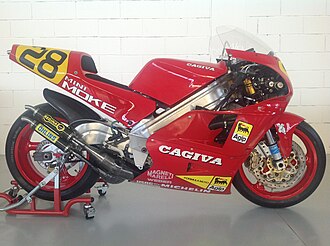
Cagiva C590: The Story of an Italian Grand Prix Racing Motorcycle
The Cagiva C590 represents an important chapter in the history of Italian motorcycle racing, a period when engineering ambition, national pride, and the relentless pursuit of Grand Prix success came together on the world’s most demanding circuits. Developed by the Italian manufacturer Cagiva for the premier 500cc class of the motorcycle Grand Prix World Championship, the C590 belonged to an era when two-stroke racing engines, sophisticated chassis designs, and fearless riders defined the highest level of motorcycle competition. Although it never achieved the championship dominance enjoyed by some of its Japanese rivals, the Cagiva racing project became a symbol of persistence and technical development, demonstrating how a determined European manufacturer could challenge established competitors through years of experimentation, investment, and gradual improvement.
The C590 is particularly interesting because it belongs to the transitional years of Cagiva’s Grand Prix campaign, when the company was moving beyond the initial stages of its return to international racing and working toward becoming a genuine contender for race victories. Its story is not simply about engine capacity, horsepower, or top speed; it is also about the difficulties of developing a competitive racing motorcycle against manufacturers with substantial experience and resources. Understanding the Cagiva C590 therefore requires looking at the company behind the machine, the technical environment of the 500cc championship, the development philosophy that shaped its motorcycles, and the wider significance of Cagiva’s efforts during one of the most demanding periods in modern motorcycle racing.
What Was the Cagiva C590?
The Cagiva C590 was a purpose-built Grand Prix racing motorcycle associated with Cagiva’s participation in the 500cc World Championship during the early 1990s. Unlike road-going motorcycles, which must balance performance with comfort, emissions regulations, everyday reliability, and production costs, a machine such as the C590 was designed around the specific requirements of professional circuit racing. Every major component served a competitive purpose: the engine had to deliver acceleration and power across a usable rev range, the chassis had to provide stability under braking and through fast corners, the suspension had to maintain tire contact over changing surfaces, and the entire motorcycle had to respond predictably to the rider’s inputs at extreme speeds.
The model’s designation reflects its place in Cagiva’s sequence of racing machines, although the number alone should not be treated as a definitive indication of engine displacement or a complete specification. The motorcycle belonged to the 500cc Grand Prix category, a championship class historically associated with highly tuned two-stroke engines and exceptionally demanding power delivery. Cagiva’s development program evolved from one season to another, meaning that motorcycles carrying related model designations could incorporate significant changes in engine configuration, chassis geometry, suspension settings, electronic systems, and aerodynamic details. For this reason, the C590 is best understood as a particular stage in a continuing engineering program rather than as an isolated production model with one universally applicable specification sheet.
Cagiva and the Italian Motorcycle Industry
Cagiva was an Italian motorcycle manufacturer that built its reputation through a combination of distinctive styling, sporting ambition, and involvement in competitive racing. The company’s name is associated with the Castiglioni family and its efforts to develop an Italian motorcycle business capable of competing internationally. During the 1980s and 1990s, Cagiva operated in a motorcycle market in which Japanese manufacturers had established formidable positions in both production motorcycles and Grand Prix competition. Competing against these manufacturers required more than an attractive motorcycle or a powerful engine; it demanded sustained technical development, effective testing programs, experienced racing personnel, and the ability to translate lessons learned on the circuit into better machines for subsequent seasons.
Cagiva’s racing activities also reflected a broader Italian tradition of treating motorsport as an essential part of a manufacturer’s identity. For many European motorcycle companies, competition offered an opportunity to demonstrate engineering ability, attract attention from enthusiasts, and establish a recognizable sporting image. Cagiva’s Grand Prix motorcycles became part of this tradition, with their distinctive appearance and unmistakably Italian character helping them stand out on international starting grids. The C590 belongs to this larger story of a manufacturer that continued to pursue racing success even when the technical and financial demands of the championship made progress difficult.
The Importance of the 500cc Grand Prix Category
To appreciate the C590, it is important to understand the environment in which it competed. The 500cc Grand Prix World Championship was the premier class of motorcycle road racing before the introduction of MotoGP as the championship’s new premier-class identity in 2002. During the C590’s era, the category was dominated by technologically advanced two-stroke racing motorcycles capable of delivering exceptional power relative to their weight. These machines were not designed for ordinary road use, and their performance depended on a careful balance of engine tuning, tire performance, chassis behavior, rider technique, and race strategy.
The 500cc class was especially challenging because its motorcycles could deliver power abruptly, making throttle control and rear-tire management crucial. Riders had to accelerate while the motorcycle was still leaning, manage wheelspin as grip changed, and maintain precision while braking from very high speeds. Engineers faced an equally complicated problem: maximizing acceleration and straight-line performance without making the motorcycle unstable, unpredictable, or difficult to control over a full race distance. The C590 was developed within these constraints, where even a small improvement in corner exit speed, traction, or braking stability could influence a rider’s ability to compete against better-established rivals.
Design and Engineering of the Cagiva C590
Engine Architecture and Power Delivery
At the heart of the 1990 Cagiva C590 was a liquid-cooled, two-stroke V4 engine with a displacement of approximately 493cc. Published specifications for a documented C590 give a capacity of 492.6cc, a bore and stroke of 56 × 50mm, and a cylinder-bank angle of 80 degrees. The engine was designed for Grand Prix competition, where a high power-to-weight ratio and the ability to accelerate rapidly out of corners were essential advantages. Unlike a four-stroke road motorcycle engine, a two-stroke racing engine produces a power stroke with every crankshaft revolution, allowing it to generate substantial power from a relatively compact package when operating at high engine speeds. This architecture, however, also demands careful management of combustion, exhaust tuning, cooling, and engine speed, especially when the rider must repeatedly accelerate hard through a series of corners.
The C590’s engine should be understood in the context of the development work that Cagiva had already undertaken with its earlier C588 and C589 racing motorcycles. The C590 was an evolution of the preceding machine rather than a completely unrelated design, and the team concentrated on improving areas that had limited the motorcycle’s competitiveness. Period development accounts describe changes to the V4’s cylinder-bank angle, with the angle increasing from 58 degrees on the C589 to 70 degrees on the revised configuration, helping accommodate larger reed-valve assemblies and contributing to an increase in output. Published descriptions of the C590 are not entirely consistent about the exact engine configuration and power rating, so it is important to distinguish general development history from the specifications of a particular surviving motorcycle. A commonly documented example is rated at approximately 150 horsepower at 12,000 rpm, while other historical accounts describe output slightly above 160 horsepower for the revised engine. These figures should not be combined as if they referred to one standardized specification.
High-Revving Performance and Racing Character
The C590’s performance was shaped by the characteristics of a competition two-stroke engine. Its useful power delivery depended on maintaining the engine within an effective operating range, which placed considerable demands on the rider and the gearbox. A rider had to select the correct gear before entering a corner, control the throttle carefully while the motorcycle was leaned over, and exploit the engine’s available power as the machine returned toward an upright position. When everything worked correctly, the combination of a lightweight chassis and a powerful engine could produce exceptional acceleration, but a sudden increase in torque at the rear wheel could also overwhelm the available grip. This was particularly important in an era when tire technology, suspension development, and electronic assistance differed significantly from those of modern MotoGP motorcycles.
Engine output alone could not guarantee success. A motorcycle with excellent peak horsepower might still lose time if its power arrived too abruptly, if the rear tire spun excessively, or if the rider had to compensate for unpredictable behavior through a corner. Cagiva therefore needed to consider engine performance as part of a complete system involving gearing, chassis geometry, suspension response, and weight distribution. The C590 illustrates the central challenge of Grand Prix engineering: producing a motorcycle that was not merely powerful in theory, but also fast, consistent, and manageable over an entire race.
Gearbox and Drivetrain
The Cagiva C590 used a six-speed sequential gearbox, a configuration suited to the rapid gear changes required in Grand Prix racing. Rather than selecting gears through a conventional road-bike shift pattern in ordinary traffic conditions, the rider used a sequential mechanism designed to support quick, repeatable changes under acceleration and braking. Gear ratios were important because the engine’s performance characteristics required the rider to maintain an effective engine speed as circuit conditions changed. A shorter ratio could improve acceleration out of slower corners, while a taller ratio could help the motorcycle make better use of its power on a long straight.
Power was transmitted to the rear wheel through a chain final drive. This arrangement was common in racing motorcycles because it was relatively light, mechanically efficient, and allowed the final drive ratio to be adjusted to suit different circuits. Engineers and mechanics could change sprocket sizes to adapt the motorcycle to a track with slow hairpins, a circuit with long straights, or a layout that required a compromise between acceleration and maximum speed. The correct gearing could make a significant difference to lap time, particularly when a rider needed to keep the engine in its strongest operating range without making unnecessary shifts or sacrificing drive out of corners. The published specifications of the C590 list both the six-speed transmission and chain final drive as part of its competition-oriented mechanical package.
Chassis, Suspension, and Handling
Aluminium Frame and Structural Design
The chassis was one of the most important elements of the C590’s engineering package. The documented 1990 machine used an aluminium beam frame, a design intended to provide a useful combination of rigidity, low weight, and predictable handling. Aluminium offered advantages over heavier traditional steel structures when designers were trying to reduce mass while maintaining the structural strength needed to withstand hard braking, acceleration, and cornering loads. In a racing motorcycle, the frame must also provide a controlled amount of flex rather than simply being as rigid as possible, because the rider needs to feel how the tires are interacting with the track surface.
Cagiva’s chassis development was influenced by the handling difficulties encountered with earlier motorcycles in the program. The company worked on weight distribution, steering geometry, engine positioning, and swingarm length in an effort to improve traction and make the machine more predictable when the rider applied power. These changes were especially important because a 500cc two-stroke racing motorcycle could be difficult to control if its rear tire was not loaded appropriately during acceleration. A frame that allowed rapid changes of direction but did not provide sufficient stability or traction could become a disadvantage once the rider began driving out of a corner. The C590’s development consequently involved finding a balance between agility, stability, and effective delivery of engine power.
Front and Rear Suspension
The C590 was equipped with fully adjustable Öhlins suspension, including a telescopic front fork and a rear shock absorber working with the swingarm. Adjustable suspension was indispensable in Grand Prix competition because every circuit presented different demands. A smooth, fast track required a different setup from a bumpy circuit with repeated hard braking zones, and the same motorcycle might need substantial changes depending on tire condition, fuel load, weather, and the rider’s preferences. Engineers could alter settings to influence how quickly the suspension compressed under braking, how it responded when the rider accelerated, and how effectively the tires maintained contact with the asphalt.
Suspension adjustment also played an important role in managing the C590’s power delivery. If the rear suspension failed to maintain the appropriate tire contact patch during acceleration, the engine’s output could result in wheelspin rather than forward movement. If the front suspension behaved poorly under braking, the rider might struggle to maintain confidence when entering a corner at high speed. Properly tuned suspension helped the motorcycle remain composed as weight transferred between the front and rear wheels, improving the rider’s ability to brake late, turn accurately, and accelerate efficiently. The C590’s use of Öhlins components reflected the importance of specialist suspension technology in top-level racing during the early 1990s.
Wheels, Tires, and Braking Components
The C590’s published specification lists Marchesini wheels and Brembo braking components, two names closely associated with high-performance motorcycle equipment. Lightweight wheels were valuable because reducing rotating and unsprung mass could improve the motorcycle’s response to changes of direction and help the suspension react to irregularities in the track. Wheel dimensions also influenced tire selection, handling characteristics, and the overall geometry of the machine. As with other Grand Prix motorcycles of the period, the objective was to create a package that could change direction quickly without becoming unstable during braking or high-speed cornering.
Braking performance was equally important. The C590 used Brembo brakes, which had to provide powerful, repeatable deceleration while allowing the rider to control the motorcycle precisely as the front tire approached the limits of grip. Grand Prix riders frequently brake while beginning to turn, so braking stability and steering response are closely linked. Excessive front-end instability can make a motorcycle difficult to place accurately, while inadequate braking performance can force a rider to begin slowing earlier and surrender valuable time. The combination of racing wheels, specialist brakes, and adjustable suspension helped the C590 meet the demanding requirements of a premier-class racing machine.
The 1990 Racing Season: The C590 in Competition
The Riders Who Raced the Cagiva C590
The 1990 Grand Prix season was an important period in Cagiva’s racing history because it exposed both the potential of its motorcycle and the difficulties the manufacturer still faced against established competitors. Cagiva fielded Randy Mamola, Ron Haslam, and Alex Barros on the C590. All three brought different experience and riding characteristics to the team, giving engineers valuable feedback about the machine’s behavior across different circuits and race conditions. Mamola was already a highly experienced Grand Prix competitor, Haslam had extensive experience in international racing, and Barros represented a younger generation of riders working to establish themselves in the premier class. Their combined efforts helped Cagiva continue its development program, even though the season did not produce the breakthrough results the company wanted.
The riders faced a motorcycle that required considerable commitment and precision. At the highest level of Grand Prix racing, a machine must inspire confidence not only when accelerating down a straight but also when braking into a corner, changing direction, and applying power while leaned over. Small handling problems become magnified at racing speed, and a motorcycle that behaves inconsistently can force a rider to leave a safety margin that competitors do not need. The C590’s development therefore depended on close cooperation between riders, mechanics, and engineers, with every practice session offering an opportunity to understand how changes in setup affected the machine. This work was essential to the long-term Cagiva project, even when the immediate championship results remained disappointing.
Results and Championship Performance
The C590’s 1990 campaign was a mixed season rather than a story of consistent podium finishes. Alex Barros was the highest-placed Cagiva rider in the final championship standings, finishing 12th, and his best result was fifth at the Belgian Grand Prix. Across the three riders, the team recorded 17 top-ten finishes. These results demonstrated that the C590 could be competitive on individual occasions, but they also highlighted the difficulty of maintaining the pace and consistency required to challenge for the championship against manufacturers such as Honda, Yamaha, and Suzuki.
A season’s results rarely reveal the full story of a racing motorcycle. A rider’s finishing position can reflect mechanical reliability, tire performance, qualifying position, weather, circuit layout, and the ability to maintain a competitive pace over a race distance. A motorcycle might be quick in one sector but lose time elsewhere because of traction problems or limited acceleration. Similarly, a machine that performs well over a few laps might struggle to maintain that performance as tires deteriorate or the rider’s confidence is affected by inconsistent handling. The C590’s results should therefore be viewed as part of a continuing technical development process, rather than as a simple judgment on the quality of the motorcycle or the abilities of its riders.
Technical Experiments During the Season
One particularly interesting aspect of the C590 program was Cagiva’s experimentation with alternative chassis construction. A motorcycle featuring a carbon-fibre frame appeared at the Czech Grand Prix toward the end of the 1990 season. This development illustrated the team’s willingness to investigate advanced materials in its pursuit of improved performance. Carbon fibre offered the possibility of reducing weight and controlling structural characteristics, but its practical value depended on the complete design, including how loads were distributed and how the frame interacted with the suspension and tires. Introducing a new material into a racing chassis also brought challenges involving manufacturing, durability, repair, and the interpretation of feedback from riders.
The appearance of the carbon-fibre machine is a reminder that Grand Prix development does not always follow a straight line. Manufacturers frequently test experimental components in competition, where real-world conditions reveal limitations that may not be apparent during workshop testing. An innovative component can provide a measurable advantage in one area while introducing new difficulties elsewhere, and its long-term success depends on whether the overall motorcycle becomes faster and more consistent. Cagiva’s experimentation during the C590 era contributed to the company’s broader understanding of chassis design and its search for a competitive advantage.
How the Cagiva C590 Compared With Its Rivals
Competition Against Japanese Manufacturers
The early 1990s were a demanding period for any manufacturer attempting to compete in the 500cc Grand Prix championship. Japanese companies possessed extensive engineering resources, developed racing infrastructures, and years of experience refining their machines. Honda, Yamaha, and Suzuki had competitive motorcycles, experienced riders, and the ability to introduce technical improvements throughout the season. Cagiva, by comparison, was attempting to close a substantial performance gap while operating with more limited resources. Its challenge was not simply to produce enough power to match its rivals; it also needed to improve chassis behavior, traction, reliability, and the consistency of its race performance.
The C590’s significance lies partly in the fact that it formed part of a sustained effort to challenge that established order. The motorcycle was not a mass-produced sportbike adapted for racing but a dedicated Grand Prix machine designed for the specific demands of the 500cc championship. This distinction matters because racing motorcycles are engineered around a very different set of priorities from road machines. Components are selected for performance, adjustability, and competition requirements, while comfort, luggage capacity, passenger accommodation, and everyday usability are largely irrelevant. Cagiva was therefore competing in an environment where almost every engineering decision had to contribute directly to performance on the circuit.
The Difference Between Peak Power and Lap Time
It is tempting to compare racing motorcycles by looking only at horsepower, but this approach misses much of what determines success in Grand Prix competition. A motorcycle with greater peak power can still be slower if it cannot transfer that power to the asphalt effectively, if its chassis is difficult to control, or if the rider must compensate for unpredictable behavior. Acceleration out of a corner depends on the relationship between engine output, gear selection, weight transfer, tire grip, and suspension response. A small improvement in any of these areas can be more valuable than a modest increase in maximum horsepower.
The C590’s development illustrates why racing engineers pay so much attention to the balance of a motorcycle. Steering geometry influences how easily a machine turns, while swingarm length and weight distribution affect traction and stability. Suspension settings determine how loads move through the chassis, and gearing influences how effectively engine power is delivered at different points on a circuit. These elements cannot be optimized independently because a change intended to improve one characteristic may negatively affect another. The ultimate objective is not to create the most powerful motorcycle in the paddock on paper, but to build a machine that allows its rider to achieve consistently fast lap times.
From the C590 to the C591: The Road Toward Success
Learning From the 1990 Season
The lessons of the C590 era helped establish the foundation for the next stage of Cagiva’s Grand Prix campaign. The following C591, introduced for the 1991 season, represented a further development of the company’s 500cc racing motorcycle. Cagiva continued working on the balance between engine performance and chassis behavior, while changes in the technical regulations and the experience accumulated by the team influenced the direction of development. The transition from the C590 to the C591 demonstrates how manufacturers build competitive racing motorcycles over several seasons rather than expecting a single design to solve every problem immediately.
One of the most important developments was the arrival of Eddie Lawson, the highly accomplished American rider and four-time 500cc world champion, for the 1991 season. Lawson brought extensive technical knowledge and a reputation for consistency, qualities that could help Cagiva translate its engineering work into better results. A rider with experience winning championships can provide valuable feedback because they understand the difference between a motorcycle that feels fast and one that allows repeatable performance over an entire race. Lawson’s involvement helped the team make progress and strengthened the belief that Cagiva could eventually win races in the premier class.
Cagiva’s First 500cc Grand Prix Victory
The breakthrough came in 1992, when Eddie Lawson won the Hungarian Grand Prix on the Cagiva C592. The victory was a landmark achievement for the manufacturer, demonstrating that years of development and investment could produce a motorcycle capable of defeating the established leaders of the championship. It was not a victory for the C590 itself, and the distinction is important: the C590 belonged to the developmental stage that preceded Cagiva’s first premier-class Grand Prix win. Nevertheless, the later success gives the earlier machine additional historical significance because it helps explain the progression from a motorcycle with clear performance limitations to a competitive factory racing package.
Cagiva’s subsequent achievements continued to strengthen its place in Grand Prix history. John Kocinski won races on later Cagiva machinery, and the C594 helped the company achieve a particularly strong 1994 season, including a third-place finish in the championship for Kocinski. Cagiva ultimately withdrew from premier-class Grand Prix racing at the end of 1994. Its racing program had not produced a long period of championship dominance, but it had achieved the kind of breakthrough that once seemed difficult to imagine when the team was struggling with the earlier motorcycles.
Why the Cagiva C590 Remains Interesting to Collectors
Historical Significance and Rarity
The Cagiva C590 is interesting to motorcycle historians and collectors because it represents a specific moment in the evolution of factory Grand Prix racing motorcycles. Unlike mass-produced road motorcycles, factory 500cc racers were built in relatively small numbers, developed from season to season, and often modified throughout their competitive lives. Surviving examples can therefore have histories that differ substantially from one another, depending on their original configuration, racing use, subsequent restoration, and the replacement of parts during their careers.
Authenticity is particularly important when assessing a surviving C590. A motorcycle’s model designation alone does not establish that every component remains original to its original racing specification. Frames, engines, suspension components, bodywork, and other parts may have been replaced or modified during competition or restoration. Racing liveries can also be misleading, particularly when a motorcycle has been repainted to represent a famous rider or season. A detailed provenance record, including chassis and engine numbers, period photographs, ownership documentation, and specialist inspection, can help establish whether a particular example is correctly identified and how closely it matches its original configuration.
Restoration and Preservation
Preserving a C590 presents different challenges from restoring a road-going classic motorcycle. Some components were designed specifically for competition and may be difficult to source, while others might have been modified or replaced during the motorcycle’s racing career. Original engine parts can be particularly important because the behavior of a highly tuned two-stroke engine depends on precise component dimensions, correct assembly, and appropriate setup. A restoration that prioritizes appearance without respecting the mechanical design risks producing a motorcycle that looks convincing but does not accurately represent the original engineering.
A responsible preservation project begins with documentation. Photographs, component markings, frame numbers, engine numbers, period specifications, and historical records can help identify the machine and distinguish original parts from later replacements. Specialists familiar with historic Grand Prix motorcycles may also be able to identify details that are not obvious to a general motorcycle restorer. When an original component is missing, a carefully documented reproduction may be a practical solution, but it should not be represented as an original factory part. For collectors, the combination of authenticity, mechanical understanding, and a credible ownership history is often more meaningful than cosmetic perfection alone.
The Value of the C590 in Motorcycle History
The C590’s importance does not depend on its having won a world championship. Many historically significant racing motorcycles are remembered because they illustrate a turning point, an engineering experiment, or the beginning of a manufacturer’s progress toward success. The C590 belongs to this category: it demonstrates how a factory team identified weaknesses, tested solutions, and continued developing its technology despite disappointing results. Its place in the Cagiva story becomes clearer when viewed alongside the C591, C592, C593, and C594, which collectively show the progression of the company’s 500cc Grand Prix program.
For enthusiasts of Italian engineering, the C590 also represents a period when smaller European manufacturers were still willing to challenge major international rivals in the highest level of motorcycle road racing. Its combination of a compact V4 two-stroke engine, specialist suspension, lightweight construction, and experimental chassis development captures the character of the era. It remains a compelling subject for anyone interested in the technical history of Grand Prix racing and the long process through which a manufacturer transforms ambition into competitive performance.
Cagiva C590 Technical Specifications
The following table summarizes the commonly published specifications for the 1990 Cagiva C590. Because historic racing motorcycles were frequently modified and different sources sometimes report different engine configurations or performance figures, these values should be treated as a reference for a documented C590 rather than as a guarantee that every surviving example has identical specifications. The engine’s reported power is particularly important to interpret carefully, as historical accounts describe both approximately 150 horsepower and slightly higher figures for revised configurations.
| Technical specification | Cagiva C590 (1990) |
|---|---|
| Manufacturer | Cagiva, Italy |
| Model year | 1990 |
| Motorcycle category | 500cc Grand Prix racing motorcycle |
| Engine type | Liquid-cooled, two-stroke V4 |
| Displacement | 492.6cc |
| Bore × stroke | 56 × 50 mm |
| Cylinder-bank angle | 80° reported for the documented specification; development variants require verification |
| Maximum power | Approximately 150 hp at 12,000 rpm |
| Reported torque | Approximately 83.3 Nm at 11,500 rpm |
| Ignition system | Magneti Marelli CDI |
| Transmission | Six-speed sequential gearbox |
| Final drive | Chain |
| Frame | Aluminium beam frame |
| Swingarm | Aluminium banana-type swingarm |
| Front suspension | Fully adjustable Öhlins telescopic fork |
| Rear suspension | Fully adjustable Öhlins shock absorber |
| Wheels | Marchesini |
| Front wheel dimensions | 3.50 × 17 inches, as reported |
| Rear wheel dimensions | 6.00 × 18 inches, as reported |
| Brakes | Brembo |
| Wheelbase | Approximately 1,400 mm |
| Overall length | Approximately 2,015 mm |
| Overall width | Approximately 500 mm |
| Seat height | Approximately 800 mm |
| Dry weight | Approximately 122 kg |
| Racing season | 1990 |
| Notable riders | Randy Mamola, Ron Haslam, Alex Barros |
| Best championship result for the team | Alex Barros finished 12th overall |
| Best individual Grand Prix result | Fifth place at the Belgian Grand Prix, achieved by Alex Barros |
Specification references: MCNews’ historical technical feature and the Cagiva C590 specification listing at FastestLaps. Values may vary with the individual motorcycle and period configuration.
Conclusion: The Legacy of the Cagiva C590
The Cagiva C590 deserves attention as more than an unsuccessful Grand Prix motorcycle from the early 1990s. It was an important part of an ambitious engineering program through which an Italian manufacturer attempted to challenge the established leaders of the 500cc World Championship. Its V4 two-stroke engine, aluminium chassis, adjustable Öhlins suspension, Marchesini wheels, and Brembo brakes reflected the sophisticated technology required to compete at the highest level of motorcycle road racing. At the same time, its development history demonstrates that impressive technical specifications do not automatically translate into race victories, particularly when traction, handling, reliability, and rider confidence remain difficult to optimize.
The 1990 season exposed the limitations that Cagiva still needed to overcome, but it also provided experience that contributed to the development of subsequent machines. The arrival of Eddie Lawson, the progress of the C591 and C592, and the later success of the C593 and C594 demonstrate the importance of sustained engineering work and collaboration between riders and designers. Cagiva’s eventual Grand Prix victories were the result of a continuing development process rather than the achievement of a single motorcycle.
For modern enthusiasts, the C590 offers a fascinating look at an era when highly tuned two-stroke engines defined premier-class racing and manufacturers experimented with new materials, chassis configurations, and suspension solutions in pursuit of small but decisive advantages. Its significance lies in the combination of Italian racing ambition, distinctive engineering, and the lessons learned during a difficult stage of Cagiva’s Grand Prix campaign. Whether studied as a technical artifact, a collector’s motorcycle, or a chapter in the history of the 500cc World Championship, the Cagiva C590 remains a valuable example of the persistence required to compete at the highest level of motorsport.
