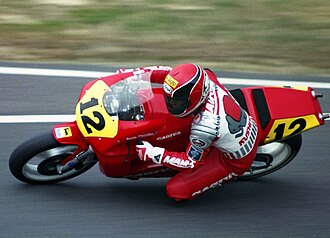
The Cagiva C589 and Its Place in Motorcycle Racing History
The Cagiva C589 is one of the most fascinating motorcycles to emerge from the golden era of 500 cc Grand Prix racing. Developed by the Italian manufacturer Cagiva for the 1989 World Championship season, this high-performance racing machine embodied the company’s determination to challenge the established Japanese manufacturers in the most demanding category of motorcycle road racing. With a liquid-cooled, two-stroke V4 engine, an advanced aluminium frame, distinctive bodywork designed by Massimo Tamburini, and a reported output of approximately 150 horsepower, the C589 was an ambitious combination of Italian engineering and uncompromising competition technology. It was also a motorcycle with a complicated personality: extraordinarily powerful for its weight, visually striking, and difficult to exploit consistently on the race track.
The C589 was ridden most famously by American Grand Prix star Randy Mamola, whose spectacular riding style made the motorcycle memorable even during a season when its results fell short of expectations. Mamola was renowned for his ability to control powerful racing machines at the edge of adhesion, and his association with Cagiva gave the Italian company a rider capable of providing detailed technical feedback while attracting attention from racing fans around the world. Yet the C589’s 1989 campaign demonstrated an important lesson in motorcycle engineering: high engine output and low weight do not automatically create a successful racing motorcycle. Balance, traction, suspension behaviour, steering geometry, and the ability to deliver power effectively are equally important, particularly when competing against manufacturers with years of experience at the highest level.
Today, the Cagiva C589 is remembered as an important stage in the evolution of Cagiva’s Grand Prix programme. It followed the C588, which had delivered the company’s first 500 cc Grand Prix podium in 1988, and preceded the C590, the next development in the manufacturer’s continuing effort to build a competitive premier-class racer. The C589 did not become famous because of a championship victory, but because it represented the ambition, experimentation, and technical challenges that defined Cagiva’s journey toward eventual Grand Prix success. Understanding this motorcycle means looking beyond its impressive specifications and exploring the engineering decisions, racing circumstances, and people that shaped its story.
The Origins of the Cagiva C589
Cagiva’s ambition to compete in the 500 cc Grand Prix class
Cagiva’s involvement in Grand Prix racing grew out of a desire to establish the company as more than a manufacturer of stylish road motorcycles and off-road machines. During the late 1970s and 1980s, the premier 500 cc category represented the ultimate test for motorcycle manufacturers. The machines were purpose-built prototypes, and the championship demanded a combination of engine development, chassis engineering, rider skill, mechanical reliability, and a highly organised race team. Japanese manufacturers had considerable advantages in resources and experience, while Cagiva had to build its own knowledge base while competing against established international rivals. This made the company’s racing programme a long-term technical project rather than a quick route to success.
The early Cagiva Grand Prix motorcycles evolved through several engine configurations and chassis concepts. The company experimented with different layouts before adopting the V4 architecture that became central to its later 500 cc racing identity. Each new design reflected the lessons of previous seasons, including the need to improve power delivery, reduce mass, refine suspension behaviour, and make the motorcycle more predictable when pushed hard through corners. These developments were not always straightforward, because a change that improved one aspect of performance could create difficulties elsewhere. Increasing engine output, for example, was of limited value if the rear tyre could not transfer that power to the track, while a chassis that turned quickly could become unstable or difficult to control during acceleration.
By the late 1980s, Cagiva was moving toward a more mature and technically sophisticated racing programme. The C588, used during the 1988 season, represented a meaningful advance and helped establish that the Italian manufacturer could occasionally challenge the leading teams. Randy Mamola’s podium at the Belgian Grand Prix at Spa-Francorchamps that year was an especially important milestone. It showed that Cagiva’s long-running investment in Grand Prix racing could produce results at the highest level, and it created expectations for the next generation of machinery. The C589 was therefore developed at a time when Cagiva had reason to believe that further progress was possible, but still faced significant technical challenges before it could regularly compete for victories.
What does the name C589 mean?
Cagiva’s racing model names followed a practical system that identified the manufacturer, the racing category, and the season associated with a particular machine. In the C589 designation, the initial letter refers to Cagiva, the number five identifies the 500 cc Grand Prix class, and the final two digits indicate the 1989 season. This naming convention makes the C589 relatively easy to place within the company’s racing history. The C588 belongs to the preceding 1988 season, while the C590 followed in 1990. The system also helps explain why Cagiva’s 500 cc racers often appear as a succession of closely related model names even when their mechanical and chassis details differ significantly.
Although the name suggests a clearly defined model year, a Grand Prix motorcycle should not be understood as a completely fixed production specification. Factory racing machines were frequently modified during testing and competition, and individual chassis could receive revised suspension arrangements, engine components, bodywork, or other updates as the season progressed. The specification of a C589 at the beginning of 1989 may therefore differ from that of another example later in the year. This is particularly relevant when studying surviving motorcycles, historic photographs, or auction descriptions, because components can be exchanged between development machines and later versions. The C589 name identifies the core 1989 racing project, but the exact details of an individual machine depend on its chassis history and documented configuration.
Engine and Performance: The Heart of the Cagiva C589
A 492.6 cc liquid-cooled two-stroke V4
The Cagiva C589 was powered by a liquid-cooled, four-cylinder, two-stroke V4 engine with a displacement of approximately 492.6 cc. Published specifications commonly identify an 80-degree angle between the cylinder banks, with a bore of 56 mm and a stroke of 50 mm. This compact, high-revving engine was developed specifically for Grand Prix competition, where the objective was to extract as much usable performance as possible from a tightly regulated engine capacity. Unlike a road motorcycle engine designed to operate across a wide range of everyday conditions, the C589’s powerplant was intended to deliver extraordinary acceleration and high peak output during a race, with its operating characteristics shaped by the demands of competition rather than comfort or convenience.
The two-stroke operating cycle was central to the motorcycle’s performance. In a two-stroke engine, the power-producing cycle occurs with every revolution of the crankshaft, allowing a suitably designed racing engine to generate substantial output from a relatively compact package. This potential came with considerable complexity, however, because combustion, exhaust flow, intake timing, cooling, and engine speed had to work together with great precision. Exhaust chambers played a particularly important role in shaping the engine’s behaviour, helping determine how efficiently the cylinders filled and cleared their gases at different engine speeds. A small adjustment to the exhaust system, carburettor calibration, or ignition timing could significantly alter the power curve, making engine setup a critical part of race preparation.
The V4 layout also offered a useful balance between compactness and power potential. Four cylinders could produce a strong overall output while allowing the engine to be packaged within a racing chassis that needed to remain narrow enough for effective cornering and rider movement. However, the configuration brought its own engineering demands, including the management of heat, vibration, mechanical complexity, and the delivery of power to the transmission. Cagiva’s V4 development was the product of years of experimentation, and the C589 inherited both the benefits of that experience and the difficulties that remained unresolved. Its engine was powerful enough to make it a serious Grand Prix machine, but the chassis and suspension still needed to transform that power into consistent acceleration.
Power output and high-revving character
The C589 is commonly reported to have produced approximately 150 horsepower at around 12,000 rpm, an extraordinary figure for a motorcycle with a dry weight of roughly 122 kg. These figures help illustrate the scale of the engineering challenge faced by the riders. The relationship between power and weight was extremely favourable on paper, but the motorcycle’s real performance depended on how effectively the engine could deliver its output under racing conditions. Maximum power is only one point on an engine’s operating curve, and it does not reveal how sharply the engine responds to throttle input, how easily the rider can maintain the ideal rev range, or how much traction is available when the engine reaches its strongest output.
A high-output two-stroke Grand Prix engine can be demanding because its power delivery may become much more aggressive as engine speed rises into the effective range. The rider must select the right gear, manage throttle openings carefully, and anticipate how the rear tyre will react when the engine begins producing strong acceleration. If the power arrives too abruptly, the rear wheel may spin or lose stability, particularly when the motorcycle is still leaned over or the track surface offers limited grip. If the gearing is poorly matched to the circuit, the engine may fall outside its ideal operating range during acceleration, reducing the benefit of its impressive peak output. These considerations made the C589’s engine a highly specialised racing component rather than simply a source of raw horsepower.
The performance figures reported for the C589 should also be interpreted as historical reference values, not as a guarantee that every surviving example would produce exactly the same output. Racing engines were frequently rebuilt, tuned, and modified, while published specifications may refer to a particular development stage or a manufacturer’s claimed figure. Different accounts can also use different measurement methods or round the values for simplicity. The commonly cited figure of approximately 150 horsepower at 12,000 rpm provides a useful indication of the C589’s performance level, but it should be distinguished from a fully documented engine-dynamometer result for a specific chassis and engine number.
Transmission and power delivery
The C589 used a six-speed sequential racing gearbox, with a chain final drive transmitting engine power to the rear wheel. The gearbox was designed to keep the engine operating within its relatively narrow high-performance range as the motorcycle accelerated out of corners and along the straights. Unlike a road motorcycle, where gear selection often prioritises flexibility and ease of use, a Grand Prix machine needs ratios that match the engine’s characteristics to the circuit’s particular combination of slow corners, fast turns, and long acceleration zones. The rider’s ability to select the right gear at the right moment can have a significant influence on lap time, particularly when engine response is highly dependent on rotational speed.
The transmission also had to tolerate substantial mechanical stress. Rapid gear changes, hard acceleration, engine braking effects, and repeated operation near the engine’s performance limits all place demanding loads on the gearbox and final drive. Racing teams therefore needed to monitor wear carefully and inspect components between sessions, while choosing gearing that offered the best compromise for the conditions. A motorcycle could have sufficient peak power to compete on a straight yet lose time if the ratios were poorly suited to the circuit or if the engine struggled to recover speed after a slow corner. In the case of the C589, power delivery and traction were central concerns, making the relationship between the engine, gearbox, rear suspension, and tyre particularly important.
Chassis and Suspension: The Challenge of Putting Power on the Ground
Aluminium beam frame and structural design
The Cagiva C589 featured an aluminium beam-style frame, reflecting the broader movement in Grand Prix racing toward lightweight, high-strength chassis structures. The frame had to support the engine, suspension, rider, and other components while maintaining a carefully controlled amount of stiffness. A racing chassis cannot simply be made as rigid as possible, because a certain degree of flex can help the tyres maintain contact with an uneven surface and provide the rider with useful feedback. At the same time, excessive movement can reduce precision and make the motorcycle difficult to control when braking hard, accelerating aggressively, or changing direction at high speed.
The C589’s frame and bodywork formed part of an integrated design rather than a collection of independent components. Engine placement affected mass distribution, the swingarm determined how rear-wheel movement interacted with acceleration forces, and suspension geometry influenced how the motorcycle responded to weight transfer. The chassis needed to accommodate a powerful V4 engine while leaving room for the cooling system, exhaust chambers, fuel supply, and other race equipment. These requirements made packaging an important engineering task, especially when designers attempted to improve aerodynamic efficiency and keep the overall motorcycle compact.
The C589’s aluminium construction was consistent with the technological direction of top-level racing during the period. Aluminium offered a useful combination of low weight and structural strength, although the precise behaviour of a frame depended on its shape, dimensions, material properties, welds, and connection points. A well-designed beam frame could provide a more controlled structural response than older or less developed layouts, but it still had to be tuned around the tyres, suspension, and rider. The C589 illustrates how the design of a Grand Prix motorcycle depends on the interaction between all of these systems rather than on a single component’s material or appearance.
The banana swingarm and rear suspension layout
One of the C589’s distinctive features was its banana-style swingarm, a shape that helped accommodate the engine and exhaust packaging while maintaining the required rear-wheel travel. The swingarm is a critical part of a motorcycle’s chassis because it controls the rear axle’s movement relative to the frame and interacts with the suspension linkage to determine how the rear wheel responds to bumps and acceleration. In racing, these characteristics influence traction, stability, and the rider’s confidence when opening the throttle out of a corner. The shape of the swingarm may also be affected by the need to provide clearance for the exhaust system, particularly on a high-performance two-stroke machine with large expansion chambers.
The rear suspension arrangement proved to be one of the C589’s most controversial engineering decisions. Historical accounts describe a horizontal rear shock layout that compromised the motorcycle’s balance and made it harder to transfer engine power effectively to the track. The design was intended to help manage packaging and the extraction of hot air around the engine, but the resulting arrangement created difficulties in suspension response and weight distribution. When the rider accelerated, the rear tyre needed to remain planted while the chassis maintained an appropriate attitude. If the suspension could not respond effectively to changing loads, the motorcycle could wheelie, spin the rear tyre, or become less predictable during corner exits.
These problems demonstrate why an innovative layout does not automatically translate into better performance. The horizontal shock arrangement may have offered theoretical packaging advantages, but its practical consequences had to be assessed through testing and rider feedback. The C589’s difficulty in putting its power down became a recurring issue during the 1989 season, showing that the success of a suspension design depends on its behaviour under real loads, not simply on how neatly it fits within the frame. For engineers, the challenge was to balance the competing demands of mass distribution, suspension travel, progressive response, chassis geometry, and engine packaging.
Steering geometry and weight distribution
The C589’s handling difficulties were closely connected to weight distribution and steering geometry. The placement of the engine, fuel, rider, and suspension components determines how the motorcycle’s mass is divided between the front and rear wheels. That distribution affects braking, corner entry, mid-corner stability, and acceleration. Too much load on the front can make steering feel quick and responsive but may reduce the rear tyre’s ability to transmit power. Too much rearward bias can improve traction in some situations while making the front end feel vague or reluctant to turn. A successful Grand Prix motorcycle needs a balance that works across the full range of riding conditions encountered during a race.
The C589 was reported to have an awkward balance that made it difficult to exploit its high engine output. In particular, the motorcycle could raise its front wheel dramatically under acceleration, a behaviour that became part of its visual identity during Randy Mamola’s races. Although wheelies can be spectacular and may sometimes be used deliberately by riders, an uncontrolled tendency to lift the front wheel reduces the effectiveness of acceleration because the rider must manage the motorcycle’s attitude rather than concentrate entirely on driving toward the next corner. It can also make it harder to maintain a consistent line, especially when the track requires a rapid change of direction immediately after a corner exit.
Steering geometry and suspension response are interdependent, so changing one aspect of the chassis can influence several others. Altering the position of the rear shock, for example, can change the available suspension movement and the way loads are transferred through the swingarm and frame. A modification intended to improve packaging may therefore require further changes to spring rates, damping, linkage geometry, ride height, or steering setup. The C589’s development experience showed that a Grand Prix motorcycle needs to be evaluated as a complete system: its engine, frame, swingarm, suspension, tyres, and rider must work together if its theoretical performance is to become usable speed.
Design and Aerodynamics: Massimo Tamburini’s Influence
A distinctive one-piece bodywork concept
The Cagiva C589 is remembered not only for its mechanical features but also for its striking appearance. Its bodywork continued the one-piece fairing concept developed for the C588 and associated with designer Massimo Tamburini. The design gave the motorcycle a smooth, unified exterior that looked futuristic compared with many racing machines of the period. Rather than appearing as a collection of separate panels, the bodywork created a continuous shell around much of the motorcycle, helping establish a clear visual identity while addressing the practical requirements of aerodynamic protection and component packaging.
Tamburini was known for his ability to combine technical constraints with strong visual design, and his work helped shape the appearance of several influential Italian motorcycles. On a Grand Prix racer, however, styling could not be separated from function. Fairing surfaces affected airflow around the rider and engine, while the openings around the radiators needed to provide sufficient cooling without creating unnecessary drag. The shape also had to permit access for mechanics, allow components to be removed for maintenance, and avoid interfering with the steering or suspension. These requirements made the C589’s bodywork a functional part of the engineering package rather than merely a decorative covering.
The C589’s fairing was visually related to its predecessor, but historical descriptions note small changes to the radiator openings and front screen. Such differences may appear minor when viewed in isolation, yet they help distinguish the 1989 machine from the C588 and reveal how racing motorcycles evolved through incremental revisions. A new vent shape or altered screen profile could reflect an attempt to improve cooling, manage airflow, or refine the motorcycle’s appearance without requiring a completely new bodywork design. In racing, these small changes formed part of the continual search for performance improvements.
The relationship between aerodynamics and cooling
Aerodynamics was becoming increasingly important in Grand Prix racing as speeds rose and manufacturers paid closer attention to drag, stability, and rider protection. A fairing needs to reduce the amount of air pressure acting on the rider while maintaining predictable behaviour when the motorcycle changes direction or encounters crosswinds. At the same time, the engine and radiators require adequate airflow to remove heat. The challenge is to guide air where it is needed without creating excessive drag or disrupting the pressure distribution around the motorcycle. The C589’s bodywork reflected these competing demands, with a streamlined outer shape and carefully positioned openings around the cooling system.
Cooling was particularly important for a highly stressed two-stroke V4. Sustained high engine speeds and combustion loads generated substantial heat, and the engine needed to maintain an appropriate operating temperature throughout practice, qualifying, and race conditions. Insufficient cooling could affect performance and reliability, while excessive or poorly directed airflow might compromise aerodynamic efficiency. The radiator openings, internal air paths, and surrounding fairing surfaces therefore formed part of the motorcycle’s thermal-management system. This illustrates the complexity of racing design: a bodywork modification intended to improve one characteristic may influence engine temperature, airflow, drag, and rider comfort at the same time.
The C589’s appearance has aged into a distinctive representation of late-1980s Grand Prix technology. Its long, low silhouette, angular surfaces, and enclosed bodywork captured an era when manufacturers were exploring new approaches to both aerodynamics and chassis integration. While modern racing motorcycles use different technologies and operate under different technical regulations, the C589 remains an interesting example of how design ambition and engineering experimentation came together during a formative period in high-performance motorcycle development.
