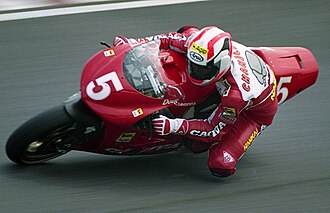
Cagiva C593: The Italian 500cc Grand Prix Motorcycle That Challenged the Racing Giants
The Cagiva C593 occupies a special place in the history of motorcycle racing because it represents the moment when an ambitious Italian manufacturer demonstrated that years of engineering development could produce a genuine challenger to the dominant Japanese factory teams. Built for the 1993 500cc Grand Prix World Championship, the C593 was a highly specialized racing motorcycle powered by a liquid-cooled, two-stroke V4 engine, with a lightweight aluminium chassis, sophisticated Öhlins suspension, and the advanced mechanical and electronic systems required to compete at the highest level of international motorcycle road racing. It followed the successful C592, which had given Cagiva its first premier-class Grand Prix victory in 1992, and carried that progress into a season that would produce another memorable triumph, this time with American rider John Kocinski at the United States Grand Prix at Laguna Seca. The C593 was not a mass-produced sportbike intended for ordinary roads; it was a factory racing machine developed to extract the greatest possible performance from a 500cc two-stroke engine while remaining controllable at extraordinary speeds.
What makes the C593 particularly interesting is the combination of technical ambition and competitive results that defined its short career. During the early 1990s, the premier class was an environment in which Honda, Yamaha, and Suzuki possessed formidable engineering resources, established development programs, and highly experienced riders. Cagiva had to overcome the disadvantages of being a smaller manufacturer while refining engine performance, chassis behavior, traction, and reliability. The C593 emerged from this process as a motorcycle capable of approximately 180 horsepower at the rear wheel in commonly published specifications, despite weighing only around 130 kilograms dry. Its development included titanium exhaust components, lightweight carbon-fibre silencers, advanced suspension, and a distinctive Big Bang firing arrangement intended to improve how the engine’s power reached the rear tire. Together, these features made the C593 one of the most compelling examples of Italian Grand Prix engineering in the final years of the classic 500cc two-stroke era.
The History of the Cagiva C593
Cagiva’s Ambitious Grand Prix Racing Project
Cagiva’s involvement in premier-class motorcycle racing grew out of a determination to establish the company as a serious international competitor rather than merely a manufacturer of distinctive Italian road motorcycles. Associated with the Castiglioni family, Cagiva invested in a succession of purpose-built Grand Prix machines during the late 1980s and early 1990s, gradually developing the technical expertise required to compete against manufacturers with much larger racing operations. The challenge was substantial because the 500cc championship demanded constant development in several interconnected areas: engines had to produce exceptional power from a small displacement, frames needed to balance rigidity and feedback, suspension had to maintain tire contact over difficult surfaces, and the rider needed predictable behavior during hard acceleration and braking. A manufacturer could not solve these problems independently, because every improvement to one component potentially affected the behavior of the others. Cagiva’s racing program consequently became a long-term process of experimentation, testing, and incremental refinement, with each successive motorcycle building on the lessons learned from the preceding season.
The company’s Grand Prix lineage included the C587, C588, C589, C590, C591, C592, C593, and ultimately the C594. These motorcycles shared a broad technical identity, but they were not identical machines with different numbers attached to their fairings. Each represented a particular stage in the evolution of Cagiva’s 500cc racing program, incorporating revised engine configurations, chassis developments, suspension changes, and increasingly sophisticated electronic systems. The C592’s victory with Eddie Lawson at the 1992 Hungarian Grand Prix demonstrated that Cagiva could finally defeat the established championship leaders, giving the engineers a stronger foundation on which to develop the next motorcycle. The C593 therefore arrived with an important objective: build on that breakthrough, improve the motorcycle’s competitive consistency, and demonstrate that the previous season’s success could be repeated against the world’s strongest factory teams.
What the Name C593 Represents
The C593 designation follows Cagiva’s straightforward model-naming convention for its 500cc Grand Prix motorcycles. The letter C identifies the manufacturer, the number 5 refers to the premier 500cc class, and the final two digits identify the 1993 racing season. The model was the direct successor to the C592 and the predecessor of the C594, the final major evolution of Cagiva’s 500cc Grand Prix project. This naming convention makes the company’s racing history easier to follow and helps distinguish individual seasons within a program in which technical development continued at a rapid pace.
The year-specific designation is particularly relevant when researching the C593 because historical accounts sometimes use the name Cagiva GP500 or V593 when describing related machines. These labels refer to the same general family of factory 500cc racers, although detailed specifications can vary according to the exact motorcycle, its race configuration, and the source being consulted. The machine raced by Doug Chandler early in the season, for example, should not automatically be assumed to have had every component fitted to John Kocinski’s later motorcycle. Cagiva experimented with different air-intake layouts and swingarm designs during the C593 season, illustrating how a single model designation could encompass several engineering configurations.
How the C593 Improved on the C592
The C593 retained the basic architecture of its predecessor, including the liquid-cooled V4 two-stroke engine with an 80-degree cylinder-bank angle and twin crankshafts. One of the most important characteristics carried over from the C592 was the Big Bang firing arrangement, which altered the timing of the engine’s power pulses in an effort to improve rear-wheel traction. The major suspension change was the adoption of Öhlins components in place of the Showa units used on the previous machine. This gave the team a different suspension package to develop around the motorcycle’s handling requirements, with adjustments intended to improve the rider’s ability to control the machine during corner entry, mid-corner transitions, and acceleration out of turns. The C593 also incorporated lightweight titanium expansion chambers and carbon-fibre exhaust silencers, reducing mass while supporting the demands of a highly tuned two-stroke engine.
The development process was not limited to replacing individual components. Cagiva also worked to improve the relationship between engine power, chassis geometry, and rider feedback. A motorcycle with a powerful engine can still lose time if its rear tire struggles for grip or its front end becomes difficult to control under braking. Equally, a chassis that provides excellent stability may not change direction quickly enough to suit a circuit with repeated tight corners. The C593’s development therefore involved balancing competing priorities rather than maximizing a single specification. Its increased output offered greater acceleration potential, but the motorcycle also had to remain manageable enough for its rider to use that power consistently. The result was a machine that combined the accumulated knowledge of earlier Cagiva racers with the new technical solutions needed to remain competitive in 1993.
Cagiva C593 Engine and Performance
The 498.5cc Two-Stroke V4 Engine
The heart of the Cagiva C593 was its liquid-cooled, two-stroke V4 engine, with a commonly published displacement of 498.5cc, a bore of 56mm, a stroke of 50.6mm, and an 80-degree angle between the cylinder banks. The compact four-cylinder configuration allowed Cagiva to build a racing power unit capable of producing exceptional performance without requiring the dimensions of a much larger engine. Unlike a four-stroke engine, which completes its full operating cycle over two crankshaft revolutions, a two-stroke engine can deliver a power stroke on every revolution. In a highly developed Grand Prix engine, this characteristic, combined with carefully tuned induction and exhaust systems, allows a remarkable amount of power to be extracted from a relatively small displacement. The C593 was designed to operate at very high engine speeds, where combustion efficiency, exhaust pressure waves, cooling, lubrication, and precise fuel delivery all became critical to performance.
One particularly distinctive feature of the C593’s engine was its twin-crankshaft arrangement. Rather than simply following the layout of every rival V4 engine, Cagiva continued developing an architecture intended to package the cylinders efficiently and support its chosen firing sequence. The engine’s configuration was closely linked to the motorcycle’s Big Bang concept, which influenced how combustion events delivered their forces to the rear wheel. In a powerful racing two-stroke, the timing of those forces matters enormously because the rear tire has only a limited amount of grip available for acceleration, cornering, and maintaining stability. The C593’s engine therefore needs to be understood as part of a complete racing system: its design was intended not only to generate high output but also to make that output usable on a circuit where traction could determine the outcome of a race.
Approximately 180 Horsepower at 12,700 RPM
Published technical specifications commonly list the C593 at approximately 180 horsepower at the rear wheel at 12,700 rpm, with torque figures around 103 Nm at 12,000 rpm in several reference listings. These numbers should be treated as historical reference figures rather than universal measurements for every C593. Racing engines were frequently revised, and quoted power could vary according to the motorcycle’s precise specification, the test equipment used, and whether a figure represented crankshaft output or rear-wheel output. Some period and retrospective accounts also quote higher figures for particular versions of the related V593 racing machine, illustrating why it is important to identify the source and configuration before comparing headline numbers.
Even at approximately 180 horsepower, the C593’s most significant achievement was not simply its peak output but the way its engine worked with the rest of the motorcycle. High engine speed and strong acceleration were essential on circuits with long straights, but the rider also needed a predictable response when opening the throttle while leaned over. Too much abrupt torque could overwhelm the rear tire and produce wheelspin, wasting power and making the motorcycle harder to control. Too little response, on the other hand, could leave the rider losing ground when accelerating away from slower corners. Cagiva’s engineers therefore had to develop an engine that could deliver its power within a usable operating range, supported by suitable gearing, carefully tuned electronics, and a chassis capable of managing the resulting forces.
The Big Bang Firing Order and Rear-Wheel Traction
One of the defining technical characteristics of the C593 was its use of the Big Bang firing arrangement, which had been introduced on the preceding C592. In broad terms, this approach concentrated combustion events into a different pattern rather than distributing them as evenly as possible throughout the engine cycle. The intention was to alter the way torque reached the rear tire, allowing the tire more opportunity to recover grip between successive power pulses. This was particularly relevant to the 500cc two-stroke class, where powerful engines could generate abrupt increases in rear-wheel torque that made acceleration difficult when the motorcycle was still leaned over.
The Big Bang concept was not a guarantee of improved traction in every circumstance, because tire grip depended on numerous variables, including track temperature, surface condition, suspension response, throttle position, and the rider’s technique. Instead, it represented one approach to managing the interaction between engine output and the available grip. The C593 carried this concept forward while increasing performance, which created an important engineering challenge: improving the motorcycle’s acceleration without making its power delivery too difficult to control. Its reputation rests partly on this attempt to balance raw performance with the practical requirements of racing.
Induction, Carburetors, and Exhaust Technology
The C593 used crankcase reed-valve induction and specialist Mikuni carburetors, with historical technical descriptions identifying electronically controlled power-jet systems on the racing engine. The induction system was designed to deliver the correct fuel-air mixture as engine speed and load changed, while the carburetors and associated controls needed to respond reliably to the demanding conditions of Grand Prix racing. A small change in fuel delivery or engine response could affect acceleration, combustion stability, and the rider’s ability to maintain a consistent pace. For this reason, induction tuning was an essential part of the motorcycle’s performance rather than a secondary detail.
The exhaust system was equally important. The C593 used titanium expansion chambers and carbon-fibre silencers, components that combined racing-specific exhaust tuning with a focus on reducing mass. An expansion chamber is especially important on a two-stroke engine because its shape and dimensions influence the pressure waves that help control the movement of exhaust gases and fresh charge through the cylinder. Exhaust tuning can strongly influence the engine’s effective power range, so changes intended to improve peak output may also affect how the motorcycle responds at lower or intermediate engine speeds. Cagiva’s use of specialized materials and carefully developed exhaust components reflected the attention required to extract maximum performance from a highly tuned 500cc engine.
Six-Speed Gearbox and Electronic Quickshifting
The C593 was equipped with a six-speed sequential gearbox, a dry multi-plate clutch, and a chain final drive. The gearbox was designed for competition, where riders repeatedly changed gears under hard acceleration and braking while attempting to keep the engine within its effective operating range. Historical technical descriptions also identify an electronic quick-shift system on the V593 specification, enabling faster gear changes under racing conditions. The exact details of the gearbox and quickshifter should be verified against the particular machine being described, but the overall objective was clear: reduce interruptions to acceleration and allow the rider to concentrate on braking points, cornering lines, and throttle control.
Gear ratios were selected to suit individual circuits, rather than being fixed around the requirements of ordinary road riding. A track with slow corners and short straights might require different gearing from a circuit with several long high-speed sections. Mechanics could alter the final drive ratio and, where the gearbox design permitted, internal ratios to improve acceleration or make better use of the engine’s available power. The C593’s transmission was consequently an important contributor to its competitiveness, working with the engine and rear tire to turn theoretical horsepower into forward speed.
Chassis, Suspension, and Braking
Lightweight Aluminium Frame
The Cagiva C593 used a twin-beam aluminium frame designed to combine low mass with the rigidity and feedback required for high-speed racing. In a Grand Prix motorcycle, the frame is not merely a structure holding the engine, suspension, and wheels together; it also influences how the machine responds to steering inputs, braking forces, cornering loads, and changes in grip. Engineers must achieve a balance between stiffness and controlled flex because the rider needs a chassis that is stable at high speed while still communicating what the tires are doing. Too much movement can make the motorcycle feel imprecise, whereas excessive rigidity can affect feedback and the way the tires maintain contact with an uneven surface.
The C593’s aluminium frame formed part of a broader effort to improve the motorcycle’s handling as engine output increased. Its relatively short wheelbase, reported at approximately 1,390mm, supported the need for rapid direction changes and responsive steering. However, a short wheelbase also makes the relationship between acceleration, weight transfer, and front-wheel stability especially important. The engineers therefore had to consider the frame together with the swingarm, suspension, steering geometry, and engine placement. The objective was to build a motorcycle that could change direction quickly while remaining stable when the rider accelerated hard or approached a corner under heavy braking.
Öhlins Suspension and Experimental Swingarms
A major change for the C593 was the adoption of Öhlins suspension, replacing the Showa units associated with the preceding C592. The motorcycle used an inverted front fork and a fully adjustable rear shock absorber, allowing the team to tune suspension behavior for individual tracks, tire choices, and rider preferences. Adjustments to preload, compression damping, and rebound damping could influence how quickly the motorcycle responded to braking, how it settled when entering a corner, and how effectively the rear tire maintained contact with the asphalt during acceleration. These settings were crucial because a high-performance racing engine could only deliver its full potential if the chassis remained predictable under changing loads.
Cagiva also experimented with different swingarm and air-intake arrangements during the C593 season. Historical descriptions distinguish the configuration associated with John Kocinski, which used a carbon-fibre swingarm and a centrally positioned air intake, from versions associated with Doug Chandler and Mat Mladin, which retained an aluminium swingarm with an upper reinforcing structure and used side air intakes. These differences demonstrate that the C593 was not necessarily identical in every detail across the team. Engineers were continuing to test alternative solutions, seeking improvements in chassis behavior, airflow, and overall performance.
Marchesini Wheels and Michelin Tires
The C593 used Marchesini racing wheels and Michelin tires, a combination selected for the demands of Grand Prix competition. Wheel weight affects the motorcycle’s response to changes of direction and the suspension’s ability to control unsprung mass, while wheel dimensions influence tire selection and handling characteristics. At racing speeds, even small changes in wheel and tire behavior can influence how confidently the rider brakes, turns, and accelerates. The objective was to create a package that allowed the motorcycle to respond quickly without sacrificing stability or traction.
Tire choice was also an important part of race preparation. Different compounds and constructions offered different balances of grip, durability, and performance under changing temperatures. Engineers and riders needed to understand how a tire would behave over the course of a race, not simply how much grip it provided when new. Although the C593’s most famous victory came with John Kocinski at Laguna Seca, its competitiveness depended on this wider interaction between tires, chassis setup, and rider technique. The motorcycle’s performance was the result of many carefully coordinated decisions rather than a single exceptional component.
Brembo Brakes and High-Speed Deceleration
The C593 was equipped with Brembo braking components, including carbon-fibre front discs in the racing configuration described by several technical sources. Carbon brakes offered advantages in weight and performance under the high operating temperatures associated with Grand Prix racing, but they required appropriate conditions to function as intended. Their braking characteristics differed from those of conventional steel discs, meaning riders had to understand how performance changed as the brakes reached their working temperature. The exact disc dimensions varied across historical descriptions and configurations, so individual examples should be checked against their documented specification.
Braking performance mattered just as much as engine output because the rider needed to slow the motorcycle repeatedly from very high speeds while maintaining control of the front tire. The ability to brake late could create opportunities to overtake, but excessive braking force or poor chassis stability could compromise corner entry and reduce confidence. Carbon brakes, specialist suspension, and carefully developed chassis geometry helped the C593 meet these demands. Together, they supported the rider’s ability to exploit the engine’s power while maintaining the precision necessary to compete at the front of a Grand Prix field.
The 1993 Grand Prix Season
Doug Chandler’s Strong Start
The 1993 season began with Doug Chandler as one of Cagiva’s principal riders, alongside Australian Mat Mladin. Chandler made an encouraging start by finishing third in the opening Grand Prix at Eastern Creek in Australia, demonstrating that the C593 was capable of challenging for a podium against the established manufacturers. That result was important for a team trying to build on its first premier-class victory the previous year. It suggested that Cagiva’s development work had produced a competitive machine, even though maintaining that level of performance across an entire championship remained difficult.
Chandler finished the season tenth in the championship standings, while Mladin finished thirteenth, with a best result of sixth place at Jarama according to retrospective accounts. These results reflected the challenges faced by a relatively small factory team competing against highly experienced rivals with substantial technical resources. A promising result at one circuit did not guarantee the same competitiveness elsewhere, because different tracks placed different demands on the engine, chassis, suspension, and tires. The C593 nevertheless provided a strong foundation for the team’s later success, demonstrating that the motorcycle could compete near the front and offering further opportunities to refine its setup.
John Kocinski Joins the Team
John Kocinski joined Cagiva for the final four rounds of the 1993 season, bringing a highly competitive approach and considerable experience from international racing. His arrival gave the team another opportunity to demonstrate the C593’s potential during the closing stages of the championship. Kocinski was known for his speed and determination, and his addition to the lineup strengthened Cagiva’s chances of achieving strong results as the season approached its conclusion. The team’s decision to field him late in the year proved significant because he quickly demonstrated that the motorcycle could compete successfully against the leading riders.
Kocinski’s first results on the C593 included two fourth-place finishes before his breakthrough victory at Laguna Seca. He ultimately finished eleventh in the championship despite contesting only the final four rounds, a result that underlined the effectiveness of his short campaign. The significance of his contribution went beyond the championship points: he delivered another major victory for Cagiva and demonstrated that the company had developed a motorcycle capable of winning on a demanding international circuit.
John Kocinski’s Historic Victory at Laguna Seca
The 1993 United States Grand Prix
The defining moment in the Cagiva C593’s career came on 22 August 1993, when John Kocinski won the United States Grand Prix at Laguna Seca in California. The victory was particularly meaningful because it came on American soil, in front of a crowd that could celebrate the success of a home rider competing on an Italian motorcycle. Kocinski’s performance demonstrated the C593’s ability to compete against the strongest factory machines and added another major achievement to Cagiva’s developing Grand Prix history. He finished ahead of Alex Barros and Luca Cadalora, with the victory becoming one of the most memorable results of the 1993 season.
The race was important for more than its sporting outcome. Cagiva had entered the premier class with the ambition of challenging the Japanese manufacturers, but it had spent years struggling to turn technical progress into victories. Eddie Lawson’s success with the C592 in 1992 had already proved that the company could win a Grand Prix; Kocinski’s triumph in 1993 showed that the previous year’s breakthrough had not been an isolated event. The C593 was competitive enough to deliver another victory, strengthening the reputation of Cagiva’s engineering team and confirming that its development program was producing meaningful results. The Laguna Seca win also demonstrated the importance of combining a capable motorcycle with a rider who could exploit its strengths under the pressure of Grand Prix competition.
Why the Laguna Seca Victory Mattered
Laguna Seca was a demanding venue, known for its elevation changes, challenging corners, and the famous Corkscrew sequence. Its layout placed a premium on braking precision, chassis stability, rapid direction changes, and the ability to accelerate effectively out of corners. A motorcycle needed to respond predictably through a wide variety of situations, rather than relying on straight-line power alone. The C593’s combination of a high-output V4 engine, specialist suspension, and lightweight construction provided Kocinski with a competitive platform, while his riding ability allowed him to make effective use of the motorcycle’s performance.
The result also strengthened Cagiva’s position within the 1993 championship. The company ultimately finished fourth in the manufacturers’ standings, a significant achievement for a team competing against larger and better-established rivals. Kocinski’s victory was the high point of a season that included Chandler’s early podium and several other strong performances. Together, these results showed that Cagiva had developed a credible alternative to the dominant Japanese racing motorcycles, even though sustaining that level of performance across multiple seasons would remain a substantial challenge.
The Final Race and the End of Kocinski’s Campaign
Kocinski’s late-season campaign was short but highly effective. After his victory at Laguna Seca and strong results in his earlier appearances for Cagiva, he entered the final round with considerable attention focused on the Italian machine. His last race of the season ended in retirement following a collision, bringing his brief but memorable campaign to a disappointing conclusion. Despite that setback, his results had already made a substantial contribution to the team’s reputation and reinforced the belief that the C593 was capable of competing at the highest level.
The contrast between the success of individual races and the difficulty of maintaining consistency across a complete championship illustrates the nature of Grand Prix development. A manufacturer must be competitive at a variety of circuits, manage mechanical reliability, adapt to changing conditions, and provide its riders with a motorcycle that remains predictable throughout the season. Cagiva had made significant progress, but the resources required to continue challenging the largest manufacturers were substantial. The C593’s achievements therefore represented both a major accomplishment and a reminder of the difficulties facing a smaller factory team in premier-class racing.
The Cagiva C593 Compared With Its Rivals
Honda, Yamaha, and Suzuki
During the 1993 season, the 500cc Grand Prix championship featured highly developed two-stroke racing motorcycles from Honda, Yamaha, and Suzuki. These manufacturers had extensive experience in the class and the engineering resources to introduce frequent technical improvements. Their machines were supported by experienced riders, sophisticated testing programs, and established factory racing organizations. Cagiva had to overcome this competitive advantage while continuing to refine its own engine and chassis technology. The C593’s success is particularly impressive when viewed against this background because it showed that a smaller manufacturer could still win races through focused development and effective use of its resources.
The C593 shared many of the fundamental characteristics of its competitors, including a high-revving two-stroke engine, lightweight frame, specialized suspension, and racing-specific brakes. Its distinctive features included the twin-crankshaft V4 layout, Big Bang firing arrangement, and the experimental components introduced during its development. These features were not necessarily superior in every circumstance, but they reflected Cagiva’s effort to develop a motorcycle that offered a different balance of power delivery, traction, and handling. The Laguna Seca victory demonstrated that the resulting package could be competitive against the established leaders when the motorcycle, rider, and circuit conditions came together.
Why Horsepower Alone Did Not Determine Success
The C593’s commonly quoted output of around 180 horsepower at the rear wheel was impressive for a motorcycle weighing approximately 130 kilograms dry. However, peak horsepower is only one measure of racing performance, and it does not fully explain why a motorcycle wins or loses a Grand Prix. Acceleration depends on the ability to transmit power through the rear tire, while lap time is influenced by braking performance, cornering speed, stability, gearing, and the rider’s confidence. A motorcycle with a higher theoretical output can still be slower if its power delivery is difficult to manage or if its chassis forces the rider to sacrifice speed through corners.
Cagiva’s approach to the C593 reflected this understanding. The Big Bang firing arrangement was intended to influence rear-wheel traction, while suspension development and chassis experiments sought to improve stability and feedback. The engine, gearbox, and tires had to work together to provide effective acceleration, and the brakes and front suspension needed to allow the rider to enter corners confidently. The C593 was therefore an example of an integrated engineering project in which performance depended on the combined behavior of the entire motorcycle rather than the output of its engine alone.
From the C593 to the C594: Cagiva’s Final Evolution
Continuing Development for 1994
The Cagiva C594 followed the C593 for the 1994 season and represented the final major stage of the company’s premier-class racing program. The experience gained with the C593 provided a foundation for further improvements, including developments intended to refine the engine’s power delivery, chassis behavior, and overall competitiveness. John Kocinski continued to play an important role in the program, and the C594 helped Cagiva achieve its strongest championship position during its later years in the 500cc class. These developments demonstrated that the company had become a serious contender, even though it never secured the world championship title.
The progression from the C592 to the C593 and then the C594 illustrates the importance of continuity in racing engineering. A successful motorcycle is rarely the result of one breakthrough alone. Instead, manufacturers build on previous designs, identify weaknesses through competition, and make improvements that gradually increase performance. Cagiva’s later results were connected to the knowledge accumulated during the earlier years of its program, and the C593 played a significant role in establishing the competitive platform from which the final generation of machines developed.
Cagiva’s Withdrawal From Grand Prix Racing
Cagiva withdrew from premier-class Grand Prix competition at the end of the 1994 season, although the marque made a final appearance at the Italian Grand Prix in 1995. Financial and organizational pressures made it increasingly difficult to sustain a competitive factory program against the leading manufacturers. The company’s withdrawal marked the end of an ambitious chapter in Italian motorcycle racing, one that had produced three premier-class Grand Prix victories and established Cagiva as a genuine competitor after years of development.
The C593 consequently occupies an important position in the manufacturer’s racing history. It was not the first Cagiva to win a premier-class Grand Prix, but it was the machine that delivered the company’s second victory and helped demonstrate that the 1992 breakthrough could be repeated. Its combination of innovative engineering, competitive results, and a memorable American Grand Prix victory makes it one of the most historically significant motorcycles produced during Cagiva’s 500cc campaign.
The Cagiva C593 as a Collectible Racing Motorcycle
Rarity, Authenticity, and Provenance
The C593 is an interesting subject for motorcycle collectors because it was a factory-built Grand Prix racing machine produced for a specific championship season. Unlike mass-produced road motorcycles, factory racing machines were built in limited numbers and frequently modified during their competitive careers. Engines, frames, swingarms, suspension components, and bodywork could be replaced or revised as engineers responded to new requirements. Consequently, surviving C593 examples may differ in important details, even when they share the same model designation.
A motorcycle’s provenance is particularly important when assessing its historical value. Documentation linking a particular chassis to a named rider or Grand Prix can make a substantial difference to its significance. Period photographs, engine and frame numbers, team records, restoration invoices, and credible ownership histories can help establish whether a machine is an original factory motorcycle, a restored racer using authentic components, or a recreation based on the original design. This distinction is especially important for a model associated with John Kocinski’s famous Laguna Seca victory, because the historical importance of that race can make accurate identification essential.
Restoration and Mechanical Preservation
Restoring a C593 requires specialist knowledge because its engine and chassis were developed for Grand Prix competition rather than everyday use. The two-stroke V4 power unit depends on precise component dimensions, correct assembly, suitable fuel and lubrication practices, and careful adjustment of its induction and exhaust systems. Original racing components may be difficult to source, and replacement parts must be evaluated for both compatibility and authenticity. A restoration that prioritizes appearance without respecting the original engineering can produce a motorcycle that looks convincing but no longer accurately represents its historical configuration.
The best preservation projects begin with careful documentation. Photographs, technical records, component markings, and historical specifications can help establish the correct configuration for a particular machine. Specialist engineers can assess the condition of the engine, gearbox, suspension, and braking systems, while historical research can help identify changes made during its racing career. When original components are missing, a well-documented reproduction may be a practical solution, but it should be clearly distinguished from an authentic period part. For collectors, preserving the motorcycle’s mechanical integrity and historical record is often as important as maintaining its visual appearance.
Why Enthusiasts Still Admire the C593
The C593 appeals to enthusiasts because it combines technical sophistication with a genuine racing success story. Its compact V4 engine, distinctive firing arrangement, lightweight construction, and advanced suspension reflect the engineering priorities of a period when two-stroke motorcycles defined the premier class. At the same time, the motorcycle’s history demonstrates the importance of perseverance in motorsport. Cagiva had to overcome years of difficult development before becoming competitive, and the C593 helped prove that its investment could produce results against the largest manufacturers in the championship.
The motorcycle is also significant because it captures a transitional moment in racing technology. Electronics were becoming increasingly important, lightweight materials were being explored more aggressively, and engineers were seeking new ways to manage the relationship between engine power and rear-wheel traction. The C593’s experimental swingarm and air-intake arrangements show that the development process remained active even after Cagiva had achieved its first victory. For historians and collectors, the machine offers a fascinating example of how innovation, rider feedback, and competitive pressure shaped the evolution of Grand Prix motorcycles.
Cagiva C593 Technical Specifications
The following table summarizes commonly published specifications for the 1993 Cagiva C593. Figures are drawn from historical technical descriptions and reference databases, but they should be treated as representative rather than universally applicable to every surviving motorcycle. Differences can arise from development changes, individual race configurations, and the distinction between crankshaft and rear-wheel measurements. In particular, power and braking specifications may differ between sources describing the general C593 model and a specific V593 race machine.
| Technical specification | Cagiva C593 (1993) |
|---|---|
| Manufacturer | Cagiva |
| Country of origin | Italy |
| Model year | 1993 |
| Racing category | 500cc Grand Prix |
| Predecessor | Cagiva C592 |
| Successor | Cagiva C594 |
| Engine type | Liquid-cooled, two-stroke V4 |
| Engine displacement | 498.5cc |
| Cylinder-bank angle | 80 degrees |
| Bore × stroke | 56 × 50.6 mm |
| Crankshaft configuration | Twin crankshafts |
| Firing arrangement | Big Bang |
| Induction | Crankcase reed-valve induction |
| Carburetion | Mikuni racing carburetors with electronic power-jet control |
| Ignition | Programmable electronic ignition |
| Exhaust | Titanium expansion chambers with carbon-fibre silencers |
| Maximum power | Approximately 180 hp at 12,700 rpm, commonly quoted at the rear wheel |
| Maximum torque | Approximately 103 Nm at 12,000 rpm in published specifications |
| Transmission | Six-speed sequential gearbox |
| Clutch | Dry multi-plate |
| Gear-shift system | Electronic quickshifter reported for the V593 specification |
| Final drive | Chain |
| Frame | Aluminium twin-beam frame |
| Swingarm | Aluminium or experimental carbon-fibre, depending on configuration |
| Front suspension | Fully adjustable Öhlins inverted fork |
| Rear suspension | Fully adjustable Öhlins monoshock |
| Wheels | Marchesini racing wheels |
| Tires | Michelin racing tires |
| Front brakes | Twin carbon discs with Brembo calipers, depending on configuration |
| Rear brake | Single disc with Brembo caliper |
| Wheelbase | Approximately 1,390 mm |
| Dry weight | Approximately 130 kg |
| Fuel capacity | Approximately 21 litres |
| Reported top speed | Approximately 310 km/h |
| Principal riders | Doug Chandler, Mat Mladin, John Kocinski |
| Best-known victory | John Kocinski, 1993 United States Grand Prix at Laguna Seca |
| Championship significance | Cagiva finished fourth in the manufacturers’ standings |
Sources: MCNews’ historical C593 feature, the C593 technical record, Carole Nash’s C593 review, and retrospective coverage of John Kocinski’s winning motorcycle. Figures may vary with the exact race configuration and measurement method.
Conclusion: The Lasting Legacy of the Cagiva C593
The Cagiva C593 deserves recognition as one of the most interesting Italian Grand Prix motorcycles of the early 1990s. Its liquid-cooled 498.5cc V4 two-stroke engine, Big Bang firing arrangement, lightweight aluminium chassis, Öhlins suspension, and specialist racing components reflected Cagiva’s determination to challenge the established leaders of the 500cc World Championship. Its engineering story is particularly compelling because the motorcycle was developed during a period when every manufacturer was searching for improvements in traction, power delivery, chassis behavior, and electronic control. Cagiva’s willingness to experiment with different swingarms, air-intake layouts, and lightweight exhaust materials demonstrated that the company continued refining the motorcycle even after its first major success.
The C593’s greatest moment came at Laguna Seca in 1993, when John Kocinski secured a memorable victory at the United States Grand Prix. That achievement reinforced the importance of the previous year’s breakthrough with Eddie Lawson and showed that Cagiva had developed a machine capable of winning against the championship’s most powerful competitors. Doug Chandler’s early-season podium and the team’s fourth-place finish in the manufacturers’ standings further demonstrated that the motorcycle could produce meaningful results across the season. Although Cagiva eventually withdrew from premier-class racing, its Grand Prix campaign left a lasting mark on motorcycle history.
For modern enthusiasts, the C593 remains a compelling example of the relationship between engineering ambition and competitive achievement. It demonstrates that a racing motorcycle’s success depends on much more than peak horsepower: the engine, chassis, suspension, tires, braking system, and rider must work together as a coherent package. Its historical importance also lies in the way it helped Cagiva progress toward the final stages of its GP500 program, culminating in the C594 and the manufacturer’s strongest championship performances. The Cagiva C593 is therefore remembered not simply as a fast two-stroke racing motorcycle, but as a symbol of the determination, ingenuity, and persistence that defined Cagiva’s challenge to the Grand Prix establishment.
