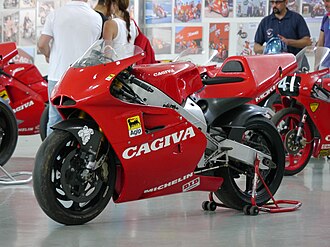
Cagiva GP500: The Story of Italy’s Legendary 500cc Grand Prix Racing Motorcycle
Cagiva’s Ambitious Challenge to Grand Prix Racing
The Cagiva GP500 remains one of the most memorable Italian racing motorcycle projects of the late twentieth century, representing a determined attempt to challenge the Japanese manufacturers that dominated the premier class of motorcycle Grand Prix racing. Developed during an era when 500cc two-stroke machines demanded exceptional riding ability, precise engineering, and relentless development, the Cagiva combined Italian design ambition with advanced racing technology and a distinctive personality. Its deep-red bodywork, compact V4 engine, aggressive exhaust note, and reputation for explosive acceleration helped make it instantly recognizable on international circuits. Although Cagiva never secured the premier-class world championship that its supporters dreamed of, the manufacturer eventually transformed its early struggles into race-winning performances, establishing itself as a genuine competitor against much larger and better-resourced rivals. The GP500 was not one unchanging motorcycle but a family of factory racing machines developed through successive versions, including the C587, C588, C589, C590, C591, C592, C593, and C594. Each generation reflected the team’s continuing efforts to improve engine performance, chassis behavior, reliability, and rider confidence.
The importance of the Cagiva GP500 goes beyond its results in individual races. It demonstrated how a European manufacturer could continue developing a competitive machine in a championship increasingly shaped by the financial strength, engineering resources, and testing capacity of Japanese companies. Cagiva’s progress was gradual rather than immediate: early seasons exposed weaknesses in handling and reliability, while later development brought more effective engines, improved suspension, and a better understanding of how to translate raw power into consistent lap times. The arrival of experienced riders, particularly four-time world champion Eddie Lawson, played an important role in that transformation. Lawson helped the Italian team understand what a top-level 500cc motorcycle needed to deliver, both in outright speed and in the more subtle areas of braking stability, corner entry, traction, and rider feedback. By the early 1990s, Cagiva had become more than an ambitious outsider; it had earned race victories and podium finishes and had created a machine that remains fascinating to enthusiasts of classic Grand Prix motorcycles.
The Origins of the Cagiva GP500 Project
From an Italian industrial company to a Grand Prix challenger
Cagiva’s Grand Prix adventure emerged from the ambitions of the Castiglioni family, who wanted to establish a strong sporting identity for their motorcycle business and prove that Italian engineering could compete at the highest level of international road racing. The project began well before the GP500 reached its most successful form. Early machines used different engine configurations and chassis solutions as the company explored the most effective way to compete in the 500cc category. The development process was difficult because the leading manufacturers already possessed years of experience with highly sophisticated racing motorcycles, and Cagiva could not simply copy a successful formula without also solving its own problems in manufacturing, testing, and race preparation. The early motorcycles showed promise, but progress was restricted by inconsistent handling, mechanical difficulties, and the challenge of making a powerful two-stroke engine manageable over an entire Grand Prix distance. Even so, Cagiva persisted, gradually creating a technical foundation that would eventually support its most competitive V4 machines.
The evolution of the GP500 illustrates why Grand Prix racing is rarely won by engine power alone. A racing motorcycle must deliver its performance in a form that the rider can use repeatedly, lap after lap, in changing temperatures, on different surfaces, and while tires and mechanical components are under enormous stress. A machine that accelerates impressively down a straight can still lose time if it is difficult to turn, unsettled under braking, or unpredictable when the rider opens the throttle. Cagiva’s engineers therefore had to develop the complete motorcycle rather than concentrate exclusively on peak horsepower. Engine layout, crankshaft behavior, frame stiffness, suspension settings, weight distribution, aerodynamic shape, and electronic control systems all influenced the final result. The successive GP500 versions were physical records of this learning process: each new machine incorporated the experience gained from previous seasons, the feedback of professional riders, and the technical lessons revealed by competition.
The importance of the 80-degree V4 engine
One of the defining features of the later Cagiva GP500 machines was their liquid-cooled, two-stroke V4 engine with an 80-degree cylinder-bank angle. The configuration offered a compact arrangement for a racing motorcycle while allowing engineers to pursue high power output from a displacement close to the 500cc limit. The later machines are commonly listed at approximately 498cc, with a bore and stroke of 56.0 by 50.6 millimetres. This relatively short-stroke design was suited to the high engine speeds required in Grand Prix competition, where riders needed powerful acceleration and strong performance throughout the upper portion of the rev range. The engine was not simply a smaller version of a road motorcycle motor; it was a specialized racing unit developed around competition requirements, with carefully designed induction, exhaust tuning, ignition management, and power-valve control. These systems worked together to extract substantial performance from a compact two-stroke engine, while the surrounding chassis had to make that performance usable on a circuit.
The GP500’s engine architecture also reflected the technical character of its era. Two-stroke Grand Prix engines could produce extraordinary power for their size, but their delivery was demanding, and the usable power band was narrower than that of many modern four-stroke road motorcycles. The rider had to understand the relationship between engine speed, gear selection, throttle position, tire grip, and corner geometry. A poorly timed throttle input could disturb the rear tire, while an inappropriate gear could leave the engine outside its strongest operating range. Cagiva’s development team worked to improve not only maximum output but also the quality and consistency of power delivery. For a rider competing against factory Honda, Yamaha, and Suzuki machinery, the objective was to create an engine that could accelerate strongly without making the motorcycle unnecessarily difficult to control.
Technical Development and the Evolution of the GP500
The C587, C588, C589 and C590 generations
The late-1980s development stages of the Cagiva GP500 were marked by experimentation and gradual refinement. The C587, C588, C589, and C590 formed part of the manufacturer’s continuing effort to establish a competitive package in the premier class, with engineers learning how to combine a high-output two-stroke engine with a chassis capable of handling the speed and cornering forces of Grand Prix racing. These motorcycles were developed in an environment where small improvements could make a major difference. A revised frame, a change in weight distribution, better suspension behavior, or more predictable engine response could determine whether a rider was able to maintain a competitive pace over a race distance. The team also had to develop dependable procedures for assembly, maintenance, and trackside adjustment, since even a technically advanced machine would struggle to achieve consistent results if its mechanical performance varied from one event to another.
During this period, Cagiva benefited from the involvement of experienced riders who could identify the practical limitations of the motorcycles. Randy Mamola was among the prominent competitors associated with the project, and his experience helped the team evaluate the bike against established championship machinery. Development in the 500cc class was particularly demanding because riders needed a motorcycle that remained stable at very high speeds while also responding accurately to steering and throttle inputs. The challenge was magnified by the characteristics of the tires and the power delivery of contemporary two-stroke engines. Rather than achieving an immediate breakthrough, Cagiva accumulated knowledge through repeated testing and racing, creating the basis for the more significant progress that followed. The early GP500 machines are therefore important not only as historical models in their own right, but also as stepping stones toward the competitive motorcycles of the early 1990s.
The C591 and Eddie Lawson’s contribution
A major turning point came in 1991, when Cagiva recruited Eddie Lawson, already a four-time world champion, to help develop the factory motorcycle. Lawson brought a rare combination of speed, technical understanding, and experience with championship-winning equipment. His presence gave the team a clearer reference point for assessing the motorcycle’s performance and identifying the areas that required improvement. The C591 represented an important stage in this process, with the move to an 80-degree V4 configuration among the significant changes associated with the 1991 generation. Lawson’s contribution was not limited to riding quickly; his feedback helped the engineers understand how the motorcycle behaved during braking, cornering, acceleration, and transitions between different phases of a lap. Such feedback was essential in a class where a motorcycle could possess impressive straight-line speed yet remain difficult to ride consistently.
The 1991 season gave Cagiva evidence that its long-term approach was beginning to work. Lawson achieved podium finishes and helped raise the team’s competitive profile, demonstrating that the Italian machine could challenge established rivals under the right circumstances. These results were significant because they showed that Cagiva was no longer merely trying to qualify and finish races; it was beginning to compete for leading positions. Nevertheless, the motorcycle still required further development. Handling limitations and front-end confidence remained important considerations, and the team needed to improve the consistency of its performance across different circuits and track conditions. The experience gained with Lawson provided a platform for the next stage of the project, when the Cagiva GP500 would achieve its first premier-class Grand Prix victory.
The C592 and Cagiva’s breakthrough in 1992
The C592 was a crucial development in the GP500 family because it carried Cagiva from promising challenger to Grand Prix race winner. The most famous moment arrived at the 1992 Hungarian Grand Prix, where Eddie Lawson took advantage of difficult, changing conditions and made an effective tire choice to secure Cagiva’s first 500cc Grand Prix victory. The result was a landmark for the manufacturer and a reward for years of investment, engineering work, and racing experience. Winning in mixed conditions required more than speed: the rider had to judge the available grip, manage the motorcycle’s power delivery, and make decisions that balanced risk against the changing behavior of the track. Lawson’s victory showed that Cagiva had developed a machine capable of winning at the highest level, while also demonstrating the importance of rider judgment and race strategy in a championship where mechanical performance alone rarely determined the outcome.
The significance of the C592 extended beyond the single victory. It established confidence within the team and helped demonstrate that the GP500 project had reached a level of maturity that its earlier machines had struggled to achieve. The motorcycle’s V4 engine, evolving chassis, and increasingly refined setup offered a stronger foundation for future development. Yet the result did not mean that Cagiva had solved every problem or that it could suddenly match the full resources of its Japanese competitors across an entire championship. The challenge was to turn an exceptional race performance into repeatable results, improve consistency from circuit to circuit, and continue developing the machine while maintaining reliability. The next generation would build on this progress, bringing Cagiva closer to its most competitive period.
The C593: Cagiva’s Red Motorcycle Makes Its Mark
A refined machine for the 1993 season
The C593 represented another important step forward in the GP500 story. Developed for the 1993 season, it retained the 80-degree V4 engine and twin counter-rotating crankshafts of its predecessor while incorporating further refinements intended to improve competitiveness and rider confidence. One notable change was the adoption of Öhlins suspension, replacing the Showa units used previously. Suspension was crucial in the 500cc class because the motorcycle had to cope with tremendous acceleration, hard braking, rapid direction changes, and the uneven surfaces found on some circuits. Better suspension control could help the tires maintain contact with the track, allowing the rider to brake later, carry speed through corners, and apply power more effectively on corner exit. The C593 was reported to produce approximately 180 horsepower at around 12,700 rpm, with a dry weight of roughly 130 kilograms and a top speed near 310 km/h, figures that placed it firmly among the serious contenders of its period.
The C593 was raced by Doug Chandler and Australian rider Mat Mladin, while John Kocinski joined the team late in the season. Chandler demonstrated the motorcycle’s potential with a third-place finish at the opening round at Eastern Creek, while Mladin gained valuable experience in the highly competitive premier class. Kocinski’s arrival proved especially important. A former 250cc world champion with considerable natural speed, he quickly adapted to the Cagiva and helped reveal how competitive the package could be when matched to the right riding style and setup. His early results included strong finishes, but the defining moment came when he won the United States Grand Prix at Laguna Seca. That victory turned the C593 into one of the most memorable motorcycles of the 1993 season and confirmed that Cagiva’s development programme had become capable of producing race-winning performance.
John Kocinski and the Laguna Seca victory
Kocinski’s victory at Laguna Seca was much more than an isolated success for a smaller European manufacturer. The American rider won in only his third race aboard the Cagiva, defeating established competition and giving the factory team a landmark result on home soil. Laguna Seca’s combination of fast sections, demanding corners, elevation changes, and the famous Corkscrew required a motorcycle that could accelerate strongly while remaining controllable under braking and through rapid changes of direction. The result showcased the combined strengths of rider and machine: the Cagiva had the power and chassis capability to compete at the front, while Kocinski’s ability to adapt quickly allowed him to exploit those qualities. The win also brought attention to a team that had spent years working in the shadow of much larger factory operations.
Kocinski’s performance helped change perceptions of the Cagiva GP500. The motorcycle was no longer simply an attractive Italian alternative to the Japanese machines; it was a proven Grand Prix winner. The victory also strengthened the team’s belief that the next development stage could yield further progress. However, the season continued to underline how difficult it was to sustain a championship challenge. A single race-winning package had to become a consistently competitive motorcycle across a complete calendar, and the team still faced challenges in reliability, setup, and extracting the best performance from its engine and chassis at different circuits. The C593 nevertheless provided the foundation for the final major evolution of the project: the C594.
The C594: The Most Developed Cagiva GP500
A sophisticated racing machine for 1994
The C594 was the final principal evolution of Cagiva’s 500cc Grand Prix programme and is often regarded as the most accomplished version of the family. Rather than simply increasing engine output, the engineers focused on making the entire motorcycle more manageable and consistent. The machine retained the liquid-cooled, 80-degree V4 two-stroke engine, but benefited from a more sophisticated engine-management system and refinements to its power delivery. Its composite chassis combined carbon-fibre structural elements with aluminium components, creating a distinctive construction that reflected the technical ambition of the Cagiva project. The frame design aimed to provide a combination of low weight, rigidity, and adjustability, helping the team tailor the motorcycle to different circuits and rider preferences. Aluminium and carbon-fibre swingarm configurations appeared during development and competition, illustrating how the factory continued to experiment with chassis behavior and component performance.
The C594’s development was especially interesting because it showed that a racing motorcycle could become more competitive even if its peak power figure did not increase dramatically. According to historical accounts, the later engine-management system provided multiple maps and made the motorcycle easier to control than the C593. This was an important advantage for a 500cc two-stroke machine, whose power delivery could be abrupt and physically demanding. A rider needed to apply power progressively, particularly when the rear tire was near the limit of grip. Improved control could make acceleration more repeatable, reduce unnecessary wheelspin, and help the rider maintain a fast pace over a full race distance. In elite racing, a machine that produces slightly less peak power but allows the rider to use more of its performance can be more effective than a motorcycle with greater output that is difficult to control. The C594 embodied this principle, combining the accumulated knowledge of earlier GP500 versions with a more integrated approach to engine and chassis development.
John Kocinski’s outstanding 1994 season
Kocinski continued with Cagiva in 1994 and immediately demonstrated the potential of the C594 by winning the opening round of the championship at Eastern Creek in Australia. His victory gave the team a strong start and showed that the previous year’s Laguna Seca success had not been a one-off achievement. During the season, Kocinski accumulated additional podium finishes and remained competitive against riders from Honda, Yamaha, and Suzuki. He ultimately finished third in the 500cc world championship with 172 points, just two points behind runner-up Luca Cadalora and ahead of several highly accomplished competitors. Mick Doohan won the championship for Honda, but Kocinski’s position in the final standings represented one of the most successful seasons in Cagiva’s history and confirmed the C594 as a serious contender at the highest level.
Kocinski’s success was particularly meaningful because Cagiva was competing against manufacturers with enormous engineering and financial resources. The Italian team had spent years developing its motorcycle and had finally produced a package capable of winning races and fighting consistently near the front. Yet a championship campaign demands more than occasional brilliance: it requires reliable machinery, competitive performance at a broad range of circuits, effective tire management, and the ability to recover points when conditions are unfavorable. Cagiva’s third-place finish was therefore both a major achievement and a reminder of how narrow the margin was between a strong independent challenge and a full championship-winning campaign. The C594 was a culmination of the team’s technical progress, but it arrived at a time when the costs of competing at the highest level were becoming increasingly difficult to sustain.
Engineering Features of the Cagiva GP500
Two-stroke V4 engine and twin crankshafts
The later Cagiva GP500 motorcycles used a liquid-cooled, 498cc-class two-stroke V4 engine with an 80-degree cylinder-bank angle. The commonly quoted bore and stroke measurements are 56.0 mm and 50.6 mm, respectively. A defining feature was the use of twin crankshafts, an arrangement associated with the engine’s compact packaging and its distinctive power characteristics. The engine was designed to produce substantial output at high rpm, and published figures for late GP500 versions generally fall in the region of 177 to 185 horsepower, depending on the specific model, source, and measurement method. These figures should be treated as approximate rather than as a single universal specification for every machine in the family. A race motorcycle changed substantially during its development, and reported power could vary according to engine configuration, tuning, fuel, and whether the measurement referred to crankshaft or rear-wheel output.
The twin-crank arrangement was part of a broader effort to manage the engine’s behavior as well as its power. The later machines are closely associated with the so-called Big Bang firing concept, in which combustion events are grouped more closely together rather than distributed as evenly as possible around the engine cycle. This approach was explored in Grand Prix racing to influence how the rear tire received torque and how it recovered grip between power pulses. Its effect depended on the complete engine and chassis package, and it did not eliminate the challenge of controlling a powerful two-stroke motorcycle. Instead, it represented one of several engineering approaches aimed at helping the rider manage traction. The result was an engine that was both a remarkable technical achievement and a demanding racing tool, requiring careful throttle control and a strong understanding of the motorcycle’s behavior.
Induction, power valves and exhaust tuning
The GP500’s induction and exhaust systems were designed specifically for high-performance two-stroke racing. Later versions used reed-valve induction, pressurized airboxes, and Mikuni carburetors equipped with electronic power-jet systems. Electronically controlled exhaust power valves helped broaden the engine’s effective operating range by changing exhaust behavior as engine conditions changed. This was particularly important because two-stroke engines depend heavily on the pressure waves generated within their exhaust systems. The expansion chambers were not simply pipes that carried exhaust gases away; their shape and dimensions played an active role in determining how effectively the engine filled its cylinders and retained the fresh charge. Titanium was used for expansion chambers on some later configurations, while carbon-fibre silencers helped reduce weight. Together, these components illustrate the close relationship between materials engineering, gas dynamics, and engine performance in a factory Grand Prix motorcycle.
Electronic control also became increasingly important as the GP500 evolved. Programmable ignition advance and electronically coordinated engine settings allowed the team to adapt the engine’s behavior to operating conditions and rider preference. The C594’s more sophisticated management system represented a further step in this direction, reflecting the wider development of electronic systems in top-level motorcycle racing during the early 1990s. These technologies did not make the machine easy to ride in the modern sense; instead, they gave the engineers additional tools for tailoring a highly specialized engine to the demands of a particular circuit. The combination of mechanical ingenuity and emerging electronics is one reason the late Cagiva GP500 machines remain interesting to students of racing technology.
Gearbox, clutch and final drive
The later GP500 models used a six-speed sequential gearbox, with a cassette-style arrangement that allowed the transmission to be removed and serviced more efficiently than a conventional road-bike gearbox. This mattered in racing, where gear ratios could be changed to suit a circuit’s combination of slow corners, long straights, and high-speed bends. The gearbox needed to withstand repeated high-rpm shifts and heavy loads while providing a precise, predictable connection between engine and rear wheel. Reports on specific versions also describe an electronic quick-shift system, helping the rider change gear with minimal interruption to acceleration. A dry multi-plate clutch and chain final drive completed the basic transmission layout. These components were selected for racing performance, serviceability, and the ability to withstand the severe conditions of Grand Prix competition rather than for the comfort or low-maintenance priorities of a road motorcycle.
Chassis, suspension and braking system
The chassis was as important to the GP500’s success as its engine. Later versions used an aluminium twin-spar structure, while the C594 introduced a composite carbon-fibre and aluminium frame arrangement. The team also experimented with different swingarm materials, including aluminium and carbon fibre, in pursuit of the right combination of stiffness, weight, and traction. These choices were not simply attempts to use exotic materials for their own sake. A frame must provide sufficient rigidity for accurate steering and braking while allowing the tires to follow the track surface and maintain grip. Too much or too little stiffness in the wrong area can make the motorcycle difficult to set up, particularly when tire construction and suspension behavior are also changing. Cagiva’s use of advanced composite construction demonstrated the company’s willingness to explore unconventional solutions in order to compete with the leading factories.
The later motorcycles were equipped with fully adjustable Öhlins suspension, including inverted front forks and a rear monoshock. Adjustable suspension allowed the team to change damping, spring behavior, and related settings to suit circuit conditions and rider preference. Braking hardware was equally specialized: some documented late GP500 configurations used twin carbon-carbon front discs with Brembo calipers, together with a carbon rear disc. Carbon brakes were prized for their performance at racing temperatures, but they required appropriate heat to operate effectively, making warm-up and temperature management essential. The wheel and tire package also evolved with racing needs, with specialist wheels and slick tires chosen to support high cornering forces. Taken together, the chassis, suspension, brakes, wheels, and tires made the GP500 a complete Grand Prix machine rather than simply a powerful engine attached to a frame.
What Made the Cagiva GP500 Different?
Italian design identity and technical ambition
One of the most distinctive aspects of the Cagiva GP500 was the way it combined a recognizable Italian visual identity with highly specialized racing engineering. Its red bodywork gave the motorcycle a strong presence on the grid, while its technical development reflected a willingness to experiment with materials, engine configuration, and electronic management. The machine was unmistakably a factory racer, designed around the demands of competition rather than the compromises required for road use. Its narrow fairing, compact riding position, racing exhausts, and purposeful chassis layout all reflected a focus on speed. Yet the motorcycle’s appeal was not only visual. Cagiva’s commitment to developing its own competitive platform made the GP500 a symbol of technical independence in a championship where a small number of major manufacturers possessed significant advantages in resources and experience.
The GP500 also embodied a period of motorcycle racing when engineers could pursue distinctive technical solutions while remaining within the regulations of the 500cc two-stroke category. The development of firing sequences, twin-crank engines, power valves, specialized exhaust systems, and composite structures made the bikes complex, highly tuned machines. At the same time, riders still had a direct and demanding relationship with the motorcycle. Throttle control, gear selection, body position, braking technique, and the ability to recognize changes in tire grip remained decisive. This combination of advanced engineering and physical riding skill helped define the appeal of the era, and it explains why the GP500 continues to attract interest among enthusiasts of historic racing machinery.
How it compared with Honda, Yamaha and Suzuki
Cagiva competed against some of the most formidable motorcycles in Grand Prix history, including Honda’s NSR500, Yamaha’s YZR500, and Suzuki’s RGV500. Those machines benefited from extensive factory programmes, experienced engineering teams, and years of continuous development. The Cagiva could produce competitive power and had the ability to win races, but the challenge was to match the rivals’ overall consistency across an entire season. The Japanese manufacturers were not standing still, and every improvement Cagiva made had to be measured against an equally demanding competitive environment. Engine output was only one part of the comparison: tire performance, chassis balance, braking stability, fuel strategy, reliability, and rider confidence all affected the final result. The Cagiva’s race victories and podiums demonstrated that it could compete at the highest level, even though it never secured the championship title that would have completed the project.
The story of the GP500 is therefore best understood as a long-term development achievement rather than a simple tale of victory or defeat. Cagiva’s early machines struggled, but the team continued to improve its designs until it could win against established rivals. The C591, C592, C593, and C594 each represented a different stage of that progress, with Lawson and Kocinski playing particularly important roles in translating engineering potential into race results. The motorcycle’s legacy lies partly in the fact that it came so close to sustained championship-level competitiveness, and partly in the distinctive solutions that the engineers explored along the way. For fans of Grand Prix history, the GP500 offers a compelling example of how persistence, rider feedback, and technical creativity can allow a smaller manufacturer to challenge much larger competitors.
The End of Cagiva’s 500cc Grand Prix Programme
Withdrawal after the 1994 season
Despite the C594’s strong results, Cagiva ended its principal Grand Prix racing programme after the 1994 season. The withdrawal marked the end of a long effort to challenge the Japanese manufacturers in the premier class. The programme had achieved its major sporting breakthrough with Lawson’s 1992 victory and added further success through Kocinski’s wins in 1993 and 1994. Across its premier-class campaign, Cagiva is commonly credited with three Grand Prix victories, eleven podium finishes, six pole positions, and three fastest laps. These achievements represented a remarkable outcome for a manufacturer that had spent years trying to close the gap to the leading factories. Nevertheless, the costs of top-level racing, combined with the demands of continued technical development, made the project increasingly difficult to sustain.
The Cagiva GP500 made one further Grand Prix appearance in 1995 at the Italian Grand Prix, where Pierfrancesco Chili finished tenth. That final outing provided a brief epilogue to the factory programme, but the competitive era of the Cagiva 500 was effectively over. Its withdrawal reflected a broader truth about Grand Prix racing: a manufacturer can build a race-winning motorcycle and still find it difficult to maintain the investment required to fight for a world championship. The GP500’s story ended without a title, but it left behind tangible achievements, memorable performances, and a technical legacy that continues to interest motorcycle historians and collectors.
The motorcycle’s place in racing history
The GP500 remains a significant part of Cagiva’s identity because it showed what the company could accomplish when its resources, engineering ambition, and rider talent came together. Lawson’s breakthrough in Hungary gave the programme its first premier-class victory, while Kocinski’s successes demonstrated that the motorcycle could win against the strongest opposition of its time. The late machines also captured an important moment in racing technology, combining high-revving two-stroke power with increasingly sophisticated electronic management, composite materials, and specialist chassis components. For enthusiasts, the GP500 is a reminder of an era when manufacturers could pursue different technical philosophies and when the challenge of controlling a powerful 500cc two-stroke machine was central to the sport’s identity.
The GP500’s historical value also comes from the range of riders who competed on it, including Randy Mamola, Eddie Lawson, Doug Chandler, Mat Mladin, and John Kocinski. Each rider brought different strengths and feedback, contributing to the development of the motorcycle across several seasons. Their experiences helped turn the GP500 from an ambitious project into a genuine race winner. Today, surviving examples and carefully preserved factory machines provide a link to that period, allowing enthusiasts to study the engineering details and appreciate the complexity of a motorcycle created exclusively for elite competition.
Cagiva GP500 Technical Specifications
The following table summarizes the commonly reported specifications of the later Cagiva GP500 family, particularly the C593 and C594-era machines. Because the GP500 evolved over several seasons, some details differed between model years and individual race configurations. Published power figures, weight measurements, chassis materials, and electronic systems should therefore be treated as representative rather than universal specifications for every version.
| Specification | Commonly reported details |
|---|---|
| Manufacturer | Cagiva, Italy |
| Motorcycle type | 500cc Grand Prix racing motorcycle |
| Development period | Late 1980s to 1994; final GP appearance in 1995 |
| Notable model versions | C587, C588, C589, C590, C591, C592, C593, C594 |
| Engine | Liquid-cooled, two-stroke V4 |
| Cylinder-bank angle | 80 degrees on later versions |
| Displacement | Approximately 498cc |
| Bore × stroke | 56.0 × 50.6 mm |
| Crankshaft configuration | Twin crankshafts on later V4 machines |
| Induction | Reed-valve induction; pressurized airbox on documented later versions |
| Carburetion | Mikuni carburetors with electronic power-jet system on documented configurations |
| Engine management | Programmable ignition; electronic power-valve control; more advanced mapping on C594 |
| Exhaust | Expansion chambers; titanium chambers and carbon-fibre silencers on some later versions |
| Maximum power | Approximately 177–185 hp, depending on version and source |
| Peak engine speed | Approximately 12,500–12,700 rpm in commonly cited specifications |
| Maximum torque | Approximately 100–103 Nm in commonly cited specifications |
| Transmission | Six-speed sequential cassette gearbox |
| Clutch | Dry multi-plate |
| Final drive | Chain |
| Frame | Aluminium twin-spar on some versions; composite carbon-fibre/aluminium construction on C594 |
| Swingarm | Aluminium or carbon fibre, depending on version and configuration |
| Front suspension | Fully adjustable inverted forks; Öhlins on later versions |
| Rear suspension | Fully adjustable monoshock; Öhlins on later versions |
| Brakes | Specialist racing discs with Brembo calipers; carbon-carbon components on documented configurations |
| Wheelbase | Approximately 1,390 mm |
| Dry or race weight | Around 130 kg is commonly reported, though figures vary by version and measurement |
| Fuel capacity | Approximately 21 litres |
| Reported top speed | Around 310 km/h for some late versions |
| Notable riders | Randy Mamola, Eddie Lawson, Doug Chandler, Mat Mladin, John Kocinski, Alex Barros |
| First 500cc Grand Prix win | Eddie Lawson, 1992 Hungarian Grand Prix |
| Notable later victories | John Kocinski, 1993 United States GP and 1994 Australian GP |
| Best championship finish | Third, John Kocinski, 1994 |
| Overall premier-class record | Commonly listed as 3 wins, 11 podiums, 6 poles and 3 fastest laps |
Conclusion: Why the Cagiva GP500 Still Matters
The Cagiva GP500 is one of the most compelling motorcycles of the 500cc Grand Prix era because its story combines technical ambition, persistence, and genuine sporting success. What began as a difficult attempt to challenge established manufacturers evolved into a sophisticated racing programme that produced competitive V4 machines and memorable victories. The progression from the early GP500 versions to the C591, C592, C593, and C594 shows how each season contributed to a more capable motorcycle, while the achievements of Eddie Lawson and John Kocinski demonstrated what the machine could accomplish in the hands of exceptional riders. Although Cagiva never won the 500cc world championship, its victories and podium finishes established the GP500 as a credible rival to the dominant Japanese factories and gave the company a distinctive place in Grand Prix history.
The motorcycle’s appeal endures because it represents a particular kind of racing engineering: high-revving two-stroke power, complex exhaust tuning, experimental crankshaft arrangements, lightweight materials, specialized suspension, and electronics that were advanced for their time. The red Cagiva machines were not merely beautiful objects; they were the products of years of difficult development and the work of riders, engineers, and mechanics who refused to accept that a smaller manufacturer could not compete at the highest level. For fans of classic Grand Prix motorcycles, the Cagiva GP500 remains a powerful symbol of Italian racing determination and an enduring reminder that a manufacturer does not need to win a world championship to leave a lasting mark on the sport.
