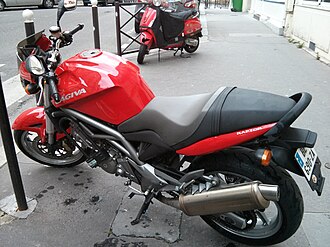
A Unique Blend of Italian Style and Japanese Engineering
The Cagiva Raptor 650 is one of those motorcycles that deserves more attention than it typically receives in discussions about middleweight naked bikes. Combining distinctive Italian design with proven Japanese engine technology, it offers an appealing alternative to more familiar motorcycles from established Japanese and European manufacturers. Its muscular proportions, exposed mechanical components, compact dimensions, and unmistakable streetfighter character give it a personality that remains attractive even years after its introduction. Rather than relying on extravagant electronics or cutting-edge technology, the Raptor 650 focuses on the fundamentals that make motorcycling enjoyable: responsive acceleration, accessible handling, an engaging riding position, and a direct connection between rider and machine.
Produced by the Italian manufacturer Cagiva, the Raptor family emerged during a period when naked motorcycles were becoming increasingly popular among riders who wanted performance without the weight, expense, and visual complexity of fully faired sport bikes. The Raptor 650 occupies an interesting position within this category because its identity is shaped by two different motorcycle traditions. Its styling reflects Italian creativity and attention to visual detail, while its engine comes from Suzuki, bringing reliability, straightforward maintenance, and a well-established mechanical foundation. This combination makes the motorcycle more than an unusual alternative to mainstream roadsters; it represents a thoughtful approach to building a practical, characterful machine with a distinctive identity.
The History and Development of the Cagiva Raptor 650
Cagiva’s Approach to Motorcycle Design
Cagiva has a long history in the Italian motorcycle industry, with a reputation for producing machines that combine distinctive styling with an interest in sporting performance. The company became known for its involvement in road motorcycles, off-road models, and competition-oriented machines, establishing an identity that differed from the mass-market approach of many larger manufacturers. During the late 1990s and early 2000s, naked motorcycles began attracting riders who wanted the performance of modern road bikes without the conventional appearance of a fully enclosed sport motorcycle. Cagiva responded with the Raptor range, a family designed to deliver a muscular, minimalist aesthetic while retaining the engineering necessary for everyday use.
The Raptor’s design philosophy emphasized visible mechanical elements, compact bodywork, a broad-looking fuel tank, and a distinctive front end. Instead of hiding the engine behind extensive fairings, the motorcycle made its mechanical layout part of its visual appeal. This approach gave it a more substantial appearance than its displacement alone might suggest, while its relatively compact chassis helped preserve the agility expected from a middleweight roadster. The result was a motorcycle that looked purposeful without being excessively aggressive, appealing to riders who valued individuality as much as outright performance.
Why the 650-Class Model Matters
The Raptor 650 was designed for riders who wanted a manageable, versatile motorcycle rather than an intimidating high-performance machine. Its middleweight engine provides enough power for spirited road riding, urban commuting, and longer journeys, while avoiding the additional weight and operating costs that can accompany larger-displacement motorcycles. This balance is particularly important in the used-bike market, where riders often seek a motorcycle that offers genuine character without requiring a premium purchase price.
The 650 model also benefits from sharing its fundamental engine architecture with Suzuki’s established SV650 platform. This connection gives the Raptor a practical advantage: its Italian appearance is supported by a Japanese powertrain with a strong reputation for usability. Although the Cagiva has its own chassis, styling, and component specifications, the engine’s established design helps explain why the motorcycle continues to interest enthusiasts looking for something less common than a conventional Japanese naked bike.
Engine and Performance: The Suzuki Connection
A Proven 645 cc V-Twin Engine
At the heart of the Cagiva Raptor 650 is a liquid-cooled, four-stroke, 90-degree V-twin engine with a displacement of approximately 645 cc. The four-valve-per-cylinder layout and double overhead camshafts contribute to efficient breathing and a broad operating range, while electronic fuel injection supports consistent fueling and everyday usability. This engine architecture became well known through Suzuki’s SV650, making it a particularly appropriate choice for a motorcycle intended to combine sporting character with practical road performance.
The V-twin configuration is central to the Raptor’s appeal. Unlike many parallel-twin engines, a 90-degree V-twin has a distinctive firing character and produces a sound and mechanical feel that many riders find especially engaging. Acceleration feels immediate and substantial at ordinary road speeds, and the engine delivers enough flexibility to make overtaking straightforward when the rider selects an appropriate gear. Although it does not offer the extreme top-end performance of a modern supersport motorcycle, it provides a satisfying mixture of low- and midrange response that suits real-world riding conditions.
Real-World Riding Performance
The Raptor 650 is best understood as a road-oriented naked motorcycle rather than a machine designed exclusively for maximum speed. Its performance is sufficient for motorway travel, although wind exposure becomes increasingly noticeable as speed rises because the rider receives little protection from a fairing. On winding country roads, the combination of V-twin torque, manageable dimensions, and an upright riding position can make the motorcycle particularly enjoyable. The engine encourages smooth, deliberate acceleration instead of demanding constant high revs, helping create a relaxed yet engaging riding experience.
Performance figures vary according to the exact model year, market specification, and measurement method, but the Raptor 650 is generally associated with approximately 70 horsepower and a top speed around 190–200 km/h under favorable conditions. These numbers should be treated as approximate rather than guaranteed results for every motorcycle. Actual performance depends on mechanical condition, gearing, rider weight, weather, and maintenance history. For most everyday riders, the more important characteristic is the engine’s usable power delivery rather than its maximum speed.
Design and Styling: Italian Character on Two Wheels
A Muscular Naked-Motorcycle Silhouette
One of the strongest reasons to consider the Cagiva Raptor 650 is its appearance. The motorcycle combines a compact frame with a sculpted fuel tank, exposed engine components, a short-looking rear section, and a distinctive headlight arrangement. Its proportions communicate strength without relying on oversized bodywork, and the visible engine gives the machine a purposeful, mechanical appearance. While many naked motorcycles share similar basic layouts, the Raptor has enough individual styling details to stand apart from more common alternatives.
The Italian influence is especially evident in the way the major components come together visually. The fuel tank, seat, frame, and engine form a cohesive design rather than appearing as unrelated pieces assembled around a powertrain. Its styling also avoids excessive decoration, allowing the motorcycle’s underlying shape to provide most of its visual impact. For riders who appreciate motorcycles that look distinctive when parked as well as when moving, this is a meaningful advantage.
Ergonomics and Everyday Comfort
The riding position is generally upright and natural, giving the rider a useful view of surrounding traffic and allowing comfortable control at ordinary road speeds. The handlebars provide leverage for low-speed maneuvering, while the seat and footpeg arrangement create a compromise between relaxed road riding and a more sporting posture. Compared with a fully faired sport bike, the Raptor is less demanding on the wrists and generally easier to use in traffic, although individual comfort depends on rider height, flexibility, and the condition of the seat and suspension.
Its naked design also introduces a familiar limitation: wind protection is minimal. Short commutes and twisty-road rides are well suited to the motorcycle, but extended motorway journeys can become tiring at higher speeds. A suitable aftermarket windscreen may improve comfort, although the result depends on the accessory and rider dimensions. Prospective owners should test the motorcycle in person whenever possible, since a seat that feels comfortable during a short ride may become less suitable after several hours in the saddle.
Handling, Suspension, and Braking
A Chassis Built for Everyday Enjoyment
The Cagiva Raptor 650 uses a tubular steel frame designed to balance rigidity, stability, and responsive handling. Its relatively short wheelbase and compact overall proportions help it feel manageable in urban environments while providing the confidence needed for faster country-road riding. The motorcycle is not exceptionally lightweight by modern standards, but its mass is distributed in a way that makes it feel reasonably agile once moving. At low speeds, the upright riding position and wide handlebars help the rider negotiate tight turns, parking areas, and congested streets without excessive effort.
Suspension specifications vary with model year, but the Raptor 650 is associated with an upside-down telescopic front fork and a rear shock absorber with spring-preload adjustment on relevant versions. This arrangement gives the motorcycle a sporting foundation while retaining enough compliance for ordinary road surfaces. Suspension condition is especially important when evaluating an older example, as worn fork seals, tired springs, neglected damping components, or incorrect adjustments can significantly affect its behavior. A properly maintained Raptor should feel controlled and predictable over typical road imperfections rather than harsh or unsettled.
Braking Performance and Road Confidence
The braking system typically consists of twin front discs and a single rear disc, providing a sensible combination of stopping power and control for a middleweight naked motorcycle. Depending on the version, the front discs are approximately 298–300 mm in diameter, while the rear disc measures around 220 mm. These components are appropriate for the motorcycle’s performance level, and the dual-disc front arrangement helps provide progressive braking during everyday riding as well as more demanding situations.
As with any older motorcycle, however, the condition of the braking system matters more than the original specification alone. Brake fluid should be replaced according to the maintenance schedule, calipers and pistons should move freely, and hoses, pads, and discs should be inspected carefully. Tire condition is equally important because even excellent brakes cannot compensate for old rubber or inadequate grip. Riders considering a used Raptor should also confirm the equipment fitted to the individual motorcycle rather than assuming that every model year has identical components or safety features.
Fuel Economy, Reliability, and Maintenance
What to Expect from Running Costs
The Raptor 650 offers a practical balance between performance and operating costs. Its 645 cc engine provides enough power for a wide range of riding conditions without the fuel consumption typically associated with larger, more powerful motorcycles. Published fuel-economy figures differ according to test methods, model year, and riding style, but approximately 4.5–5.5 litres per 100 kilometres is a reasonable general expectation for a mechanically healthy motorcycle ridden under mixed conditions. Aggressive acceleration, sustained high-speed travel, heavy traffic, and mechanical problems can all increase consumption.
Fuel-tank capacity also varies across specification listings and production versions, with many later examples listed at approximately 17.5 litres and some earlier specifications reporting a larger capacity. Consequently, owners should verify the capacity of their particular motorcycle before estimating its touring range. Routine expenses include engine oil, filters, spark plugs, tires, brake components, chain maintenance, and periodic valve-clearance checks. Although the underlying engine design is well established, the age and relative rarity of the Cagiva mean that budgeting for occasional specialist work and sourcing model-specific bodywork or electrical components is sensible.
Reliability and Long-Term Ownership
The Suzuki-derived V-twin is one of the Raptor 650’s strongest practical advantages. Its basic architecture has a long history in road motorcycles, and its established engineering makes it less mysterious than an obscure engine designed exclusively for a short-lived model. Nevertheless, a proven engine does not guarantee that every used example will be reliable. Maintenance records, previous repairs, storage conditions, and the quality of replacement parts all have a major influence on long-term ownership.
Before purchasing, check for cold-start difficulties, irregular idling, coolant leaks, oil leaks, charging-system problems, worn chain and sprockets, and evidence of crash damage. Inspect the frame, steering head, wheels, suspension, and exhaust system carefully, paying particular attention to corrosion and improvised repairs. It is also worth checking whether routine servicing has been performed on schedule and whether the motorcycle starts and runs properly when fully warm. Because Cagiva-specific trim and bodywork may be harder to find than common service parts, an apparently inexpensive motorcycle can become costly if it requires extensive cosmetic restoration.
Buying a Used Cagiva Raptor 650
What to Look for Before Purchasing
Buying a Raptor 650 is primarily about finding a well-preserved individual example rather than choosing the newest or most powerful motorcycle available. Service history, mechanical condition, and the availability of essential components should take priority over minor cosmetic imperfections. A clean motorcycle with documented maintenance and a sensible ownership history will usually be a more attractive prospect than a cheaper example with unexplained modifications or signs of neglect. Check that the engine, chassis, and identification documents correspond correctly, and establish whether any aftermarket parts have been fitted in a way that affects road legality or insurance.
A proper test ride is particularly valuable because it can reveal problems that are difficult to identify while the motorcycle is stationary. The engine should accelerate cleanly, the clutch should engage predictably, the gearbox should select gears without unusual noises, and the motorcycle should track straight without persistent vibration or instability. Listen for abnormal mechanical sounds and check that the temperature remains within its normal operating range. If you are unfamiliar with the model, an independent inspection by a motorcycle mechanic can help identify expensive faults before money changes hands.
Is It Suitable for New Riders?
The Raptor 650 can be approachable for riders moving up from smaller motorcycles, thanks to its manageable proportions, accessible riding position, and useful midrange performance. However, its power output is substantial enough to demand respect, particularly on wet roads or when accelerating out of tight corners. A newer rider should prioritize smooth throttle control, progressive braking, and a gradual increase in riding experience rather than treating the motorcycle’s middleweight classification as a guarantee of beginner-friendly behavior. Licensing restrictions also differ by country, so buyers should confirm that the specific motorcycle’s registered power output and their license category are compatible.
Cagiva Raptor 650: Main Technical Specifications
The following table summarizes commonly published specifications for the standard Cagiva Raptor 650. Figures can differ between model years, markets, and individual versions, so the original owner’s manual and vehicle documentation should be used to confirm the details of a particular motorcycle.
| Specification | Cagiva Raptor 650 |
|---|---|
| Motorcycle category | Naked roadster |
| Engine type | Four-stroke, 90-degree V-twin |
| Engine displacement | 645 cc |
| Cooling system | Liquid-cooled |
| Valve configuration | DOHC, 8 valves |
| Bore × stroke | 81 × 62.6 mm |
| Fuel system | Fuel injection on later versions; verify model year |
| Maximum power | Approximately 69–73 hp (51–53.3 kW) |
| Maximum torque | Approximately 63.5–64 Nm |
| Maximum power speed | Approximately 9,000 rpm |
| Maximum torque speed | Approximately 7,000–7,400 rpm |
| Transmission | Six-speed manual |
| Final drive | Chain |
| Frame | Tubular steel frame |
| Front suspension | Telescopic fork; upside-down type on relevant versions |
| Rear suspension | Single shock absorber |
| Front brakes | Twin discs, approximately 298–300 mm |
| Rear brake | Single disc, approximately 220 mm |
| Front tire | 120/70-17 |
| Rear tire | 160/60-17 |
| Wheelbase | Approximately 1,438–1,440 mm |
| Seat height | Approximately 770–800 mm, depending on version |
| Dry weight | Approximately 175–180 kg |
| Fuel tank capacity | Approximately 17.5–19.3 litres, depending on version |
| Approximate top speed | Around 190–200 km/h, depending on conditions and version |
Conclusion: An Underrated Alternative in the Middleweight Class
The Cagiva Raptor 650 remains an appealing motorcycle because it combines several qualities that are not always found together in a single package: distinctive Italian styling, a proven Japanese-derived V-twin engine, practical middleweight performance, and a chassis designed for enjoyable everyday riding. It may lack the advanced electronics, rider aids, and extensive dealer support associated with newer motorcycles, but its straightforward mechanical character is part of its appeal. For riders who value individuality and prefer a motorcycle with a recognizable personality, the Raptor offers an alternative to the more predictable choices in the used naked-bike market.
Its age and relative rarity mean that purchasing decisions require care, particularly when it comes to maintenance records, replacement components, and the condition of model-specific parts. Yet a well-maintained example can still make an engaging companion for commuting, weekend rides, and occasional longer journeys. The Cagiva Raptor 650 is not simply an Italian-styled motorcycle with a familiar engine; it is a distinctive blend of European design and Japanese engineering that rewards riders who appreciate character as much as performance. For the right owner, that combination is precisely what makes it worth seeking out.
