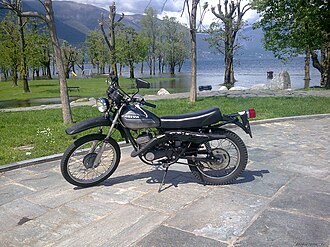
Discovering the Cagiva SXT
The Cagiva SXT is a classic Italian off-road motorcycle that reflects the adventurous spirit of motorcycling during the 1970s and early 1980s. Designed to combine everyday practicality with the freedom of exploring unpaved roads, the SXT belongs to a generation of lightweight enduro motorcycles that helped make off-road riding accessible to a wider audience. With its tall front wheel, narrow bodywork, upright riding position, and rugged appearance, it was built for riders who wanted something more versatile than a conventional road motorcycle. Its straightforward mechanical design, relatively light construction, and distinctive Italian character have helped preserve its appeal among vintage motorcycle enthusiasts.
One important detail about the Cagiva SXT is that the name refers to a family of motorcycles rather than a single engine size. The range included several displacements, notably 125 cc, 175 cc, 250 cc, and 350 cc versions, with specifications changing over the course of production. The earliest models were associated with the Italian manufacturing operation previously connected with AMF Harley-Davidson, before the Cagiva identity became established following the company’s acquisition of the Varese motorcycle business. This transition gives the SXT an interesting place in Italian motorcycle history, linking an earlier industrial period with the emergence of Cagiva as an independent motorcycle brand. Understanding the differences between individual versions is essential when researching the SXT, since engine architecture, transmission, brakes, and dimensions are not identical throughout the family.
The History of the Cagiva SXT
From AMF Harley-Davidson to Cagiva
The origins of the SXT are closely connected with the history of motorcycle production in Schiranna, near Varese, Italy. During the 1970s, the local factory produced motorcycles under the AMF Harley-Davidson name as part of the wider industrial arrangement between the American company and its Italian operation. When the Castiglioni family acquired the business and developed Cagiva, the existing motorcycle range became part of a changing manufacturing landscape. The SXT therefore represents more than an individual off-road model: it reflects a transition in which an established Italian production operation developed a new identity and eventually became associated with a recognizable family of Cagiva motorcycles.
The SXT appeared during a period when lightweight trail and enduro motorcycles were gaining popularity across Europe. Riders wanted machines capable of handling ordinary roads while remaining suitable for dirt tracks, rural paths, and recreational off-road excursions. Unlike specialized competition motorcycles, these machines needed to be practical enough for regular transportation, with lighting equipment, usable seats, and mechanical systems that could be maintained without extensive workshop facilities. The Cagiva SXT followed this philosophy, combining a relatively simple engine with long-travel-style suspension components, spoked wheels, and an upright riding position. Its appeal came from versatility rather than extreme performance, making it particularly relevant to riders who wanted one motorcycle for several different purposes.
A Family of Different Engine Sizes
The SXT range evolved through several engine capacities, allowing riders to select a motorcycle suited to their experience, intended use, and local licensing requirements. The smaller versions were attractive to younger riders and those seeking economical transportation, while the larger models offered additional performance for open roads and more demanding routes. The 125 cc model became particularly recognizable because of its accessible dimensions and lively two-stroke engine, whereas the larger-displacement variants provided a different balance of power, weight, and practicality.
The model family also experienced technical changes over time. Early SXT motorcycles included air-cooled two-stroke engines, while later derivatives and successor models introduced different mechanical arrangements. In particular, the Aletta Rossa name appears in later model descriptions and is associated with important changes, including liquid-cooled two-stroke 125 cc and 200 cc versions and a four-stroke 350 cc version. Consequently, it is important not to confuse every SXT with an Aletta Rossa or assume that all motorcycles carrying similar names have the same specifications. Model year, engine size, and original identification documents are the most reliable starting points when determining the exact identity of a surviving motorcycle.
Engine and Performance: Simple Engineering with Character
The Two-Stroke Engines
The traditional Cagiva SXT is closely associated with single-cylinder, two-stroke engines, a configuration valued for its relatively simple construction and favorable power-to-weight ratio. Two-stroke engines complete their combustion cycle in fewer crankshaft revolutions than four-stroke engines, giving them a distinctive response and a characteristic exhaust note. On a lightweight enduro motorcycle, this design provides useful acceleration without requiring a large or particularly heavy powerplant. The engine’s compact dimensions also help maintain the narrow profile that is so valuable when riding on rough ground or maneuvering along tight trails.
The 125 cc version illustrates this philosophy particularly well. Depending on the year and specification, it used an air-cooled, single-cylinder two-stroke engine with a displacement of approximately 125 cc, a carburetor, and a manual gearbox. Period specifications commonly quote output in the region of 17 horsepower for certain versions, although earlier machines and later derivatives can differ significantly. The power delivery is more energetic than the modest displacement might suggest, particularly when the engine is kept within its effective operating range. At the same time, the relatively small engine capacity helps make the motorcycle approachable for riders who do not need the weight or running costs of a larger enduro machine.
Differences Between the 125, 200, 250, and 350
The larger SXT variants offer a useful illustration of how changing engine capacity affects the character of a classic enduro motorcycle. The 175 cc and 250 cc models retain the traditional two-stroke concept, while the 350 cc version introduced additional displacement for riders seeking more substantial performance. However, specifications vary across production periods, and the later 350 cc Aletta Rossa should not be treated as mechanically identical to the earlier two-stroke SXT 350. Some published specifications for the earlier 350 list an air-cooled two-stroke engine, while the Aletta Rossa 350 is documented with a four-stroke single-cylinder engine.
In practical terms, the smaller versions emphasize manageable weight and straightforward riding, while the larger engines can provide stronger acceleration and greater flexibility on open roads. None should be judged solely by modern performance expectations. These motorcycles were designed for the roads, trails, and recreational riding conditions of their era, when simplicity and ease of use were important selling points. Their real appeal lies in the direct mechanical connection between rider and machine, rather than in sophisticated electronics, high peak speeds, or advanced electronic suspension systems.
Design and Chassis: Built for Adventure
A Classic Enduro Silhouette
The Cagiva SXT has the unmistakable proportions of a traditional enduro motorcycle. Its tall front wheel, narrow fuel tank, relatively slim seat, wide handlebars, and elevated front mudguard create a practical design intended to cope with changing road surfaces. The spoked wheels and upright riding position contribute to its off-road identity, while the compact engine and exposed frame make the motorcycle appear uncomplicated and purposeful. Unlike modern adventure motorcycles, which often feature large body panels, extensive instrumentation, and protective equipment, the SXT keeps its design focused on the essentials.
The appearance also reflects the manufacturing priorities of its era. Components were designed to perform practical functions rather than provide visual complexity, and the relatively narrow bodywork allowed the rider to move naturally while standing on the footpegs. A dual seat made the motorcycle more versatile for everyday use, while a rear luggage rack on certain versions provided space for small bags or basic equipment. These features helped bridge the gap between a recreational trail bike and a motorcycle that could still be used for ordinary journeys.
Suspension, Wheels, and Braking
The SXT’s chassis combines a steel frame with conventional suspension components suited to mixed-surface riding. Depending on the model and production year, the front suspension uses telescopic forks, while the rear employs a swingarm with either twin shock absorbers or a different arrangement on particular derivatives. This variation matters when identifying a motorcycle, because the specification of an early SXT 125 should not automatically be applied to an SXT 350 or an Aletta Rossa.
Spoked wheels and relatively narrow tires help the motorcycle handle uneven ground more effectively than many road-oriented machines of the same period. A 21-inch front wheel is particularly useful on traditional enduro motorcycles because it can roll over obstacles and irregular surfaces with reasonable stability. The smaller rear wheel provides a compromise between traction, strength, and maneuverability. Braking equipment also varies, but the SXT 125/N is documented with a front disc brake and rear drum brake, while other versions may have different component specifications. Compared with modern motorcycles, the brakes and suspension are relatively simple, so their condition is especially important when restoring or riding a surviving example.
Riding Experience and Everyday Practicality
On the Road and on the Trail
The Cagiva SXT was designed to offer flexibility rather than specialize exclusively in competition or high-speed road travel. Its upright handlebars and narrow body make it relatively easy to maneuver through small towns, rural roads, and tight tracks, while the tall front wheel and trail-oriented tires help it deal with loose surfaces. The lightweight character of the smaller versions is especially valuable when negotiating difficult terrain, where a manageable motorcycle can be easier to control than a much heavier machine. Riders can shift their body position naturally, stand on the footpegs when necessary, and maintain a clear view of the terrain ahead.
On paved roads, however, the SXT has the limitations expected of an older enduro motorcycle. Its small engine, modest wind protection, and trail-oriented ergonomics make it less suitable for sustained high-speed touring than a modern road bike. Two-stroke versions also require the rider to understand their particular power delivery and maintenance needs. Nevertheless, for short commutes, countryside exploration, and leisurely rides along mixed surfaces, the SXT offers an engaging experience that places emphasis on skill and mechanical simplicity.
Fuel Economy and Maintenance
Running costs depend on the engine size, mechanical condition, and riding style. The smaller-displacement models can be economical when maintained correctly, but consumption should not be assumed to match that of a modern fuel-injected 125 cc motorcycle. Carburetor condition, ignition timing, air-filter cleanliness, and correct lubrication all influence performance and fuel use. On two-stroke models, the oil-injection system or specified lubrication arrangement requires particular attention; owners should follow the correct procedure for their exact version rather than assume that every SXT uses the same system.
Routine maintenance is relatively straightforward compared with that of many modern motorcycles, but the age of the machines introduces additional challenges. Rubber seals, fuel lines, electrical connections, wheel bearings, cables, and suspension components may have deteriorated even when the motorcycle has covered relatively few kilometres. Before riding a restored or long-stored example, inspect the fuel system, brakes, tires, chain, wheel bearings, and steering components. Engine compression and gearbox operation should also be checked, and any signs of overheating, abnormal mechanical noise, or persistent starting problems should be investigated before the motorcycle is used regularly.
Buying and Restoring a Cagiva SXT
What Collectors Should Check
A surviving Cagiva SXT can be an appealing project for a vintage motorcycle enthusiast, particularly when it retains its original frame, engine, tank, wheels, and period-correct components. However, originality and mechanical condition are often more important than superficial appearance. Before buying, verify the model designation, production year, engine number, and registration documents, since the SXT family includes several versions that can look similar while having substantially different specifications. Establishing the exact model is also essential when ordering replacement parts or searching for reliable technical information.
Pay particular attention to corrosion, damage to the frame, worn suspension, missing electrical components, and non-original engine parts. Cosmetic items such as mudguards, side panels, decals, and model-specific trim may be difficult to source, while older two-stroke engines can require specialist attention if internal components are worn or damaged. A complete motorcycle with a documented history may therefore be a more sensible restoration project than a cheaper but heavily dismantled example. Where possible, consult marque specialists or historic Cagiva clubs before purchasing rare components.
Why the Cagiva SXT Still Matters
The SXT represents an important stage in the development of Italian lightweight enduro motorcycles. It combines practical engineering, a recognizable off-road silhouette, and the historical transition from the AMF Harley-Davidson-associated production period to Cagiva’s growing independent identity. For collectors, it offers a connection to a time when manufacturers were developing versatile motorcycles for riders who wanted to travel beyond paved roads without committing to a specialized competition machine.
Its appeal today is not based on outperforming modern motorcycles. Instead, the SXT provides a distinctive vintage riding experience and an opportunity to appreciate the simplicity of earlier motorcycle design. Whether preserved as an original classic or carefully restored for occasional use, it remains an interesting part of the history of Italian motorcycling.
Cagiva SXT: Technical Specifications Summary
Because the Cagiva SXT was produced in several engine sizes and underwent changes during its history, the following table uses the Cagiva SXT 125/N, circa 1982, as the principal reference. These specifications should not be applied automatically to the 175 cc, 250 cc, or 350 cc models.
| Specification | Cagiva SXT 125/N |
|---|---|
| Manufacturer | Cagiva |
| Model period | Early 1980s; exact years vary by version |
| Motorcycle category | Enduro / dual-purpose |
| Engine type | Single-cylinder, two-stroke |
| Displacement | 124.63 cc |
| Bore × stroke | 50 × 50.6 mm |
| Compression ratio | 12.1:1 |
| Cooling system | Air-cooled |
| Fuel system | Dell’Orto PHBL 25 carburetor |
| Lubrication | Automatic oil injection |
| Ignition | 12 V electronic ignition |
| Maximum power | Approximately 17 hp, depending on specification |
| Transmission | Six-speed manual |
| Final drive | Chain |
| Frame | Steel double-cradle frame |
| Front suspension | Telescopic fork with hydraulic damping |
| Rear suspension | Swingarm with hydraulic shock absorbers |
| Front brake | Single disc |
| Rear brake | Drum, approximately 125 mm |
| Front tire | 2.75-21 |
| Rear tire | 3.50-18 |
| Fuel tank capacity | Approximately 9.4 litres |
| Dry weight | Approximately 101 kg |
| Maximum speed | Around 100 km/h, depending on condition and version |
Specifications are based primarily on the Registro Storico Cagiva’s SXT 125/N technical record. Other SXT versions differ in engine capacity, power, transmission, chassis details, weight, and fuel-tank capacity.
Conclusion: A Classic Italian Enduro Worth Remembering
The Cagiva SXT is a distinctive example of the lightweight enduro motorcycles that helped shape recreational off-road riding during the 1970s and early 1980s. Its straightforward engine designs, practical chassis, tall front wheel, and upright riding position reflect a philosophy centered on versatility and accessibility. The range’s different engine sizes allowed it to serve a variety of riders, from those seeking a manageable 125 cc motorcycle to enthusiasts who preferred the greater capacity of the larger models.
Today, the SXT is best appreciated as a classic motorcycle whose value lies in its history, simplicity, and individual character. Prospective owners should pay careful attention to the exact model designation and the availability of replacement parts, but a well-preserved example can offer a rewarding ownership experience. For vintage enthusiasts interested in Italian motorcycle history, the Cagiva SXT remains a memorable machine that captures the adventurous spirit of an era when exploring a dirt road was as much a part of motorcycling as riding on asphalt.
