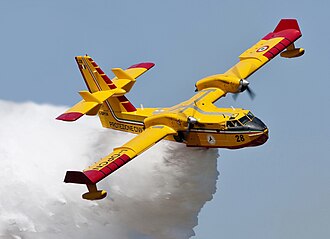
Canadair CL-415: The Legendary Amphibious Firefighter Aircraft Built to Battle Wildfires
The Aircraft That Changed Aerial Firefighting Forever
The Canadair CL-415 is one of the most recognizable and successful amphibious aircraft ever developed for specialized firefighting operations. Known around the world as the “Super Scooper,” the aircraft was designed to perform a mission unlike almost any other airplane: collecting large quantities of water directly from lakes, rivers, and coastal waters before rapidly delivering it onto wildfires. Since entering service in the mid-1990s, the CL-415 has become a vital tool for governments, emergency agencies, and firefighting organizations facing increasingly severe wildfire seasons.
Developed in Canada as a successor to the highly respected Canadair CL-215, the CL-415 represented a major evolution in amphibious firefighting technology. It retained the proven concept of a flying boat capable of operating from both land and water while incorporating more powerful engines, improved aerodynamics, modern avionics, and increased water-carrying capacity. The result was an aircraft specifically optimized for repeated low-altitude missions in challenging environments where speed, reliability, and precision are essential.
Unlike conventional firefighting aircraft that require airports or temporary bases to reload, the CL-415 can land on suitable bodies of water, fill its tanks in seconds while skimming across the surface, and return immediately to the fire zone. This unique capability allows it to deliver multiple water drops in a short period, making it particularly effective in regions dominated by forests, mountains, islands, and remote terrain.
Today, the Canadair CL-415 remains one of the most important aerial firefighting platforms in the world. Its distinctive design, operational flexibility, and proven performance have made it a symbol of modern wildfire response and a remarkable example of Canadian aerospace engineering.
The Development of the Canadair CL-415
Building on the Success of the CL-215
The origins of the CL-415 can be traced back to the Canadair CL-215, which first flew in 1967 and became the world’s first aircraft specifically designed for aerial firefighting. The CL-215 introduced a revolutionary concept: a purpose-built amphibious aircraft capable of collecting water from natural sources and delivering it directly onto fires.
Although highly successful, the CL-215 was powered by piston engines, limiting its performance in hot weather, high-altitude environments, and heavily loaded operations. As firefighting demands increased and operators sought improved efficiency, Canadair began developing a more advanced version that would address these limitations.
The solution was the CL-415, which maintained the basic amphibious firefighting concept while introducing significant improvements. The aircraft received modern turboprop engines, upgraded flight systems, improved structural components, and a redesigned cockpit. These changes produced a faster, more capable aircraft with greater operational flexibility.
A New Generation of Amphibious Aircraft
The first prototype of the CL-415 made its maiden flight in December 1993, and production aircraft entered service in 1994. The aircraft was initially produced by Canadair, which later became part of Bombardier Aerospace following changes in Canada’s aerospace industry.
The design philosophy behind the CL-415 was simple but highly effective: preserve the qualities that made the CL-215 successful while improving every aspect of performance. Engineers focused on creating an aircraft that could operate reliably in harsh conditions, require minimal ground support, and deliver maximum effectiveness during wildfire emergencies.
The aircraft quickly gained international attention, with operators in Europe, North America, and Asia adopting it for firefighting and maritime missions. Its ability to operate from relatively small water surfaces gave it a major advantage over many conventional firefighting aircraft.
Design and Engineering
Amphibious Configuration
The defining feature of the CL-415 is its amphibious design. The aircraft combines a boat-shaped fuselage with retractable landing gear, allowing it to operate from both water and conventional runways. This capability gives operators enormous flexibility, particularly in remote areas where airports may be unavailable but lakes or coastal waters are abundant.
The hull structure is reinforced to withstand repeated water operations, while wing-mounted floats provide stability during takeoff and landing on water. The aircraft’s design allows pilots to approach a water surface, touch down smoothly, and immediately begin the scooping process without requiring extensive preparation.
This amphibious capability is the foundation of the CL-415’s effectiveness. During wildfire operations, time is often the most critical factor, and the ability to reload water close to the fire can significantly reduce response times.
Powerful Turboprop Engines
One of the most important improvements over the CL-215 was the replacement of piston engines with two Pratt & Whitney Canada PW123AF turboprop engines. These engines provide greater power, improved reliability, and better performance in demanding environmental conditions.
Turboprop power allows the CL-415 to operate effectively in hot climates and mountainous regions where air density is reduced and aircraft performance is affected. The increased power also improves climb performance after a water drop, allowing crews to return quickly to altitude and prepare for another attack run.
The engines were selected specifically for reliability and durability, as firefighting missions often involve repeated cycles of low-level flying, rapid acceleration, and exposure to smoke, heat, and difficult weather conditions.
Water-Scooping System
The aircraft’s most impressive feature is its water-scooping system. During a typical firefighting mission, the CL-415 approaches a suitable water source at low altitude and extends its scooping probes into the water while maintaining forward speed. In approximately 12 seconds, the aircraft can collect thousands of liters of water without landing.
This system allows the aircraft to perform multiple drops per hour, depending on the distance between the fire and available water sources. The rapid turnaround capability is one of the reasons the CL-415 is so valuable in wildfire suppression.
The aircraft can also carry foam or other firefighting additives, improving the effectiveness of water drops against certain types of fires.
Operational Capabilities
The Ultimate Wildfire Suppression Aircraft
The primary mission of the CL-415 is aerial firefighting, and it has become one of the world’s most effective aircraft for this purpose. It is especially valuable in regions where forests, dry climates, and seasonal winds create significant wildfire risks.
Countries such as Canada, Greece, Italy, France, Spain, Croatia, and Turkey have used CL-415 fleets extensively during wildfire seasons. The aircraft’s ability to repeatedly collect water from nearby lakes and coastlines allows it to remain active for long periods without returning to a distant base.
Firefighting pilots must operate with extreme precision, often flying through smoke, turbulence, and mountainous terrain. The CL-415’s stable handling characteristics and responsive controls make it well suited for these demanding missions.
Search and Rescue Operations
Although best known as a firefighting aircraft, the CL-415 is also capable of performing maritime search and rescue missions. Its ability to operate from water allows it to reach areas inaccessible to conventional aircraft and helicopters.
Equipped with appropriate sensors and rescue equipment, the aircraft can patrol large maritime areas, locate vessels in distress, and support emergency response operations. Several operators have adapted their CL-415 aircraft for combined firefighting and rescue roles.
Maritime Patrol and Environmental Missions
Some CL-415 variants have been used for surveillance, pollution monitoring, and coastal patrol duties. The aircraft’s long endurance, low-speed capability, and ability to operate close to the water make it suitable for monitoring marine environments.
Government agencies have used modified versions for border surveillance, fisheries protection, and environmental observation. These secondary roles demonstrate the flexibility of the basic aircraft design.
International Service and Global Impact
A Canadian Innovation with Worldwide Reach
The CL-415 became one of Canada’s most successful specialized aircraft exports. Its unique mission capability created demand among countries facing recurring wildfire threats, especially those with large forested areas or Mediterranean climates.
More than one hundred aircraft have been delivered to operators around the world. Many countries consider the CL-415 a strategic emergency-response asset because of its ability to provide rapid and effective firefighting support during major disasters.
The aircraft’s reputation has been strengthened by decades of operational experience. Crews and emergency agencies consistently highlight its reliability, ease of operation, and effectiveness in difficult conditions.
Service in Europe
Europe has become one of the largest markets for the CL-415 due to frequent summer wildfires across the Mediterranean region. Countries including Italy, Greece, France, and Croatia have relied heavily on amphibious firefighting fleets to protect forests, communities, and critical infrastructure.
The aircraft’s ability to operate from coastal waters and inland lakes makes it particularly effective in European landscapes where access to water sources is often excellent but terrain can be challenging.
During severe wildfire seasons, CL-415 fleets frequently operate for extended periods, conducting hundreds of water drops and becoming a central component of national emergency response strategies.
Evolution and Successors
The End of Production
Production of the original CL-415 ended after Bombardier sold its specialized aircraft programs. Despite its success, changing market conditions and limited demand for new amphibious aircraft led to the conclusion of production.
However, the need for dedicated aerial firefighting aircraft continued to grow as climate change contributed to more frequent and intense wildfire events worldwide. This created renewed interest in maintaining and modernizing existing CL-415 fleets.
The Next Generation
The design legacy of the CL-415 continues through newer developments. The aircraft program was acquired by Viking Air, later part of De Havilland Canada, which introduced plans for updated versions known as the DHC-515 Firefighter.
These developments demonstrate the enduring value of the original concept. The fundamental idea behind the CL-415 remains highly relevant: a dedicated amphibious aircraft capable of delivering rapid, precise, and repeated firefighting support.
Legacy of the Canadair CL-415
The Canadair CL-415 represents one of the finest examples of purpose-built aviation design. Rather than adapting an existing aircraft for firefighting, engineers created a machine specifically optimized for one of the most demanding missions in aviation.
Its success comes from the combination of several qualities: amphibious capability, reliable turboprop engines, large water capacity, excellent low-speed handling, and the ability to operate close to emergency zones. Few aircraft have been designed so specifically for a single mission while achieving such widespread international recognition.
For firefighters and emergency responders, the CL-415 is more than an airplane—it is a critical tool that helps protect forests, communities, and lives. Its distinctive silhouette over wildfire zones has become a familiar and reassuring sight in many parts of the world.
Canadair CL-415 Technical Specifications
| Specification | Details |
|---|---|
| Manufacturer | Canadair / Bombardier Aerospace |
| Current Program Successor | De Havilland Canada DHC-515 Firefighter |
| Aircraft Type | Amphibious firefighting aircraft |
| First Flight | 6 December 1993 |
| Entered Service | 1994 |
| Crew | 2 pilots |
| Passenger Capacity | Up to 17 passengers (configuration dependent) |
| Length | 19.82 m (65 ft) |
| Wingspan | 28.6 m (93 ft 10 in) |
| Height | 8.98 m (29 ft 6 in) |
| Empty Weight | Approximately 12,880 kg (28,400 lb) |
| Maximum Takeoff Weight | Approximately 19,890 kg (43,850 lb) |
| Engines | 2 × Pratt & Whitney Canada PW123AF turboprop engines |
| Engine Power | 1,775 shp each |
| Maximum Speed | Approximately 359 km/h (223 mph) |
| Cruise Speed | Approximately 333 km/h (207 mph) |
| Range | Approximately 2,400 km (1,490 miles) |
| Service Ceiling | Approximately 4,500 m (14,800 ft) |
| Water Capacity | Approximately 6,140 liters (1,620 US gallons) |
| Water Fill Time | Approximately 12 seconds while skimming |
| Landing Gear | Retractable tricycle landing gear |
| Primary Missions | Wildfire suppression, search and rescue, maritime patrol, environmental monitoring |
.jpg)