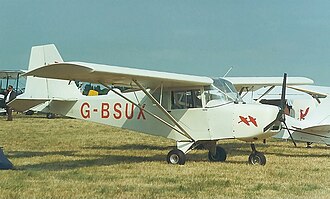
The Carlson Sparrow is a small American recreational aircraft that stands out in the history of ultralight and amateur-built aviation for its practical construction, enclosed cockpit, high-wing layout, and straightforward flying philosophy. Introduced by aircraft designer Ernie Carlson in 1987, the original Sparrow was conceived for pilots who wanted the freedom and simplicity associated with ultralight flying without giving up the enclosed cabin and familiar configuration of a conventional airplane. At a time when many ultralights featured exposed seating, minimalist airframes, and little protection from the weather, the Sparrow offered a different approach: a compact aircraft with a welded steel-tube fuselage, an aluminum wing structure, fabric covering, and tricycle landing gear. Its reception was particularly notable because it received Grand Champion recognition at EAA AirVenture Oshkosh in the year of its introduction, helping establish the design as a memorable entry in the recreational aviation market. Over time, the Sparrow concept developed into a family of aircraft, including the single-seat Sport Special, the two-seat Sparrow II, and the more powerful Sparrow II XTC. Each retained important elements of the original design while adapting the aircraft to different needs, from lightweight solo flying to shared recreational flights and longer journeys with more powerful engines.
The Carlson Sparrow is especially interesting because it represents a different side of aviation history from the military aircraft, commercial airliners, and high-performance machines that often dominate discussions of aircraft development. It was designed around accessibility, practical construction, and the pleasure of personal flight rather than speed records or large payloads. Its steel-tube fuselage and fabric-covered wing reflect longstanding traditions in light-aircraft engineering, while its enclosed cockpit and distinctive proportions gave it a recognizable identity among recreational aircraft. The Sparrow also illustrates the flexibility of the homebuilt aircraft movement, in which designers can develop a basic concept into multiple versions that suit different pilots, engines, and regulatory categories. Understanding the aircraft therefore requires looking beyond its appearance and examining its origins, engineering, performance, variants, operating considerations, and continuing place in the world of experimental aviation.
1. What Is the Carlson Sparrow?
The Carlson Sparrow is a family of small, high-wing recreational aircraft developed in the United States by Ernie Carlson and associated with Carlson Aircraft. The original version was a single-seat ultralight intended to operate within the limits of the United States Federal Aviation Regulations Part 103, which establishes the regulatory framework for qualifying ultralight vehicles. The design subsequently expanded into experimental amateur-built aircraft, including versions capable of carrying two people. Although the Sparrow family includes several configurations, its defining characteristics are the use of a welded 4130 chromoly steel-tube fuselage, a strut-braced aluminum wing, fabric covering, and an enclosed cockpit. These features give the aircraft a traditional light-airplane appearance while keeping its overall design relatively simple compared with more complex general-aviation aircraft. The Sparrow was supplied as a kit aircraft, allowing builders to assemble their own machines, and individual examples could differ according to their construction, engine installation, equipment, and subsequent modifications. Consequently, the name Carlson Sparrow refers not to one completely uniform aircraft but to a design family whose members share a common engineering philosophy.
The idea behind the Sparrow
The central idea behind the original Sparrow was to make ultralight flying feel more like flying a conventional airplane. Rather than relying on an exposed seat and a minimal open-frame structure, Carlson developed an aircraft with a fully enclosed cockpit, a recognisable fuselage, a high wing, and conventional aircraft controls. This arrangement appealed to pilots who wanted the simplicity and personal character of ultralight aviation but preferred to fly in a sheltered cabin. An enclosed cockpit could provide protection from wind and colder weather, making the experience more comfortable than an open-seat configuration, although it did not eliminate the need for appropriate clothing, ventilation, and careful consideration of temperature. The high-wing layout also provided a familiar visual arrangement for pilots accustomed to light aircraft, while the tricycle landing gear gave the original Sparrow a stance that was readily recognisable on the ground. Together, these features helped distinguish the aircraft from many ultralights of its era and contributed to its identity as a compact airplane rather than simply a lightweight flying frame.
The Sparrow’s place in recreational aviation
Recreational aviation offers a wide range of experiences, from open-cockpit ultralights and powered hang gliders to sophisticated touring aircraft and experimental designs with performance approaching that of conventional general-aviation airplanes. The Carlson Sparrow occupies the simpler end of this spectrum, but it should not be confused with a powered paraglider or a hang glider with an engine attached. It is a fixed-wing aircraft with a defined fuselage, conventional flight controls, a structured wing, landing gear, and a cockpit. Its design is intended for pilots who value uncomplicated recreational flying and who are interested in the practical relationship between an aircraft’s construction and its handling. The homebuilt nature of the Sparrow also places it within a community in which aircraft ownership can involve building, inspecting, maintaining, and understanding the machine rather than simply purchasing a finished product and relying entirely on commercial service providers. This makes the aircraft relevant not only to flying enthusiasts but also to builders interested in traditional light-aircraft construction and the engineering principles behind small recreational airplanes.
2. The History and Development of the Carlson Sparrow
Ernie Carlson and the birth of the design
The story of the Carlson Sparrow begins with Ernie Carlson, whose work in recreational aircraft design led to a machine intended to combine uncomplicated construction with the feel of a conventional airplane. The Sparrow was introduced in 1987, at a time when interest in ultralight flying and homebuilt aircraft was attracting pilots who wanted a more personal, affordable, and hands-on relationship with aviation. The design was built around a practical premise: a lightweight airplane did not have to sacrifice every feature associated with a traditional cockpit in order to remain simple. Carlson used a welded steel-tube fuselage, a strut-braced wing, fabric covering, and a compact enclosed cabin to create an aircraft that looked and felt distinct from many open ultralights. The Sparrow received Grand Champion recognition at EAA AirVenture Oshkosh in 1987, a significant achievement for a new design because Oshkosh is one of the most prominent gatherings in experimental and recreational aviation. This recognition helped establish the Sparrow’s reputation and made its introduction a memorable moment in Carlson Aircraft’s history.
The significance of the Sparrow’s introduction was not that it revolutionised aviation technology, but that it addressed a particular group of pilots whose priorities were sometimes overlooked by more performance-focused designs. Some enthusiasts wanted an aircraft they could build themselves, store relatively easily, and fly for enjoyment without the cost and complexity associated with larger touring airplanes. Others wanted the sensation of flying a conventional airplane but preferred the lightweight character and mechanical accessibility of an ultralight. The Sparrow’s enclosed cabin, conventional controls, and recognisable airframe addressed these preferences while retaining a construction approach based on established materials and methods. Its development also demonstrated how a distinctive design could gain attention through the homebuilt aviation community, where builders and pilots evaluate aircraft not only by published specifications but also by workmanship, practicality, ease of assembly, and suitability for everyday recreational use.
Recognition at EAA AirVenture Oshkosh
The Sparrow’s Grand Champion recognition at Oshkosh in 1987 forms a central part of its history. EAA AirVenture Oshkosh brings together experimental aircraft builders, pilots, designers, manufacturers, and aviation enthusiasts, making it an important venue for introducing unconventional aircraft and demonstrating the quality of a new design. Recognition at such an event can draw attention to an aircraft’s engineering, construction, and overall presentation, particularly when the design offers a different approach to a familiar category. For the Sparrow, the award helped reinforce the idea that an ultralight could be designed with the structure and cockpit arrangement of a traditional airplane while retaining a lightweight, recreational purpose. It also gave Carlson a foundation on which to develop a broader aircraft family. The award should not be interpreted as a guarantee of the performance or safety of every aircraft subsequently built from the design, since individual aircraft depend on construction quality, equipment, maintenance, and operating practices. Rather, it marks the original Sparrow’s successful introduction and its positive reception within the experimental aviation community.
From a single-seat ultralight to an aircraft family
The original Sparrow was only the beginning of the design’s development. As recreational pilots’ requirements became more varied, the Sparrow concept expanded into several models, each retaining the fundamental structural approach while addressing a different style of flying. The Sparrow Ultralight remained the lightweight, single-seat member of the family, while the Sparrow Sport Special introduced conventional tailwheel landing gear and a more powerful engine in an experimental amateur-built configuration. The Sparrow II widened the design to accommodate two occupants seated side by side and included dual controls, allowing either occupant to operate the aircraft when appropriately qualified. The Sparrow II XTC further developed the two-seat concept to accommodate larger, more powerful engines, including four-stroke installations. These variations show how a basic aircraft design can evolve when the original structure and layout provide a useful starting point for different missions. They also demonstrate why the specifications of one Sparrow model cannot automatically be applied to another: additional seats, fuel, engine power, and equipment can change weight, performance, operating limitations, and regulatory status.
3. Design Philosophy: Simplicity, Practicality, and Accessibility
A conventional airplane in a compact package
The Carlson Sparrow’s most distinctive design characteristic is the way it combines a compact airframe with features familiar from conventional light aircraft. Its high wing is supported by external struts, its fuselage is built around a welded metal framework, and its enclosed cockpit places the pilot within a defined cabin rather than in an exposed seat. This arrangement makes the Sparrow visually recognisable and communicates the priorities behind its design. Instead of attempting to minimise every component at the expense of conventional aircraft features, Carlson adopted a structure that many builders could understand and work with, using materials and construction techniques familiar from the broader world of amateur-built aviation. The result is an aircraft whose appeal comes partly from its mechanical straightforwardness: the structure can be inspected, its main components are visible when the covering is removed, and the design does not depend on the highly integrated systems associated with more complex modern aircraft. That does not mean the Sparrow requires no specialist knowledge or that every repair is simple, but it does help explain its appeal to owners who enjoy learning about the engineering of their aircraft.
Why the high-wing configuration matters
The high-wing layout is a longstanding choice in light-aircraft design because it offers several practical advantages for recreational flying. Positioning the wing above the fuselage provides a familiar cabin arrangement and can make it easier for occupants to enter or exit an aircraft designed around that layout. The wing also provides some shade over the cockpit, depending on the sun’s position, and can offer a useful downward view in certain directions. However, a high wing does not guarantee unobstructed visibility in every direction, since the wing itself can obstruct views above and to the side, and the fuselage, struts, and cockpit framing create their own limitations. In the Sparrow, the high wing is supported by struts, which transfer structural loads between the wing and fuselage. This external bracing is a practical feature of lightweight aircraft design, allowing the wing to be supported without relying solely on a heavy internal cantilever structure. The result is a recognisable arrangement that suits the Sparrow’s emphasis on straightforward construction and modest operating requirements.
Enclosed cockpit and everyday comfort
The Sparrow’s enclosed cockpit was one of its defining features from the beginning. Many ultralights of the 1980s prioritised minimum weight and simplicity, leaving the pilot exposed to the airflow. The Sparrow took a different approach by surrounding the pilot with a cabin, offering protection from wind and making cooler-weather flying more practical. An enclosed cockpit can also reduce the direct exposure of instruments and controls to rain and airborne debris, although the effectiveness of this protection depends on the aircraft’s actual canopy, seals, ventilation, and maintenance condition. Cabin comfort remains relative in a lightweight aircraft: noise, vibration, temperature changes, and limited space can still affect the experience, and the cockpit should not be assumed to provide the same amenities or environmental control as a larger touring aircraft. Nevertheless, the enclosed arrangement gives the Sparrow a more conventional character and broadens its appeal to pilots who prefer a sheltered cockpit. In the two-seat models, the cabin also allows occupants to sit side by side, making conversation and shared recreational flying more natural than in a tandem arrangement.
4. Airframe Construction and Materials
The welded 4130 chromoly steel-tube fuselage
The Sparrow family uses a fuselage built from welded 4130 chromoly steel tubing. This steel alloy is widely associated with light-aircraft structures because it offers a useful combination of strength, toughness, and suitability for tubular construction when correctly specified, fabricated, and inspected. In a welded-tube fuselage, individual tubes form a framework that transfers the loads created by the aircraft’s weight, flight manoeuvres, landing impacts, and other operating conditions. The geometry of the framework is as important as the material itself: the tubes must be arranged to carry loads through the structure, and the quality of the welds has a direct bearing on structural integrity. A well-designed and properly fabricated framework can provide a durable foundation for a lightweight aircraft, but steel tubing is not automatically maintenance-free. Corrosion, damaged welds, poorly executed repairs, or modifications that change the original load paths can compromise the structure. This is particularly relevant for older homebuilt aircraft, whose condition may depend on the quality of the original build and the care taken by successive owners. The Sparrow’s steel-tube construction is therefore best understood as a practical engineering choice that supports its lightweight design, not as a substitute for careful inspection and maintenance.
The use of a welded framework also contributes to the Sparrow’s suitability for amateur construction. Builders can see the basic arrangement of the fuselage structure, understand how its members are connected, and inspect many areas that might otherwise be hidden inside a monocoque shell. In a kit aircraft, some components may be supplied pre-welded or prepared to reduce the work required from the builder, although the precise level of completion depends on the kit and production period. The availability of prepared components can make a project more manageable, but it does not remove the builder’s responsibility to follow the approved or applicable construction documentation, verify alignment, install equipment correctly, and complete the required inspections. The attraction of this construction method lies in its combination of traditional craftsmanship and practical accessibility: the aircraft remains a real engineered structure, but its underlying arrangement is understandable to a mechanically minded builder.
Aluminum wing structure
The Sparrow’s wing uses aluminum I-beam spars and stamped aluminum ribs, with struts and jury struts supporting the wing structure. The spars are among the most important structural components of a wing because they carry bending loads generated by lift and other forces during flight. The ribs establish the wing’s cross-sectional shape and support the covering, helping maintain the intended aerodynamic profile. External struts transfer loads between the wing and fuselage, while jury struts reinforce the bracing arrangement. Aluminum is well suited to this kind of structure because it offers a useful strength-to-weight ratio and can be formed into components appropriate for lightweight aircraft construction. The design is nevertheless dependent on correct assembly, suitable fasteners, proper load paths, and protection against deterioration. Wing structure must be inspected for corrosion, cracks, loose or damaged fittings, and evidence of previous repairs, with particular attention paid to areas where loads are concentrated or different materials meet. The Sparrow’s aluminum wing illustrates the use of relatively conventional aircraft materials in a design intended to remain straightforward to build and maintain.
Fabric covering and aerodynamic surfaces
Fabric covering completes the Sparrow’s wing and other covered surfaces, producing a smooth external finish over the underlying structure. Fabric-covered construction has a long history in aviation because it can provide a lightweight skin without requiring an entirely metal outer structure. Once properly applied and finished, the covering creates the aerodynamic surface required for flight, while the spars, ribs, and framework carry the principal structural loads. The fabric and its protective finish must remain in good condition, since deterioration can result from ultraviolet exposure, moisture, abrasion, unsuitable storage, or ageing of the covering system. The precise inspection and maintenance requirements depend on the fabric type, finish, aircraft documentation, and applicable regulations. Repairs should follow appropriate technical procedures rather than improvised methods, because apparently minor covering damage can conceal problems with the underlying structure or affect the integrity of the finished surface. For owners who appreciate traditional light-aircraft construction, fabric covering also offers a practical benefit: the aircraft’s structural and aerodynamic systems can be understood as distinct but connected parts of the design, rather than as a single sealed shell.
Struts, landing gear, and ground handling
The Sparrow Ultralight uses tricycle landing gear, with a nosewheel ahead of the main wheels. The main gear uses bungee suspension, which provides a simple way to absorb some of the energy associated with landing and ground movement. The nosewheel arrangement can make the aircraft easier to manage on the ground for pilots accustomed to modern light aircraft, although ground handling still depends on correct technique, surface conditions, wind, and the aircraft’s individual setup. The Sparrow Sport Special differs by using conventional tailwheel landing gear, which changes both the aircraft’s stance and the demands of ground operation. A tailwheel aircraft typically requires particular care during taxiing, take-off, and landing because directional control can become more demanding if the aircraft begins to yaw. These differences demonstrate that even a relatively small change in landing gear can give two related aircraft noticeably different operating characteristics. The landing gear, suspension components, wheels, tyres, and attachment points also require regular inspection, since their condition affects not only ground handling but also the structural loads transmitted to the fuselage during landing.
5. Engine and Propulsion System
The Rotax 277: the original Sparrow’s powerplant
The original Carlson Sparrow Ultralight was historically associated with the Rotax 277, a lightweight, single-cylinder, two-stroke engine rated at approximately 28 horsepower. This engine suited the original design’s emphasis on low weight and simplicity, providing propulsion without the mass and complexity of a larger four-stroke aircraft engine. The Rotax 277 became closely associated with early Sparrow aircraft because it offered a practical balance between power, engine weight, and the requirements of a single-seat ultralight. Its relatively modest output also reflected the Sparrow’s intended mission: recreational flying at comparatively low speeds rather than long-distance touring, heavy payload operations, or high-performance aerobatics. In an aircraft designed around a strict weight budget, the engine’s mass matters as much as its nominal horsepower, because the complete propulsion installation includes the propeller, mounting structure, exhaust, fuel system, controls, and other necessary components. The Rotax 277 was therefore a logical choice for a design intended to remain lightweight and mechanically uncomplicated.
A two-stroke engine produces power through a relatively simple operating cycle, but its operation and maintenance differ from those of a typical four-stroke aircraft engine. Lubrication arrangements, fuel requirements, cooling, engine operating temperatures, and maintenance intervals must all be considered according to the specific engine model and installation. The condition of the engine and propeller has a direct effect on aircraft performance, and an older engine should not be assumed to deliver its original rated output simply because it belongs to the correct model family. Historical engine specifications are useful for understanding the design, but actual aircraft owners must rely on the documentation, inspection findings, and operating limitations applicable to their particular installation. The Sparrow’s lightweight powerplant illustrates the compromises inherent in ultralight aviation, where designers must carefully balance available power against weight, fuel consumption, cost, and mechanical simplicity.
Alternative engines and the Sparrow Sport Special
The Rotax 277 was not the only engine associated with the original Sparrow concept. Historical sources also identify alternatives such as the Zenoah G-25 and certain 2si engines, while the Sparrow Sport Special became associated with the more powerful Rotax 503 twin-cylinder, two-stroke engine, rated at approximately 50 horsepower. The additional power made the Sport Special a different proposition from the original ultralight, particularly because it was designed as an experimental amateur-built aircraft with conventional tailwheel landing gear. More engine power can improve acceleration and climb performance when the airframe and propeller are appropriately matched, but it can also increase fuel consumption, installation weight, and structural demands. Engine substitution is therefore not a matter of simply fitting a larger powerplant and assuming the aircraft will perform better in every respect. It requires careful attention to the aircraft’s design documentation, weight and balance, cooling, propeller compatibility, and applicable operating limitations.
The Rotax 582 and Sparrow II
The two-seat Carlson Sparrow II was historically associated with the Rotax 582, a liquid-cooled, twin-cylinder, two-stroke engine commonly rated at approximately 64–65 horsepower. The Sparrow II was designed to carry two occupants seated side by side and featured dual controls, so its propulsion requirements differed from those of the single-seat original. The larger cabin and the possibility of carrying a second person, additional fuel, and more equipment create a different overall weight and performance equation. A more powerful engine can help support the greater demands of a two-seat aircraft, but the actual carrying capacity depends on the particular aircraft’s approved or applicable maximum weight, empty weight, and loading limits. A nominal two-seat layout does not automatically mean that two adults, full fuel, and all optional equipment can be carried simultaneously. For anyone considering a Sparrow II, the aircraft-specific weight-and-balance documentation is more informative than the engine rating alone.
The Sparrow II XTC and higher-powered installations
The Sparrow II XTC represented a further development of the two-seat concept, designed to accommodate larger powerplants such as the Rotax 912 UL, Subaru EA-81 automotive conversion, and Continental C-85 aircraft engine. These installations are generally associated with outputs of approximately 80–85 horsepower, depending on the engine and configuration. The XTC was intended for pilots who wanted greater performance and the potential for longer journeys than the two-stroke versions could comfortably support. However, the different engine choices produce meaningful differences in installation weight, cooling arrangements, fuel requirements, and maintenance procedures. An automotive engine conversion, for example, cannot automatically be assumed to have the same reliability characteristics, documentation, or operating requirements as an engine designed specifically for aircraft use. Similarly, the use of a familiar aircraft engine does not eliminate the need to verify the individual airframe’s installation and operating limitations. The XTC is best viewed as the more powerful branch of the Sparrow family, with performance dependent on the particular aircraft rather than on the model name alone.
6. Flight Characteristics and Performance
Speed and the purpose of lightweight flying
The original Carlson Sparrow Ultralight was designed around the performance and weight constraints associated with American ultralight regulation. Historical reference figures commonly give it a maximum speed of approximately 63 mph, or 101 km/h, and a cruising speed of around 58 mph, or 93 km/h. These numbers should be understood as historical figures for a representative original configuration, not guaranteed values for every surviving Sparrow. The actual performance of an individual aircraft can differ according to its engine, propeller, condition, weight, aerodynamic cleanliness, and modifications. For a recreational ultralight, the objective is not necessarily to achieve the highest possible speed; it is to provide a manageable aircraft suitable for enjoyable local flights. The Sparrow’s modest performance figures reflect that philosophy. It was developed to offer the experience of conventional airplane flying in a compact, lightweight package, and its usefulness depends on whether that mission matches the pilot’s expectations.
Take-off, climb, and low-speed flight
Take-off and climb performance in a small aircraft depend on several factors, including engine condition, propeller efficiency, aircraft weight, density altitude, wind, runway or take-off surface, and pilot technique. A lightweight aircraft may have relatively modest power yet still provide satisfactory performance in favourable conditions, while the same machine can behave quite differently on a hot day, at a higher-elevation airfield, or when operating close to its maximum permitted weight. For the Sparrow, the difference between the original ultralight and the more powerful models is especially relevant because their engines and structural configurations were not identical. It would be misleading to assign one universal take-off distance or climb rate to the entire family without specifying the version and the conditions under which the figure was obtained. The same principle applies to stall speed and handling: the aircraft’s loading, centre of gravity, configuration, and condition all influence its behaviour. Pilots should use the operating documentation for their specific aircraft and receive appropriate instruction rather than relying on generic figures as operational guidance.
Cruising range and endurance
Historical specifications for the original Sparrow Ultralight list a range of approximately 230 miles, or 370 kilometres, and a fuel capacity of around five US gallons, equivalent to approximately 19 litres. These figures provide a useful indication of the aircraft’s intended role, but they should not be interpreted as a promise of practical range under all conditions. Actual range depends on engine settings, fuel consumption, weather, wind, route planning, aircraft loading, and the fuel reserve required for safe operation. A strong headwind can significantly reduce the distance covered over the ground, while a tailwind may increase it. Fuel consumption can also vary with engine condition and installation, so the nominal capacity of a fuel tank is not enough to determine the safe duration of a flight. The Sparrow’s relatively small fuel capacity is consistent with its origins as a recreational ultralight intended primarily for local flying rather than extended cross-country journeys. Pilots considering longer flights need to plan around the capabilities and limitations of the individual aircraft, not simply the maximum range stated in a historical reference.
Handling and the importance of pilot experience
Small aircraft can feel responsive because they have relatively low mass and limited inertia, but lightweight construction does not automatically make an aircraft easy to fly in every condition. Wind, turbulence, crosswinds, loading, and changes in centre of gravity can all affect handling. The Sparrow’s conventional controls and familiar high-wing configuration may make it recognisable to pilots with light-aircraft experience, but each version has its own handling characteristics, and differences in engine power and landing gear can alter the overall flying experience. The tailwheel-equipped Sport Special, for example, presents different ground-handling demands from the tricycle-gear Sparrow Ultralight or Sparrow II. Likewise, a two-seat aircraft can have different control responses when flown solo compared with when it carries a passenger. Pilot training, proper loading, and adherence to the applicable flight manual or operating documentation remain essential. The Sparrow’s appeal lies in recreational simplicity, but responsible operation still requires the same respect for weather, aircraft limitations, and sound airmanship that applies to any other aircraft.
7. The Main Carlson Sparrow Variants
The Sparrow family developed beyond the original single-seat ultralight, and understanding its members is essential when discussing specifications, performance, or ownership. Although the aircraft share a common design philosophy, the different models are not interchangeable. Their seating arrangements, landing gear, engines, weights, and regulatory categories differ. The manufacturer’s current historical overview identifies four principal members of the Sparrow family.
Carlson Sparrow Ultralight
The original Sparrow Ultralight is a single-seat aircraft introduced in 1987 and designed around the requirements of FAR Part 103. Its most recognisable characteristics include an enclosed cockpit, high wing, strut bracing, welded steel-tube fuselage, fabric covering, and tricycle landing gear. The Rotax 277 was its principal historical engine, although alternative installations have been reported. The aircraft’s lightweight construction and relatively modest performance make it representative of recreational ultralight design, where low mass and straightforward systems take priority over high speed and extensive payload capacity. Its enclosed cabin helped distinguish it from many open ultralights of the same period, while its conventional configuration made it look more like a small general-aviation airplane. It remains the best-known starting point for understanding the Carlson Sparrow family.
Carlson Sparrow Sport Special
The Sparrow Sport Special adapted the original concept for pilots who wanted a single-seat aircraft with conventional tailwheel landing gear and a more powerful engine. Historically associated with the Rotax 503, the Sport Special is classified as an experimental amateur-built aircraft rather than simply as the original Part 103 ultralight. Its tailwheel configuration gives it a different appearance on the ground and introduces different ground-handling characteristics. The more powerful engine also changes the aircraft’s performance and operating requirements, although actual results depend on the individual installation and loading. The Sport Special preserves the Sparrow’s enclosed cabin and traditional construction methods while moving the design toward a more powerful single-seat recreational aircraft.
Carlson Sparrow II
The Sparrow II expanded the concept to accommodate two people seated side by side, with dual controls and tricycle landing gear. It was historically associated with the Rotax 582 engine, and an optional folding wing was available to make storage or transport more practical. The two-seat cabin made the design suitable for shared recreational flying, although the aircraft’s actual useful load depends on its empty weight, equipment, fuel, and permitted maximum weight. The addition of a second seat also changed the aircraft’s regulatory status: the Sparrow II is an experimental amateur-built aircraft rather than a two-seat vehicle that automatically qualifies under the original single-seat ultralight concept. Its combination of compact construction, enclosed cabin, and dual controls makes it one of the most versatile members of the family for pilots who want to share the experience of flying.
Carlson Sparrow II XTC
The Sparrow II XTC developed the two-seat design to accommodate larger engines and greater power. Historical installations include the Rotax 912 UL, Subaru EA-81 conversion, and Continental C-85. The model retained the side-by-side seating arrangement, dual controls, enclosed cockpit, and high-wing structure of the Sparrow II, but its powerplant options gave it a different performance potential. The XTC was intended for pilots interested in covering more ground and using a more powerful aircraft than the original lightweight two-stroke designs. However, its performance cannot be reduced to a single figure because engine selection, propeller, cooling installation, fuel capacity, equipment, and aircraft weight vary. It is consequently important to distinguish an individual XTC’s documented configuration from general figures published for the family.
8. Building and Maintaining a Carlson Sparrow
The homebuilt aircraft experience
One of the defining aspects of the Carlson Sparrow is its connection to amateur aircraft construction. Kit aircraft appeal to people who want to understand how their airplane is assembled and who enjoy the process of turning a collection of components into a functioning aircraft. The Sparrow’s steel-tube fuselage, aluminum wing structure, and fabric covering make its construction methods relatively understandable compared with those of more complex composite or highly integrated aircraft. Historically, kit aircraft of this general type have been supplied with varying degrees of factory preparation, and the work required can differ substantially between kits and individual projects. The time required to complete an aircraft depends on the builder’s experience, the kit’s completeness, the tools available, the workspace, the quality of the instructions, and the amount of custom work involved. For these reasons, a single construction-time estimate should not be treated as a guarantee. Building an aircraft is a technical undertaking that requires patience, accurate workmanship, appropriate inspections, and compliance with the regulations applicable to the project.
The educational value of building a Sparrow can extend beyond the finished aircraft. A builder may gain a clearer understanding of structural loads, control systems, engine installation, fuel systems, weight and balance, and the way individual components interact. That knowledge can be useful throughout the aircraft’s service life, particularly when diagnosing faults or deciding whether a modification is appropriate. However, familiarity with an aircraft does not replace qualified inspection or technical documentation. Structural repairs, engine changes, control-system adjustments, and modifications to the wing or fuselage can affect airworthiness and operating characteristics. Builders and owners should therefore follow the documentation applicable to their aircraft and obtain suitable professional advice whenever a task exceeds their competence or the scope of the approved procedures.
Inspection of steel, aluminum, and fabric components
The Sparrow’s combination of steel tubing, aluminum wing components, and fabric covering means that inspection needs to address several different types of material. The steel-tube fuselage should be checked for corrosion, cracks, damaged welds, and evidence of previous repairs or alterations. Aluminum spars, ribs, struts, and fittings require attention to corrosion, deformation, cracks, fastener condition, and any signs of unusual loading. Fabric-covered surfaces need to be examined for deterioration, damage, poor adhesion, and defects in the protective finish. Areas where different materials meet can deserve particular attention because moisture, movement, or improper assembly may create localised problems. These checks are not unique to the Sparrow; they are part of the broader maintenance demands of lightweight aircraft built with mixed materials. The aircraft’s age and individual history are also important. A well-maintained older aircraft may be in better condition than a newer machine that has been neglected, while a visually attractive restoration does not by itself prove that the underlying structure and systems are airworthy.
Engine, propeller, and fuel-system maintenance
The engine installation must be maintained according to the specific engine manufacturer’s instructions and the requirements applicable to the aircraft. Two-stroke engines such as the Rotax 277, Rotax 503, and Rotax 582 differ from four-stroke installations such as the Rotax 912 UL and Continental C-85, while an automotive conversion may have its own additional considerations. Maintenance requirements can include inspections of the ignition system, fuel lines, carburettors or fuel-injection components, cooling arrangements, exhaust, engine mounts, and propeller. The fuel system also deserves careful attention because contamination, leaks, deteriorated hoses, or incorrect fuel can create serious risks. Propellers must be inspected for damage and installed in accordance with the applicable specifications, since they influence both engine loading and aircraft performance. Because the Sparrow family includes multiple engine options, owners should avoid assuming that a procedure or service interval for one model automatically applies to another. The correct reference is the documentation for the engine and installation actually fitted to the aircraft.
Why aircraft-specific documentation matters
An aircraft’s model name is only the starting point for determining how it should be operated and maintained. Two Sparrows of the same nominal model can differ in engine, propeller, instrumentation, fuel capacity, empty weight, and modifications introduced by previous owners. These differences can affect the centre of gravity, useful load, performance, and regulatory classification. Carlson Aircraft’s current website states that historical specifications may vary by aircraft, engine, configuration, builder, and year, and that its original factory documentation is being reviewed for several models. The company advises owners and builders to consult the documentation applicable to their particular aircraft and to verify the relevant regulatory requirements. This is especially important when assessing an older kit-built aircraft, where the available paperwork and the actual configuration may not match a generic published specification.
9. Regulatory Classification and the Meaning of Part 103
The original Sparrow and ultralight regulations
The original Carlson Sparrow was designed around the United States Federal Aviation Regulations Part 103, which governs qualifying ultralight vehicles. The category establishes specific requirements concerning factors such as empty weight, fuel capacity, and maximum speed under defined conditions. These limits help distinguish qualifying ultralights from aircraft that must be operated under a different regulatory framework. The original Sparrow’s lightweight design and modest engine were intended to fit this category, but the name of the model does not guarantee that every example remains eligible. A particular aircraft may have been built with a different engine, additional equipment, a larger fuel installation, or other modifications that change its weight or characteristics. The distinction matters because regulatory status determines the applicable operating requirements and cannot safely be inferred from appearance alone. A pilot or prospective buyer must verify the actual aircraft’s configuration and the current rules rather than relying solely on a historical description of the original design.
Why the two-seat models are different
The Sparrow II and Sparrow II XTC were developed as two-seat experimental amateur-built aircraft, while the Sport Special was a single-seat experimental design with a more powerful engine and tailwheel landing gear. These models belong to a different regulatory context from the original Part 103 ultralight. Their additional seating, powerplant options, weights, and equipment mean that the operating rules applicable to the original Sparrow cannot simply be transferred to them. In the United States, experimental amateur-built aircraft are subject to their own registration, inspection, and operating requirements, including limitations specified for the individual aircraft. Other countries may classify similar aircraft under different rules, so the relevant authority and national legislation must be consulted. For a prospective owner, this distinction affects far more than paperwork: it can influence pilot privileges, passenger carriage, operating areas, maintenance responsibilities, and the legal use of the aircraft.
The importance of checking a particular aircraft
Anyone researching or purchasing a Carlson Sparrow should establish exactly which model is involved, how it is registered, what engine is installed, what modifications have been made, and which operating limitations apply. The original Sparrow Ultralight, Sport Special, Sparrow II, and Sparrow II XTC may look related, but their differences are substantial enough that generic specifications can be misleading. The correct aircraft documentation should identify the configuration and provide the information needed to assess its condition, loading, and operating limits. A prospective buyer should also examine construction records, maintenance history, evidence of repairs, engine records, and any available inspection reports. This approach is particularly important for homebuilt aircraft, where individual build quality and modifications can create significant variation between examples. The Sparrow’s accessible construction is part of its appeal, but responsible ownership requires verifying the details of the individual aircraft rather than assuming that every example matches a standardised factory-built product.
10. The Carlson Sparrow in Modern Recreational Aviation
A distinctive alternative to mainstream light aircraft
The Carlson Sparrow occupies a distinctive niche in recreational aviation because it combines traditional aircraft construction with a compact size and enclosed cockpit. Many pilots choose aircraft primarily for travel speed, payload, range, or the convenience of carrying several passengers. Sparrow owners and enthusiasts may instead value the satisfaction of flying a small, relatively simple machine, the opportunity to build or maintain an aircraft themselves, and the experience of being closely connected to its mechanical systems. The Sparrow is not intended to replace a touring airplane for every task, nor should its modest performance be considered a disadvantage without reference to its intended purpose. Its appeal lies in providing a different kind of flying experience, one in which local flights, mechanical understanding, and the enjoyment of recreational aviation can matter more than rapid cross-country travel. The various Sparrow models also demonstrate how a single design philosophy can accommodate different priorities, from minimum weight to two-seat flying and higher-powered installations.
Storage, transport, and ownership practicality
The practical demands of owning a small aircraft include more than fuel and engine maintenance. Owners must consider where the aircraft will be stored, how it will be transported if necessary, what inspections are required, and whether parts and documentation are available. The Sparrow II’s optional folding-wing arrangement was intended to make storage and trailering easier, potentially helping owners who do not have access to a conventional hangar. However, folding wings introduce additional procedures and require careful attention to the applicable design and assembly instructions. The aircraft must be secured, inspected, and returned to its correct flight configuration before operation. Storage conditions are also relevant for fabric-covered aircraft, since prolonged exposure to sunlight and moisture can affect covering materials and structural components. For an older Sparrow, the availability of replacement parts, the condition of the engine, and the completeness of its build records may influence the overall practicality of ownership as much as the aircraft’s published performance.
The role of the owner and builder community
Homebuilt aviation depends on the knowledge and experience shared among builders, pilots, maintainers, and specialist organisations. Owners of older aircraft may rely on historical plans, build records, technical manuals, and advice from people familiar with the design. Such knowledge can be especially valuable when a model has been out of production for an extended period and surviving aircraft differ in their equipment and configuration. However, information shared informally should be checked against reliable documentation, especially when it concerns structural repairs, engine modifications, or operating limitations. Carlson Aircraft’s current support efforts focus on reconnecting with owners and builders, preserving the designs, reviewing historical documentation, and addressing questions about existing aircraft. Its website advises interested people to contact the company for information about kits, components, plans, and support availability rather than assuming that every historical item remains available for purchase.
11. Is the Carlson Sparrow a Good Aircraft for Recreational Flying?
Whether the Carlson Sparrow is a suitable recreational aircraft depends on the pilot’s goals, experience, budget, location, and the condition of the specific aircraft being considered. For someone interested in lightweight flying, an enclosed cockpit, conventional controls, and a machine that reflects traditional homebuilt construction, the Sparrow can be an appealing option. The original single-seat version was designed around a lightweight ultralight concept, while the two-seat variants provide a different experience for pilots who want to share flights. Its relatively modest performance is well suited to the philosophy of relaxed local flying, but it would be inappropriate to choose it solely on the basis of its historic specifications without evaluating the individual aircraft and its intended operating environment. A pilot who regularly needs to carry passengers, travel long distances, operate in demanding weather, or transport substantial equipment may find that a different aircraft category better matches those needs.
Advantages of the design
The Sparrow’s most notable advantages include its enclosed cockpit, recognisable high-wing layout, mixed-material structure, and the variety of configurations developed from the original concept. The welded steel-tube fuselage and aluminum wing are based on established construction techniques, and the design can appeal to builders who value mechanical accessibility and a practical understanding of their aircraft. The original model’s lightweight configuration also reflects an emphasis on simplicity rather than unnecessary complexity. The existence of the Sport Special, Sparrow II, and Sparrow II XTC means that the family offers different approaches to recreational flying without abandoning its underlying design identity. For enthusiasts, the Sparrow’s historical recognition at Oshkosh and its long association with homebuilt aviation add to its appeal as a distinctive aircraft rather than an anonymous utility machine.
Limitations and considerations
The same design characteristics that make the Sparrow attractive also define its limitations. The original ultralight has a single seat and modest engine power, so it cannot provide the passenger capacity or touring performance of a larger general-aviation airplane. The two-seat models have greater capability, but their useful load and performance depend on the actual engine, equipment, empty weight, and permitted maximum weight. Fabric covering and a steel-tube fuselage require appropriate inspection and maintenance, while older engines may need careful evaluation before the aircraft is returned to service. Availability of parts, documentation, and experienced technical support can also influence the ownership experience. Furthermore, the legal category of an individual Sparrow must be established rather than assumed from the model name. A careful evaluation should therefore include a review of the aircraft’s records, a condition inspection by someone qualified for the particular aircraft, verification of its regulatory status, and a realistic assessment of whether its performance suits the pilot’s intended missions.
12. Technical Specifications of the Carlson Sparrow
The table below summarises the commonly published historical specifications for the original single-seat Carlson Sparrow Ultralight, traditionally associated with the Rotax 277 engine. It does not describe the Sparrow Sport Special, Sparrow II, or Sparrow II XTC, which have different engines, configurations, weights, and operating characteristics. The manufacturer’s current website notes that it is reviewing original documentation and that published historical figures can vary by aircraft, engine, configuration, builder, and year. The values below should therefore be treated as reference figures, not as a substitute for the documentation of a particular aircraft.
| Specification | Carlson Sparrow Ultralight |
|---|---|
| Aircraft type | Single-seat recreational ultralight |
| Country of origin | United States |
| Designer | Ernie Carlson |
| Manufacturer / design family | Carlson Aircraft |
| Introduction | 1987 |
| Recognition | Grand Champion, EAA AirVenture Oshkosh, 1987 |
| Crew | 1 |
| Seating | Single-seat, enclosed cockpit |
| Configuration | High-wing monoplane |
| Fuselage construction | Welded 4130 chromoly steel-tube framework |
| Wing construction | Aluminum I-beam spars and stamped aluminum ribs |
| Wing support | Strut-braced, with jury struts |
| Covering | Fabric |
| Landing gear | Tricycle gear on the original configuration |
| Historical standard engine | 1 × Rotax 277, single-cylinder, two-stroke |
| Engine power | Approximately 28 hp (21 kW) |
| Propeller | Two-bladed wooden propeller, in the cited historical specification |
| Length | 16 ft 9 in (5.11 m) |
| Wingspan | 30 ft 3 in (9.22 m) |
| Height | 6 ft 9 in (2.06 m) |
| Wing area | 120 sq ft (11.15 m²) |
| Empty weight | Approximately 254 lb (115 kg) |
| Maximum gross weight | Approximately 504 lb (229 kg) |
| Fuel capacity | 5 US gal (approximately 19 L) |
| Maximum speed | Approximately 63 mph (101 km/h) |
| Cruising speed | Approximately 58 mph (93 km/h) |
| Stall speed | Approximately 27 mph (43 km/h) |
| Historical range | Approximately 230 mi (370 km) |
| Service ceiling | Approximately 10,000 ft (3,050 m) |
| Intended operating category | Designed around U.S. FAR Part 103 ultralight requirements |
| Primary purpose | Recreational and local flying |
Specification note: These figures are drawn from historical reference material for the original Sparrow Ultralight. They are not verified limits for every surviving aircraft. Modifications, equipment, engine changes, repairs, and differences between individual builds can alter weight, balance, performance, and regulatory eligibility. Always consult the documentation applicable to the specific aircraft.
How the Sparrow variants compare
The original Sparrow is only one member of the family. The following table provides a concise comparison of the principal versions, focusing on their seating, landing gear, and historical engine installations. Exact performance and weight figures should be checked against the documentation for each individual aircraft.
| Model | Seats | Landing gear | Historical engine association | General distinction |
|---|---|---|---|---|
| Sparrow Ultralight | 1 | Tricycle | Rotax 277 | Original lightweight ultralight |
| Sparrow Sport Special | 1 | Tailwheel | Rotax 503 | More powerful single-seat experimental aircraft |
| Sparrow II | 2, side by side | Tricycle | Rotax 582 | Two-seat design with dual controls; folding wing available |
| Sparrow II XTC | 2, side by side | Tricycle | Rotax 912 UL, Subaru EA-81, or Continental C-85 | Higher-powered development of the Sparrow II |
Conclusion: The Enduring Appeal of the Carlson Sparrow
The Carlson Sparrow is a distinctive example of American recreational aircraft design, combining the practical character of traditional light-aircraft construction with the compact dimensions and relatively simple mission of an ultralight. Introduced by Ernie Carlson in 1987, it gained early recognition at EAA AirVenture Oshkosh and became the foundation for a family of aircraft that expanded the original concept in several directions. Its welded steel-tube fuselage, aluminum wing structure, fabric covering, high-wing configuration, and enclosed cockpit reflect a philosophy centred on practical construction and accessible recreational flying. The original Sparrow Ultralight was designed around the requirements of Part 103, while the Sport Special, Sparrow II, and Sparrow II XTC extended the concept into experimental aircraft with different landing gear, seating arrangements, and powerplants. These developments illustrate how a small aircraft design can evolve to meet changing preferences without losing the qualities that made the original distinctive.
The Sparrow’s enduring interest lies in its combination of engineering simplicity, historical character, and adaptability. It is not a high-speed touring airplane, nor was it intended to compete with complex modern aircraft in payload or range. Instead, it represents a form of flying in which the relationship between pilot, machine, and builder remains central to the experience. For aviation enthusiasts, the Sparrow offers an instructive example of how familiar materials and conventional aerodynamic arrangements can be used to create an aircraft with a strong individual identity. For prospective owners, it also serves as a reminder that a model’s reputation and published specifications are only part of the picture: the condition, configuration, documentation, and regulatory status of the particular aircraft matter just as much. More than three decades after its introduction, the Carlson Sparrow remains a compelling subject for anyone interested in ultralights, homebuilt airplanes, and the enduring appeal of simple recreational aviation.
