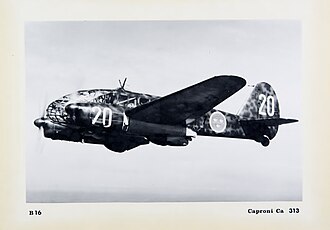
This article explores the origins, engineering, performance, operational history, variants, and legacy of the Caproni Ca.313, explaining why the aircraft was developed, how it differed from its predecessors, and what its specifications reveal about the practical demands placed on a multirole aircraft during the Second World War. It also examines the distinction between the Ca.313 and closely related models, particularly the Ca.311 and Ca.314, since understanding this family of aircraft is essential to appreciating the Ca.313’s place within Italian aviation.
1. Introduction to the Caproni Ca.313
The Caproni Ca.313 was a low-wing, twin-engine monoplane designed to perform reconnaissance missions and light bombing duties, with its precise equipment and configuration varying according to production batch and national operator. Its development reflected an important trend in interwar military aviation: the growing preference for aircraft that could perform several related missions rather than being designed exclusively for one narrow purpose. Military planners needed aircraft capable of surveying enemy positions, photographing strategic locations, observing battlefield movements, communicating information to ground forces, and carrying modest bomb loads when required. A twin-engine design offered practical advantages for such work, including the ability to accommodate a crew of several specialists, install defensive armament, carry mission equipment, and provide a measure of redundancy compared with a single-engine aircraft. The Ca.313 was not a heavy bomber or a frontline fighter, and its design should be understood in that context. It was intended to provide a flexible combination of speed, endurance, observation capability, and limited offensive power, allowing air forces to perform numerous supporting tasks without committing larger and more expensive aircraft to every mission. Its importance therefore lies not in any single spectacular achievement, but in the way it embodied the practical priorities of military aviation during a period of rapid technological and strategic change.
The Ca.313’s performance figures make it a particularly interesting subject for comparison with contemporary reconnaissance aircraft. A maximum speed in the region of 430 km/h was respectable for a light twin-engine aircraft of its generation, although speed alone could not determine operational effectiveness. Reconnaissance missions also depended on visibility, navigation, radio reliability, photographic equipment, fuel capacity, and the ability to return safely after encountering enemy fighters or ground-based anti-aircraft fire. The Ca.313’s value consequently depended on the complete operational system surrounding the aircraft, not simply the numbers recorded in its technical specifications.
2. Historical Background and the Origins of the Ca.313
The Caproni company and Italian aviation
The history of the Ca.313 cannot be separated from the broader development of the Caproni aircraft company, one of the most important Italian aviation manufacturers of the early twentieth century. Founded by Gianni Caproni, the company had gained experience with a wide range of aircraft before the Second World War, including experimental machines, large bombers, civil aircraft, and military types. During the interwar period, Italian aviation companies operated in an environment shaped by government procurement, export competition, industrial modernization, and the desire to establish Italy as a major air power. Aircraft manufacturers were expected to produce designs that could satisfy domestic military requirements while also attracting foreign customers, whose demands sometimes differed considerably from those of the Italian armed forces. Caproni responded by developing families of related aircraft that could be modified with different engines, armament arrangements, and mission equipment, allowing the company to make use of existing engineering experience rather than beginning every project from scratch. This approach was especially relevant to light reconnaissance aircraft, where manufacturers needed to balance production costs with the ability to accommodate new equipment and improve performance as engine technology advanced. The Ca.313 emerged from this environment of incremental development, demonstrating both the practical advantages of building upon an established design and the limitations that could arise when a fundamentally familiar airframe was adapted to meet increasingly demanding military expectations.
The development of the Ca.309, Ca.310, and Ca.311
The Ca.313 belonged to a closely related family of Caproni aircraft whose development stretched back to the mid-1930s. One of its early ancestors was the Ca.308 Borea, a light transport aircraft that first flew in 1935. Caproni subsequently developed the Ca.309 Ghibli for colonial and general-purpose duties, followed by the Ca.310, which introduced a retractable landing gear and twin Piaggio radial engines. These aircraft provided the manufacturer with experience in designing relatively compact twin-engine monoplanes that could be adapted to military work. However, the Ca.310 did not fully satisfy its performance expectations, prompting further experimentation with alternative powerplants and improvements to the basic design. The Ca.312, developed for Norwegian requirements, used more powerful Piaggio radial engines, while the Ca.311 incorporated a revised nose and became an important reconnaissance-bomber and observation aircraft for the Italian air force. The Ca.313 followed this pattern of evolutionary improvement, retaining the general layout of the earlier aircraft while adopting inverted V-12 engines from Isotta-Fraschini. Rather than representing an entirely new aircraft designed from a blank sheet, it was a further refinement of an established family, intended to improve performance while preserving as much of the existing design concept as practical.
This lineage matters because it helps explain both the Ca.313’s strengths and its limitations. Reusing a proven general layout could reduce development time, simplify aspects of manufacturing, and allow an aircraft manufacturer to introduce a new version more quickly than an entirely new design. At the same time, an airframe originally conceived around earlier engines and requirements could impose restrictions on later improvements, especially when additional equipment, stronger armament, or greater take-off weights became necessary. The Ca.313 was therefore part of a continuing process of refinement rather than a radical departure from earlier Caproni practice. Its development reflected the realities of military procurement in an era when air forces wanted better performance rapidly, while industrial capacity, engine availability, and the demands of an expanding war limited the time available for clean-sheet aircraft projects.
Why a new version was necessary
By the late 1930s, the pace of aviation development was accelerating. Aircraft that had appeared modern only a few years earlier were increasingly challenged by improvements in engine output, aerodynamic efficiency, weaponry, and combat tactics. A reconnaissance aircraft that could operate effectively in relatively permissive conditions might struggle once enemy air forces deployed faster fighters, better radar-directed defences, and more effective anti-aircraft weapons. At the same time, military authorities wanted reconnaissance platforms that could perform useful secondary duties, including carrying bombs against exposed targets. Caproni’s answer was to install more powerful engines in the existing aircraft family, giving the Ca.313 a more promising combination of speed and mission capability than the earlier Ca.310. The prototype, converted from a Ca.310 airframe and equipped with Isotta-Fraschini A.120 engines rated at approximately 770 horsepower each, made its first flight on 22 December 1939. Production aircraft adopted the Isotta-Fraschini Delta R.C.35 I-D.S. engine, rated at around 730 horsepower for take-off. This change was central to the Ca.313’s identity: the aircraft retained the general character of its predecessors but gained a substantially revised powerplant installation, which was intended to improve its ability to operate as a reconnaissance-bomber in a rapidly changing military environment.
3. Design and Engineering of the Caproni Ca.313
Airframe construction and materials
The Caproni Ca.313 used a mixed-construction airframe, reflecting the manufacturing methods and engineering compromises common in Italian aircraft design during the period. Its fuselage was built around a steel-tube framework covered with fabric, while the wing was constructed primarily from wood and covered with plywood. The tail surfaces combined metal structural elements with fabric and plywood covering. This arrangement differed from the predominantly all-metal construction increasingly adopted by several leading military aircraft manufacturers, but it was not unusual for the period, particularly among aircraft manufacturers working with established production techniques and available industrial resources. Each material had its advantages: steel tubing could provide a strong framework for the fuselage, wood could be shaped into efficient wing structures without requiring extensive metal-forming facilities, and fabric covering helped keep certain structural surfaces relatively light. Plywood also offered a useful means of creating smooth aerodynamic surfaces over a wooden framework. The combination made the Ca.313 a product of an engineering environment in which aircraft designers had to consider not only weight and aerodynamic performance but also production capacity, the availability of skilled labour, material supply, and the practicalities of maintaining aircraft in military service.
Mixed construction, however, also demanded careful attention to inspection and maintenance. Wooden wing structures could be affected by moisture, deterioration, and the quality of protective finishes, while fabric-covered surfaces required periodic checks for damage and loss of tension. Metal components could experience fatigue or corrosion, especially under demanding operating conditions. These were not problems unique to the Ca.313, and it would be misleading to treat its construction as inherently defective simply because it was not entirely metal. Instead, its airframe illustrates the transitional nature of aircraft engineering immediately before and during the Second World War, when different manufacturers used a variety of materials according to the requirements of the design, the experience of their workforce, and the resources available to them. The aircraft’s structural arrangement also helps explain why production quality and maintenance standards could have a substantial effect on the reliability of individual machines.
Wing configuration and aerodynamic layout
The Ca.313 featured a low-mounted wing and a conventional twin-engine monoplane configuration, with one engine installed on each wing. This layout provided a practical arrangement for reconnaissance and light bombing because it left the central fuselage available for the crew compartment, mission equipment, internal bomb storage, and other operational systems. The low-wing configuration also gave the aircraft a relatively streamlined appearance and permitted the engines to be positioned in nacelles integrated into the wings. The retractable landing gear folded into these nacelles, reducing the drag associated with a fixed undercarriage during flight. Compared with earlier aircraft featuring fixed landing gear, this was an important aerodynamic advantage, as reducing drag could improve speed and cruising efficiency without requiring a corresponding increase in engine power. The Ca.313’s overall proportions were consistent with its intended role: it needed enough wing area to carry fuel, crew, equipment, and weapons, but it also needed to maintain a sufficiently clean aerodynamic shape to achieve useful speed and altitude performance. Although the exact dimensions differ between published descriptions of particular versions, the aircraft had a wingspan of approximately 16.2–16.65 metres, placing it within the general size range expected of a compact twin-engine military aircraft of the period.
Aerodynamic efficiency was especially important for an aircraft expected to conduct reconnaissance over potentially hostile territory. A relatively high cruising speed could reduce the time spent above a target area, while a retractable undercarriage and carefully arranged engine nacelles helped reduce unnecessary drag. Nevertheless, aerodynamic performance always involved compromises. The aircraft needed sufficient wing area and structural strength to support its operational weight, and the same structure had to accommodate the loads imposed by manoeuvring, turbulence, landing, and, in some versions, bombing operations. A design intended to carry reconnaissance equipment and a useful bomb load could not be optimized solely for maximum speed. It had to remain practical for military units to operate, and its performance would vary according to fuel load, installed equipment, altitude, atmospheric conditions, and the specific production configuration.
The twin-engine arrangement
One of the Ca.313’s most important characteristics was its use of two engines. A twin-engine aircraft could provide greater total power than a comparable single-engine machine, while its separate engine installations allowed designers to distribute propulsion across the wings. For military reconnaissance, the arrangement also offered a potential safety advantage: if one engine failed, the remaining engine could, under suitable conditions and at an appropriate aircraft weight, provide enough thrust to maintain flight and possibly return to base. This was not a guarantee of safe recovery, since a twin-engine aircraft operating on one engine would suffer a substantial loss of performance and could become difficult to control if engine failure occurred at low speed or during take-off. Even so, twin-engine designs were attractive for missions in which aircraft might spend extended periods away from friendly airfields or over terrain where a forced landing would be dangerous. They also provided room for a more capable electrical and equipment installation than some smaller single-engine platforms could accommodate. The Ca.313’s two-engine layout therefore reflected a practical balance between mission requirements, available powerplants, and the need to carry a multi-person crew with reconnaissance and defensive equipment.
The choice of engines was equally important. Production Ca.313 aircraft used two Isotta-Fraschini Delta R.C.35 I-D.S. inverted V-12 engines, each rated at approximately 730 horsepower for take-off. The inverted configuration positioned the engine’s cylinders below the crankshaft, creating a relatively compact installation that could help improve the pilot’s forward visibility compared with some arrangements using larger engine profiles above the propeller axis. The engines drove three-bladed propellers, converting engine output into the thrust required for take-off, climb, cruise, and manoeuvring. As with any aircraft of this class, the performance achieved in service depended on more than nominal horsepower: engine condition, propeller efficiency, cooling, fuel quality, maintenance, and the weight of the aircraft all affected actual results. The Ca.313’s powerplant upgrade was therefore a significant development, but its practical benefits depended on the reliability of the entire propulsion system rather than the engine rating alone.
Landing gear and ground handling
The Ca.313 was fitted with a retractable tailwheel landing gear, a configuration that was widespread among military aircraft of the era. The two main wheels retracted into the engine nacelles, while the smaller tailwheel remained at the rear of the fuselage. Retracting the main wheels reduced aerodynamic drag during flight and contributed to the aircraft’s streamlined profile. On the ground, however, the tailwheel arrangement meant that the fuselage sat at an angle with the nose raised, which could limit forward visibility while taxiing and required pilots to use appropriate ground-handling techniques. The arrangement was familiar to military pilots of the period, but it still demanded care during take-off, landing, and manoeuvring on uneven airfields. The landing gear also had to support the aircraft’s weight while absorbing the impact forces associated with touchdown, particularly when operating from less-than-ideal runways. Because the Ca.313 family evolved from earlier aircraft, modifications to structural strength and permitted take-off weight became relevant to the development of later versions. The related Ca.314, for example, incorporated reinforcements to the engine mountings and undercarriage to accommodate a greater take-off weight, illustrating how changes in operational requirements could lead to substantial structural adjustments within an existing aircraft family.
4. Engines and Flight Performance
Isotta-Fraschini Delta engines
The Isotta-Fraschini Delta engine was central to the Ca.313’s development because it provided a more powerful alternative to the radial engines used in earlier members of the Caproni family. Isotta-Fraschini was an established Italian engineering manufacturer, and the Delta was an air-cooled, inverted V-12 design intended for aircraft applications. Its configuration provided the Ca.313 with a substantial increase in available power relative to the earlier Ca.310 installation. The prototype’s first flight used A.120 engines rated at approximately 770 horsepower each, while production aircraft were associated with Delta R.C.35 I-D.S. engines rated at around 730 horsepower for take-off. These figures should not be treated as interchangeable ratings for the same engine under identical conditions: the prototype and production aircraft used different engine types, and engine ratings could also vary according to operating regime and technical documentation. The production engine’s output was intended to support the aircraft’s greater speed and improved operational flexibility, while its twin-engine installation provided the thrust required for a reconnaissance-bomber carrying crew, fuel, equipment, and a limited weapons load.
The choice of an inverted V-12 also gave the Ca.313 a distinctive technical identity within the broader family of Italian twin-engine aircraft. Radial engines, such as those fitted to some earlier Caproni models, had their own advantages, including a comparatively compact frontal arrangement in certain installations and established manufacturing experience. Inline and inverted V engines, on the other hand, could offer a narrower frontal profile, potentially reducing drag and improving the forward view from the cockpit when properly integrated into the airframe. Neither configuration was universally superior; the practical result depended on the complete aircraft design, including the engine nacelles, cooling arrangements, propellers, wing structure, and overall weight. For the Ca.313, the more powerful engine installation was a logical attempt to extract better performance from an existing aircraft layout. The resulting machine was faster than many earlier light reconnaissance aircraft, although it remained subject to the same fundamental compromises between speed, payload, endurance, and operational reliability that affected its contemporaries.
Maximum speed and cruising performance
Published specifications for the Ca.313 commonly place its maximum speed at approximately 430–436 km/h, or roughly 267–271 mph, with the higher figure associated with a particular R.P.B.2 specification. Such figures describe a specific performance condition rather than the speed an aircraft could maintain in every operational situation. Maximum speed was normally measured under defined conditions, including a specified altitude and aircraft configuration, and it could not be assumed to represent a sustainable cruising speed while carrying a full operational load. For a reconnaissance aircraft, cruising performance was often more relevant to everyday operations than a headline maximum speed. A useful cruising speed allowed an aircraft to reach its assigned area efficiently, spend time gathering information, and return to base while preserving fuel reserves. Published data for one Ca.313 R.P.B.2 specification gives a cruising speed of approximately 350 km/h at 3,500 metres under a stated reduced-power condition. The difference between this and maximum speed illustrates the practical distinction between a short-duration performance figure and the speed used for more economical flight.
The Ca.313’s performance should also be evaluated against the threats and mission requirements of its period. A speed of around 430 km/h could be useful for reducing exposure to enemy fighters, but it did not make the aircraft invulnerable, especially as frontline fighters became faster and more heavily armed. Reconnaissance aircraft frequently had to fly predictable routes, maintain an altitude appropriate for observation or photography, and return to airfields whose locations might be known to the enemy. Defensive machine guns could provide some protection, but they could not compensate fully for an unfavourable encounter with a capable fighter. The Ca.313 was therefore best understood as a platform whose speed supported its mission rather than as an aircraft designed to fight for air superiority. Its performance offered a practical improvement over earlier types, but survival depended on operational circumstances, crew skill, intelligence, escort availability, and the effectiveness of the wider air force.
Range, endurance, and service ceiling
Range was another important characteristic because reconnaissance and observation missions often required aircraft to operate well beyond the immediate vicinity of their airfields. The Ca.313’s reported range varies across published specifications, with figures around 1,200 kilometres appearing in data for the R.P.B.2 and higher figures appearing in some other summaries of the family. These values should be interpreted carefully because range depends on fuel capacity, engine settings, altitude, payload, weather, and the amount of fuel reserved for the return flight. An aircraft’s theoretical maximum range is not the same as its practical mission radius, which must account for outbound travel, time over the target, changes in weather, navigation uncertainty, and a safe reserve. The Ca.313 had two 520-litre fuel tanks in the centre section of its wings, with provision for additional fuel tanks in the fuselage. This arrangement gave designers some flexibility in configuring the aircraft for different missions, although extra fuel would increase weight and could affect take-off performance and payload.
The service ceiling, or the highest altitude at which an aircraft could sustain a specified minimum rate of climb, is also reported differently depending on the specification being referenced. One set of data for the Ca.313 R.P.B.2 gives a service ceiling of approximately 7,300 metres, while other summaries of the type report higher figures. Such discrepancies can arise from differences between variants, engine ratings, test conditions, and secondary reference works. For historical accuracy, the most useful approach is to identify the particular version being discussed rather than combining every published figure into a single supposedly definitive specification. Altitude capability mattered because operating higher could help an aircraft avoid some ground-based threats and improve the geometry of certain reconnaissance missions, but flying at greater altitude could also affect engine output, visibility, navigation, and crew workload. As with speed and range, the Ca.313’s practical value depended on the mission profile rather than one isolated specification.
5. Crew Arrangement, Cockpit, and Mission Equipment
A three-person crew
The Ca.313 was generally operated by a crew of three, consisting of a pilot, a second crew member who also served as observer and bomb-aimer, and a radio operator. This arrangement reflected the aircraft’s intended multirole duties. The pilot concentrated on flying and navigation, while the second crew member could assist with observation, identify targets, and perform bomb-aiming tasks when the aircraft was assigned an offensive mission. The radio operator managed communications and could also operate the ventral defensive weapon. Depending on the aircraft’s configuration, the second crew member was associated with a forward observation or bomb-aiming station and responsibility for the dorsal gun position. Although the exact layout varied between versions, the broad division of labour allowed the aircraft to combine flight operations, observation, communication, and defensive tasks without requiring the pilot to perform every function alone. This was particularly important during reconnaissance sorties, when the aircraft might have to navigate accurately, maintain a suitable flight path, identify landmarks, communicate observations, and respond to changing conditions while under pressure.
The crew arrangement also highlights the difference between reconnaissance and fighter operations. A fighter pilot usually needed to concentrate on rapidly changing tactical situations, while a reconnaissance crew had to manage a more complex combination of navigation, observation, information recording, communications, and sometimes photographic equipment. The presence of a second crew member allowed responsibilities to be shared, improving the possibility of gathering useful information while maintaining flight discipline. The radio operator added another important function, since information collected in the air was of limited value if it could not be communicated to the relevant command structure. However, adding crew members and mission equipment also consumed space and weight, which had to be accommodated within the aircraft’s overall performance limits. The Ca.313’s design represented a practical attempt to balance these competing demands within a relatively compact airframe.
Nose configuration and cockpit development
Two principal nose arrangements are associated with the production Ca.313. Early production aircraft, designated Ca.313 R.P.B.1, featured a glazed nose without the stepped arrangement later seen on the R.P.B.2. The subsequent R.P.B.2 used a stepped nose with a more clearly separated cockpit section. These differences were not merely cosmetic: the forward fuselage was important to the observer’s field of view, the placement of mission equipment, and the overall arrangement of the crew stations. A glazed nose could provide useful visibility for observation and bomb-aiming tasks, while a revised cockpit arrangement could alter the relationship between the pilot, observer, and surrounding airframe. The choice of configuration reflected the continuing refinement of an aircraft that had to serve several roles while meeting the preferences of different customers and military authorities. The existence of distinct nose versions also illustrates why descriptions and photographs of the Ca.313 can appear noticeably different, even when they depict aircraft belonging to the same basic model.
Radio communications and reconnaissance equipment
Radio communication was essential to the aircraft’s usefulness as a military reconnaissance platform. An observer could collect information about enemy movements, infrastructure, terrain, or battlefield conditions, but that information needed to reach commanders quickly enough to influence decisions. A functioning radio allowed the crew to report observations and maintain contact with operational control, although the effectiveness of such communication depended on equipment quality, signal conditions, procedures, and the availability of compatible ground stations. Reconnaissance could also involve visual observation and photographic work, depending on the aircraft’s mission equipment and assigned duties. These activities placed different demands on the crew: visual observation required attention to terrain and objects on the ground, while photographic reconnaissance required appropriate cameras, careful positioning, and the ability to record useful imagery without compromising the mission. It is important not to assume that every Ca.313 carried identical equipment, since different operators and variants configured their aircraft for distinct tasks. The airframe’s flexibility allowed it to be used in several roles, but the equipment fitted to an individual aircraft determined which missions it could perform effectively.
6. Armament and Combat Capabilities
Defensive machine guns
Although the Ca.313 was not designed as a fighter, defensive armament was an important feature because reconnaissance aircraft could encounter hostile fighters or ground fire while operating over contested territory. The aircraft’s defensive arrangement could include machine guns mounted in the dorsal position, a ventral position, and the wing-root area, with the exact weapons varying according to operator and version. Some Italian specifications identify three 12.7 mm Scotti–Isotta Fraschini machine guns, while Swedish aircraft used a different combination of weapons, including 8 mm machine guns in defensive positions and 13.2 mm automatic weapons in the wing roots in certain configurations. French aircraft associated with the initial export programme were also described with 7.5 mm machine guns. These differences illustrate an important point about wartime aircraft: the armament listed for a particular version should not automatically be applied to every aircraft bearing the same model designation. National procurement requirements, weapons availability, and local modification practices could produce meaningful differences between machines that were otherwise closely related.
The purpose of these weapons was principally to discourage attacks and give the crew a chance to defend the aircraft if intercepted. A dorsal gun position provided coverage against some attacks from above and behind, while a ventral position could address threats from below and behind, depending on the installation’s field of fire. Fixed forward-firing or wing-root weapons offered another means of engaging a target, although their usefulness depended on the aircraft’s configuration and tactical circumstances. The effectiveness of such armament was necessarily limited by the Ca.313’s role and performance. A reconnaissance-bomber could not be expected to match a dedicated fighter in acceleration, manoeuvrability, or the ability to engage hostile aircraft on favourable terms. Its weapons were a defensive measure rather than a substitute for fighter escort, sound intelligence, or appropriate mission planning.
Bomb capacity and light attack missions
The Ca.313 could also carry bombs, making it useful for selected light attack tasks in addition to reconnaissance. Published information for the R.P.B.2 gives a bomb capacity of up to approximately 400 kilograms in an internal bomb bay, with combinations that could include four 100 kg bombs, eight 50 kg bombs, or larger numbers of smaller bombs. Swedish aircraft could use an external rack for a 250 kg bomb, while certain Swedish variants and configurations had different reported total carrying capacities. Such figures should be interpreted as configuration-specific rather than as a universal load that every Ca.313 could carry in every circumstance. The amount of ordnance available for a mission depended on the aircraft’s version, the mounting arrangements, fuel requirements, take-off weight, and the distance to the target. A larger bomb load could reduce fuel available for a long reconnaissance sortie, while carrying additional fuel could limit the weapons carried. The aircraft therefore required a compromise between the demands of endurance, payload, and operational safety.
The Ca.313’s light bombing role made it suitable in principle for attacks on exposed installations, transport links, field positions, and other targets that did not necessarily require a heavy bomber. Its relatively high speed for its class could help it approach and depart a target area more quickly than slower aircraft, while its twin-engine configuration and crew arrangement supported missions that combined observation with an attack. Nevertheless, the aircraft’s bomb load was modest compared with that of dedicated medium and heavy bombers, and its effectiveness depended on the accuracy of target identification, bombing conditions, and the degree of enemy opposition. It is therefore more accurate to describe the Ca.313 as a reconnaissance-bomber with a limited attack capability than to portray it as a specialised bomber designed for sustained offensive operations against heavily defended targets.
The balance between reconnaissance and attack
The combination of reconnaissance equipment, defensive armament, and a modest bomb load represented a practical compromise. An aircraft capable of both observing and attacking could be useful to air forces that needed flexibility, especially when resources were limited and operational requirements changed rapidly. However, every additional function created demands on weight, internal volume, crew workload, and maintenance. Defensive weapons required mounting structures and ammunition; bomb-carrying arrangements needed release mechanisms and sufficient internal space; radio and observation equipment required their own installations. A single aircraft could perform several roles, but it could not necessarily perform all of them equally well at the same time. The Ca.313’s design should consequently be judged according to its intended mission set, not by comparing it directly with specialist aircraft whose performance was optimized for a narrower task.
7. International Orders and Export Prospects
French and British interest before Italy entered the war
One of the most striking aspects of the Ca.313’s history is the international interest it attracted before Italy’s entry into the Second World War. France placed an order for 200 aircraft on 26 September 1939, before the Ca.313 had completed its first flight. Great Britain followed with an order for 300 Ca.313s on 26 January 1940, alongside a separate order for 100 Ca.311 aircraft intended for training purposes. These orders demonstrated that foreign air forces saw potential in Caproni’s twin-engine reconnaissance-bomber concept and were prepared to consider Italian aircraft as part of their efforts to expand and modernize military aviation. At the same time, they reflected the urgent procurement environment of the period: European governments were seeking aircraft in substantial numbers as the conflict widened, and orders could be placed before a new design had completed its full programme of testing and evaluation. The prospective French and British contracts therefore provide evidence of the Ca.313’s commercial appeal, but they should not be confused with proof that the aircraft had already established a mature operational record.
The political and military situation changed dramatically in 1940. Italy entered the war in June, placing the country in direct opposition to Britain and France. As a result, the planned export programmes could not proceed as originally intended, and the bulk of the aircraft associated with those orders did not reach their intended foreign customers. A small number of Ca.313F aircraft were delivered to France before the situation made further deliveries impossible, but the anticipated large-scale export service in Western Europe never materialized. Aircraft produced or allocated for these contracts were instead redirected into other channels, including Italian military use. This reversal illustrates how quickly political developments could transform an aircraft programme: a design initially intended to serve multiple national air forces became predominantly associated with the military requirements of the country that manufactured it. It also demonstrates the risks inherent in international aircraft procurement during wartime, when industrial output, diplomacy, shipping, and the strategic position of the supplier could change almost overnight.
The Swedish procurement programme
Sweden became one of the most important foreign operators of the Ca.313. In August 1940, the Swedish Air Force ordered 84 aircraft, which were delivered in batches. The Swedish procurement programme drew on aircraft that had originally been associated with the French order but were no longer deliverable to France under the changed wartime circumstances. Sweden was pursuing its own military modernization while seeking to maintain national security in a Europe dominated by expanding conflict. Acquiring a twin-engine aircraft that could undertake reconnaissance, bombing, and other supporting missions offered a way to strengthen several aspects of its air arm with a single general family of aircraft. Swedish examples were adapted to local requirements, including differences in armament and operational configuration, and were given designations corresponding to their assigned functions. Their service illustrates how an aircraft designed in one country could acquire a different operational identity when adopted by another air force, particularly when national doctrine and mission requirements shaped the way the aircraft was equipped and used.
The Swedish connection is particularly important when considering the Ca.313’s historical legacy. The aircraft is not remembered solely through Italian wartime service; it also became part of Sweden’s military aviation history and is represented in the country’s aviation heritage. Swedish aircraft were associated with bomber, reconnaissance, and other specialised designations, reflecting the range of roles envisaged for the type. Some Swedish variants were intended for torpedo operations, but those aircraft did not ultimately establish the intended torpedo-bomber capability and were converted to reconnaissance use. Other versions were configured for bombing or photographic reconnaissance. This variety demonstrates the adaptability of the underlying design, while also showing that not every proposed role translated successfully into routine operational service. The Swedish experience is therefore an important part of any comprehensive account of the Ca.313, particularly because it extends the aircraft’s story beyond the circumstances of Italy’s wartime air force.
Norway and the wider Caproni family
Norway’s connection to the Ca.313 requires a distinction between the aircraft itself and its closely related predecessor, the Ca.312. Norwegian procurement efforts were associated with the Ca.312, which used more powerful Piaggio radial engines than the earlier Ca.310. The Ca.312 was accepted as a replacement for the remaining Ca.310 aircraft ordered by Norway, although only four Ca.310s had been delivered. Additional Ca.312 aircraft were ordered by Belgium for service in the Belgian Congo, but the collapse of Belgium in 1940 prevented the planned deliveries from proceeding as intended. These details are relevant because accounts of the Caproni family can sometimes blur the distinctions between related aircraft, particularly when several models were being developed and offered to foreign customers at the same time. The Ca.312, Ca.313, and Ca.314 shared aspects of their design lineage, but they were not interchangeable designations for a single aircraft. Separating their procurement histories helps prevent the Ca.313 from being credited with orders or service experiences that belonged to other members of the family.
8. Operational Service During the Second World War
Service with the Italian air force
The Ca.313 entered an operational environment in which the demands placed on reconnaissance aircraft were increasing rapidly. The Italian air force, known as the Regia Aeronautica, needed aircraft that could provide battlefield observation, gather information on enemy movements, support ground operations, and carry out selected bombing missions. The Ca.313’s improved engine installation offered a more capable platform than earlier members of the family, and its multirole design made it useful for tasks that did not necessarily justify the deployment of a heavier bomber. Its operational significance was also connected to the broader Italian effort to expand and adapt its aircraft fleet during the war. The Ca.313 was one of several aircraft types that helped fill the space between small liaison or observation machines and larger dedicated bombers. However, its service took place under the increasingly difficult conditions of a major industrial and military conflict, where aircraft availability depended not just on design quality but also on spare parts, maintenance personnel, fuel, trained crews, and the capacity to replace losses.
Reconnaissance work was essential to the functioning of military operations because commanders needed information about enemy positions, transport routes, airfields, defensive installations, and changes on the battlefield. The Ca.313 could support these activities by carrying a multi-person crew, communication equipment, and the equipment appropriate to its assigned mission. It could also carry bombs when required, allowing it to attack suitable targets without requiring a separate specialist aircraft for every task. Nevertheless, the effectiveness of such missions depended on the broader circumstances of the war. An aircraft could only gather useful information if it reached the relevant area, obtained observations of sufficient quality, communicated them accurately, and returned in a condition that allowed the information to be used. These demands made reconnaissance a complex operational discipline rather than simply a matter of flying over enemy territory. The Ca.313’s design was intended to support that discipline, but the aircraft remained vulnerable to enemy fighters, ground fire, and the mechanical difficulties that affected all wartime aviation.
Changing battlefield conditions
As the war progressed, military aviation became more demanding. Fighter aircraft grew faster and more heavily armed, air-defence systems became more effective, and operational planning increasingly depended on coordinated information from several sources. A reconnaissance aircraft’s speed and armament could improve its chances of completing a mission, but neither guaranteed survival when confronted by a superior opponent. Its crew also needed to consider the distance to the target, the location of friendly airfields, weather conditions, fuel reserves, and the likelihood of encountering hostile aircraft. In this context, the Ca.313 occupied a difficult position between versatility and specialization. It was more capable than some lighter observation aircraft, yet it was not a dedicated high-performance fighter or a heavily protected bomber. Its strengths were most relevant when its mission profile matched the aircraft’s capabilities and the surrounding tactical environment allowed it to use them effectively.
The aircraft’s evolution into related versions also reflects the pressures of wartime operations. As military authorities sought greater payload and stronger structural margins, the Ca.313 family developed into the Ca.314, which incorporated reinforcements to the engine mountings and landing gear to support a greater take-off weight. At the time of the Italian armistice in September 1943, the Italian Air Force’s inventory included approximately 80 Ca.313s and around 200 Ca.314s, according to the Italian Air Force’s historical summary. These figures are useful for understanding the scale of the wider family, but they should not be interpreted as a precise production total for the Ca.313 alone. The distinction is essential: the Ca.314 was a related development rather than simply another name for the Ca.313, and its structural changes reflected the increasing demands placed on the basic design.
Operational strengths and limitations
The Ca.313 offered several practical strengths. Its twin-engine configuration provided substantial power for a light reconnaissance-bomber, its retractable undercarriage helped reduce drag, and its three-person crew could divide the responsibilities of flying, observation, communications, and defensive operation. Its bomb bay allowed it to carry a modest offensive load, and its different nose arrangements demonstrated that the design could be adapted as requirements changed. These characteristics made it a useful example of the flexible aircraft philosophy adopted by several air forces during the late 1930s and early 1940s. Rather than developing an entirely separate platform for every task, a manufacturer could adapt a related aircraft family to perform reconnaissance, observation, bombing, or other supporting duties.
The limitations were equally significant. The Ca.313’s mixed-material construction required appropriate maintenance, its defensive armament could not turn it into a fighter, and its practical payload had to be balanced against fuel and endurance requirements. Like other aircraft of its generation, it operated in a technological environment that was changing faster than many existing designs could be improved. The fact that the Ca.313 was developed from an earlier aircraft family enabled relatively rapid progress, but it also meant that its basic airframe inherited certain constraints. Furthermore, the aircraft’s service record cannot be evaluated solely through its maximum speed or nominal bomb load. Reliability, availability, production quality, crew training, and the strategic circumstances in which it operated all influenced its usefulness. Its history is best understood as that of a capable but specialised supporting aircraft rather than a machine that fundamentally transformed the course of aerial warfare.
9. Variants of the Caproni Ca.313
The Ca.313 was produced in several configurations, and its relationship with the wider Caproni family can make the designation system confusing. The most useful way to understand the variants is to distinguish changes to the Ca.313 itself from related aircraft that shared much of its underlying design. Differences in nose shape, armament, structural strength, engine installation, and mission equipment reflected the requirements of individual customers and the Italian military. Some designations identified production configurations, while others were associated with different roles or subsequent developments. The following sections outline the most important distinctions.
Caproni Ca.313 prototype
The prototype was converted from a Ca.310 airframe and fitted with two Isotta-Fraschini A.120 I.R.C.C.40 engines rated at approximately 770 horsepower each. It first flew on 22 December 1939, marking the beginning of the Ca.313’s flight-test programme. Its purpose was to demonstrate the benefits of replacing the earlier radial engines with more powerful inverted V-12 units while retaining the established general airframe layout. Prototype performance and equipment should be distinguished from those of production aircraft, which used the Delta R.C.35 I-D.S. engines and incorporated the changes required for series manufacture and military service. The prototype therefore represents the developmental stage of the programme rather than a precise specification for every Ca.313 that followed.
Caproni Ca.313 R.P.B.1
The R.P.B.1 was an early production configuration associated with a glazed, unstepped nose. This arrangement provided a relatively continuous forward glazing profile, suitable for the aircraft’s observation and bomb-aiming duties. Aircraft from the initial production programme were connected with export orders placed by France and Britain before Italy entered the war. The political situation prevented those contracts from being fulfilled as originally planned, and the aircraft’s subsequent allocation reflected the changed military circumstances. The R.P.B.1 is particularly useful for understanding the early development of the production aircraft, as its nose arrangement distinguished it visually from later examples.
Caproni Ca.313 R.P.B.2
The R.P.B.2 introduced a stepped nose and a more clearly separated cockpit arrangement. It is also the version most often associated with the published specification figures used in modern summaries of the aircraft, including a maximum speed of approximately 436 km/h, a crew of three, and a bomb load of up to 400 kg. Its overall dimensions are commonly listed as 11.80 metres in length, 16.65 metres in wingspan, and 3.70 metres in height, although figures vary across references and should be tied to the source and specific version being described. The R.P.B.2 illustrates how the Ca.313’s basic design was refined to meet production and operational needs without changing its fundamental identity as a twin-engine reconnaissance-bomber.
Caproni Ca.313S and Swedish mission variants
Swedish Ca.313 aircraft were adapted to the requirements of the Swedish Air Force and were associated with several role-specific designations. The broader Swedish family included bomber aircraft designated B 16A, reconnaissance aircraft designated S 16A, and aircraft originally intended for torpedo duties under the T 16A designation. The torpedo aircraft did not establish the intended operational role and were converted to reconnaissance duties, with converted examples associated with the S 16B designation. Transport-related designations are also associated with the wider Swedish family. These variants demonstrate the flexibility envisaged for the airframe, but they should not be treated as identical in equipment or operational capability. A Swedish reconnaissance aircraft, for example, could have different armament and mission equipment from an Italian aircraft configured for light bombing.
The Caproni Ca.314: a related development
The Ca.314 is important to the Ca.313 story because it developed from the same general design lineage but incorporated structural changes to accommodate a greater take-off weight. The Italian Air Force describes the Ca.313 R.A., intended for armed reconnaissance, as the basis for the Ca.314 development, which included reinforcements to the engine mounts and landing gear. Although the two aircraft were closely related, the Ca.314 should not be treated as a mere alternative name for the Ca.313. Its modifications reflect the process by which an existing airframe family was adapted to evolving military demands. This distinction also matters when discussing inventory figures, performance, and service history, because information about the entire family does not necessarily apply to the Ca.313 alone.
10. Production, Manufacturing, and Wartime Industry
The production history of the Ca.313 reflects the difficulty of manufacturing military aircraft during a period of rapid expansion and international conflict. Aircraft production required more than an assembly line: manufacturers needed reliable supplies of engines, structural materials, instruments, weapons, radios, tyres, and other specialised components. Each item had to be compatible with the aircraft’s design, and the completed machines had to be inspected, tested, delivered, and supported by maintenance infrastructure. When several aircraft types were in production at the same time, industrial planners also had to balance competing demands for skilled labour, factory space, and components. The Caproni group’s experience with a family of related aircraft offered advantages because it allowed some engineering knowledge and production practices to be carried from one model to another. However, the Ca.313’s reliance on its specific engine installation and mixed-material airframe meant that the availability of suitable components and the consistency of manufacturing remained important to the aircraft’s practical success.
The export orders originally placed by France and Britain added another layer of complexity. In peacetime, large foreign contracts could help a manufacturer maintain production volumes, expand industrial capacity, and establish an aircraft’s reputation in international markets. Under wartime conditions, however, the same contracts could be disrupted by political developments, transport difficulties, changing military priorities, and the loss of access to overseas customers. Italy’s entry into the war made the planned French and British programmes impossible to complete as intended, redirecting the aircraft’s history toward Italian and Swedish service. This change demonstrates how procurement plans and operational outcomes could diverge sharply during the Second World War. The aircraft’s design did not exist in isolation from international politics: the destinations of individual airframes, the configuration of equipment, and the countries that eventually operated the type were all influenced by events beyond the factory.
Production numbers should be approached with similar care. Figures reported for the Ca.313 vary between reference works, and totals can differ according to whether a source counts prototypes, specific production versions, export aircraft, or related variants. The Ca.314 must be kept separate when calculating Ca.313 totals, and Swedish subdesignations should not automatically be counted as additional aircraft types. Without a clearly defined accounting method, combining figures from several summaries can create an apparently precise total that conceals important differences in what is being counted. For historical writing, it is preferable to identify the scope of a production figure and acknowledge uncertainty where reliable sources disagree, rather than presenting one number as definitive without qualification.
11. The Ca.313 Compared with Contemporary Aircraft
The Ca.313 belonged to a broad category of twin-engine aircraft that combined reconnaissance with light bombing and other supporting missions. Aircraft in this category were expected to provide useful speed and range, carry mission equipment, and deliver a modest payload without the expense and complexity of a larger bomber. Comparing the Ca.313 with other aircraft therefore requires attention to role, rather than simply placing maximum-speed figures next to one another. A dedicated bomber might carry a larger load but operate at a lower speed, while a specialised reconnaissance aircraft might sacrifice some offensive capability to improve endurance, altitude performance, or photographic equipment. The Ca.313’s particular combination of features reflected the Italian military’s needs and Caproni’s decision to develop an existing design family.
Comparison with the Caproni Ca.310
The Ca.310 was an important predecessor of the Ca.313 and provided the basic airframe from which the later design evolved. It used Piaggio radial engines, whereas the Ca.313 adopted inverted V-12 engines from Isotta-Fraschini. This change represented a major attempt to improve performance without abandoning the existing general configuration. The earlier Ca.310’s disappointing performance against expectations was one reason for the continued development of the family, and the Ca.313’s new powerplant was intended to address that limitation. The comparison highlights a common pattern in aviation engineering: a manufacturer could preserve a useful airframe layout while introducing a different engine and associated changes to obtain better results. It also explains why the Ca.313’s development history is closely linked to that of the Ca.310, even though the two aircraft differed in important technical respects.
Comparison with the Caproni Ca.311
The Ca.311 was another direct relative and an important reconnaissance-bomber in Italian service. It had a revised nose compared with the Ca.310 and became a foundation for further development within the family. The Ca.313 retained the broader design concept but introduced more powerful inverted V-12 engines, aiming to improve performance. This distinction is important because the Ca.311 and Ca.313 shared a recognisable lineage while representing different stages in the family’s evolution. The Ca.311 also appeared in the British procurement plans as an aircraft intended for training duties, alongside the proposed order for Ca.313s, illustrating that the related designs could be considered for different purposes within a larger procurement programme. The comparison shows how Caproni’s incremental development strategy allowed a family of aircraft to address changing needs without requiring every mission to be served by a completely unrelated design.
Comparison with dedicated reconnaissance aircraft and bombers
Compared with a dedicated reconnaissance aircraft, the Ca.313’s ability to carry bombs and defensive weapons provided additional flexibility, but this versatility came with weight and space requirements. Compared with a dedicated bomber, its bomb capacity was modest, and it was not designed to deliver the large payloads associated with heavier aircraft. Its role lay between these categories: it could gather information, communicate observations, and undertake limited offensive tasks when required. That combination made sense in an air force seeking a practical supporting aircraft, but it also meant that the Ca.313 could not match every specialist aircraft in its own field. The same principle applies to its defensive armament. Guns could improve the crew’s options in an emergency, but the aircraft was not built to establish air superiority or conduct sustained fighter operations. Understanding these distinctions helps place the Ca.313 in its proper historical context and avoids judging it against tasks it was never designed to perform.
12. The Ca.313’s Legacy and Surviving Representation
Why the aircraft is historically significant
The Caproni Ca.313 is significant because it demonstrates how aircraft design evolved through incremental engineering changes during the late 1930s and early 1940s. It was neither an entirely new design nor merely a cosmetic modification of its predecessor. Instead, it combined an established airframe concept with more powerful engines, updated cockpit arrangements, retractable landing gear, defensive weapons, and the capacity to carry bombs. Its development reflects the pressures faced by manufacturers that had to produce aircraft quickly while meeting changing operational requirements. The international procurement story adds another dimension, showing how the aircraft’s intended export market was transformed by the outbreak and expansion of the war. Its Swedish service further demonstrates how a design developed in Italy could be adapted to another country’s needs, acquiring a distinct operational history through changes in equipment and mission assignment. These features make the Ca.313 a valuable subject for understanding the practical realities of military aviation rather than simply compiling a list of aircraft specifications.
The aircraft also illustrates the limits of multirole design. A single platform could provide several useful capabilities, but every capability had to fit within the same structural, aerodynamic, and operational constraints. Adding fuel increased endurance but also increased weight; adding defensive weapons consumed space and required ammunition; carrying bombs affected the payload available for other equipment. A more powerful engine could improve speed and climb, but the overall benefit depended on the airframe, cooling, propeller efficiency, and reliability. The Ca.313’s evolution and its relationship to the Ca.314 show that designers continued to adjust the family in response to these constraints. Its story therefore offers a practical example of the compromises involved in designing an aircraft intended to perform several related military roles.
The replica at the Flygvapenmuseum
No original, complete Caproni Ca.313 airframe is known to survive today. However, a full-size replica constructed in Sweden for a television miniseries, incorporating some original parts, was placed on display at the Flygvapenmuseum in Linköping. This replica provides a physical representation of an aircraft that would otherwise be known primarily through historical photographs, technical documents, and written accounts. It is important to distinguish the replica from an original surviving aircraft: it helps communicate the Ca.313’s size, shape, and general appearance, but it is not an intact wartime airframe preserved in its original operational condition. Its existence nevertheless demonstrates the continuing interest in the type and the role museums can play in preserving the memory of aircraft that no longer survive as complete originals.
For aviation historians and enthusiasts, the Ca.313 remains a useful case study in design lineage, export procurement, and the changing requirements of military reconnaissance. Its story also serves as a reminder that aircraft history is not limited to the most famous fighters and bombers. Supporting aircraft could be essential to the gathering of intelligence, the coordination of military operations, and the flexible use of air power. Even when an aircraft did not become iconic, it could still reveal much about the industrial, political, and technological conditions in which it was developed.
13. Technical Specifications of the Caproni Ca.313
The following table summarises commonly published specifications for the Caproni Ca.313 R.P.B.2. These figures should be understood as a representative specification for that version, rather than as universal values for every Ca.313 variant. Some historical references give different dimensions, weights, range, and altitude performance, so the distinction between individual versions is important when using the information for technical comparisons.
| Specification | Details |
|---|---|
| Aircraft type | Twin-engine reconnaissance-bomber |
| Country of origin | Italy |
| Manufacturer | Caproni Aeronautica Bergamasca |
| First flight | 22 December 1939 |
| Crew | 3 |
| Length | 11.80 m (38 ft 9 in) |
| Wingspan | 16.65 m (54 ft 8 in) |
| Height | 3.70 m (12 ft 2 in) |
| Wing area | 38.90 m² (418.7 sq ft) |
| Empty weight | Approximately 4,300 kg (9,480 lb) |
| Maximum loaded weight | Approximately 5,900 kg (13,007 lb) |
| Powerplant | 2 × Isotta-Fraschini Delta R.C.35 I-D.S. inverted V-12 engines |
| Engine power | Approximately 730 hp (544 kW) per engine for take-off |
| Propellers | Three-bladed |
| Maximum speed | Approximately 436 km/h (271 mph) at 3,500 m |
| Cruising speed | Approximately 350 km/h (217 mph) at 3,500 m under the cited test condition |
| Range | Approximately 1,200 km (746 mi), according to one R.P.B.2 specification |
| Service ceiling | Approximately 7,300 m (23,950 ft), according to one R.P.B.2 specification |
| Bomb capacity | Up to approximately 400 kg, depending on configuration |
| Defensive armament | Up to 3 × 12.7 mm machine guns in the cited Italian configuration |
| Landing gear | Retractable main landing gear with tailwheel |
| Primary roles | Reconnaissance, observation, light bombing |
| Notable operators | Italy and Sweden; limited French deliveries |
Specification note: Published values differ among historical references, particularly for empty and loaded weight, range, service ceiling, armament, and overall dimensions. The table uses the R.P.B.2 figures where available and should not be applied automatically to the prototype, the R.P.B.1, Swedish mission variants, or the related Ca.314. The reported engine output is also a take-off rating and should not be confused with continuous cruising power.
Conclusion: The Enduring Historical Interest of the Caproni Ca.313
The Caproni Ca.313 occupies an interesting place in the history of Italian military aviation because it combined an established twin-engine airframe with a more powerful engine installation and a flexible set of mission capabilities. Developed from the Ca.310 and Ca.311 family, it was intended to perform reconnaissance, observation, and light bombing tasks at a time when air forces increasingly needed aircraft that could operate across several supporting roles. Its retractable landing gear, mixed-material construction, three-person crew, defensive armament, and bomb-carrying capacity reflected the practical demands of this mission category. The aircraft’s development was also shaped by international politics: the French and British orders demonstrated the potential of its export programme, but Italy’s entry into the war prevented those contracts from proceeding as intended, while Sweden became a significant foreign operator. The Ca.313’s relationship with the Ca.314 further illustrates how manufacturers continued to adapt existing aircraft families as payload requirements and operational demands changed.
Although the Ca.313 never became one of the most widely recognised aircraft of the Second World War, its history offers a valuable perspective on the less celebrated machines that supported military operations. Reconnaissance aircraft had to do much more than achieve an impressive maximum speed: they needed to carry trained crews and mission equipment, navigate accurately, communicate observations, manage fuel reserves, and return safely under potentially hostile conditions. The Ca.313’s technical characteristics were designed to support these tasks, while its limitations reflected the compromises inherent in multirole aircraft of the period. Today, its place in aviation history is preserved through historical documentation and the full-size replica displayed at Sweden’s Flygvapenmuseum. For enthusiasts interested in Italian aircraft design, wartime procurement, or the evolution of reconnaissance-bombers, the Caproni Ca.313 remains a compelling example of how engineering decisions, military requirements, and international events combined to shape an aircraft’s story.
