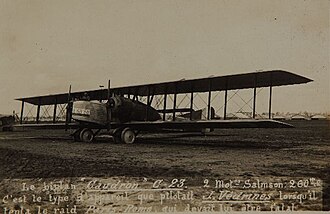
Caudron C.23: The Ambitious French Night Bomber That Found a Second Life in Civil Aviation
The Caudron C.23 and Its Place in Aviation History
The Caudron C.23 was a large French twin-engine biplane developed during the First World War to meet the growing demand for long-range night-bombing aircraft. Designed at a time when military aviation was evolving from a supporting role on the battlefield into a potential instrument of strategic warfare, the C.23 represented an ambitious attempt to carry substantial bomb loads over long distances and attack targets far behind enemy lines. Developed by the French aircraft manufacturer Caudron, the aircraft combined an expansive two-wing structure, twin Salmson engines, defensive machine-gun positions, and a fuselage designed to accommodate a three-person crew. Its first flight took place in February 1918, during the final year of the war, when France and its allies were seeking more effective ways to strike military installations, industrial facilities, transport networks, and other strategically important targets.
Although the Caudron C.23 never achieved the wartime operational significance originally intended for it, its story extends well beyond its military origins. The aircraft arrived too late to make the contribution envisioned by its designers, and its relatively modest performance for its size limited its usefulness in military service. Nevertheless, the end of the war gave the design an unexpected opportunity to demonstrate a different purpose. Several examples were adapted for passenger transportation, illustrating how large military aircraft could be repurposed during the formative years of commercial aviation. These conversions connected the C.23 with the early development of European air travel, when aircraft manufacturers and operators were experimenting with passenger capacity, international routes, and practical applications for surplus military machines. The Caudron C.23 therefore occupies an interesting position in aviation history: it was an ambitious bomber whose potential was constrained by wartime circumstances, yet its airframe also contributed to the transition from military aviation to civilian passenger transport.
Historical Background: French Aviation During the First World War
The Evolution of Military Aircraft Between 1914 and 1918
When the First World War began in 1914, military aircraft were still relatively primitive machines, generally constructed from wooden frames, fabric-covered wings, exposed mechanical components, and engines that produced only limited power by modern standards. Their initial responsibilities centered on reconnaissance, artillery observation, communication, and the monitoring of enemy movements. As the conflict expanded, however, aviation became increasingly important to military planning, and aircraft designers began developing specialized machines for fighting other aircraft, attacking ground targets, and conducting bombing missions. Improvements in engines, airframe construction, navigation, and defensive armament gradually made it possible to build aircraft capable of carrying heavier payloads and operating farther from their bases. By 1917 and 1918, several European air forces were pursuing larger multi-engine aircraft that could undertake missions beyond the immediate battlefield, reflecting a growing recognition that aviation might be used to disrupt the industrial and logistical foundations of an enemy’s war effort.
Night bombing presented a particularly demanding challenge. Aircraft operating after dark faced limited visibility, uncertain navigation, difficult weather conditions, and considerable risks during takeoff and landing. Crews had to identify targets using imperfect maps, landmarks, and basic navigation techniques, often without the sophisticated instruments and radio-navigation systems that later became standard. Larger aircraft offered certain advantages because they could carry more fuel, bombs, and defensive equipment than smaller single-engine machines, but their increased size also brought structural complexity, greater weight, and demanding engine requirements. The French military therefore had good reasons to investigate heavy night bombers, but turning the strategic ambition of long-distance bombing into a dependable operational capability required more than simply building a larger aeroplane. The Caudron C.23 emerged from this environment of rapid experimentation, when aircraft manufacturers were attempting to balance payload, range, speed, stability, and mechanical reliability under intense wartime pressure.
The Caudron Company and Its Design Philosophy
The Caudron brothers, René and Gaston Caudron, established their aviation enterprise before the First World War and became associated with the development of practical aircraft for training, reconnaissance, and other military purposes. Their company built a reputation through designs that reflected the rapid evolution of early European aviation, when relatively small manufacturers often had to respond quickly to military requirements and changing technical expectations. Like other French aircraft producers, Caudron expanded its activities during the war and explored different configurations as military authorities demanded aircraft with greater endurance, carrying capacity, and specialized equipment. The company’s experience with twin-engine designs provided a foundation for the larger aircraft that eventually led to the C.23, although increasing the dimensions and weight of an existing configuration introduced substantial engineering challenges.
The C.23 was designed by Paul Deville and belonged to a family of developments that included the Caudron C.21 and C.22. These earlier designs explored the possibilities of twin-engine biplanes, but the C.23 was substantially larger and intended to fulfill a more demanding military role. Its development illustrates an important feature of wartime aviation: manufacturers frequently pursued incremental improvements to existing designs rather than beginning every project from an entirely new technical foundation. A familiar arrangement could reduce design uncertainty and allow engineers to concentrate on increasing lifting area, installing more powerful engines, improving payload capacity, and adapting the fuselage to the needs of military crews. However, the C.23 also demonstrated the limits of this approach, because enlarging an aircraft increased its overall mass and did not automatically produce the speed, climb performance, or handling characteristics required for effective combat operations.
Design and Development of the Caudron C.23
A Large Twin-Engine Biplane
The Caudron C.23 was a conventional biplane in overall configuration, but its dimensions made it a substantial aircraft by the standards of 1918. Its upper wing had a span of approximately 24.50 metres, while the lower wing measured about 23.57 metres. The aircraft was approximately 13 metres long and 3.4 metres high, with a wing area commonly listed at around 107 square metres. The unequal wingspan was characteristic of its arrangement, and the large lifting surface helped support the considerable weight of the fuselage, engines, crew, fuel, defensive armament, and intended bomb load. The wings were fabric-covered structures built around wooden framework, reflecting the materials and manufacturing methods widely used in aircraft construction during the First World War. Multiple bays of interplane struts and bracing wires connected the upper and lower wings, producing the structural rigidity needed to withstand aerodynamic forces during flight.
The biplane configuration offered an effective way to achieve substantial lifting area without creating an excessively long single wing, which would have presented different structural difficulties using contemporary materials. At the same time, the numerous struts, wires, and wing surfaces created aerodynamic drag, limiting the speed achievable with the available engines. The C.23’s broad wings were therefore both an advantage and a compromise: they made a large payload-carrying aircraft possible, but they also contributed to a design that prioritized carrying capacity and endurance over high speed. Its long, relatively flat-sided fuselage housed the crew positions and essential equipment, while a conventional tail assembly provided directional and longitudinal stability. The aircraft’s fixed landing gear used paired main wheels supported by a framework beneath the wing and engine areas, together with a tailskid. This arrangement was typical of heavy aircraft of the period, when retractable landing gear would have added weight and mechanical complexity without offering sufficient practical benefit for a slow, large biplane.
Twin Salmson Engines and Propulsion
Power was supplied by two Salmson 9Z nine-cylinder water-cooled radial engines, each generally rated at approximately 260 horsepower. These engines were mounted above the lower wing, positioned between the wings on dedicated supporting structures. Their placement helped distribute the weight of the powerplants across the airframe and allowed the aircraft to use two separate engines rather than depending on a single powerplant. Twin-engine propulsion was especially attractive for a bomber intended to fly long distances while carrying substantial loads, since two engines could collectively provide more power than the smaller engines commonly used on reconnaissance aircraft. The arrangement also introduced additional mechanical systems, fuel requirements, maintenance demands, and aerodynamic resistance, making the performance of each engine particularly important to the success of the overall design.
Despite the combined output of approximately 520 horsepower, the C.23 was not especially fast for an aircraft of its size and intended mission. Its large wings, heavy construction, extensive bracing, and operational payload all contributed to the challenge of achieving strong performance. Historical accounts describe the aircraft as underpowered in service, a criticism that helps explain why the French military did not continue to rely on it once more suitable alternatives became available. Designers considered more powerful engine arrangements, including higher-output Salmson engines and Hispano-Suiza powerplants, but these investigations did not transform the standard production aircraft into the high-performance bomber originally desired. The C.23 consequently illustrates a recurring engineering problem in early aviation: an aircraft could be structurally capable of carrying a large load, yet still struggle to perform effectively if its engines could not provide enough power for the complete operating weight.
Crew Accommodation and Defensive Armament
The military Caudron C.23 was designed around a crew of three, despite its association with a French night-bomber category whose designation could imply a different crew arrangement. The pilot occupied an open cockpit beneath the forward part of the upper wing, while defensive gun positions were arranged toward the nose and farther aft. The forward position carried twin Lewis machine guns, giving the aircraft a means of defending itself against attacks from certain directions. The rear gunner’s position included another pair of Lewis guns and an additional weapon that could fire downward through an opening in the fuselage floor. This combination reflected the vulnerability of large bombers, which could be attacked by enemy fighters during their approach to a target or on the return journey. Defensive armament was intended to discourage such attacks and give the crew some ability to respond, although machine guns alone could not eliminate the risks faced by slow bombers operating in hostile airspace.
The placement of the crew and armament also reveals the compromises inherent in early military aircraft design. The pilot needed a useful forward view and access to the essential controls, while the gunners required fields of fire that covered different approach angles. Open cockpits and exposed gun positions made it easier to install weapons and observe the surrounding sky, but they left personnel vulnerable to cold, wind, precipitation, and the physical effects of prolonged flight. Night operations introduced further complications because identifying enemy aircraft in darkness was difficult and coordinating defensive action depended heavily on crew experience and visibility. Although the C.23 carried a substantial defensive arrangement for its period, the weight of its armament and crew added to the total burden that its engines had to lift. Its design therefore embodied the familiar tension between protection, payload, endurance, and performance that shaped the development of bomber aircraft throughout the early twentieth century.
The Caudron C.23 as a First World War Night Bomber
Strategic Ambitions and the Proposed Berlin Mission
The Caudron C.23 was developed to meet the French military’s demand for a long-range night bomber capable of carrying a significant bomb load against targets deep inside enemy territory. Its intended mission was more ambitious than simply attacking trenches or artillery positions near the front line. Strategic targets such as railway junctions, industrial facilities, supply depots, and military infrastructure could affect the enemy’s ability to maintain its war effort, and the possibility of striking locations far from the front encouraged designers to develop larger aircraft with greater fuel capacity. The C.23’s design objective was associated with the ambition of reaching Berlin, a target that symbolized the increasing strategic reach imagined for military aviation. Such an undertaking would have demanded sufficient fuel, a substantial payload, reliable engines, effective navigation, and the ability to operate in darkness while crossing defended territory.
The aircraft’s published bomb-load figure is generally given as approximately 600 kilograms, although historical descriptions of the wider development programme and projected variants sometimes mention different payload requirements. These distinctions matter because the specifications for an operational aircraft should not be confused with the ambitions attached to a design proposal or a more advanced engine configuration. A long-distance bombing mission involved trade-offs between fuel and weapons: carrying more fuel could extend range but increase takeoff weight, while a heavier bomb load could reduce endurance or climb performance. The C.23 was intended to balance these competing requirements, but its relatively modest speed and power limited the practical advantages of its large size. The strategic concept behind the aircraft was significant, even if the production design did not fully realize the potential suggested by the mission it was created to undertake.
Operational Service and the End of the War
The first flight of the Caudron C.23 took place in February 1918, leaving only a limited period for development, production, evaluation, and potential operational deployment before the Armistice of November 1918. Approximately 54 aircraft had been delivered to the French military by the end of the conflict, according to commonly cited histories. Although this represented a meaningful production effort for a large aircraft of the period, the C.23 arrived too late to play the intended role in the wartime bombing campaign. The available evidence does not establish a record of successful combat bombing missions by the type during the First World War, and its significance should not be exaggerated by assuming that planned operations necessarily took place. The end of hostilities changed the military value of the aircraft almost immediately, leaving France with large biplanes that had been designed for a conflict that was already over.
The C.23’s experience was not unusual among late-war aircraft programmes. Technological development often accelerated so quickly during the conflict that an aircraft could be obsolete, inadequate, or no longer strategically necessary by the time production reached meaningful numbers. The long development cycle of a large bomber was particularly vulnerable to delays involving engines, structural testing, manufacturing capacity, and military priorities. Even a design that looked promising on paper could lose its relevance if competing aircraft offered better climbing performance, greater reliability, or a more favorable combination of speed and payload. For the Caudron C.23, the Armistice removed the immediate justification for a long-range bomber programme while leaving the practical problem of deciding what to do with the completed machines. Its postwar story emerged directly from this change in circumstances.
Performance and Flight Characteristics
Speed, Endurance, and Operating Ceiling
The Caudron C.23’s published maximum speed was approximately 143 kilometres per hour at sea level, equivalent to about 89 miles per hour. That figure was reasonable for many aircraft of its era, but it did not make the C.23 a fast aircraft when measured against the requirements of a heavy bomber expected to operate over long distances. Its endurance is commonly listed at approximately 6.75 hours in one widely reproduced specification set, although other historical references give shorter endurance figures and different range estimates. Such differences can arise from the use of different test conditions, fuel assumptions, loading configurations, or source material, and they should not be treated as proof that every aircraft could achieve the same performance in ordinary operations. A large aircraft carrying bombs, defensive weapons, crew, and a substantial fuel load would have operated under conditions quite different from those of a lightly loaded test machine.
The aircraft’s service ceiling is also reported differently in secondary sources, with figures of approximately 3,500 metres and 4,500 metres appearing in published specifications. The lower figure is associated with one commonly reproduced technical summary, while other historical aircraft references report a higher ceiling. For readers comparing historical aircraft, this discrepancy demonstrates the importance of identifying the source and variant behind each technical figure rather than combining every published number into a single supposedly definitive specification. Regardless of the exact ceiling achieved under a particular test condition, the C.23’s overall performance was constrained by its weight and available engine power. Its maximum speed, climb performance, and handling characteristics did not provide the operational advantage needed to make it a leading long-range bomber, especially as the military began evaluating more capable postwar aircraft.
Strengths and Limitations of the Design
The Caudron C.23 had several practical strengths, particularly its large lifting surface, twin-engine arrangement, substantial internal volume, and potential to carry useful payloads over extended flights. These features made it a credible candidate for the heavy night-bomber role that French planners had in mind. Its configuration also gave engineers a platform that could be modified for other purposes after the war, as the passenger conversions later demonstrated. However, these advantages were offset by the disadvantages of a large biplane powered by engines that provided insufficient performance for its overall mass. The extensive bracing and fabric-covered wings created drag, the aircraft required considerable structural support, and the two-engine arrangement did not automatically guarantee satisfactory performance if both powerplants were insufficient for the intended load.
The C.23 is therefore best understood as a transitional design rather than a complete technical failure or a decisive breakthrough. It reflected the rapid expansion of aviation’s ambitions during the First World War, when aircraft designers attempted to move beyond short-range reconnaissance and light bombing toward longer and more demanding missions. Its weaknesses became more apparent as the requirements for effective heavy bombers became clearer and alternatives with improved performance emerged. The fact that it was subsequently adapted for civil use does not erase its military shortcomings; instead, it demonstrates that an aircraft’s usefulness can change significantly when its operating purpose changes. A design that was disappointing as a combat bomber could still offer value as a passenger carrier, where speed, defensive armament, and bomb capacity were no longer the principal requirements.
Postwar Transformation: From Bomber to Passenger Aircraft
The Emergence of Civil Aviation After 1918
The end of the First World War created a new environment for aviation. European countries possessed experienced pilots, trained mechanics, established aircraft factories, and large numbers of military machines that were no longer required in their original roles. At the same time, businesses, governments, and private operators began exploring the possibilities of using aircraft for passenger travel, mail delivery, and commercial transportation. The development of civil aviation was not simply a matter of repainting military aircraft and immediately placing them into service. Passenger operations demanded changes in seating arrangements, baggage accommodation, access to the aircraft, maintenance practices, and expectations concerning comfort and safety. Nevertheless, converting surplus military aircraft was often more practical than designing an entirely new commercial aeroplane from the beginning, particularly during the uncertain economic conditions that followed the war.
The Caudron C.23 was well suited to experimentation of this kind because its large fuselage and lifting surfaces offered space and capacity that smaller military aircraft could not provide. With its original military purpose no longer relevant, some examples were modified to transport passengers in place of bombs and military equipment. The conversion process illustrated how the same basic airframe could support very different missions depending on how its interior and equipment were arranged. Military crews and weapons gave way to civilian passengers, while the aircraft’s large size became an advantage rather than simply a burden. This transition was part of a broader movement in which the technologies and industrial capabilities developed during wartime helped establish the foundations of commercial aviation across Europe.
The Twelve-Passenger Conversion
Some postwar Caudron C.23 aircraft were modified to carry as many as twelve passengers. These early passenger arrangements were relatively basic by modern standards, and one commonly described conversion used an open passenger space created between existing crew positions. Unlike a modern airliner, the aircraft did not provide a fully enclosed cabin with pressurization, climate control, modern restraints, or the carefully engineered evacuation systems expected today. Passengers would have experienced considerable noise, vibration, wind exposure, and changes in temperature during flight. Even so, the ability to carry several people in one aircraft represented an important step in the development of commercial aviation, especially when compared with the much smaller capacity of typical prewar aeroplanes.
The conversion also demonstrated the practical value of adapting existing aircraft instead of discarding them after military service. The C.23’s original design had emphasized carrying fuel, bombs, weapons, and military personnel, but many of the structural features needed to support those loads could also support passenger operations once the aircraft had been appropriately modified. Removing military equipment created opportunities for alternative seating and interior layouts, while the existing twin-engine configuration allowed the aircraft to continue using its established propulsion system. Such adaptations were not necessarily ideal long-term solutions, but they provided a way for operators to experiment with routes and passenger demand while the commercial aviation industry was still developing its technical and business models.
The Caudron C.23 bis and Its Enclosed Cabin
A more developed civil variant, known as the Caudron C.23 bis, was adapted to carry up to fifteen passengers inside an enclosed cabin. This version represented a more deliberate attempt to transform a wartime aircraft into a passenger-carrying machine rather than merely adding seats to a military layout. The enclosed cabin improved the basic passenger environment by offering protection from direct exposure to the elements, although it remained a product of early aviation technology and cannot be compared directly with the comfort standards of later airliners. Its greater passenger capacity also illustrates the design pressures that shaped the emerging air transport industry, where operators sought to increase the number of paying passengers carried on each flight without requiring a completely new aircraft programme.
The C.23 bis is historically interesting because it shows how the early aviation industry approached innovation through practical modification and experimentation. In the years immediately following the First World War, the boundaries between military aircraft and commercial aircraft were still flexible, and some manufacturers used their existing designs as starting points for new markets. The C.23’s transformation did not make it a particularly advanced passenger aircraft by later standards, but it helped demonstrate that large multi-engine aircraft could serve civilian purposes beyond mail delivery and specialist transport. Its story forms part of the wider development of European passenger aviation, when manufacturers and operators were learning how to turn the technical achievements of wartime aircraft production into sustainable peacetime services.
The Paris–Brussels Passenger Flight of 10 February 1919
One of the most notable events associated with the Caudron C.23’s civilian history occurred on 10 February 1919, when a converted example flew between Paris and Brussels carrying five passengers. The flight is commonly described in historical accounts as the first passenger flight between the two cities, and it is an important example of how rapidly aviation began to develop new uses after the Armistice. International air travel in 1919 remained experimental, and operating a passenger flight across national borders required more than simply having an aircraft capable of reaching the destination. Operators had to address route planning, weather, fuel, maintenance, ground arrangements, and the practical challenges of transporting people by air at a time when airports, navigation aids, and commercial aviation regulations were still developing. The flight demonstrated that aircraft originally intended for military purposes could be adapted for practical civilian journeys, even if the passenger experience remained basic.
The significance of the Paris–Brussels journey lies less in the level of comfort it offered than in the change of purpose it represented. Only a short time earlier, the C.23 had been designed to carry bombs toward enemy territory under the difficult conditions of night warfare. In its civilian form, the aircraft carried passengers between two European capitals, illustrating the speed with which the role of aviation could change after the end of hostilities. The journey also belonged to a wider movement toward regular international air services, in which aircraft gradually became more than experimental machines or military equipment. Although the C.23 was not the only aircraft involved in the early development of commercial air travel, its participation in this flight makes it a noteworthy example of the transition from wartime aviation to peacetime transportation.
Jules Védrines and the Tragic Paris–Rome Attempt
A Celebrated French Pilot
Jules Védrines was one of the prominent French aviators of the early twentieth century, known for his prewar flying achievements and his involvement in aviation during a period when pilots were often public figures. The early flying community combined technical experimentation with competitive performance, record attempts, demonstrations, and increasingly ambitious travel projects. Pilots such as Védrines helped popularize aviation by showing what could be accomplished with aircraft that were still mechanically demanding and often difficult to operate. Their work took place before the development of many of the navigation systems, safety procedures, and engine-reliability standards that later became fundamental to air transport. Long-distance journeys consequently required exceptional skill, careful planning, and a willingness to accept risks that would be considered unacceptable in modern commercial aviation.
Védrines became connected with the Caudron C.23 during its transition to civilian use. His involvement gave the aircraft a place in the personal history of a well-known pilot as well as in the technical history of French aviation. The attempt to establish a Paris–Rome air connection was consistent with the broader ambitions of the immediate postwar period, when aviators sought to demonstrate that aircraft could connect major European cities and support future commercial services. Such flights were intended not merely as feats of endurance but also as demonstrations of aviation’s practical potential. However, the technology of the period remained unreliable, and the risks of operating a large aircraft over long distances were considerable.
The Fatal Flight in April 1919
On 21 April 1919, Védrines undertook an ambitious attempt to fly from the Paris area toward Rome and return within a single day. The flight ended in disaster after an engine failed, forcing the aircraft into an emergency situation. Védrines and his mechanic, Marcel Guillain, died in the crash near Saint-Rambert-d’Albon in southeastern France. Historical accounts differ in some details concerning the intended route and the exact circumstances of the flight, but the central facts are clear: the aircraft suffered an engine failure during a demanding long-distance attempt, and both men lost their lives. Their deaths highlighted the limitations of early multi-engine aviation, particularly the fact that the presence of two engines did not necessarily provide a safe means of continuing flight when one powerplant failed.
Twin-engine aircraft offered the possibility of greater total power and, in principle, an additional source of propulsion. However, early aircraft did not always possess the power reserves, aerodynamic characteristics, or engine-out handling performance required to maintain safe flight after losing one engine. A heavy aircraft operating at high weight could experience a substantial loss of performance if one engine stopped, particularly when the remaining engine could not provide enough thrust to overcome drag and maintain altitude. The C.23’s underpowered reputation makes the accident a sobering reminder of the challenges faced by early aviators, but the specific accident should not be reduced to a simplistic conclusion that engine failure alone explains every aspect of the crash. The event remains part of the broader history of a period when ambitious aviation pioneers pushed machines and technology beyond the limits of established operational experience.
Military Legacy and Replacement by the Farman Goliath
Why the C.23 Did Not Become a Lasting Bomber
The Caudron C.23’s military career was limited by the combination of its late arrival, the end of the First World War, and its performance limitations. A bomber intended for long-range operations had to do more than carry a large payload: it needed to climb adequately when heavily loaded, maintain useful speed, operate reliably over long distances, and provide crews with a reasonable chance of reaching and returning from their targets. The C.23’s twin Salmson engines delivered a combined nominal output of approximately 520 horsepower, but this was not enough to overcome all the aerodynamic and weight-related challenges created by its large airframe. Contemporary military aviation was advancing quickly, and an aircraft that might have appeared promising during early design work could lose its appeal once flight testing exposed weaknesses or alternative designs offered better overall performance.
After the war, some C.23s continued to serve with French military aviation, including aircraft associated with the 22nd squadron. Their remaining military usefulness was limited, however, and the type was eventually replaced by the Farman F.60 Goliath, a larger twin-engine biplane that found more sustained use in both military and civil aviation. The replacement reflected the need for aircraft that could deliver a more effective combination of carrying capacity and performance. The C.23 had demonstrated the feasibility of a large twin-engine configuration, but its limitations prevented it from becoming a long-term solution for French heavy bombing requirements. Its historical significance therefore lies primarily in what it reveals about the challenges of wartime aircraft development rather than in any major combat achievement.
A Transitional Aircraft Rather Than a Forgotten Failure
It would be misleading to judge the Caudron C.23 solely by its inability to fulfil its intended wartime mission. The aircraft emerged during a period when the capabilities and limitations of heavy bombers were still being explored, and its development contributed to the broader experimentation that shaped early multi-engine aviation. It combined a substantial wing structure, two powerful-for-the-period engines, a defensive weapons arrangement, and a fuselage capable of carrying a meaningful payload. Those features made it an ambitious aircraft, even though its actual performance did not fully meet the expectations placed upon it. Its postwar adaptations also demonstrate that aircraft design is closely connected to the mission an airframe is expected to perform: characteristics that are disadvantages in one role may become less important, or even useful, in another.
The C.23’s passenger conversions are especially relevant to understanding the relationship between military and civilian aviation. The end of the war did not immediately produce a mature commercial aircraft industry, and manufacturers had to work with the equipment, knowledge, and industrial resources available to them. Repurposing existing aircraft was a practical way to test the commercial possibilities of air travel while new passenger designs were being developed. The C.23 was not the most successful or influential of these converted aircraft, but its story provides a clear illustration of how aviation moved from wartime experimentation toward peacetime transport. Its history is therefore more varied than that of a bomber that simply entered service and disappeared when its military usefulness ended.
Variants of the Caudron C.23
Caudron C.23 BN.2: The Military Bomber
The principal military version was the Caudron C.23 BN.2, designed for long-range night bombing. It used two Salmson 9Z engines, carried a three-person crew, and was equipped with defensive Lewis machine guns in forward and rear positions. Its intended bomb load is commonly listed at approximately 600 kilograms, while its overall dimensions and fuel capacity reflected the ambition to undertake extended missions. The designation BN.2 related to the French military classification for night bombers and should not be interpreted as a complete description of every aspect of the aircraft’s operational crew arrangement. The production version was the one most closely associated with the C.23’s original military purpose, although the Armistice prevented it from making the contribution envisaged during development.
Civil Caudron C.23: The Passenger Conversion
After the war, several aircraft were modified to carry passengers, with commonly cited accounts giving a capacity of approximately twelve people for the open passenger arrangement. These conversions retained the basic twin-engine biplane airframe while changing its internal configuration to accommodate civilian travel. The removal of military equipment and the creation of passenger space represented a practical response to the changing aviation market, as operators searched for ways to transport people and exploit the aircraft manufacturing capacity left over from the war. The converted aircraft remained technologically basic and did not provide the comfort or safety features associated with purpose-built airliners, but they offered a valuable opportunity to explore the possibilities of international passenger travel.
Caudron C.23 bis: The Enclosed-Cabin Version
The C.23 bis was a more developed passenger variant that could accommodate up to fifteen people in an enclosed cabin. It represented an effort to make the aircraft more suitable for civilian transportation by improving passenger accommodation and increasing capacity. The version illustrates the experimentation that characterized the early years of commercial aviation, when manufacturers modified existing airframes to investigate different cabin arrangements and operating concepts. Although the C.23 bis did not establish a lasting family of airliners, it remains an important part of the C.23 story because it demonstrates how a wartime bomber could be adapted for a completely different role.
Technical Specifications of the Caudron C.23
The following table summarizes the commonly cited specifications of the military Caudron C.23 BN.2. Figures should be interpreted as historical reference values rather than as guaranteed performance under all conditions, particularly because published sources differ on endurance, service ceiling, and some dimensions.
| Specification | Caudron C.23 BN.2 |
|---|---|
| Country of origin | France |
| Manufacturer | Caudron |
| Designer | Paul Deville |
| Aircraft category | Twin-engine night bomber |
| First flight | February 1918 |
| Crew | 3 |
| Number built | Approximately 54 |
| Overall length | 13.00 m (42 ft 8 in) |
| Upper wingspan | 24.50 m (80 ft 5 in) |
| Lower wingspan | 23.57 m (77 ft 4 in) |
| Height | Approximately 3.40 m (11 ft 2 in) |
| Wing area | Approximately 107 m² (1,152 sq ft) |
| Powerplant | 2 × Salmson 9Z nine-cylinder water-cooled radial engines |
| Power output | Approximately 260 hp (194 kW) per engine |
| Total nominal power | Approximately 520 hp (388 kW) |
| Propellers | Two-bladed |
| Empty weight | Approximately 2,341 kg (5,161 lb) |
| Loaded weight | Approximately 4,170 kg (9,193 lb) |
| Fuel capacity | Reported as 980 L plus 132 L in one specification set |
| Maximum speed | Approximately 143 km/h (89 mph) at sea level |
| Stall speed | Approximately 82 km/h (51 mph), as reported in one source |
| Endurance | Approximately 6.75 hours in one published specification set |
| Service ceiling | Reported as approximately 3,500–4,500 m, depending on source |
| Bomb load | Approximately 600 kg (1,323 lb) |
| Defensive armament | Lewis machine guns in forward and rear positions, including a downward-firing weapon |
| Military operator | French military aviation |
| Passenger conversion | Approximately 12 passengers in a reported open arrangement |
| C.23 bis capacity | Up to 15 passengers in an enclosed cabin |
Conclusion: The Enduring Historical Interest of the Caudron C.23
The Caudron C.23 remains an interesting example of the ambitions, technical compromises, and rapid changes that characterized aviation during and immediately after the First World War. Conceived as a large French night bomber capable of carrying a substantial payload toward distant targets, it reflected the growing belief that aircraft could extend military power far beyond the battlefield. Its broad biplane wings, twin Salmson engines, three-person crew, and defensive armament were all intended to support a demanding mission, yet the aircraft’s performance limitations and the end of the war prevented it from achieving the operational importance its designers had hoped for. Its brief military career illustrates how difficult it was to transform ambitious specifications into an effective operational aircraft, particularly when engines, materials, and aeronautical knowledge were developing so rapidly.
The C.23’s subsequent conversion into a passenger aircraft gives its history an additional dimension. Rather than existing solely as an unsuccessful wartime bomber, it became part of the early experimentation that helped establish European passenger aviation. The twelve-passenger conversions and the fifteen-seat C.23 bis demonstrated that large military airframes could be repurposed for civilian transportation, while the Paris–Brussels passenger flight of February 1919 linked the aircraft to the beginnings of international air travel. The tragic death of Jules Védrines and his mechanic Marcel Guillain during the 1919 Paris–Rome attempt also underlines the considerable risks associated with long-distance flying in an era when engine reliability and emergency procedures remained limited.
Ultimately, the Caudron C.23 should be remembered neither as a major combat success nor simply as a failed design. It was a transitional aircraft that embodied the rapid expansion of aviation’s ambitions during the final months of the First World War and the search for useful applications in the peace that followed. Its military shortcomings, passenger conversions, and place in early European air transport provide a valuable perspective on the development of multi-engine aircraft and the transformation of aviation from a wartime technology into an increasingly practical means of transportation.
