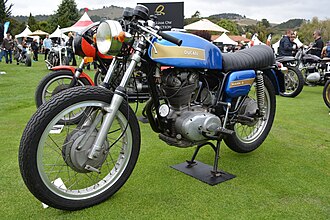
Ducati 350 Mark 3: The Classic Italian Single That Bridged Performance and Elegance
The Ducati 350 Mark 3 is one of the most fascinating motorcycles from Ducati’s celebrated single-cylinder era. Produced from 1968 to 1974, it combined a relatively compact 340cc engine with sophisticated overhead-camshaft technology, bevel-gear drive, a five-speed transmission, and a lightweight sporting chassis. At a time when European manufacturers were increasingly competing through larger engines and more cylinders, Ducati demonstrated that a well-developed single could still provide genuinely exciting performance. The 350 Mark 3 was not simply a larger version of a small commuter motorcycle; it was conceived as a serious sporting road machine and became one of the most recognizable members of Ducati’s wide-case single-cylinder family.
The motorcycle is particularly important because it arrived during a transitional period in Ducati engineering. The company was moving from its earlier narrow-case singles toward the stronger wide-case engines derived from racing development. At the same time, Ducati was exploring desmodromic valve control for production motorcycles, resulting in the closely related 350 Mark 3D. The standard Mark 3 therefore sits at an interesting crossroads: it retained conventional valve springs but used the same fundamental bevel-drive single-cylinder architecture that helped establish Ducati’s reputation for technically distinctive motorcycles.
Today, the 350 Mark 3 has considerable appeal among enthusiasts of classic Italian motorcycles. Its specifications may look modest compared with modern machines, but its combination of approximately 24 horsepower, roughly 128kg dry weight, a five-speed gearbox, and a claimed top speed around 150 km/h gave it an impressive performance-to-weight ratio for its era. More importantly, it delivered that performance through a mechanical package that was beautifully direct, with no electronic intervention between rider and engine.
The Origins of the Ducati 350 Mark 3
From the Sebring to the Wide-Case Generation
The 350 Mark 3 succeeded the Ducati Sebring and was introduced as one of the company’s early wide-case single-cylinder motorcycles. The basic engine displaced 340.235cc, using a 76mm bore and 75mm stroke. This almost square configuration gave the engine a useful balance between torque and the ability to operate at relatively high engine speeds.
The move to the wide-case engine was significant in Ducati’s development. The new architecture had wider rear engine mountings and a strengthened bottom end, reflecting lessons learned from competition machinery. Ducati’s wide-case singles used vertically split aluminum crankcases, a forward-inclined cylinder, and a single overhead camshaft driven by straight-cut bevel gears from the crankshaft. The five-speed gearbox was integrated into the crankcase, creating a compact and highly characteristic mechanical package.
The 350 Mark 3 consequently belongs to a particularly important generation of Ducati singles. It was not simply an inexpensive road motorcycle using an old engine design. Instead, it benefited from a technical lineage that connected Ducati’s production motorcycles with its racing efforts.
A Motorcycle Designed for the Road
Despite its racing-derived engineering, the Mark 3 was fundamentally a road motorcycle. Its standard riding position was more practical than the extreme café-racer ergonomics associated with some of Ducati’s sportier machines, making it suitable for fast everyday riding as well as longer journeys.
This distinction becomes particularly important when comparing the standard Mark 3 with the Mark 3D. The Desmo version emphasized Ducati’s high-performance technology, whereas the conventional Mark 3 offered a more straightforward interpretation of the same basic chassis and engine concept. Both motorcycles shared the unmistakable character of Ducati’s wide-case singles, but the standard machine was arguably the more approachable expression of the design.
The 340cc Ducati Single
Bevel-Drive Overhead Camshaft
The engine is unquestionably the heart of the 350 Mark 3. Its 340.235cc air-cooled single-cylinder layout is mechanically simple in terms of cylinder count but surprisingly sophisticated in valve-train design. A single overhead camshaft operates the valves, with the camshaft driven by a vertical bevel-gear arrangement. This bevel drive became one of Ducati’s most recognizable engineering signatures.
The use of bevel gears to drive the camshaft gave Ducati’s engineers accurate mechanical control while also creating an engine whose internal architecture was visually distinctive. On the right side of the engine, the vertical bevel-drive tower immediately identifies the motorcycle as one of Ducati’s classic singles. It is a component that contributes both to the motorcycle’s engineering identity and its aesthetic appeal.
The standard Mark 3 used conventional valve operation rather than desmodromic control. Its compression ratio is commonly documented at approximately 9.5:1, while published specifications give maximum output at about 24 horsepower at 8,500 rpm. Some references give slightly different figures depending on production year and market, but the general specification remains consistent: a relatively high-revving 340cc single producing respectable performance from a very compact engine.
Carburetion and the Character of the Big Single
Fuel delivery changed during the model’s production life. Early 350 Mark 3 motorcycles used a Dell’Orto SS1 29D carburetor, while later machines used a Dell’Orto VHB29AD. Detailed period jetting references document the SS1 29D for 1968–69 and the VHB29AD from 1970 onward.
That evolution is important when examining an individual motorcycle because a restored machine should ideally be evaluated according to its specific production year rather than against a generic Mark 3 specification. Carburetor type, jetting, exhaust configuration, ignition equipment, suspension components, and bodywork can all influence how a particular example behaves.
The carbureted single also gives the Mark 3 a distinctly physical character. The rider is directly involved in starting and controlling the engine, and the response changes naturally with temperature, throttle position, and engine speed. There is no electronic system smoothing away the mechanical personality of the engine. The result is an experience that feels immediate and unusually connected compared with modern motorcycles.
Five-Speed Transmission and Road Performance
Making the Most of 340cc
A five-speed gearbox was an important feature of the Mark 3. Rather than depending on displacement alone for acceleration, the motorcycle allowed the rider to keep the engine operating within its useful rev range. This suited the character of the single-cylinder engine and helped transform its modest horsepower into lively real-world performance.
The published top speed of approximately 150 km/h, or about 93 mph, is remarkable when considered alongside the motorcycle’s displacement and weight. Some period and reference sources quote slightly different figures, and actual performance naturally depends on gearing, engine condition, rider weight, aerodynamics, and specification. Nevertheless, the numbers demonstrate why Ducati considered the Mark 3 a sporting motorcycle rather than merely a practical 350.
The appeal of the Mark 3 was therefore not overwhelming power. Instead, it was balance. The rider had a light motorcycle, a responsive engine, a five-speed gearbox, and a sporting chassis. This combination made the machine entertaining on winding roads without requiring the enormous engine capacity that became common in later decades.
The Wide-Case Chassis
A Lightweight Structural Design
The 350 Mark 3 used a tubular-steel single-cradle frame with the engine contributing significantly to the motorcycle’s structure. Ducati’s wide-case singles were designed around this lightweight approach, with the engine mounted at the front through plates and directly at the rear.
This arrangement helped keep the motorcycle’s mass under control. Published specifications generally give a dry weight of approximately 128kg, although later equipment and individual specifications can result in somewhat different figures. A motorcycle of this weight with around 24 horsepower has a very different performance character from a modern 350kg-class machine, even if their engine capacities happen to be similar.
The compact proportions also contributed to the Mark 3’s distinctive riding experience. The approximately 1,330mm wheelbase was short enough to give the motorcycle a responsive feel while remaining appropriate for stable road use.
Marzocchi Suspension
The suspension was similarly conventional but sporting. A telescopic fork was used at the front, while the rear featured a swinging arm and twin Marzocchi shock absorbers. Ducati’s wide-case documentation identifies the rear shocks as three-way adjustable, giving riders useful control over the suspension behavior.
Most Mark 3 models used 31.5mm Ducati telescopic forks until the 1973 update, while other wide-case Ducati singles commonly used 35mm Marzocchi forks. This distinction is useful when identifying or restoring a Mark 3 because later motorcycles received significant chassis updates.
The suspension setup was appropriate for a lightweight sporting motorcycle. It was not designed to isolate the rider completely from the road; instead, it provided a relatively direct connection between the chassis and the surface beneath it.
Brakes and Wheels
Classic Drum-Brake Technology
The standard 350 Mark 3 was equipped with drum brakes, with both front and rear braking handled by conventional drum assemblies. Early specifications commonly list 18-inch wheels with a 2.75-18 front tire and a 3.00-18 rear tire.
From a modern perspective, these brakes are one of the clearest reminders that the Mark 3 belongs to another era. Contemporary riders are accustomed to large hydraulic disc brakes with multiple pistons and sophisticated anti-lock systems, whereas the Ducati relied on mechanical drum braking.
Yet the drums suited the motorcycle’s relatively low weight. A carefully maintained Mark 3 can provide effective period-appropriate braking, although anyone riding one today should allow considerably more margin than they would on a modern motorcycle.
Later versions of the Mark 3 family received chassis updates. The 1973 revision included 35mm Marzocchi forks and a twin-sided Grimeca front brake, while the final 1974 machines moved toward a Ceriani fork and single Brembo disc arrangement in the Desmo range. These changes illustrate how Ducati progressively modernized its singles as the production run approached its end.
Styling and the Evolution of the Mark 3
Elegant, Functional Italian Design
The visual appeal of the Ducati 350 Mark 3 comes from its proportions rather than excessive decoration. The narrow single-cylinder engine, slim fuel tank, spoke wheels, exposed frame, and twin rear shocks create a classic silhouette that immediately identifies the motorcycle as a product of late-1960s Italian design.
Early wide-case Mark 3 models featured the distinctive Leopoldo Tartarini-designed “bread box” fuel tank with twin filler caps. A single-filler version followed in 1969, and the tank was redesigned again in 1971. By 1973 Ducati had substantially revised the styling, including the seat, side covers, instruments, headlight, and color scheme.
These changes make originality particularly important to collectors. A 1968 Mark 3 should not necessarily look identical to a 1973 machine. Differences in tanks, seats, controls, wheels, suspension, and braking equipment can be clues to the motorcycle’s age and specification.
The Ducati 350 Mark 3D
The Desmodromic Alternative
The standard Mark 3 had a technically fascinating sibling: the 350 Mark 3D. The “D” referred to Ducati’s desmodromic valve system, in which the valves were mechanically controlled during both opening and closing rather than relying entirely on conventional valve springs. The system had been developed extensively by Ducati engineer Fabio Taglioni and was particularly valuable at high engine speeds because it reduced the risk of valve float and allowed precise valve control.
The Mark 3D was introduced alongside the standard Mark 3 in 1968 and used a different cylinder head derived from Ducati’s 350 SCD racing engine. The rest of the engine and chassis were closely related to the conventional model. Ducati’s classic-bike documentation describes the Mark 3 Desmo as the company’s first street model to receive this high-performance desmodromic technology.
The Mark 3D was considerably more performance-oriented. Sources cite approximately 34 horsepower and a top speed around 165 km/h, while optional race equipment, including a megaphone exhaust and fairing, could raise the claimed figures still further.
This difference helps explain why the ordinary 350 Mark 3 should not be dismissed as simply the “lesser” model. It represents the conventional road-going version of a platform that was sophisticated enough to support Ducati’s emerging desmodromic technology.
What Is the Ducati 350 Mark 3 Like to Ride?
The experience of riding a 350 Mark 3 is fundamentally different from riding a modern motorcycle. The relatively low weight makes the machine feel small and manageable, while the single-cylinder engine produces a characteristic pulse that becomes an integral part of the experience.
The five-speed gearbox encourages active riding, and the engine rewards the rider who understands its useful rev range. Rather than overwhelming the chassis with power, the engine works in harmony with it. This is one of the reasons classic Ducati singles remain so attractive: the rider can explore the motorcycle’s capabilities on ordinary roads without immediately reaching speeds that would be inappropriate for public-road riding.
There is also a tactile quality to the machine that is increasingly rare. The throttle, clutch, gearbox, brakes, kick starter, carburetor, and engine all communicate directly with the rider. Mechanical vibration is not filtered away, and the engine’s response is something the rider experiences rather than something a computer manages.
For enthusiasts, that sense of connection may be more important than outright performance. The 350 Mark 3 is a motorcycle that encourages the rider to participate.
Collecting and Restoring a Ducati 350 Mark 3
The 350 Mark 3 is an especially interesting restoration subject because production lasted several years and Ducati made numerous running changes. A prospective owner should therefore identify the year, engine type, frame configuration, and original equipment before purchasing replacement parts.
The engine deserves particular attention. The bevel-drive camshaft system is one of the motorcycle’s defining features, but it also requires proper maintenance and adjustment. The bottom end, valve gear, gearbox, clutch, carburetor, and lubrication system should all be inspected carefully on a motorcycle that has been stored for decades.
Originality is another important consideration. Because the Mark 3 shares many components and styling cues with other Ducati singles, it can be tempting during restoration to substitute parts from related models. That may produce a functional motorcycle, but it can reduce historical authenticity. A correct early tank, period carburetor, appropriate instruments, original exhaust, and correct suspension components can be especially valuable to a serious collector.
Production numbers also add to the motorcycle’s appeal. Sources commonly estimate approximately 2,300 standard 350 Mark 3s were produced, alongside around 1,350 Mark 3Ds. That relatively limited production helps explain why authentic surviving examples attract interest among Ducati collectors.
Ducati 350 Mark 3 Technical Specifications
The following table summarizes commonly published specifications for the Ducati 350 Mark 3. Because the model evolved between 1968 and 1974, individual motorcycles can differ in equipment and dimensions, particularly in later years.
| Specification | Ducati 350 Mark 3 |
|---|---|
| Production | 1968–1974 |
| Manufacturer | Ducati |
| Class | Standard / Sporting motorcycle |
| Engine | Air-cooled 4-stroke single-cylinder |
| Valve Train | SOHC, bevel-gear driven |
| Displacement | 340.235 cc |
| Bore × Stroke | 76 × 75 mm |
| Compression Ratio | Approx. 9.5:1 |
| Carburetor | Dell’Orto 29 mm; type varied by year |
| Cooling | Air |
| Lubrication | Wet sump |
| Starting | Kick starter |
| Transmission | 5-speed manual |
| Clutch | Multiplate wet clutch |
| Primary Drive | Gears |
| Final Drive | Chain |
| Maximum Power | Approx. 24 bhp @ 8,500 rpm |
| Claimed Top Speed | Approx. 150 km/h / 93 mph |
| Frame | Tubular-steel single cradle |
| Front Suspension | Telescopic fork |
| Rear Suspension | Swingarm with twin shocks |
| Front Brake | Drum on standard early/mid-production models |
| Rear Brake | Drum |
| Front Tire | Approx. 2.75-18 |
| Rear Tire | Approx. 3.00-18 |
| Wheelbase | Approx. 1,330 mm |
| Length | Approx. 2,000 mm |
| Width | Approx. 600 mm |
| Height | Approx. 940 mm |
| Seat Height | Approx. 735 mm |
| Dry Weight | Approx. 128 kg |
| Fuel Capacity | Approximately 13–15 litres, depending on specification |
The Legacy of the Ducati 350 Mark 3
The Ducati 350 Mark 3 is an excellent example of why classic motorcycles cannot be judged solely by horsepower or engine capacity. Its 340cc single may appear modest by modern standards, but Ducati gave it a level of mechanical sophistication that made it a genuine performance motorcycle in its period.
The bevel-driven overhead camshaft, lightweight chassis, five-speed gearbox, adjustable rear suspension, and compact dimensions created a package that was both technically interesting and enjoyable to ride. More importantly, the Mark 3 helped bridge Ducati’s earlier single-cylinder history with the company’s growing emphasis on desmodromic valve technology. The closely related Mark 3D demonstrated how the same basic platform could be transformed into a much more performance-oriented machine.
The Mark 3’s production from 1968 to 1974 also captures a fascinating period in Ducati history. During those years, the company continually refined its single-cylinder motorcycles, introducing new tanks, suspension components, brakes, carburetors, styling details, and eventually more sophisticated braking systems. The final years of the production run marked the end of Ducati’s long-running bevel-drive overhead-camshaft single era.
For today’s collector, the Ducati 350 Mark 3 therefore represents much more than a vintage 350cc motorcycle. It is a compact piece of Italian engineering history, a motorcycle that combines racing-derived ideas with practical road-going usability. Its mechanical simplicity is deceptive: behind the single-cylinder layout is an intricate bevel-drive valve train and a chassis carefully developed around the requirements of a lightweight sporting motorcycle.
That combination is what gives the Ducati 350 Mark 3 its enduring appeal. It does not attempt to overpower the rider with brute force. Instead, it rewards mechanical sympathy, careful riding, and an appreciation for engineering. More than half a century after its introduction, the Mark 3 remains a compelling reminder of an era when a small Italian single-cylinder motorcycle could be both technically ambitious and extraordinarily charismatic.
.jpg)