Ford Bronco as a Used Car: Everything You Need to Know Before Buying America’s Legendary Off-Roader
Few vehicles have managed to build a reputation as enduring as the Ford Bronco. For decades, the Bronco has represented freedom, adventure, rugged engineering, and the ability to travel far beyond paved roads. Whether climbing rocky mountain trails, crossing muddy forest tracks, or simply turning heads in city traffic, the Bronco has become one of the most recognizable sport utility vehicles ever produced by Ford.
Buying a used Ford Bronco is very different from purchasing an ordinary SUV. Unlike many vehicles that gradually lose their identity as they age, the Bronco often becomes even more desirable. Older generations have achieved classic status, while the newest sixth-generation model has generated enormous enthusiasm among off-road enthusiasts and collectors alike. This unique position means that buyers must think carefully about which generation best suits their needs, budget, and intended use.
Some buyers dream of restoring a vintage first-generation Bronco from the 1960s, while others simply want a capable everyday SUV that can confidently tackle camping trips, snowy roads, or weekend adventures. The Bronco can satisfy both groups, but each generation offers different advantages and disadvantages.
This comprehensive guide explores the Ford Bronco as a used vehicle, examining its history, design, engines, off-road performance, comfort, reliability, maintenance costs, common problems, buying advice, and long-term ownership experience. By understanding what makes the Bronco unique, prospective buyers can avoid expensive mistakes and find an example that will continue providing enjoyment for many years.
The History of the Ford Bronco
The Ford Bronco first appeared in 1966 as Ford’s answer to the growing popularity of compact four-wheel-drive utility vehicles such as the Jeep CJ and International Harvester Scout. Rather than simply copying its competitors, Ford developed a versatile platform that could serve as a work vehicle during the week and a recreational off-roader on weekends.
The original Bronco remained in production until 1977 and quickly earned a reputation for exceptional durability, compact dimensions, and impressive off-road capability. Today, these early models are highly sought after by collectors, with well-restored examples commanding remarkable prices.
In 1978, Ford transformed the Bronco into a larger full-size SUV based on the F-Series pickup truck. This approach continued through multiple generations until 1996, when production ceased following changing market demands and the introduction of the Ford Expedition.
For nearly twenty-five years, Bronco enthusiasts waited for the legendary nameplate to return. Finally, in 2021, Ford introduced the sixth-generation Bronco, an entirely new vehicle designed specifically to compete with the Jeep Wrangler. Unlike many nostalgic revivals that merely borrow historic names, the modern Bronco successfully captures the adventurous spirit of the original while incorporating modern safety systems, technology, and comfort.
Today, used buyers can choose from several very different generations, each offering a unique ownership experience.
Exterior Design: Instantly Recognizable Across Generations
One of the Bronco’s greatest strengths is its timeless appearance. Every generation possesses a distinctive personality while maintaining recognizable design elements that link it to the original model.
Classic Broncos (1966–1977)
The first-generation Bronco features simple, boxy proportions with round headlights, flat body panels, minimal overhangs, and short wheelbases that make it exceptionally maneuverable off-road. These early vehicles have become icons of American automotive history and continue to inspire modern SUV design.
Their compact dimensions, removable roof, and rugged stance make them highly desirable among collectors and restorers.
Full-Size Broncos (1978–1996)
The later generations grew significantly larger, sharing many body components with Ford pickup trucks. Their imposing size, broad front grille, and high seating position project confidence and strength.
The removable rear hardtop became one of the Bronco’s signature features, allowing owners to enjoy open-air driving while maintaining practical utility.
Modern Bronco (2021-Present)
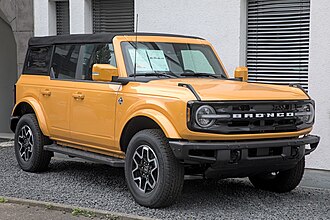
The latest Bronco successfully blends retro inspiration with modern engineering. Round LED headlights, bold wheel arches, upright windshield, removable doors, modular roof panels, and exposed hinges create an unmistakable appearance.
Unlike many contemporary SUVs that prioritize aerodynamic styling, the Bronco proudly embraces its utilitarian heritage.
Interior Design and Everyday Comfort
Interior quality varies dramatically depending on the generation under consideration.
Early Broncos offer extremely basic cabins with durable materials, straightforward instrumentation, and virtually no luxury features. Buyers seeking modern convenience will naturally find these vehicles primitive, but their simplicity contributes greatly to their mechanical reliability and ease of restoration.
The full-size Broncos of the 1980s and 1990s introduced significantly improved comfort. Air conditioning, power windows, cruise control, leather upholstery, premium audio systems, and improved seating transformed the Bronco into a capable long-distance touring vehicle.
The sixth-generation Bronco offers an interior that successfully balances ruggedness with modern expectations. Large physical controls remain easy to operate while wearing gloves, washable surfaces simplify cleaning after muddy adventures, and advanced infotainment systems provide smartphone integration, navigation, and driver assistance technologies.
Passenger space is generous, especially in four-door models. Cargo capacity easily accommodates camping equipment, bicycles, fishing gear, or luggage for extended road trips.
Engine Options Throughout the Years
Because the Bronco has existed across multiple decades, engine availability varies enormously.
Classic Inline-Six and V8 Engines
Early Broncos were available with dependable inline-six engines and later with several V8 options.
These powerplants emphasized durability over outright performance. Their relatively simple mechanical construction allows straightforward repairs even today, making them particularly attractive for hobbyists comfortable performing their own maintenance.
Full-Size Truck-Based Engines
The larger Broncos adopted engines shared with Ford’s F-Series trucks.
Depending on the production year, buyers could find reliable inline-six engines as well as several V8 variants including the famous 302 and 351 Windsor engines.
These engines remain widely respected for longevity, abundant replacement parts, and excellent aftermarket support.
EcoBoost Turbocharged Engines
Modern Broncos introduced turbocharged EcoBoost gasoline engines.
The 2.3-liter four-cylinder delivers strong performance with respectable fuel economy, while the 2.7-liter twin-turbocharged V6 provides considerably more power and torque, making highway driving and off-road climbing effortless.
High-performance Bronco Raptor models feature an even more powerful 3.0-liter EcoBoost V6 capable of delivering exhilarating acceleration while maintaining impressive off-road capability.
Transmission Choices
Classic Broncos primarily featured manual gearboxes, although automatic transmissions became increasingly common in later years.
The modern Bronco offers both a seven-speed manual transmission, including an ultra-low crawler gear for difficult terrain, and a sophisticated ten-speed automatic that delivers smooth performance under virtually every driving condition.
Both transmissions have earned favorable reputations, although buyers planning serious off-road adventures often appreciate the manual’s additional control.
Driving Experience on the Road
The Bronco’s on-road behavior largely depends on the generation.
Classic models provide a nostalgic driving experience with relatively slow steering, body roll, and limited sound insulation. These characteristics are entirely normal for vintage utility vehicles and contribute to their charm.
The full-size Broncos offer a softer ride, benefiting from their longer wheelbase and truck-based suspension.
Modern Broncos represent a dramatic improvement. Steering feels precise, ride quality remains comfortable despite substantial ground clearance, and highway stability surpasses many traditional off-road vehicles.
Although the Bronco cannot entirely disguise its rugged design, it proves remarkably civilized during everyday commuting.
Off-Road Performance
This is undoubtedly the Bronco’s defining characteristic.
Ford engineered every generation with genuine off-road capability rather than simply creating an SUV with rugged styling.
Depending on specification, buyers may benefit from features including four-wheel drive, locking differentials, disconnecting stabilizer bars, terrain management systems, skid plates, hill descent control, high ground clearance, generous suspension articulation, and specialized off-road driving modes.
The latest Bronco’s GOAT (“Goes Over Any Terrain”) driving modes automatically optimize drivetrain settings for mud, sand, rocks, snow, and other challenging conditions.
Whether navigating forest trails, crossing streams, climbing rocky hills, or exploring remote camping locations, few SUVs perform as confidently.
Fuel Economy
Fuel consumption has never been the Bronco’s strongest selling point.
Older V8-powered models naturally consume considerable amounts of fuel, especially during city driving.
Modern EcoBoost engines significantly improve efficiency without sacrificing capability. The turbocharged four-cylinder represents the most economical choice, while the V6 provides stronger performance at the expense of slightly higher fuel consumption.
Owners planning frequent long-distance travel should carefully consider engine selection based on expected annual mileage.
Reliability
The Bronco enjoys an overall positive reliability reputation, although certain issues vary by generation.
Classic Broncos benefit from exceptional mechanical simplicity. With proper maintenance, many continue operating reliably after more than fifty years.
The truck-based Broncos share proven components with Ford’s pickup range, ensuring widespread parts availability and experienced repair specialists.
Modern Broncos initially experienced several minor quality-control concerns typical of new model introductions, but Ford addressed many through recalls, software updates, and production improvements.
Overall, properly maintained Broncos frequently deliver hundreds of thousands of kilometers of dependable service.
Common Problems to Watch For
Like every used vehicle, the Bronco has areas requiring careful inspection.
Rust on Older Models
Corrosion remains the single biggest concern for vintage Broncos.
Wheel arches, floor pans, door bottoms, tailgates, chassis rails, suspension mounting points, and rocker panels deserve especially close examination.
Because restoration costs can quickly exceed purchase prices, structural rust should never be underestimated.
Suspension Wear
Heavy off-road use naturally accelerates wear of bushings, ball joints, shock absorbers, steering components, and wheel bearings.
A comprehensive suspension inspection is essential, particularly for vehicles modified with oversized tires or lift kits.
Transfer Case and Four-Wheel Drive Components
Buyers should verify proper operation of four-wheel drive, locking hubs, differentials, and transfer case mechanisms.
Any unusual noises, vibration, or difficulty engaging four-wheel drive warrant further investigation.
Turbocharged Engine Maintenance
Modern EcoBoost engines require consistent oil changes using the correct specification.
Neglected servicing may shorten turbocharger life and reduce long-term reliability.
Electrical Equipment
Modern Broncos contain considerably more electronic systems than earlier generations.
Testing every feature—including infotainment, cameras, terrain management controls, adaptive cruise control, removable roof electrical connections, and lighting—is advisable before purchase.
Maintenance Costs
Maintenance expenses vary significantly between generations.
Classic Broncos generally feature inexpensive mechanical repairs but may require costly body restoration or sourcing of rare original components.
Truck-based Broncos remain relatively affordable because of extensive parts sharing with Ford pickups.
The newest Bronco naturally incurs higher servicing costs due to advanced electronics, turbocharged engines, and sophisticated suspension systems.
Fortunately, routine maintenance remains straightforward for qualified workshops familiar with Ford vehicles.
Availability of Spare Parts
Parts availability remains one of the Bronco’s strongest advantages.
Mechanical components for older truck-based Broncos are widely available throughout North America and increasingly accessible internationally through specialist suppliers.
Classic first-generation models benefit from an enormous restoration industry offering reproduction body panels, trim, suspension components, interior parts, and complete restoration kits.
Modern Broncos continue receiving excellent manufacturer support along with a rapidly expanding aftermarket.
Modification Potential
Few SUVs offer aftermarket support equal to the Bronco.
Owners routinely install lift kits, larger tires, heavy-duty bumpers, winches, auxiliary lighting, roof racks, snorkels, upgraded suspension systems, skid plates, camping equipment, and performance enhancements.
Because so many aftermarket manufacturers produce Bronco-specific accessories, customization possibilities are virtually endless.
Buyers should nevertheless inspect modified vehicles carefully, as poor-quality modifications may negatively affect reliability or safety.
Buying Advice
When shopping for a used Bronco, overall condition always outweighs mileage.
A meticulously maintained vehicle with comprehensive service records is usually preferable to a lower-mileage example that has experienced neglect.
Inspect the body carefully for accident damage, corrosion, and evidence of poor repairs.
Verify that four-wheel drive engages correctly, listen for drivetrain noises, inspect suspension components, and ensure electronic systems operate normally.
Service documentation becomes particularly valuable for turbocharged modern models, demonstrating regular oil changes and scheduled maintenance.
If purchasing a heavily modified Bronco, determine whether modifications were professionally installed and whether original components are included.
Who Should Buy a Ford Bronco?
The Bronco appeals to a remarkably broad audience.
Outdoor enthusiasts appreciate its off-road capability, towing ability, and cargo flexibility.
Families benefit from spacious interiors and excellent safety in modern models.
Collectors continue pursuing early Broncos as appreciating classics.
Drivers simply seeking a distinctive SUV enjoy the Bronco’s unmistakable styling and charismatic personality.
However, buyers primarily focused on fuel economy or urban maneuverability may find more suitable alternatives elsewhere.
Ownership Experience
Living with a Bronco extends beyond simple transportation.
Owners frequently become part of an enthusiastic community centered around camping, overlanding, off-road exploration, restoration, and vehicle customization.
Numerous clubs, online forums, and organized trail events create opportunities to share technical knowledge, travel experiences, and maintenance advice.
Modern Broncos also retain impressive resale values thanks to continuing market demand, while restored classic models have become genuine collector investments.
This strong community support significantly enhances long-term ownership satisfaction.
How the Bronco Compares with Its Rivals
Compared with the Jeep Wrangler, the Bronco generally offers more refined on-road manners while maintaining comparable off-road capability.
Against the Toyota 4Runner, the Bronco delivers greater customization potential and removable roof options, although Toyota often enjoys a slight advantage in long-term reliability reputation.
Compared with the Land Rover Defender, the Bronco usually costs less to maintain while offering similarly impressive terrain capability.
Against mainstream crossover SUVs, the Bronco stands apart by offering genuine body-on-frame construction, advanced four-wheel-drive systems, and serious off-road engineering rather than merely rugged styling.
Is the Ford Bronco a Good Used Buy?
The answer depends largely on choosing the correct generation and purchasing a well-maintained example.
Classic Broncos provide investment potential, timeless styling, and unmatched nostalgia, although restoration costs can be substantial.
Truck-based Broncos combine durability, practicality, and strong towing capability at relatively affordable prices.
The latest Bronco offers one of the most capable and versatile modern SUVs available, successfully blending advanced technology with authentic off-road performance.
Across every generation, buyers should prioritize condition, documented maintenance, and careful inspection over low purchase price alone.
Final Verdict
The Ford Bronco occupies a unique place in automotive history. Few vehicles have successfully combined legendary off-road capability, unmistakable styling, practical versatility, and enduring enthusiast appeal across so many decades. Whether restored as a classic, preserved as a collectible, or used daily for commuting and outdoor adventures, the Bronco consistently delivers an ownership experience that extends far beyond ordinary transportation.
Its strengths are numerous: exceptional off-road ability, strong aftermarket support, durable mechanical engineering, spacious interiors, excellent resale values, and one of the most passionate owner communities in the automotive world. These qualities explain why demand for well-maintained Broncos remains remarkably strong even many years after production.
Naturally, no vehicle is perfect. Older models require careful rust inspection, fuel economy has never been outstanding, and heavily modified examples deserve particularly thorough evaluation. Nevertheless, buyers who select carefully and maintain their vehicles properly are likely to enjoy many years of dependable service and memorable adventures.
For anyone searching for a used SUV that offers genuine character instead of anonymous transportation, the Ford Bronco remains one of the finest choices available. It is a vehicle designed not merely to reach destinations but to encourage exploration, inspire confidence, and transform every journey into part of the adventure.
Technical Specifications Summary
| Specification | Modern Ford Bronco (Typical 2.3 EcoBoost) | Modern Ford Bronco (Typical 2.7 EcoBoost V6) |
|---|---|---|
| Production (current generation) | 2021–Present | 2021–Present |
| Body style | 3-door or 5-door SUV | 3-door or 5-door SUV |
| Construction | Body-on-frame | Body-on-frame |
| Engine | 2.3 L turbocharged inline-4 EcoBoost | 2.7 L twin-turbocharged V6 EcoBoost |
| Power | Approx. 300 hp | Approx. 330 hp |
| Torque | Approx. 440 Nm | Approx. 563 Nm |
| Transmission | 7-speed manual or 10-speed automatic | 10-speed automatic |
| Drive system | Four-wheel drive | Four-wheel drive |
| 0–100 km/h | Approx. 6.8–7.2 seconds | Approx. 5.9–6.3 seconds |
| Top speed | Approx. 160–180 km/h (trim dependent) | Approx. 160–180 km/h (trim dependent) |
| Fuel consumption (combined) | Approx. 11–12 L/100 km | Approx. 12–14 L/100 km |
| Fuel tank | Approx. 79 L | Approx. 79 L |
| Ground clearance | Up to 295 mm (version dependent) | Up to 295 mm (version dependent) |
| Towing capacity | Up to 1,588 kg | Up to 1,588 kg |
| Typical strengths | Balanced performance, lower fuel consumption, capable off-road | Excellent power, strong torque, premium driving experience |
| Typical weaknesses | Higher fuel use than crossovers, large dimensions | Higher running costs, increased fuel consumption |
