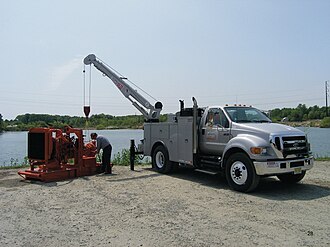
When most people hear the name Ford F-Series, they immediately think of the immensely popular F-150 pickup, a vehicle that has dominated the North American truck market for decades. However, beyond the familiar world of light-duty pickups lies another branch of the F-Series family that has quietly played a vital role in construction, municipal services, utility work, towing, emergency response, and commercial transportation. This is the Ford F-Series medium-duty truck, a range of rugged commercial vehicles engineered to bridge the gap between pickup trucks and heavy-duty Class 8 tractors.
Although they may not receive the same public attention as their lighter siblings, medium-duty Ford trucks have been an essential part of North American industry since the late 1940s. Designed to handle significantly heavier payloads, larger commercial bodies, and more demanding operating conditions, these trucks have earned a reputation for durability, versatility, and adaptability. Over several generations, Ford has continually refined the medium-duty F-Series, introducing stronger frames, more capable diesel engines, improved driver comfort, enhanced safety systems, and modern electronic technologies while preserving the fundamental characteristics that fleet operators value most.
Today, the medium-duty F-Series lineup—primarily represented by the F-650 and F-750—serves a remarkable variety of industries. These trucks can be found delivering beverages to supermarkets, carrying utility equipment to remote worksites, operating as tow trucks, transporting construction materials, serving as fire apparatus, supporting municipal maintenance departments, and providing the foundation for countless specialized vocational vehicles. Their ability to accommodate numerous body styles and drivetrain configurations has made them one of the most versatile commercial truck platforms available.
This article explores the history, engineering, development, design, performance, applications, ownership experience, maintenance requirements, technological evolution, and enduring legacy of the Ford F-Series medium-duty truck. Whether you are a trucking enthusiast, fleet manager, prospective buyer, or simply curious about commercial vehicles, this comprehensive guide provides an in-depth look at one of America’s most respected vocational truck families.
The Origins of Ford’s Medium-Duty Truck Line
Ford’s involvement in commercial truck manufacturing dates back to the earliest years of the automotive industry. As businesses increasingly relied on motorized transportation during the first half of the twentieth century, Ford recognized the growing demand for trucks capable of carrying heavier loads than passenger-car-based pickups could handle.
Following World War II, North America’s booming economy created unprecedented demand for commercial vehicles. Expanding cities, new highways, suburban development, and rapid industrial growth required dependable trucks capable of transporting building materials, machinery, agricultural products, and manufactured goods.
In 1948, Ford introduced the first generation of its postwar F-Series truck family. While light-duty pickups attracted significant consumer attention, the lineup also included progressively larger models intended for commercial service. These heavier variants featured reinforced frames, stronger suspensions, larger brakes, and more powerful engines, laying the groundwork for what would eventually become today’s medium-duty F-Series.
Throughout the following decades, Ford continually expanded and refined its commercial offerings, responding to changing regulations, customer demands, and technological advancements. Medium-duty trucks gradually evolved into highly specialized vocational platforms capable of supporting an extraordinary range of commercial applications.
Understanding Medium-Duty Trucks
Before examining the Ford F-Series in detail, it is useful to understand what qualifies as a medium-duty truck.
In North America, commercial vehicles are generally classified according to their Gross Vehicle Weight Rating (GVWR). Medium-duty trucks typically fall within Classes 5 through 7, with some Class 8 vocational configurations overlapping depending on equipment and intended use.
Ford’s modern F-650 and F-750 primarily occupy the upper end of this spectrum, offering significantly greater payload and towing capacities than the company’s Super Duty pickup trucks while remaining more maneuverable and versatile than large highway tractors.
Medium-duty trucks occupy an important niche because they combine impressive capability with practical operating characteristics. They are large enough to perform demanding commercial work but compact enough to navigate city streets, construction sites, industrial facilities, and residential neighborhoods.
Evolution Through Multiple Generations
The history of Ford’s medium-duty trucks reflects decades of continuous engineering development.
Early Generations
The earliest medium-duty F-Series models emphasized mechanical simplicity and durability. Steel cabs, ladder-frame chassis, gasoline engines, and manual transmissions dominated the market during the 1950s and 1960s.
These trucks served farms, municipalities, local delivery companies, and construction firms, often remaining in operation for decades due to their straightforward mechanical design.
Expanding Capabilities
During the 1970s and 1980s, Ford introduced stronger diesel engines, improved braking systems, heavier suspension components, and more comfortable cabs. These improvements enabled operators to carry larger payloads while reducing driver fatigue.
Commercial fleets increasingly relied on medium-duty F-Series trucks for specialized vocational applications, including utility service, towing, refuse collection, and emergency response.
Modern Era
The latest generations of the F-650 and F-750 represent the culmination of decades of refinement. Produced through a joint manufacturing venture before later returning to full Ford production, these trucks incorporate modern powertrains, electronic safety systems, advanced diagnostics, and improved ergonomics while retaining the rugged body-on-frame construction expected from commercial vehicles.
Exterior Design Focused on Utility
The exterior styling of Ford’s medium-duty trucks reflects their intended purpose. Every design element emphasizes functionality, durability, and ease of maintenance rather than purely aesthetic considerations.
The tall hood provides space for large diesel or gasoline engines while allowing efficient cooling through a substantial grille and high-capacity radiator. Broad front fenders protect the body from debris encountered on construction sites and unpaved roads.
Large rectangular headlights deliver excellent illumination for nighttime operations, while oversized mirrors provide extensive rearward visibility when towing trailers or maneuvering large vocational bodies.
Wide-opening hood panels simplify engine access, allowing technicians to perform routine maintenance with minimal disassembly. Heavy-duty steel bumpers withstand daily commercial use, and optional tow hooks increase versatility during recovery operations.
The truck’s clean body lines also facilitate the installation of numerous aftermarket accessories, including auxiliary lighting, toolboxes, brush guards, snowplow mounts, and specialized equipment.
Chassis Designed for Commercial Applications
Perhaps the greatest strength of the medium-duty F-Series lies beneath its body.
The truck employs a robust ladder-frame chassis constructed from high-strength steel designed to withstand years of demanding commercial service. Reinforced crossmembers increase torsional rigidity while accommodating a wide variety of vocational body installations.
Customers may specify numerous wheelbase lengths depending on the intended application. Longer wheelbases provide greater stability for box trucks and buses, while shorter configurations improve maneuverability for dump trucks and municipal equipment.
Frame options accommodate virtually every type of commercial body, including:
- Dump bodies
- Flatbeds
- Stake beds
- Utility service bodies
- Tow truck equipment
- Beverage delivery bodies
- Fire apparatus
- Fuel tanks
- Refrigerated cargo boxes
- Aerial lift platforms
- Crane installations
This remarkable adaptability explains why medium-duty F-Series trucks appear in so many different industries.
Powertrain Options
Throughout their history, Ford’s medium-duty trucks have been offered with numerous gasoline and diesel engines.
Gasoline Engines
Modern models are available with Ford’s proven 7.3-liter V8 gasoline engine.
This engine emphasizes:
- Strong low-speed torque
- Mechanical simplicity
- Lower acquisition cost
- Reduced maintenance complexity
- Excellent reliability
Many municipal fleets favor gasoline engines because they often experience lower annual mileage and reduced emissions-system maintenance compared with diesel alternatives.
Diesel Engines
For maximum towing capability and heavy commercial service, Ford offers the 6.7-liter Power Stroke turbo-diesel V8.
This engine delivers:
- Outstanding torque
- Excellent fuel efficiency under load
- Strong acceleration
- Advanced turbocharging
- Modern electronic engine management
The diesel engine is particularly popular among operators hauling heavy trailers or transporting substantial payloads over long distances.
Transmission Technology
Modern F-Series medium-duty trucks utilize advanced automatic transmissions designed specifically for commercial applications.
The six-speed heavy-duty automatic transmission offers:
- Smooth gear changes
- Adaptive shift programming
- Tow/haul mode
- Grade braking
- Electronic controls
- Proven durability
Automatic transmissions reduce driver fatigue, improve consistency across fleet operations, and simplify driver training compared with traditional manual gearboxes.
Suspension and Ride Quality
Commercial trucks must balance ride comfort with exceptional load-carrying capability.
Ford addresses this challenge through heavy-duty suspension systems engineered for vocational use.
Front suspension components provide precise steering while absorbing road imperfections.
Rear leaf springs support substantial payloads without excessive body movement.
Optional air suspension systems are available for applications requiring improved ride quality or protection of sensitive cargo.
Despite their commercial focus, modern medium-duty F-Series trucks deliver noticeably smoother rides than earlier generations thanks to improved suspension tuning and chassis engineering.
Braking Systems
Given the substantial weights involved, braking performance is a critical aspect of medium-duty truck design.
Modern trucks feature:
- Hydraulic or air brake systems depending on configuration
- Anti-lock braking systems (ABS)
- Electronic stability control
- Exhaust braking (diesel models)
- Integrated trailer brake controls
- Automatic traction control
These technologies significantly enhance safety while reducing stopping distances under varying load conditions.
Interior Designed for Long Working Days
Inside the cab, Ford has focused on creating an environment that supports productivity during extended work shifts.
The seating position provides excellent visibility through a large windshield and expansive side windows.
Controls are logically arranged and remain accessible while wearing work gloves.
Large analog gauges are complemented by digital information displays providing vehicle diagnostics, fuel economy data, maintenance reminders, and trip information.
Storage compartments accommodate paperwork, electronic devices, safety equipment, and personal belongings.
Optional air-ride driver’s seats significantly reduce fatigue during long hours behind the wheel.
Climate control systems maintain comfortable temperatures regardless of weather conditions, while improved insulation minimizes engine and road noise.
Technology for Modern Fleets
Although durability remains the primary priority, today’s medium-duty F-Series trucks incorporate sophisticated technology designed to improve efficiency and fleet management.
Available features include:
- Touchscreen infotainment systems
- Bluetooth connectivity
- Apple CarPlay and Android Auto
- Navigation
- Wi-Fi hotspot capability
- USB charging ports
- Fleet telematics
- Remote diagnostics
- GPS tracking integration
- Over-the-air software updates (where applicable)
Fleet managers benefit from real-time monitoring of vehicle health, fuel consumption, maintenance schedules, and driver behavior.
Safety Features
Commercial vehicle safety has advanced dramatically over recent decades, and Ford has incorporated many modern technologies into its medium-duty lineup.
Available safety systems include:
- Forward collision warning
- Automatic emergency braking
- Lane departure warning
- Adaptive cruise control
- Rearview camera
- Blind-spot monitoring for trailer applications
- Electronic stability control
- Roll stability control
- Tire pressure monitoring
These features help reduce accidents while improving driver confidence in demanding operating environments.
Vocational Applications
One of the defining characteristics of the medium-duty F-Series is its remarkable versatility.
Construction Industry
Construction companies frequently equip F-650 and F-750 chassis with dump bodies, flatbeds, cranes, or equipment transport platforms.
Their robust frames easily withstand heavy daily workloads.
Utility Companies
Electricity, telecommunications, and natural gas providers rely on medium-duty Ford trucks equipped with aerial lifts and service bodies.
These vehicles transport technicians and specialized equipment to remote locations throughout the year.
Municipal Services
Cities and counties employ these trucks for:
- Snow removal
- Street maintenance
- Water system repairs
- Sewer maintenance
- Parks departments
- Public works operations
Towing and Recovery
Tow truck operators appreciate the F-Series’ powerful engines, stable chassis, and impressive towing capability.
Both light-duty and heavy-duty recovery equipment can be mounted depending on configuration.
Emergency Services
Fire departments frequently utilize F-Series chassis for:
- Brush trucks
- Rescue vehicles
- Tankers
- Command units
- Hazardous materials response
Their durability and reliability make them well suited to emergency operations.
Delivery and Distribution
Regional delivery companies benefit from the trucks’ combination of payload capacity, maneuverability, and driver comfort.
Box bodies and refrigerated cargo compartments are common installations.
Maintenance and Serviceability
Fleet operators consistently emphasize the importance of minimizing downtime.
Ford addresses this through an emphasis on accessibility and serviceability.
Routine maintenance includes:
- Engine oil changes
- Fuel filter replacement
- Brake inspections
- Cooling system maintenance
- Suspension lubrication
- Transmission servicing
- Differential fluid replacement
- Tire rotation
Wide hood openings simplify engine access, reducing labor time during inspections and repairs.
Ford’s extensive commercial dealer network provides widespread service support across North America.
Reliability and Ownership Experience
The medium-duty F-Series has earned a strong reputation for reliability across numerous industries.
Owners frequently cite:
- Durable chassis construction
- Dependable powertrains
- Excellent parts availability
- Strong resale value
- Familiar mechanical systems
- Broad dealer support
Many trucks remain in commercial service for hundreds of thousands of miles when maintained according to manufacturer recommendations.
The ability to adapt the chassis to changing business needs also contributes to long-term ownership value.
Competition in the Medium-Duty Market
The medium-duty truck segment is highly competitive, with several established manufacturers offering capable alternatives.
Competitors include vocational models from Chevrolet, International, Freightliner, Isuzu, Hino, and Kenworth. Each manufacturer emphasizes different strengths, such as specialized body compatibility, fuel efficiency, or dealer support.
The Ford F-Series distinguishes itself through a combination of widespread brand recognition, robust engineering, extensive dealer coverage, versatile chassis configurations, and powertrain options suited to a broad range of vocational tasks. This balanced approach has helped the medium-duty F-Series remain a leading choice for fleets seeking dependable, adaptable commercial vehicles.
The Legacy of the Ford F-Series Medium-Duty Truck
While the light-duty F-150 often captures public attention, the medium-duty members of the Ford F-Series have quietly become indispensable tools across countless industries. Their influence extends far beyond construction sites and delivery routes; they support emergency responders, maintain public infrastructure, transport essential goods, and enable businesses of every size to perform demanding work efficiently.
Over more than seven decades, Ford has continually refined these trucks while remaining faithful to the principles that made them successful: strength, versatility, durability, and ease of service. The modern F-650 and F-750 embody this tradition, combining proven commercial engineering with contemporary technology and safety features.
As transportation continues to evolve toward electrification, connected fleet management, and increasingly advanced driver-assistance systems, the medium-duty F-Series is likely to continue adapting without abandoning its vocational roots. Its proven ability to accommodate diverse commercial applications ensures that it will remain a cornerstone of North American fleet operations for years to come.
Whether serving as a dump truck, utility vehicle, tow truck, fire apparatus, beverage delivery truck, or specialized municipal machine, the Ford F-Series medium-duty truck stands as one of the most versatile and dependable commercial vehicles ever produced. Its enduring reputation reflects not only impressive engineering but also decades of real-world service in some of the most demanding working environments imaginable.
Technical Specifications
| Parameter | Specification |
|---|---|
| Manufacturer | Ford Motor Company |
| Model family | Ford F-Series Medium-Duty (primarily F-650 and F-750) |
| Initial introduction | 1948 (F-Series); current modern medium-duty generation introduced in the 2010s |
| Vehicle class | Medium-duty commercial truck (typically Class 6–7, depending on configuration) |
| Body style | Conventional cab chassis |
| Construction | Body-on-frame with heavy-duty steel ladder frame |
| Drive layout | Rear-wheel drive |
| Engine options | 7.3 L V8 gasoline; 6.7 L Power Stroke V8 turbo-diesel (current offerings; varies by model year) |
| Fuel type | Gasoline or diesel |
| Transmission | Heavy-duty 6-speed automatic |
| Brake system | Hydraulic or full air brakes (configuration dependent) |
| Steering | Hydraulic power steering |
| Suspension | Heavy-duty leaf spring; optional air suspension for selected applications |
| Cab configurations | Regular cab, SuperCab, Crew Cab (availability varies) |
| Wheelbase | Multiple wheelbase options depending on chassis specification |
| GVWR | Approximately 20,500–37,000 lb (configuration dependent) |
| GCWR | Up to approximately 50,000 lb (configuration dependent) |
| PTO compatibility | Yes, for numerous vocational body applications |
| Common body types | Dump truck, flatbed, utility body, tow truck, box truck, tanker, crane truck, fire apparatus, bus chassis |
| Safety features | ABS, electronic stability control, traction control, available forward collision warning, automatic emergency braking, lane departure warning, rearview camera |
| Typical applications | Construction, utilities, municipal fleets, towing, delivery, emergency services, infrastructure maintenance |
| Key strengths | Exceptional chassis versatility, strong towing capability, durable construction, broad dealer network, adaptable vocational platform |
| Current status | In production as Ford’s primary medium-duty commercial truck lineup |
