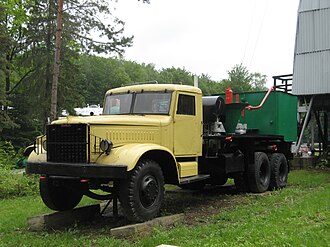
The KrAZ-219 was one of the earliest and most important heavy trucks produced by the Kremenchuk Automobile Plant in Ukraine during the Soviet era. Built from 1959 to 1965, it was a massive three-axle 6×4 truck designed to transport heavy loads over long distances and to serve as a platform for specialized equipment. Although its production life was relatively short, the KrAZ-219 played an important role in the development of the Kremenchuk truck industry and established a mechanical formula that would influence later KrAZ models for decades. Its combination of a heavy-duty frame, large-displacement two-stroke diesel, substantial payload and simple construction made it particularly suitable for military logistics, construction, industry and difficult transportation work.
The truck is also interesting because the KrAZ-219 did not originally begin life as a KrAZ. It was developed at the Yaroslavl Automobile Plant as the YaAZ-219, and production began in Yaroslavl in 1957. In 1959, Soviet industrial policy transferred heavy-truck production from Yaroslavl to the newly established Kremenchuk plant, while Yaroslavl concentrated increasingly on engines and transmissions. The vehicle was therefore transferred almost intact and received the KrAZ name while retaining its 219 designation. This transition created one of the earliest products of the Kremenchuk truck factory and established the basic architecture from which several important KrAZ models would evolve.
The Origins of the KrAZ-219
From YaAZ to KrAZ
The story of the KrAZ-219 begins with the Soviet Union’s post-war effort to develop increasingly capable heavy trucks. The vehicle was derived from the YaAZ-210 family, itself part of a broader generation of heavy Soviet trucks designed to handle significantly greater loads than many earlier vehicles. The YaAZ-219 represented the road-going cargo version of this concept, while related vehicles included the YaAZ-221 tractor unit and YaAZ-222 dump truck.
When the Kremenchuk Automobile Plant took over production, the basic design changed very little. This was a sensible decision because the truck was already established and the new factory needed to begin production without undertaking a completely new engineering program. The early KrAZ-219 therefore retained the characteristic cab, chassis architecture and YaAZ-developed mechanical components. One of the most visible changes was the replacement of the earlier YaAZ grille emblem and decorative bear emblem with KrAZ identification.
The transition was historically significant because Kremenchuk was entering the heavy-truck business at precisely the moment when the Soviet Union was expanding its demand for large commercial and military vehicles. The KrAZ-219 became one of the first major products around which the new factory built its reputation.
A Huge Six-Cylinder Two-Stroke Diesel
The YaAZ-M206A Engine
At the heart of the KrAZ-219 was an unusual powerplant by modern standards: a 6.97-liter inline six-cylinder two-stroke diesel. The YaAZ-M206A used direct fuel injection and produced approximately 132 kW, or 180 hp, at 2,000 rpm according to commonly cited specifications. Other historical references list slightly different power figures for individual engine versions, so figures quoted for surviving trucks can vary.
The two-stroke configuration is one of the most distinctive features of the truck. Unlike the four-stroke diesel engines that later became dominant in heavy commercial vehicles, the M206 family was derived from an engineering approach influenced by American two-stroke diesel technology. The engine used forced scavenging to move fresh air through the cylinders, allowing it to produce substantial power from a relatively compact engine architecture.
For a truck weighing well over 11 tonnes before loading, the engine’s output might appear modest by contemporary standards. However, the KrAZ-219 was not designed around speed. It was designed to move heavy loads reliably, and its diesel engine delivered its useful torque at relatively low engine speeds. Historical technical data places maximum torque in the region of 700 Nm, depending on the engine specification.
The engine also contributed strongly to the truck’s characteristic personality. A large two-stroke diesel produces a distinctive mechanical sound, and the combination of the long bonnet, large radiator and heavy chassis gives the KrAZ-219 an unmistakably industrial appearance.
A Heavy-Duty 6×4 Chassis
The KrAZ-219 used a conventional 6×4 configuration, meaning that all three axles were carried by the chassis while the two rear axles provided propulsion. This arrangement was particularly well suited to a heavy road truck that needed considerable traction without the additional complexity and weight of a full 6×6 system.
Its frame was built to withstand substantial loads, and the three-axle arrangement distributed the vehicle’s weight effectively. The truck’s standard payload was approximately 12 tonnes, while its permissible gross weight was around 23.5 tonnes. These figures placed the KrAZ-219 firmly in the heavy-truck category for its time.
The long chassis also made the truck an attractive platform for specialized bodies. A basic flatbed could be replaced by tanks, cranes, drilling equipment, workshop bodies and other industrial machinery. This versatility became one of the defining characteristics of KrAZ vehicles.
The Five-Speed Transmission
The engine was paired with a five-speed manual gearbox, supplemented by a two-speed transfer arrangement. The first gear was unsynchronized, reflecting the mechanical expectations of heavy trucks of the period. A low-range ratio was available through the transfer mechanism, giving the driver additional flexibility when moving heavy loads.
The transmission was not designed for quick shifts or high-speed cruising. Instead, it provided the gearing necessary to turn the engine’s torque into useful pulling power. With a maximum road speed of approximately 55 km/h, the KrAZ-219 was clearly intended to spend most of its working life carrying heavy loads rather than competing with faster highway vehicles.
That relatively low top speed also needs to be considered in its historical context. Soviet road infrastructure outside major cities could be inconsistent, and heavy trucks frequently operated on secondary roads, construction sites and industrial routes. A robust drivetrain and conservative gearing were therefore more important than high cruising speeds.
The Characteristic KrAZ Cab
Functional Rather Than Luxurious
The KrAZ-219’s cab was a product of its era. It used a wood-and-metal construction, with metal exterior panels over a predominantly wooden structure. The cab accommodated the driver and two passengers, giving it a practical three-person configuration.
There was little emphasis on the comfort equipment that would be expected in a modern heavy truck. The cab was primarily a working environment designed to provide basic protection and visibility while keeping construction relatively straightforward. Nevertheless, compared with some earlier Soviet heavy trucks, the design was considered more spacious and convenient.
The flat grille and prominent bonnet became important visual characteristics. Unlike later cab-over-engine trucks, the driver sat behind the engine compartment, giving the KrAZ-219 the long-nose profile that would remain strongly associated with many classic KrAZ vehicles.
The Large Flatbed
The standard KrAZ-219 was equipped with an open cargo platform featuring folding side and rear boards. Commonly documented dimensions for the platform are approximately 5.77 metres long and 2.45 metres wide, providing a substantial loading area for its 12-tonne payload.
This arrangement made the truck suitable for transporting machinery, building materials, industrial equipment and military supplies. The flatbed could also be adapted for specialist applications, which greatly expanded the truck’s usefulness.
A major advantage of the chassis was therefore not simply how much weight it could carry but how easily it could be converted into a specialized vehicle. This philosophy would become a recurring theme throughout KrAZ history.
KrAZ-219B: The Improved Version
The original KrAZ-219 was eventually updated into the KrAZ-219B. The modernization began in 1963 and included a revised engine and a conversion from a 12-volt electrical system to a 24-volt system. The later engine, commonly identified as the YaAZ-M206B in historical sources, increased output to approximately 205 hp (151 kW) in some references, although documentation differs depending on the exact engine designation and specification.
The 219B was produced until 1965. It represented the final stage of the original 219 family before the arrival of the KrAZ-257. The modernization was relatively logical: rather than replacing the entire truck, engineers improved the engine and electrical equipment while retaining the proven chassis architecture.
This approach allowed the basic design to remain economically useful while giving operators somewhat greater performance and improved electrical capacity for increasingly sophisticated equipment.
A Platform for Specialized Vehicles
Cranes, Military Equipment and Industrial Machinery
The KrAZ-219 became much more than a cargo truck. Its robust chassis made it a natural platform for heavy specialist equipment, including mobile cranes and industrial machinery. Historical accounts describe its use by military engineering units, air-force organizations, strategic forces and civilian industries for heavy transportation and specialist duties.
One particularly important role was supporting heavy cranes. KrAZ chassis could carry equipment that would have been impossible to install on ordinary commercial trucks. The vehicle’s long frame, high gross weight and substantial engine output made it an effective foundation for mobile lifting equipment.
The truck was also used for transporting long materials such as pipes and for carrying specialized bodies associated with construction and industrial operations. In other words, the KrAZ-219 should not be understood simply as a flatbed truck. It was better viewed as a heavy-duty mobile platform.
Military Service
The Soviet military also made extensive use of the truck family. Heavy trucks were essential to moving fuel, ammunition, engineering equipment, spare parts and other supplies, and the KrAZ-219’s 12-tonne payload made it particularly useful for logistics.
Its 6×4 configuration was not as capable in severe off-road terrain as a 6×6 truck such as the KrAZ-214, but for established roads, construction routes and firm unpaved surfaces, the 219 offered an effective combination of capacity and traction. The same basic platform could therefore serve both civilian and military organizations.
Fuel Consumption and Range
One of the unavoidable characteristics of the KrAZ-219 was its appetite for fuel. Historical specifications commonly quote fuel consumption of approximately 55–60 litres per 100 kilometres, depending on operating conditions and load. The truck was fitted with two fuel tanks, commonly totaling approximately 450 litres.
Those numbers sound extraordinary today, but they must be viewed against the vehicle’s size, weight, engine technology and operating environment. The 6.97-liter two-stroke diesel was not designed with modern fuel economy standards in mind, and the truck itself was extremely heavy.
The large fuel capacity nevertheless gave the KrAZ-219 a useful operating range for a vehicle of its period. Long-distance transportation could be undertaken without constantly searching for fuel, which was important for both military and industrial operators.
The End of the KrAZ-219
The KrAZ-219’s production period lasted from 1959 to 1965. The basic model was produced until 1964, with approximately 12,780 examples reportedly completed before production transitioned to the improved 219B.
The truck was then replaced by the KrAZ-257, a model that became one of the most recognizable heavy trucks in the history of the Kremenchuk plant. The 257 retained the basic idea of a heavy 6×4 cargo truck but introduced a newer four-stroke V8 diesel and further development of the chassis and cab.
The transition from the 219 to the 257 therefore marked a major technological step. The two models shared the philosophy of being heavy, robust workhorses, but the newer truck moved away from the two-stroke six-cylinder engine toward the four-stroke V8 configuration that would become closely associated with later KrAZ vehicles.
Why the KrAZ-219 Matters Today
The KrAZ-219 occupies an important position in Soviet and Ukrainian automotive history because it represents the beginning of the Kremenchuk plant’s identity as a major heavy-truck manufacturer. It was not an entirely new design when it arrived at KrAZ, but its production established the factory’s expertise and created a foundation for the generations of trucks that followed.
For collectors, the truck has considerable historical appeal. Its long bonnet, enormous proportions, distinctive grille and unmistakable two-stroke diesel make it immediately recognizable. Surviving examples are increasingly valued as representatives of an era when heavy trucks were mechanically straightforward, slow and extremely rugged.
The KrAZ-219 is also significant because it demonstrates how industrial policy shaped Soviet vehicle development. Its move from Yaroslavl to Kremenchuk was not simply a corporate relocation; it was part of a broader division of industrial responsibilities in which one plant concentrated on complete vehicles while another became a major supplier of engines and transmissions.
KrAZ-219 Technical Specifications
The figures below represent commonly documented specifications for the standard KrAZ-219. Exact figures can vary between production years, engine versions and specialized configurations. The later 219B had a more powerful engine and 24-volt electrical equipment.
| Specification | KrAZ-219 |
|---|---|
| Manufacturer | Kremenchuk Automobile Plant (KrAZ) |
| Original developer | Yaroslavl Automobile Plant (YaAZ) |
| Production | 1959–1965 |
| Earlier designation | YaAZ-219 |
| Configuration | 6×4 |
| Vehicle type | Heavy-duty cargo truck |
| Engine | YaAZ-M206A |
| Engine type | Inline 6-cylinder, two-stroke diesel |
| Displacement | 6.97 litres |
| Bore × stroke | 108 × 127 mm |
| Power | Approximately 180 hp / 132 kW |
| Rated speed | 2,000 rpm |
| Maximum torque | Approximately 700 Nm |
| Transmission | 5-speed manual |
| Transfer case | Two-speed |
| Fuel capacity | Approximately 450 litres |
| Fuel consumption | Approximately 55–60 L/100 km |
| Maximum speed | Approximately 55 km/h |
| Payload | Approximately 12,000 kg |
| Kerb weight | Approximately 11,300 kg |
| Gross vehicle weight | Approximately 23,500 kg |
| Cab | Three-seat wood-and-metal construction |
| Cargo body | Open flatbed with folding sides and rear |
| Cargo platform length | Approximately 5.77 m |
| Cargo platform width | Approximately 2.45 m |
| Overall length | Approximately 9.66 m |
| Overall width | Approximately 2.65 m |
| Overall height | Approximately 2.62 m |
| Wheelbase | Approximately 5.05 + 1.40 m |
| Front track | Approximately 1.95 m |
| Rear track | Approximately 1.92 m |
| Electrical system | 12 V; 24 V on later 219B |
| Successor | KrAZ-257 |
Final Thoughts
The KrAZ-219 was one of those trucks whose importance extended far beyond its production numbers. It was among the first major products of the Kremenchuk Automobile Plant, carried the engineering heritage of the YaAZ heavy-truck family into a new industrial center and established the basic formula for a generation of Soviet heavy vehicles.
Its 6.97-liter two-stroke diesel, five-speed gearbox, 6×4 drivetrain and 12-tonne payload gave it the ability to perform serious work, while its robust chassis made it suitable for everything from ordinary freight transportation to cranes and military equipment. It was slow by modern standards and exceptionally thirsty for fuel, but those disadvantages were secondary to the qualities that mattered most in its original environment: strength, simplicity, load capacity and serviceability.
The arrival of the KrAZ-257 in the mid-1960s eventually made the 219 obsolete, but the older truck had already done its job. It helped establish Kremenchuk as a major heavy-truck manufacturing center and provided the foundation for the distinctive KrAZ vehicles that would become familiar across the Soviet Union and beyond.
Today, the KrAZ-219 is best remembered as a mechanical giant from the early years of KrAZ production—a truck that combined Soviet industrial ambition with a rugged, unmistakably old-school engineering philosophy. Its short production career makes surviving examples particularly interesting, while its role in the development of later KrAZ trucks ensures that it remains an important chapter in the history of heavy commercial vehicles.
