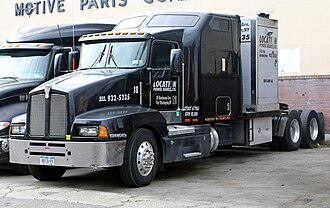
Kenworth T600: The Truck That Changed Aerodynamics Forever
The history of commercial trucking is filled with vehicles that performed important jobs, hauled immense loads, and contributed to economic growth. Yet only a handful of trucks can be credited with fundamentally changing the direction of the entire industry. The Kenworth T600 belongs to that exclusive group. More than just another heavy-duty tractor, the T600 represented a revolutionary shift in truck design, proving that aerodynamics could dramatically improve fuel efficiency, reduce operating costs, and shape the future of freight transportation.
When the Kenworth T600 was introduced in 1985, many truck drivers and fleet operators were skeptical. The truck looked radically different from the long-nosed conventional tractors that had dominated North American highways for decades. Its sloped hood, integrated body panels, aerodynamic bumpers, and streamlined profile seemed almost futuristic compared to the traditional square-front trucks of the era. Some drivers initially mocked its appearance, while others questioned whether such a design could survive the harsh realities of long-haul trucking.
However, the T600 quickly silenced its critics. The truck demonstrated measurable fuel savings, improved operational efficiency, and excellent reliability. As fuel prices continued to fluctuate and transportation companies searched for ways to reduce expenses, the advantages of aerodynamic truck design became impossible to ignore. Within a few years, the T600 had transformed industry thinking, influencing nearly every truck manufacturer in North America.
Today, the Kenworth T600 is widely regarded as one of the most important commercial vehicles ever built. It marked the beginning of the aerodynamic truck era and laid the foundation for many modern heavy-duty tractors that dominate highways around the world. This article explores the complete story of the Kenworth T600, from its revolutionary development and engineering innovations to its lasting influence on the trucking industry.
The Trucking Industry Before the T600
The Age of Traditional Conventional Trucks
To understand the significance of the T600, it is necessary to examine the trucking landscape before its arrival. Throughout the 1960s, 1970s, and early 1980s, most North American trucks followed a similar design philosophy. They featured large, upright grilles, flat windshields, square hoods, exposed air cleaners, and numerous external accessories that created significant aerodynamic drag.
These trucks were durable, easy to maintain, and visually impressive, but they were not particularly efficient when traveling at highway speeds. As trucks spent more time moving freight over long interstate routes, aerodynamic resistance became a major factor affecting fuel consumption.
At highway speeds, air resistance increases dramatically. Even small reductions in drag can translate into substantial fuel savings over hundreds of thousands of miles. Yet for decades, truck manufacturers focused primarily on power, durability, and load capacity rather than airflow optimization.
Rising Fuel Costs and Industry Pressure
The energy crises of the 1970s changed the conversation. Fuel prices increased sharply, forcing transportation companies to examine operating costs more closely than ever before. Fleet managers realized that fuel represented one of the largest expenses in long-haul trucking operations.
At the same time, competition within the freight industry intensified. Companies needed every possible advantage to maintain profitability. Improving fuel economy became a strategic priority.
Kenworth engineers recognized this challenge and began exploring ways to redesign the traditional truck without sacrificing performance, durability, or driver comfort.
The Birth of the Kenworth T600
A Revolutionary Concept
The T600 emerged from extensive research into aerodynamic principles. Engineers conducted wind tunnel testing and computer simulations to identify areas where airflow disruption created unnecessary drag.
The results challenged many long-standing assumptions about truck design. Traditional square-front trucks created significant turbulence as air moved around the vehicle. By smoothing airflow and reducing resistance, engineers discovered they could achieve substantial improvements in fuel efficiency.
When Kenworth unveiled the T600 in 1985, it represented a radical departure from conventional styling. The truck featured a sloped aerodynamic hood that became its defining characteristic.
This design was unlike anything most truck drivers had seen before.
Initial Reactions
Industry reaction was mixed.
Many fleet operators were intrigued by the promised fuel savings. Others remained cautious because the truck’s appearance differed so dramatically from established designs.
Some drivers gave the T600 nicknames based on its unusual shape. Traditionalists questioned whether the truck looked “tough” enough compared to classic long-nose tractors.
However, trucking is ultimately a business driven by economics. Once operators began seeing measurable reductions in fuel consumption, skepticism gradually transformed into acceptance.
The T600 was not merely different—it was demonstrably more efficient.
Aerodynamic Innovations
The Sloped Hood
The most recognizable feature of the T600 was its aerodynamic hood.
Instead of the upright front profile common on traditional trucks, the T600 employed a gradually sloping hood that directed airflow smoothly around the vehicle.
This innovation reduced turbulence and improved overall aerodynamic performance.
The hood quickly became the truck’s signature design element and influenced countless future truck models.
Integrated Body Components
Kenworth engineers examined every external component that interacted with airflow.
The T600 incorporated:
- Streamlined fenders
- Aerodynamic bumpers
- Integrated lighting systems
- Improved cab contours
- Reduced external protrusions
Each modification contributed to drag reduction.
Individually, these improvements may have seemed minor. Collectively, they transformed the truck’s efficiency characteristics.
Wind Tunnel Development
One of the most important aspects of the T600 project was the extensive use of wind tunnel testing.
At the time, this level of aerodynamic development was relatively uncommon in heavy-duty trucking.
Engineers studied airflow patterns around:
- The hood
- The windshield
- The cab roof
- Side panels
- Trailer connections
The resulting design reflected a scientific approach rarely seen in commercial truck development during that era.
Fuel Efficiency and Economic Impact
Why Aerodynamics Matter
Fuel efficiency improvements became the T600’s strongest selling point.
At highway speeds, aerodynamic drag represents a major force opposing vehicle motion. Reducing drag decreases the amount of energy required to maintain cruising speed.
For trucking companies operating large fleets, even modest fuel savings could generate substantial financial benefits.
The T600 demonstrated that aerodynamic improvements could reduce fuel consumption significantly compared with traditional truck designs.
Fleet Adoption
Large transportation companies quickly recognized the economic advantages.
When multiplied across hundreds or thousands of trucks, fuel savings translated into millions of dollars in reduced operating expenses.
As a result, many fleets began incorporating T600 tractors into their operations.
The truck’s success proved that aerodynamic efficiency was not simply a marketing concept—it was a practical business advantage.
Long-Term Industry Transformation
Perhaps the greatest achievement of the T600 was the way it permanently changed industry priorities.
Before the T600, aerodynamics often received limited attention.
After the T600, aerodynamic performance became a central consideration in truck development.
Virtually every major manufacturer eventually adopted similar design principles.
The modern aerodynamic tractor owes much of its existence to the pioneering work represented by the T600.
Exterior Design and Styling
Functional Beauty
The T600 demonstrated that functionality and visual appeal could coexist.
Although some traditionalists initially criticized its appearance, many drivers eventually came to appreciate its distinctive styling.
The truck projected a modern, purposeful image.
Every curve and contour served an engineering purpose while contributing to a cohesive overall design.
Distinctive Front End
The front of the T600 remains instantly recognizable.
Key characteristics included:
- Sloping hood
- Rounded grille area
- Integrated headlights
- Aerodynamic bumper
- Smooth airflow channels
These elements combined to create one of the most influential truck designs in transportation history.
Evolution of the Design
Throughout its production life, the T600 received numerous updates.
These improvements enhanced:
- Lighting systems
- Aerodynamic performance
- Safety features
- Serviceability
- Driver comfort
Despite these changes, the truck retained its essential identity.
Engine Options and Performance
Powerful Diesel Engines
Although the T600 became famous for aerodynamics, it remained a serious heavy-duty work truck capable of handling demanding freight applications.
Buyers could choose from a wide range of diesel engines.
Available options often included powerplants from:
- Cummins
- Caterpillar
- Detroit Diesel
- PACCAR
These engines provided the torque necessary for long-haul transportation and heavy cargo operations.
Cummins Power
Cummins engines became particularly popular among T600 operators.
Notable examples included:
- N14
- ISM
- ISX
These engines offered strong reliability, excellent service networks, and competitive fuel efficiency.
Caterpillar Options
Many drivers preferred Caterpillar engines for their legendary durability and pulling power.
Popular choices included:
- 3406B
- 3406C
- 3406E
- C15
These engines became favorites among owner-operators who valued performance and longevity.
Detroit Diesel Alternatives
Detroit Diesel engines also found success in T600 applications.
Their electronic controls and fuel-management systems helped support the truck’s efficiency-focused philosophy.
Driver Comfort and Interior Development
Improving Life on the Road
Kenworth understood that fuel efficiency alone would not guarantee success.
Drivers spend countless hours behind the wheel, making comfort an essential consideration.
The T600 incorporated numerous improvements designed to reduce fatigue and improve productivity.
Ergonomic Cab Design
The cab offered:
- Comfortable seating
- Logical control placement
- Improved visibility
- Reduced interior noise
- Better climate control
These features helped create a more pleasant working environment.
Sleeper Configurations
Long-haul operators could select various sleeper options.
Available sleepers provided:
- Sleeping accommodations
- Storage space
- Personal living areas
- Enhanced comfort for extended trips
As trucking routes grew longer, these amenities became increasingly important.
Noise Reduction
Aerodynamic improvements also contributed to lower wind noise.
Combined with improved insulation, the T600 delivered a quieter driving experience compared with many older truck models.
Reduced noise levels helped decrease driver fatigue during long-distance operations.
Reliability and Maintenance
Built for Commercial Duty
Despite its innovative appearance, the T600 remained a rugged commercial vehicle.
Kenworth designed the truck to withstand demanding operating conditions.
It proved capable of handling:
- Long-haul freight
- Regional transportation
- Dedicated fleet operations
- Specialized hauling applications
Serviceability
Maintenance remained a critical consideration.
The truck’s hood design allowed access to major engine components, simplifying routine service procedures.
Fleet operators appreciated:
- Reasonable maintenance costs
- Strong parts availability
- Reliable construction
- Long service life
Durability in Real-World Conditions
Over time, the T600 established a reputation for dependability.
Many examples accumulated:
- Hundreds of thousands of miles
- Over one million miles
- Multiple engine rebuild cycles
This durability reinforced confidence among fleet operators and owner-operators alike.
The T600’s Influence on Truck Design
Changing Industry Standards
The T600 did more than succeed commercially—it changed industry standards.
Competitors observed its success and began developing their own aerodynamic trucks.
Within a relatively short period, streamlined designs became common throughout North America.
The square-front conventional truck gradually gave way to more efficient shapes.
Inspiration for Future Kenworth Models
The lessons learned from the T600 directly influenced later Kenworth products.
Successor models incorporated increasingly sophisticated aerodynamic technologies.
Many design principles introduced by the T600 remain visible in modern Kenworth trucks.
Environmental Benefits
Reduced fuel consumption also delivered environmental advantages.
Improved efficiency meant:
- Lower fuel usage
- Reduced emissions
- Decreased operating costs
- Enhanced sustainability
Although environmental concerns were not the primary focus at launch, they became increasingly important in later years.
Why Truckers Remember the T600
A Truck Ahead of Its Time
Many drivers now recognize that the T600 was decades ahead of its competition.
What initially appeared unconventional eventually became the industry norm.
The truck demonstrated how innovation can overcome tradition when supported by measurable results.
Respect Earned Through Performance
The T600 earned respect not through marketing claims but through real-world performance.
Drivers and fleet managers witnessed:
- Improved fuel economy
- Strong reliability
- Comfortable operation
- Long-term durability
These qualities transformed skepticism into admiration.
A Historical Milestone
Today, transportation historians often describe the T600 as one of the most significant trucks ever produced.
Its influence extends far beyond its sales figures.
The truck fundamentally changed how engineers approach commercial vehicle design.
Collectibility and Legacy
Growing Interest Among Enthusiasts
As surviving examples become older, interest among collectors has increased.
Enthusiasts appreciate the T600 because it represents a pivotal moment in trucking history.
Restored examples often appear at:
- Truck shows
- Transportation museums
- Historical exhibitions
- Collector events
Preservation of an Industry Icon
Many owners work diligently to preserve these trucks.
Their efforts ensure that future generations can appreciate the engineering innovations that transformed commercial transportation.
Lasting Reputation
The T600’s reputation continues to grow because its impact remains visible every day.
Nearly every aerodynamic highway tractor operating today reflects principles pioneered by this groundbreaking model.
Conclusion
The Kenworth T600 stands as one of the most influential trucks ever built. Introduced in 1985 during a period of rising fuel costs and increasing economic pressure, it challenged decades of conventional design thinking and demonstrated that aerodynamics could revolutionize heavy-duty transportation. Its distinctive sloped hood, carefully engineered airflow management, and measurable fuel-efficiency improvements changed not only Kenworth’s future but the future of the entire trucking industry.
Initially viewed with skepticism by some drivers and operators, the T600 ultimately proved its value through performance, reliability, and economic benefits. Fleet managers embraced its efficiency, drivers appreciated its comfort, and competitors were forced to rethink their own engineering strategies. Over time, the truck became a symbol of innovation and progress within commercial transportation.
Today, the T600 is remembered not simply as a successful truck but as a turning point in trucking history. It demonstrated that advanced engineering could deliver meaningful real-world benefits and showed that even an industry rooted in tradition could embrace transformative change. Decades after its introduction, its influence remains visible on highways across North America, making the Kenworth T600 one of the most important and respected trucks ever produced.
Technical Specifications Table
| Parameter | Kenworth T600 (Typical Configuration) |
|---|---|
| Manufacturer | Kenworth |
| Production Start | 1985 |
| Vehicle Class | Class 8 Heavy-Duty Truck |
| Configuration | Conventional Aerodynamic Tractor |
| Drive Configurations | 4×2, 6×4 |
| Engine Manufacturers | Cummins, Caterpillar, Detroit Diesel, PACCAR |
| Horsepower Range | Approximately 300–600 hp |
| Torque Range | Up to 2,050 lb-ft |
| Fuel Type | Diesel |
| Transmission Options | Manual, Automated Manual |
| Cab Types | Day Cab, Sleeper Cab |
| Sleeper Sizes | Multiple configurations available |
| Aerodynamic Hood | Yes |
| Front Axle Capacity | Up to 14,600–22,000 lbs |
| Rear Axle Capacity | Up to 46,000 lbs or more |
| Gross Vehicle Weight Rating (GVWR) | Up to 80,000 lbs and beyond |
| Brake System | Full Air Brakes |
| Suspension Options | Air Ride, Mechanical |
| Steering System | Hydraulic Power Steering |
| Fuel Tank Capacity | Configuration dependent |
| Primary Applications | Long-Haul Freight, Regional Hauling |
| Key Innovation | Aerodynamic Heavy-Duty Design |
| Notable Achievement | Revolutionized Truck Fuel Efficiency |
| Successor Influence | Basis for Modern Aerodynamic Trucks |
