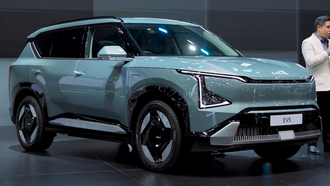
KIA EV5 as a Used Car: What Buyers Should Know
The KIA EV5 is one of the more interesting electric SUVs to consider on the used-car market because it takes a deliberately practical approach to electric mobility. Rather than trying to be a low-slung performance car, the EV5 is a family-oriented SUV with a spacious cabin, a large battery, useful towing capability and the kind of everyday versatility that many buyers expect from a conventional crossover. It is also still a relatively young model, which means that used examples are likely to have relatively low mileage and considerable factory warranty remaining. That is an advantage, but it also means buyers need to look beyond the traditional used-car checklist. Battery condition, charging performance, software, equipment and warranty history are particularly important. In European specification, the EV5 uses an 81.4 kWh battery, with both front-wheel-drive and all-wheel-drive versions available, while the FWD model can achieve up to 530 km of WLTP range in its most efficient configuration.
What Is the KIA EV5?
The EV5 is a mid-sized electric SUV designed around practicality rather than outright performance. It measures approximately 4.61 metres long, 1.875 metres wide and around 1.68 metres high, with a 2.75-metre wheelbase. Those dimensions place it firmly in family-SUV territory, while its relatively upright shape creates useful interior space without making the car excessively large. Kia has also paid considerable attention to luggage capacity: European specifications list approximately 566 litres behind the second row and up to 1,650 litres with the rear seats folded, plus a 44-litre front storage compartment. For a used family EV, those figures are arguably more important than acceleration times because they determine how easily the vehicle can handle shopping, holidays, bicycles, pushchairs and other bulky loads.
The EV5 also has a distinctive character compared with some of Kia’s other electric models. Its cabin is designed to feel more like a lounge than a traditional car interior, with practical storage, comfortable seats and a flat-folding rear-seat arrangement. Depending on trim, equipment can include heated and ventilated seats, advanced driver-assistance systems, premium relaxation seats and other convenience features. For someone considering a used EV5, this means trim level can make a significant difference to the ownership experience. A lower-spec car may offer the same fundamental electric drivetrain, but a well-equipped example can feel considerably more luxurious and versatile.
Battery Options and Electric Range
The 81.4 kWh Battery
European EV5 models are centred around an 81.4 kWh NCM lithium-ion battery. Kia’s European information gives the front-wheel-drive version a maximum WLTP range of 530 km with 18-inch wheels, while 19-inch wheels and higher equipment levels reduce the official figure. Current Czech specifications list up to 530 km for the Air FWD, 520 km for the Earth FWD and 505 km for the GT-Line FWD. The all-wheel-drive models have lower official figures, generally around 484–491 km depending on configuration.
This is an important distinction when shopping for a used EV5 because two visually similar cars can have noticeably different range figures. The large 81.4 kWh battery provides plenty of capacity, but larger wheels, heavier equipment and the additional hardware of the AWD system all influence efficiency. A buyer who values maximum range should therefore not simply search for “EV5 81.4 kWh”; the exact trim and wheel configuration deserve attention as well.
In real-world driving, the EV5’s range will naturally be lower than its WLTP number, especially at motorway speeds or in cold weather. Electric SUVs have relatively large frontal areas, and heating the cabin in winter can increase energy consumption significantly. Nevertheless, the large battery gives the EV5 a useful reserve. For a driver who starts most journeys with a high state of charge, the car should be capable of covering substantial distances without making charging a constant part of the journey.
Is the Long Range Battery Worth It?
Because the European EV5 is already based around the 81.4 kWh battery, the more important used-car decision is often whether to choose FWD or AWD rather than choosing between radically different battery sizes. The FWD version is the efficiency-focused option, while AWD provides additional traction and higher performance at the cost of increased weight and energy consumption.
For buyers who spend most of their time on paved roads, FWD is likely to be sufficient. It is lighter, more economical and has the best official range. AWD makes greater sense for people who regularly drive in mountainous regions, on slippery roads or with heavier loads, and it is also the more powerful configuration. The Czech specifications list 160 kW and 295 Nm for FWD models, compared with 195 kW and 385 Nm for AWD versions.
How Does the KIA EV5 Drive?
The front-wheel-drive EV5 produces 160 kW, equivalent to approximately 218 horsepower, and 295 Nm of torque. It reaches 100 km/h from rest in around 8.4 seconds and has a maximum speed of 165 km/h. Those numbers are not intended to turn the EV5 into a sports SUV, but they are more than adequate for family driving. Electric torque gives the vehicle immediate response when pulling away from traffic lights and useful acceleration when joining a motorway.
The AWD model is substantially quicker, with 195 kW, 385 Nm and a quoted 0–100 km/h time of approximately 7.3 seconds. Its maximum speed rises to 180 km/h. This version will appeal to buyers who want a more energetic driving experience, but the additional performance is not the main reason to choose AWD. The more significant advantage is traction. On wet, snowy or loose surfaces, distributing drive between both axles can provide additional confidence, particularly when the car is carrying passengers and luggage.
The EV5 is fundamentally tuned for comfort and everyday usability. Its upright seating position gives the driver a good view of surrounding traffic, while the SUV body makes getting in and out easier than in a low-slung electric hatchback. Buyers should still inspect suspension components, tyres and wheel alignment carefully on used examples. Heavy electric SUVs put substantial loads on tyres and suspension, and uneven tyre wear can be an early warning sign of alignment or suspension problems.
Charging the EV5
DC Fast Charging
The EV5 can accept DC fast charging at up to around 150 kW in European specification. Kia quotes approximately 30 minutes for a 10–80% charge when the vehicle is connected to a suitable 150 kW charger and the battery is at an appropriate temperature. The same charging time is quoted for the long-range configuration in Kia’s European material.
For a used buyer, this means charging behaviour deserves an actual test. If the seller allows it, connect the vehicle to a known-compatible rapid charger and make sure the charging session starts normally. A quick test cannot reproduce every possible charging condition, but it can identify obvious issues with the charging port, communication between the vehicle and charger or the vehicle’s charging system. Buyers should also inspect the charging connector for damage and check whether the charging cable supplied with the car is the correct type and in good condition.
The EV5’s DC charging performance is competitive rather than class-leading, but the large battery and approximately 30-minute 10–80% charging window make it practical for long trips. As with any EV, however, advertised charging times assume appropriate conditions. Battery temperature, state of charge, charger output and the condition of the charging infrastructure can all influence the actual result.
AC Home Charging
Home charging is where the EV5 becomes especially easy to live with. European specifications list an 11 kW AC charging capability, with a wallbox charge from 10–100% taking around 7 hours 20 minutes. That makes overnight charging straightforward for owners with access to a three-phase home wallbox.
For a used buyer, access to home charging should be one of the first practical questions. If the vehicle can be charged overnight at home, the relatively large battery becomes an advantage because daily charging can be infrequent. A driver might return home with 30 or 40 percent remaining and simply reconnect the car, waking up with a substantially higher state of charge the following morning. Owners who depend exclusively on public chargers should pay more attention to the EV5’s DC charging performance and the availability and cost of chargers in their normal driving area.
What Should You Check When Buying a Used EV5?
Battery Health
Battery condition is the most important technical check when buying any used EV, although an early EV5 should not automatically be considered risky simply because it has a large battery. The model is relatively new, and most used examples are likely to have experienced only limited battery ageing. Nevertheless, buyers should ask for the vehicle’s service history, investigate how it was used and, where possible, obtain a battery-health report.
Kia’s European warranty information is particularly useful here. Current Kia information states that high-voltage EV batteries are covered for eight years or 160,000 km, with a minimum 70% capacity guarantee under the applicable warranty terms; exact warranty provisions can vary by market and model year. This gives a used buyer an important safety net, but the individual vehicle’s registration date and applicable warranty conditions should always be verified before purchase.
It is also worth asking whether the vehicle has been involved in an accident, especially one affecting the underside. An EV’s battery pack is mounted beneath the passenger compartment, so serious underbody damage should never be dismissed simply because the car appears cosmetically repaired. A professional inspection is particularly worthwhile if the EV5 has previously been used on rough roads or has a history that is unclear.
Software and Electronics
The EV5 is heavily dependent on electronic systems, so buyers should spend time checking the car’s digital equipment. Test the infotainment system, instrument display, navigation, reversing camera, parking sensors, climate control, driver-assistance functions, wireless connectivity and all available charging controls. Warning messages should also be investigated rather than dismissed as minor electronic glitches.
Ask whether software updates have been completed and whether any recalls or technical campaigns have been carried out. Connected-car functionality can be an important part of modern EV ownership, so it is worth confirming that the vehicle can communicate correctly with its associated services and that features advertised by the seller actually work.
Is the EV5 Practical for Families?
This is probably the EV5’s strongest argument as a used car. The cabin is spacious, the seating position is upright and the luggage compartment is genuinely useful. Kia lists 566 litres of rear luggage capacity in European specifications and up to 1,650 litres with the rear seats folded. The front compartment adds another 44 litres, giving owners a convenient place for charging equipment or smaller items.
The rear seats are designed to fold flat, creating a loading area that can extend to approximately two metres. That makes the EV5 more versatile than its exterior styling might suggest. For families, the combination of a large boot, spacious rear accommodation and an upright body should make everyday use easy. Buyers with children should nevertheless test their own child seats in the vehicle before purchase, because the theoretical amount of interior space does not necessarily tell you how easily specific child seats, pushchairs and luggage will fit together.
Another useful feature is towing capability. Kia’s European specifications list up to 1,200 kg of braked trailer capacity for the FWD EV5 and up to 1,800 kg for AWD versions in the current Czech-market specification. That is significant for an electric SUV and gives the EV5 an advantage over many smaller EVs. However, towing substantially reduces range, so buyers who intend to tow frequently should consider the AWD version’s higher capacity alongside the additional energy consumption.
Running Costs and Maintenance
An EV5 should have fewer routine mechanical maintenance requirements than an equivalent petrol or diesel SUV. There is no engine oil, exhaust system, conventional automatic transmission or spark plugs, while regenerative braking can reduce wear on the friction brakes. That does not mean the vehicle is maintenance-free, however. Tyres, brakes, suspension, air conditioning, cabin filters and electrical systems still require inspection and servicing.
The weight of the EV5 is particularly relevant when considering running costs. Current Czech specifications put FWD kerb weight at roughly 1,994–2,085 kg depending on specification and AWD versions at approximately 2,077–2,168 kg. That is a substantial amount of mass for tyres and suspension components to support, and aggressive driving can also increase tyre consumption.
Electricity costs will depend on where the car is charged. Home charging can make the EV5 economical to run, while frequent use of public rapid chargers can be considerably more expensive. Prospective used buyers should calculate energy costs using their actual electricity tariff and annual mileage rather than relying on a generic claim that EVs are always cheaper to operate.
Which Used KIA EV5 Should You Buy?
For most buyers, the FWD EV5 is the logical starting point. Its 160 kW motor is sufficiently powerful for normal family driving, it has the best official range and it consumes less energy than the heavier AWD version. The current Czech figures give the Air FWD a maximum WLTP range of 530 km, with higher trims achieving slightly lower figures because of wheel and equipment differences.
The AWD EV5 is the more specialist choice. Its 195 kW output, 385 Nm of torque and 7.3-second 0–100 km/h time make it considerably quicker, while the additional driven axle improves traction. If you live somewhere with difficult winter conditions, regularly travel in mountainous areas or need the higher towing capacity, the extra cost and lower range may be justified.
Trim level also deserves careful consideration. The Air specification already includes useful equipment such as 18-inch wheels, LED lighting, dual-zone climate control, rear air vents, blind-spot assistance, highway driving assistance and adaptive cruise control in the current Czech-market range. Higher trims add comfort and technology features, so used buyers should compare actual equipment rather than assuming that a more expensive car is automatically the better purchase.
Final Verdict: Is the KIA EV5 a Good Used Car?
The KIA EV5 makes a strong case for itself as a used electric SUV because it focuses on areas that matter in everyday ownership. It has a large 81.4 kWh battery, useful range, a genuinely practical cabin, a substantial luggage compartment and respectable towing ability. Its 150 kW DC charging capability and approximately 30-minute 10–80% charging time also mean that long-distance travel is perfectly realistic, while 11 kW AC charging makes overnight home charging convenient.
Its biggest weakness as a used car is not necessarily a mechanical problem but the fact that it is still a relatively young model. There is not yet the long-term reliability history available for established combustion SUVs or older EVs. Buyers should therefore concentrate on the individual example: check the battery, charging system, software, tyres, suspension, service records and warranty status, and preferably have the car inspected independently before completing the purchase.
For most drivers, the FWD EV5 is likely to be the best used choice because it combines sufficient performance with the longest possible range and lower energy consumption. AWD is more compelling for buyers who genuinely need extra traction, performance or towing capacity. Whichever version is chosen, the EV5’s combination of SUV practicality, electric efficiency and long-distance capability makes it one of the more interesting young used EVs to consider.
KIA EV5 Technical Specifications
| Specification | EV5 FWD | EV5 AWD |
|---|---|---|
| Battery capacity | 81.4 kWh | 81.4 kWh |
| Battery type | NCM lithium-ion | NCM lithium-ion |
| Drive | Front-wheel drive | All-wheel drive |
| Maximum power | 160 kW / 218 hp | 195 kW / 265 hp |
| Maximum torque | 295 Nm | 385 Nm |
| Electric motors | 1 | 2 |
| 0–100 km/h | 8.4 s | 7.3 s |
| Maximum speed | 165 km/h | 180 km/h |
| Maximum WLTP range | Up to 530 km | Up to 491 km |
| Official combined consumption | From approx. 16.9 kWh/100 km | Approx. 18.1–18.2 kWh/100 km |
| AC charging | 11 kW | 11 kW |
| AC charging, 10–100% | Approx. 7 h 20 min | Approx. 7 h 20 min |
| DC charging | Up to 150 kW | Up to 150 kW |
| DC charging, 10–80% | Approx. 30 min | Approx. 30 min |
| Length | 4,610 mm | 4,610 mm |
| Width | 1,875 mm | 1,875 mm |
| Height | Approx. 1,680 mm | Approx. 1,680 mm |
| Wheelbase | 2,750 mm | 2,750 mm |
| Ground clearance | Approx. 167–176 mm | Approx. 167–176 mm |
| Rear luggage capacity | 566 litres | 566 litres |
| Maximum luggage capacity | 1,650 litres | 1,650 litres |
| Front luggage compartment | Approx. 44 litres | Approx. 44 litres |
| Maximum braked towing capacity | Up to 1,200 kg | Up to 1,800 kg |
| Battery warranty | Up to 8 years / 160,000 km, subject to market terms | Up to 8 years / 160,000 km, subject to market terms |
| Vehicle warranty | Market-dependent; current Czech specification: 7 years / 150,000 km | Market-dependent; current Czech specification: 7 years / 150,000 km |
*Specifications vary according to market, model year, trim and wheel size. Kia’s current Czech-market figures list FWD range from 505 to 530 km and AWD range from 484 to 491 km, while Kia’s European material quotes up to 530 km for the most efficient FWD configuration. Real-world range depends on temperature, speed, terrain, load, weather, driving style and use of heating or air conditioning.
_front_view.png)