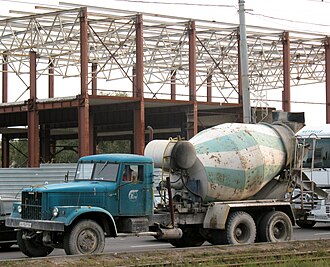
KrAZ-257 Concrete Mixer Truck: A Soviet Workhorse Built for Concrete and Construction
The KrAZ-257 occupies a distinctive place in the history of heavy construction vehicles. Developed by the Kremenchug Automobile Plant, the three-axle truck became one of the characteristic heavy-duty machines of the Soviet era, combining a rugged 6×4 chassis with a powerful diesel engine and a platform designed to accept a wide variety of specialized bodies. Although the basic KrAZ-257 was a general-purpose flatbed truck rather than a concrete mixer in its original form, its universal chassis made it an excellent foundation for specialized equipment, including concrete-mixing bodies. Photographs and surviving examples show KrAZ-257 chassis operating as cement mixer trucks, demonstrating how effectively the underlying vehicle could be adapted to demanding construction work.
What makes the KrAZ-257 particularly interesting is that it was designed during a period when simplicity, durability and the ability to operate far from sophisticated maintenance facilities were considered essential. It was not intended to be a refined highway vehicle in the modern sense. Instead, the truck was expected to haul heavy loads over imperfect roads, work in severe climates and remain useful for years with relatively straightforward mechanical servicing. Its combination of a large-displacement YaMZ diesel, mechanical transmission, heavy frame and driven rear axles gave the platform the characteristics needed for construction applications. For a concrete mixer, those qualities were especially valuable because the vehicle had to carry not only the mixer installation but also a substantial load of wet concrete without sacrificing reliability.
The Origins and Development of the KrAZ-257
From the KrAZ-219 to a New Generation of Heavy Trucks
The KrAZ-257 was introduced in the 1960s as the successor to the older KrAZ-219. Serial production began in 1965, and the model eventually evolved through several modifications, with the improved KrAZ-257B1 continuing production for many years. Sources generally place the production history of the 257 family from the mid-1960s into the 1990s, illustrating just how long the basic design remained relevant.
The transition from the earlier truck to the KrAZ-257 represented more than a cosmetic update. One of the most important changes was the adoption of the YaMZ-238 four-stroke V8 diesel engine. With a displacement of roughly 14.86 liters and an output of about 240 horsepower in the commonly cited specification, the engine provided the torque needed to move a heavily loaded vehicle across difficult terrain. The truck used a five-speed manual transmission, while its 6×4 drivetrain sent power to both rear axles.
For construction operators, this mechanical approach had an obvious advantage. A concrete mixer does not spend its entire working life on smooth highways. It may have to enter construction sites, negotiate rough access roads, climb gradients and repeatedly accelerate with a heavy load. The KrAZ-257’s substantial chassis and driven rear bogie were therefore well suited to this environment.
The Universal Chassis Concept
One of the most important aspects of the KrAZ-257 story is that the truck was not limited to a single body configuration. The KrAZ-257Sh, in particular, was developed as a universal chassis for specialized equipment. Sources list concrete mixers alongside cranes, drilling equipment, tanks and other special-purpose installations among the types of equipment that could be mounted on this platform.
This adaptability helps explain why the KrAZ-257 can be encountered today in forms that look quite different from the standard cargo truck. The basic chassis supplied the engine, transmission, axles, steering, brakes and frame, while a specialist manufacturer could install the equipment required for a particular industry. In the case of a concrete mixer, that meant replacing the conventional cargo body with a rotating drum, drive system, water and control equipment, chutes and the associated supporting structure.
The KrAZ-257 as a Concrete Mixer Truck
A Strong Platform for Heavy Construction Work
A concrete mixer truck has a demanding job. It must transport concrete while keeping the mixture moving, preventing excessive segregation or premature setting, and then deliver the material accurately at the construction site. At the same time, the vehicle carries a considerable additional mass high above the chassis, meaning that frame strength, axle capacity and drivetrain durability become particularly important.
The KrAZ-257’s heavy-duty construction made it a logical candidate for this role. Its basic payload rating is commonly given as approximately 12 tonnes, while the truck’s gross vehicle weight is around 23.3 tonnes in frequently cited specifications. The exact figures could vary according to version and body installation, so specifications for an individual mixer should always be treated as belonging to the complete vehicle rather than automatically to every KrAZ-257 chassis.
The concrete mixer installation itself changes the character of the truck considerably. Instead of a flat cargo platform, the vehicle carries a large cylindrical drum mounted behind the cab. A hydraulic or mechanical system drives the drum, while the operator controls its rotation according to whether the concrete is being mixed, transported or discharged. The rear of the mixer normally incorporates a discharge chute system, allowing the concrete to be directed into forms, foundations or other construction areas.
Why the 6×4 Layout Mattered
The 6×4 arrangement was one of the most useful characteristics of the KrAZ-257 for construction applications. The front axle provided steering, while both rear axles were driven. On a loaded concrete mixer, traction is crucial because the vehicle can become extremely heavy and may have to operate on muddy, gravel or unfinished surfaces.
The truck was also built with considerable ground clearance, cited at approximately 290 millimeters for one standard specification. That clearance, combined with its heavy-duty chassis, helped the vehicle cope with rough working environments. The KrAZ-257 was never a compact urban mixer, and its large turning requirements were a trade-off for the strength and load-carrying capability expected from a Soviet heavy truck.
Engine, Transmission and Mechanical Character
The YaMZ-238 V8 Diesel
At the heart of the KrAZ-257 was the YaMZ-238, a large V8 diesel that became one of the defining engines of this family of heavy vehicles. The commonly cited engine specification is approximately 14.86 liters, producing about 240 horsepower at 2,100 rpm and approximately 883 Nm of torque.
These numbers may appear modest by modern standards, particularly when compared with today’s electronically controlled construction trucks, but horsepower alone does not explain the character of the KrAZ. The engine was designed around low-speed pulling power and durability. Its substantial displacement gave the truck the ability to maintain momentum when heavily loaded, which was more important for its intended role than rapid acceleration.
For a mixer truck, this philosophy made sense. The vehicle’s work cycle involved relatively low road speeds, frequent stopping and starting, and heavy loads rather than high-speed transport. The engine’s strong torque characteristics complemented the manual transmission and driven rear bogie.
The Five-Speed Manual Gearbox
The mechanical five-speed gearbox was another defining element. Unlike modern mixer trucks with automated manual transmissions and sophisticated electronic control systems, the KrAZ-257 relied heavily on driver skill. Gear selection, engine speed and clutch operation all had a direct influence on how effectively the truck could climb, accelerate and maneuver.
This simplicity was also part of the vehicle’s appeal. A truck operating in remote construction regions needed systems that could be understood and repaired by experienced mechanics without specialized electronic diagnostic equipment. The KrAZ-257 belonged to an era when mechanical accessibility and field repairability were major design priorities.
Construction-Site Performance
Built for Difficult Roads
The KrAZ-257 was particularly associated with large-scale infrastructure, industrial and remote-area work. Its relatively low maximum speed—around 68–70 km/h depending on version and specification—was not a disadvantage in the environments for which it was intended. A concrete mixer spends much of its working day moving between a batching plant and construction site, and once on site, speed is largely irrelevant.
More important were the truck’s structural strength, traction and ability to tolerate difficult operating conditions. Published specifications give a climbing capability of approximately 18 degrees for some versions, while the vehicle’s heavy frame and 6×4 configuration contributed to its reputation for working on demanding terrain.
The Importance of Reliability
Concrete production depends on timing. Once cement, aggregate and water have been combined, transportation delays can become a serious problem. A truck that frequently breaks down can therefore create problems far beyond the vehicle itself, potentially affecting an entire construction operation.
The KrAZ-257’s reputation for mechanical robustness was consequently valuable. Its components were relatively straightforward, and many major systems were shared or related across the wider KrAZ family. The result was a vehicle that could be maintained using conventional heavy-truck knowledge rather than depending on highly specialized electronic systems.
Cold-Climate Versions and Harsh Environments
One particularly interesting chapter in the KrAZ-257’s history is its adaptation for the Far North. The KrAZ-257S was designed for extremely low temperatures, with sources describing operation down to approximately −60°C. Modifications included additional insulation, improved heating, double glazing and adaptations to the fuel and electrical systems.
These adaptations demonstrate the broader philosophy behind the truck. The goal was not simply to create a powerful vehicle but to create a machine capable of continuing to function where ordinary trucks might struggle. A mixer truck working in a severe climate would face additional challenges, including cold starts, frozen components and difficult roads, so a platform with a proven extreme-weather heritage had obvious advantages.
The KrAZ-257’s Place in Construction History
More Than Just an Old Soviet Truck
Today, the KrAZ-257 may look enormous, slow and mechanically primitive compared with a modern concrete mixer. Yet judging it solely by modern standards misses the reason for its historical importance. The truck was developed for a different industrial environment, one in which ruggedness, standardization and ease of maintenance could be more important than fuel economy, emissions performance, driver comfort or electronic sophistication.
The appearance of surviving KrAZ-257 concrete mixers is therefore significant. They represent the practical evolution of a chassis into a specialized construction machine. A preserved mixer is not merely an old truck with a drum attached; it is evidence of how heavy-vehicle manufacturers and equipment builders combined a general-purpose platform with specialized technology to meet the demands of large construction projects. Photographic records confirm the existence of KrAZ-257 cement mixer vehicles in Ukraine, including a documented example photographed in Kharkiv.
An Enduring Mechanical Philosophy
The enduring appeal of the KrAZ-257 comes from its straightforward engineering. A large diesel engine, manual gearbox, driven rear axles, substantial frame and adaptable chassis formed a foundation that could perform many different jobs. The concrete mixer was simply one of the most visually distinctive applications.
The model also illustrates how important specialized chassis were to the development of heavy construction equipment. Rather than designing a completely new vehicle for every task, manufacturers could create a strong basic truck and allow different bodies and equipment to transform it into a mixer, crane carrier, tanker or other specialist machine. This approach helped reduce development costs and allowed fleets to use a common mechanical foundation.
Technical Specifications of the KrAZ-257
The following table summarizes commonly cited specifications for the standard KrAZ-257. Because the model was produced for decades and adapted to numerous specialized bodies, individual vehicles—especially concrete mixers—can differ in dimensions, operating mass and performance.
| Specification | KrAZ-257 |
|---|---|
| Manufacturer | Kremenchug Automobile Plant (KrAZ) |
| Production period | 1965–1995 for the 257 family, including later variants |
| Vehicle type | Heavy-duty 3-axle truck / special-purpose chassis |
| Wheel arrangement | 6×4 |
| Engine | YaMZ-238 V8 diesel |
| Engine displacement | Approximately 14.86 L |
| Engine power | Approximately 240 hp (176.5 kW) |
| Maximum torque | Approximately 883 Nm |
| Transmission | 5-speed manual |
| Payload | Approximately 12,000 kg |
| Gross vehicle weight | Approximately 23,300–23,400 kg |
| Maximum speed | Approximately 68–70 km/h |
| Ground clearance | Approximately 290 mm |
| Overall length | Approximately 9,640–9,660 mm |
| Overall width | Approximately 2,650 mm |
| Cab height | Approximately 2,620 mm |
| Wheelbase | Approximately 5,050 + 1,400 mm |
| Tire size | 12.00-20 |
| Typical fuel consumption | Approximately 36 L/100 km in cited specifications |
| Maximum trailer mass | Approximately 16,600 kg on the standard model |
| Typical role | Cargo truck, special-purpose chassis, concrete mixer and other equipment carriers |
Conclusion
The KrAZ-257 concrete mixer truck is best understood as the meeting point between a rugged Soviet heavy-truck chassis and the specialized requirements of concrete construction. The underlying vehicle was not originally conceived solely as a mixer, but its universal chassis, 12-ton-class payload capability, 6×4 drivetrain and powerful YaMZ-238 diesel made it a natural foundation for concrete-mixing equipment. Its mechanical simplicity, high ground clearance and reputation for durability allowed it to operate in environments where lighter or more specialized road vehicles could struggle.
More than half a century after its introduction, the KrAZ-257 remains an impressive example of practical heavy-vehicle engineering. Its enormous V8 diesel, manual transmission and unmistakably robust chassis reflect an era when trucks were designed to be tools first and refined road vehicles second. As a concrete mixer, that philosophy was especially appropriate: the machine had to carry heavy material, reach unfinished construction sites and keep working under demanding conditions. The surviving examples therefore offer more than nostalgia—they provide a fascinating look at the engineering principles that shaped heavy construction equipment for an entire generation.
