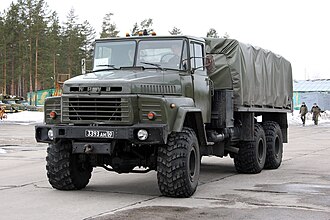
KrAZ-260: The Soviet Heavy-Duty 6×6 Truck Built for the Hardest Roads
The KrAZ-260 is one of the most recognizable heavy off-road trucks to emerge from the Soviet automotive industry. Developed by the Kremenchuk Automobile Plant, the three-axle 6×6 truck was designed around a straightforward idea: carry heavy loads, tow substantial trailers, and continue moving when roads became little more than mud, sand, snow, or broken ground. Produced from the late 1970s into the early 1990s, the KrAZ-260 became an important successor to the famous KrAZ-255 and eventually gave way to the KrAZ-6322. Its combination of a large V8 diesel, robust chassis, permanent all-wheel drive, high ground clearance, and relatively simple mechanical construction made it particularly well suited to military logistics and demanding industrial work.
The Origins of the KrAZ-260
The KrAZ-260 belongs to a generation of Soviet trucks developed when mobility away from paved roads was considered just as important as conventional road performance. The Kremenchuk plant had already established a reputation with the KrAZ-255 family, but the changing requirements of the late 20th century called for a more modern vehicle. The KrAZ-260 retained the basic philosophy of its predecessor—a powerful bonneted truck with three driven axles—while introducing a more modern all-metal cab, a turbocharged diesel engine, and improvements intended to make the vehicle more versatile and capable.
Series production began around the turn of the 1980s, with sources commonly giving 1979 as the beginning of production and 1993 as the end of the model’s production run. The vehicle was initially associated strongly with military use, although its chassis was versatile enough to serve as the basis for tankers, tractors, engineering vehicles, bridge-laying equipment, logging vehicles, and other specialized machinery. The KrAZ-260 was publicly demonstrated as a heavy military vehicle during the 1980s, helping establish its reputation as a major Soviet tactical truck.
The truck was not intended to be elegant or particularly economical. Instead, its engineering prioritized durability, traction, load capacity, and the ability to operate in environments where lighter commercial trucks could quickly become immobilized. That philosophy explains much of the KrAZ-260’s distinctive character: enormous dimensions, a heavy frame, a large-displacement diesel engine, simple suspension, and a drivetrain designed to deliver power to all six wheels.
Engine and Powertrain
The YaMZ-238L V8 Diesel
At the heart of the KrAZ-260 is the YaMZ-238L, a 14.86-liter V8 diesel engine with turbocharging. It develops approximately 300 horsepower (221 kW) at 2,100 rpm and produces about 1,079 Nm of torque at 1,500 rpm. The engine’s enormous displacement and strong low-speed torque were particularly useful for a vehicle whose primary purpose was moving heavy loads through difficult terrain rather than achieving high road speeds.
The engine’s characteristics are typical of heavy Soviet diesel engineering of the period. Rather than relying on high engine speeds, the YaMZ-238L produces substantial pulling power at relatively low rpm. This suits the KrAZ-260’s intended operating environment, where maintaining traction and momentum can be far more important than rapid acceleration. The engine was also equipped with systems intended to improve cold-weather starting, including a preheating arrangement and an electrical flame-heating device.
Transmission and Four-Wheel-Drive Philosophy
The drivetrain combines a manual YaMZ transmission with a two-speed transfer case. Sources describe the overall arrangement as providing eight forward and two reverse ratios, with the transfer case supplying additional off-road reduction. The resulting range of gearing allows the driver to keep the engine operating in a useful torque band while adapting the truck to everything from highway travel to slow movement over severe terrain.
The 6×6 layout is arguably the defining feature of the KrAZ-260. All three axles contribute to propulsion, giving the truck a major advantage when traction is poor. The transfer system incorporates an inter-axle differential, while the chassis and suspension are designed to tolerate considerable articulation and uneven loading. This is why the KrAZ-260 could remain useful in places where a conventional rear-wheel-drive heavy truck would struggle.
Chassis and Off-Road Capability
One of the most impressive aspects of the KrAZ-260 is its ability to combine substantial payload capacity with genuine off-road mobility. The truck has a ground clearance of roughly 370 mm, while its three-axle chassis and short overhangs help it negotiate uneven terrain. Its published maximum gradient capability is around 58 percent, and its rated fording depth is approximately 1.2 meters.
These figures tell only part of the story. Off-road performance depends on tires, surface conditions, vehicle loading, driver technique, and gearing, but the KrAZ-260 was designed from the beginning around these challenges. Its dependent suspension uses leaf springs, while large heavy-duty tires provide the contact area required for a truck of this weight. Steering assistance reduces the physical effort required to control the vehicle, an important consideration when maneuvering a large 6×6 at low speed.
The truck could also be fitted with a self-recovery winch. One documented specification gives the winch a pulling force of approximately 117 kN and a cable length of about 55 meters. Such equipment was not merely an accessory: for a heavy off-road truck, the ability to recover itself from mud or another difficult position can be as important as raw engine power.
Dimensions, Payload and Towing
The KrAZ-260 is physically imposing. It measures approximately 9.03 meters long, 2.72 meters wide, and just under 3 meters high to the cab, with the wheelbase arranged as 4,600 + 1,400 mm. Its unladen weight is around 12.8 tonnes, while its permitted gross weight reaches approximately 22 tonnes. Depending on the specification and source, payload figures are generally given around 9 tonnes, with some references listing approximately 9.2 tonnes for particular configurations.
Towing capacity is another area in which the KrAZ-260 demonstrates its heavy-duty purpose. Published figures give a maximum trailer weight of approximately 30 tonnes on paved roads and around 10 tonnes off-road. The difference illustrates an important principle of heavy vehicle engineering: a truck may have enough engine power to move a very large trailer, but terrain, traction, braking, axle loading, and chassis stresses place much tighter limits away from prepared roads.
On the road, the KrAZ-260 is capable of approximately 80 km/h, although that figure should not be interpreted as its ideal cruising speed. The vehicle was optimized for versatility and endurance rather than speed. Fuel consumption was correspondingly substantial; one commonly cited figure is about 34 liters per 100 km at a constant 50 km/h, while the large fuel capacity helped provide a claimed road range of roughly 1,000 km under specified conditions.
Military and Specialized Uses
More Than a Cargo Truck
Although the basic KrAZ-260 was a cargo truck, its chassis became a platform for numerous specialized vehicles. This flexibility was one of its greatest strengths. Variants included the KrAZ-260V tractor unit and KrAZ-260G long-wheelbase version, while experimental versions explored unusual heavy transport concepts. The basic chassis was also adapted for fuel tankers, engineering machinery, logging equipment, and other specialist roles.
Military applications made particularly good use of the truck’s combination of payload and mobility. The KrAZ-260 chassis was used for engineering equipment, bridge-laying systems, excavators, fuel transporters, and artillery-related applications. Some versions also served as platforms for rocket artillery systems. Its large chassis provided sufficient room and structural capacity for equipment that would have been impractical on a lighter truck.
The KrAZ-260V Tractor
The tractor version demonstrated that the underlying chassis was useful beyond conventional cargo transportation. The KrAZ-260V was intended to haul semitrailers and heavy equipment, exploiting the engine’s torque and the 6×6 drivetrain. Experimental KrAZ-260D combinations went even further, investigating active semitrailers in which the trailer itself received powered wheels. These experiments illustrate how extensively Soviet engineers explored the possibilities of the KrAZ platform for moving exceptionally heavy loads across difficult terrain.
The Driving Experience and Mechanical Character
The KrAZ-260 belongs to a very different era of truck design from modern heavy vehicles. There is little emphasis on electronic assistance, aerodynamic refinement, or fuel efficiency. Instead, the truck is dominated by mechanical systems that can be understood, maintained, and repaired with comparatively conventional heavy-vehicle practices. That simplicity is one reason the model remains interesting to enthusiasts and collectors.
The enormous bonnet, high driving position, large steering wheel, exposed mechanical components, and heavy-duty frame all reinforce the impression that this is a machine designed first and foremost as a working tool. Its 300-horsepower engine sounds modest by modern standards when compared with contemporary heavy trucks, but the 14.86-liter displacement and substantial torque output make the figure more meaningful in context.
At the same time, the KrAZ-260 has clear compromises. It is large, heavy, fuel-hungry, and hardly optimized for modern road traffic. Its braking, steering, cabin comfort, visibility, noise levels, and overall ergonomics reflect engineering priorities from several decades ago. Its strengths appear most clearly when the road disappears and traction, ground clearance, load capacity, and mechanical durability become more important than refinement.
Legacy of the KrAZ-260
The KrAZ-260 eventually gave way to the KrAZ-6322, continuing the evolution of heavy all-wheel-drive trucks from the Kremenchuk plant. Nevertheless, the 260 remains an important link between the classic KrAZ-255 generation and later Ukrainian heavy trucks. Its production period also places it at a fascinating point in history, spanning the final decades of the Soviet Union and continuing into the early post-Soviet period.
Today, the KrAZ-260 is remembered less as a fast truck than as a symbol of uncompromising heavy-duty engineering. Its formula was simple: a huge diesel engine, a strong chassis, three driven axles, low-range gearing, generous ground clearance, and enough carrying capacity to make the vehicle useful for military, industrial, and engineering applications. Those characteristics explain why the KrAZ-260 continues to attract attention among historic military-vehicle enthusiasts, model builders, truck collectors, and people interested in the engineering heritage of Soviet and Ukrainian heavy vehicles.
KrAZ-260 Technical Specifications
| Specification | KrAZ-260 |
|---|---|
| Manufacturer | Kremenchuk Automobile Plant (KrAZ) |
| Production period | 1979–1993 |
| Vehicle type | Heavy-duty off-road truck |
| Drive configuration | 6×6 |
| Engine | YaMZ-238L |
| Engine type | Turbocharged V8 diesel |
| Displacement | 14.86 L |
| Maximum power | 300 hp (221 kW) at 2,100 rpm |
| Maximum torque | 1,079 Nm at 1,500 rpm |
| Transmission | Manual, with two-speed transfer case |
| Gears | 8 forward, 2 reverse |
| Maximum road speed | Approximately 80 km/h |
| Fuel capacity | Approximately 330 L + 50 L reserve |
| Typical published fuel consumption | Approximately 34 L/100 km at 50 km/h |
| Road range | Approximately 1,000 km |
| Payload | Approximately 9 tonnes |
| Gross vehicle weight | Approximately 22 tonnes |
| Unladen weight | Approximately 12,775 kg |
| Length | 9,030 mm |
| Width | 2,720 mm |
| Height | Approximately 2,985 mm |
| Wheelbase | 4,600 + 1,400 mm |
| Ground clearance | 370 mm |
| Maximum gradient | Approximately 58% |
| Fording depth | Approximately 1.2 m |
| Maximum trailer load on road | Approximately 30 tonnes |
| Maximum trailer load off-road | Approximately 10 tonnes |
| Tire size | 11.00R20 |
| Suspension | Dependent, leaf-spring type |
Specifications can vary by production year, modification, and equipment configuration; figures above describe commonly published specifications for the standard KrAZ-260. (Wikipedia)
The KrAZ-260 ultimately stands as an excellent example of purpose-driven vehicle engineering. It was never intended to compete with modern trucks in comfort or economy. Its purpose was much simpler and, in many ways, more demanding: transport heavy loads over roads and terrain that could stop ordinary vehicles. With its 14.86-liter V8, 6×6 drivetrain, roughly nine-tonne payload, substantial towing ability, and impressive off-road geometry, the KrAZ-260 earned its reputation through capability rather than sophistication. That uncompromising character is precisely what makes it such an enduring and fascinating heavy truck.
.jpg)