MAZ-535: The Soviet 8×8 Giant That Pioneered Heavy Military Transport
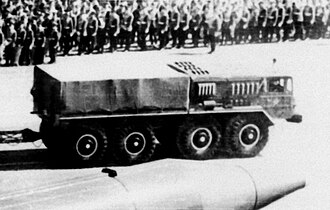
The MAZ-535 occupies a special place in the history of heavy military vehicles. Developed in the Soviet Union during the 1950s, it was not simply a larger version of an ordinary truck. It represented an entirely new approach to moving heavy artillery, missiles, equipment, and trailers across roads and terrain that conventional vehicles could not handle. With four driven axles, a huge 38.8-liter V12 diesel, hydromechanical transmission, independent suspension, enormous tires, and a remarkably high ground clearance, the MAZ-535 was among the most technically ambitious Soviet road vehicles of its era. Its development was closely associated with the Special Design Bureau of the Minsk Automobile Plant under designer Boris Lvovich Shaposhnik, and its appearance established a family of heavy 8×8 vehicles that would ultimately lead to the more powerful MAZ-537. Production of the MAZ-535 family ran from 1958 to 1964, initially at Minsk and later at the Kurgan Wheel Tractor Plant.
The Birth of the MAZ-535
A New Class of Soviet Heavy Vehicle
The origins of the MAZ-535 can be traced to the Soviet military’s growing requirement for vehicles capable of transporting increasingly heavy weapons and equipment. During the early Cold War, artillery systems, missiles, armored vehicles, and specialist military machinery were becoming larger and heavier, creating a need for tractors with capabilities far beyond those of conventional Soviet trucks. In response, the Minsk Automobile Plant established a dedicated design bureau in the mid-1950s, headed by Boris Shaposhnik. The resulting engineering program produced a series of experimental heavy vehicles before the MAZ-535 emerged as a practical production design.
The MAZ-535 was conceived primarily as a heavy artillery and transport tractor rather than as an ordinary cargo truck. Its configuration reflected that mission. The vehicle had four axles and permanent drive to all eight wheels, allowing it to distribute traction across a very large footprint. The basic design also incorporated a small rear cargo platform behind the cab, intended for personnel, ammunition, equipment, or ballast, while much of the vehicle’s real purpose was to provide the pulling power necessary for heavy trailers and specialized military loads. The result was a machine that looked less like a conventional truck and more like a mobile piece of industrial machinery.
Series production began in 1958. The first vehicles were built at the Minsk Automobile Plant, where production continued until 1961. Manufacturing was then transferred to the Kurgan Wheel Tractor Plant, which continued producing the specialized family until 1964. Although the MAZ-535’s production life was relatively short, its importance was much greater than the number of vehicles built might suggest because its chassis, drivetrain concepts, and overall architecture formed the foundation for the more capable MAZ-537 family.
An Extraordinary Engine for Its Time
The 38.8-Liter D-12-A-375 V12
One of the most remarkable features of the MAZ-535 is its engine. The truck was powered by the D-12-A-375, a liquid-cooled V12 diesel with a displacement of approximately 38.88 liters. It produced around 375 horsepower (276 kW) at 1,650 rpm. These numbers may not appear spectacular by the standards of modern heavy trucks, but they were extraordinary for a road-going military vehicle of the late 1950s. The enormous displacement gave the engine the characteristics required for heavy towing: substantial torque, durability, and the ability to maintain useful performance at relatively low engine speeds.
The engine was also a reminder of the close relationship between military vehicle engineering and armored-vehicle technology in the Soviet Union. The D-12 family was derived from an engine lineage associated with Soviet tank powerplants, and the MAZ-535 effectively adapted this large-displacement concept for a wheeled vehicle. A two-stage air-filtration system helped the engine operate in dusty environments, while a powerful preheating system was intended to assist starting and warm-up in severe cold. Published specifications indicate that the vehicle was designed to function across an exceptionally broad temperature range, from approximately −50°C to +50°C.
Fuel consumption was inevitably one of the compromises associated with such a large engine. A commonly cited control figure is approximately 75 liters per 100 kilometers, although actual consumption naturally depended on terrain, load, weather, and operating conditions. The truck carried approximately 700 liters of fuel, giving it the endurance required for military operations but also making fuel logistics an important consideration. The enormous engine and fuel requirement demonstrate that the MAZ-535 was designed around capability rather than economy.
The Innovative 8×8 Drivetrain
Hydromechanical Transmission and Independent Suspension
Perhaps the most technologically interesting aspect of the MAZ-535 is that its designers did not simply install a giant engine into a conventional truck chassis. The entire drivetrain was developed around the requirements of an exceptionally heavy off-road vehicle. The truck used a hydromechanical transmission, combining a torque converter with a planetary gearbox and a two-speed transfer system. This arrangement helped the driver manage the enormous torque produced by the V12 while reducing the need for conventional clutch operation under heavy loads.
The MAZ-535 also used permanent all-wheel drive and an elaborate differential arrangement. Contemporary descriptions identify multiple differentials, cardan shafts, and planetary hub reductions, all working together to transmit power to eight driven wheels. This was a highly sophisticated solution for its period. Instead of concentrating the engine’s output through only one or two axles, the system distributed propulsion across the entire vehicle, dramatically improving traction on loose or uneven surfaces.
Another unusual feature was the independent suspension of all wheels. For a truck of approximately 19 tonnes, this was a major engineering achievement. Independent suspension allowed the four axles to follow uneven terrain more effectively while helping keep the large tires in contact with the ground. Combined with approximately 475 mm of ground clearance, the suspension contributed to the MAZ-535’s ability to travel away from paved roads.
Built for Difficult Terrain
The MAZ-535’s physical dimensions reveal how seriously its designers approached off-road mobility. The vehicle measured approximately 8.78 meters long, 2.805 meters wide, and 2.915 meters high, with a wheelbase of about 5.75 meters. Its standard ground clearance was approximately 475 millimeters, while its large 18.00-24 tires provided considerable flotation and traction. The vehicle could climb gradients of around 30 degrees and negotiate water obstacles approximately 1.3 meters deep under specified conditions.
The four-axle configuration was particularly valuable when the truck was operating on soft ground. Instead of placing a very large load on only two axles, the MAZ-535 distributed its weight over eight wheels. This reduced the concentration of load and gave the vehicle multiple opportunities to maintain traction. The independent suspension further helped each wheel respond to changes in terrain, while the permanent 8×8 system meant that traction was available across the entire chassis.
A winch was also available on relevant versions, with published specifications giving a pulling force of approximately 15 tonnes and a cable length of around 100 meters. For a vehicle weighing close to 19 tonnes before carrying additional loads, a recovery system of this magnitude was extremely valuable. If the truck became stuck in mud, soft soil, or another difficult position, the winch could provide an important means of self-recovery or assisted recovery.
Payload and Towing Ability
A Tractor Rather Than a Conventional Truck
Although the MAZ-535 could carry approximately 7 tonnes, its greatest importance was its ability to tow. The relatively modest cargo platform was a clue to the vehicle’s true mission: the truck itself was essentially a powerful traction unit for moving heavy equipment. Published sources give a trailer capacity of around 15 tonnes for the standard configuration, although some specifications for particular variants and operating conditions differ considerably. This variation reflects the fact that the MAZ-535 family included several specialized versions intended for different military applications.
On hard surfaces, the tractor could reach approximately 60 km/h, but its speed dropped substantially when pulling heavy loads. A commonly cited figure places loaded-trailer speeds around 35–40 km/h, while other sources distinguish between different permissible combinations and operating conditions. The MAZ-535 was therefore not intended to be a fast highway vehicle. Its purpose was to move massive loads reliably, including over poor roads and difficult terrain.
This emphasis on towing rather than speed became increasingly important as Soviet military equipment grew heavier. The MAZ-535 performed the job for which it was designed, but its limitations quickly became apparent. The 375-horsepower engine and towing capacity that seemed impressive in the late 1950s were no longer sufficient for all of the heavier loads being introduced. This created pressure for a new generation of heavy tractors.
The MAZ-535 Variants
MAZ-535A, MAZ-535B and MAZ-535V
Several versions of the basic vehicle were produced or developed. The MAZ-535A represented one of the principal production configurations and is frequently used as the reference model for technical specifications. Other variants, including the MAZ-535B and MAZ-535V, were adapted for particular military roles. Changes could include differences in the rear equipment arrangement, strengthened components, specialized towing equipment, or modifications associated with missile and armored-vehicle transport.
The MAZ-535V was especially important in the evolution toward heavy transporter tractors. It was used by Soviet missile forces and was also associated with tank transport duties. Its development demonstrated that the basic MAZ-535 architecture had considerable potential beyond artillery towing. As Soviet requirements increased, however, engineers recognized that a more powerful vehicle was needed.
From MAZ-535 to MAZ-537
The Beginning of a Legendary Heavy Tractor Family
The MAZ-535’s greatest legacy may be the development of the MAZ-537. Soviet engineers began investigating a more powerful successor while the 535 was still relatively new. The objective was straightforward: retain the successful elements of the heavy 8×8 concept but substantially increase engine power and towing capacity. The resulting MAZ-537 used a D-12A-525 engine producing approximately 525 horsepower, making it dramatically more capable than the 375-horsepower MAZ-535.
The transition from the MAZ-535 to the MAZ-537 illustrates how rapidly military transportation requirements were changing during the early Cold War. Missiles, tanks, launch systems, and other equipment were becoming heavier, and the tractor itself needed to become stronger. The MAZ-535 was therefore both a successful vehicle in its own right and an important stepping stone toward the much more capable Soviet heavy transporters that followed.
Why the MAZ-535 Still Matters
The MAZ-535 is historically significant because it demonstrated what was possible when Soviet engineers approached the heavy-truck problem without being constrained by conventional commercial-vehicle design. It combined a huge V12 diesel, eight-wheel drive, hydromechanical transmission, independent suspension, planetary reductions, power steering, high ground clearance, and heavy-duty recovery equipment into one machine. Several of these technologies were unusually advanced for a Soviet truck of the 1950s.
Its importance also extends beyond its short production run. The vehicle established an engineering template that became characteristic of Soviet heavy military transport: massive displacement, multiple driven axles, robust mechanical systems, enormous tires, and a chassis designed around extreme loads. The MAZ-535 was eventually replaced by more powerful machines, but the principles demonstrated by the vehicle continued through later generations of Minsk-designed heavy tractors.
Today, the MAZ-535 is remembered as one of the pioneering Soviet heavy 8×8 vehicles. It was not economical, compact, or fast by modern standards, but those were never its primary objectives. It was created for a world in which strategic mobility could depend on moving extremely heavy equipment across undeveloped roads, muddy terrain, snow, and remote military routes. Its imposing dimensions and enormous V12 engine were practical responses to those demands rather than attempts at excess for its own sake.
MAZ-535 Technical Specifications
| Specification | MAZ-535 / MAZ-535A |
|---|---|
| Manufacturer | Minsk Automobile Plant (MAZ); later KZKT |
| Production period | 1958–1964 |
| Vehicle type | Heavy artillery / military tractor |
| Wheel configuration | 8×8 |
| Engine | D-12-A-375 |
| Engine type | Liquid-cooled V12 diesel |
| Engine displacement | 38.88 L |
| Maximum power | 375 hp (276 kW) at 1,650 rpm |
| Transmission | Hydromechanical |
| Suspension | Independent on all wheels |
| Ground clearance | 475 mm |
| Payload | Approximately 7,000 kg |
| Vehicle weight | Approximately 19 tonnes |
| Maximum speed | Approximately 60 km/h |
| Typical trailer capacity | Approximately 15 tonnes, depending on configuration |
| Fuel capacity | Approximately 700 L |
| Control fuel consumption | Approximately 75 L/100 km |
| Length | 8,780 mm |
| Width | 2,805 mm |
| Height | 2,915 mm |
| Wheelbase | 5,750 mm |
| Track width | 2,150 mm |
| Tire size | 18.00-24 |
| Maximum gradient | Approximately 30° |
| Fording depth | Approximately 1.3 m |
| Winch pulling force | Approximately 15 tonnes |
| Winch cable | Approximately 100 m |
| Electrical system | 24 V |
| Operating temperature range | Approximately −50°C to +50°C |
Specifications can vary between the MAZ-535’s different variants and production configurations. The figures above primarily reflect commonly published data for the MAZ-535A and related production vehicles.
Conclusion
The MAZ-535 was much more than a large Soviet truck. It was a pioneering heavy-duty 8×8 platform that introduced a remarkable combination of technologies at a time when multi-axle military transport was still developing rapidly. Its 38.8-liter V12 provided the muscle, while the hydromechanical transmission, permanent all-wheel drive, independent suspension, planetary reductions, and huge tires transformed that power into useful mobility. The vehicle’s short production life was ultimately a consequence of its own success: as Soviet military equipment became heavier, the 535’s capabilities were no longer sufficient, leading directly toward the more powerful MAZ-537.
For that reason, the MAZ-535 deserves to be viewed not simply as an obsolete military truck, but as a landmark in the evolution of Soviet heavy transport. It established a formula that would influence an entire generation of enormous 8×8 tractors and missile carriers. Even decades after its production ended, the sight of a MAZ-535—with its four axles, towering tires, compact cab, and enormous V12 engine—remains an unmistakable reminder of the extraordinary engineering demands of the early Cold War.
