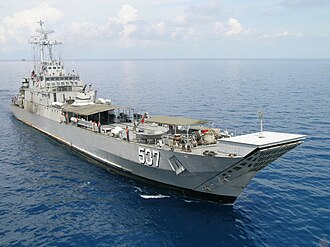
The Indonesian Navy, officially known as Tentara Nasional Indonesia Angkatan Laut (TNI AL), plays a fundamental role in protecting Indonesia’s maritime territory, maintaining national sovereignty, and supporting military operations throughout the country’s extensive archipelago. With thousands of islands spread across strategically important maritime routes, Indonesia requires a naval force capable of performing a wide range of missions, from maritime patrols and territorial defence to amphibious operations and military transportation. Among the vessels contributing to these responsibilities is KRI Teluk Manado (537), a medium landing ship tank (LST) belonging to the Frosch I family, which has served the Indonesian Navy since the 1990s.
Unlike modern frigates, destroyers, and missile-armed patrol vessels, KRI Teluk Manado is primarily designed to transport military personnel, vehicles, equipment, and logistical supplies. Its principal strength is its ability to support the movement of armed forces across Indonesia’s maritime territory, particularly to islands and coastal regions where conventional transportation infrastructure may be limited. This capability makes the vessel an important part of Indonesia’s military sealift system, allowing the armed forces to move substantial quantities of equipment and personnel between different operational areas.
KRI Teluk Manado has an interesting international history. Originally constructed in East Germany during the Cold War, the ship entered service with the East German Navy under the name Neubrandenburg and carried pennant number 633. Following German reunification and the dissolution of the East German naval force, the vessel became available for disposal and was subsequently acquired by Indonesia in 1993. After its transfer and preparation for Indonesian service, it was commissioned as KRI Teluk Manado (537) on 2 June 1995. Its transition from an East German military transport vessel to an Indonesian naval asset illustrates how military ships can continue serving different countries and strategic environments over several decades.
The ship takes its Indonesian name from Manado Bay, located in North Sulawesi. This geographical connection reflects a longstanding naming tradition within the Indonesian Navy, where warships are frequently named after important geographical features, islands, bays, and other locations associated with the country’s national identity. Its pennant number, 537, distinguishes it from other vessels in the Indonesian fleet and identifies it in official military communications and operational records.
Although KRI Teluk Manado was designed several decades ago, its transportation capabilities remain relevant to Indonesia’s geographical and military requirements. The ship has participated in operations involving the transportation of army and marine personnel, logistical equipment, and military supplies to remote regions. Its documented activities include support for personnel deployments to Papua and the transportation of military resources associated with the Damai Cartenz security operation in 2024. These missions demonstrate why landing ships remain essential even in a naval force that increasingly operates modern combat vessels.
Historical Background of KRI Teluk Manado
Construction in East Germany
The origins of KRI Teluk Manado can be traced to the shipbuilding industry of the former German Democratic Republic, commonly known as East Germany. During the Cold War, East Germany maintained a naval force called the Volksmarine, which was responsible for protecting its maritime approaches and supporting the country’s military objectives in the Baltic Sea. To fulfil these responsibilities, the East German Navy operated various types of patrol vessels, combat ships, minesweepers, and amphibious transportation vessels.
The ship that would eventually become KRI Teluk Manado was constructed at VEB Peenewerft in Wolgast, East Germany. It was built as part of the Frosch I programme, also identified as Project 108, which involved the development of medium landing ships for military transportation and amphibious operations. The ship’s construction began with the laying of its keel on 21 August 1976, and it was launched on 6 April 1977. Following its completion and acceptance into naval service, it was commissioned into the East German Navy on 28 December 1977 under the name Neubrandenburg and pennant number 633.
The Frosch I design reflected the requirements of a navy that needed to transport military vehicles, troops, and supplies while maintaining the ability to support landing operations. Unlike conventional cargo ships, which are primarily designed for commercial transportation between established ports, military landing ships are developed around the requirements of military logistics. Their construction must accommodate the movement of heavy equipment, the transportation of personnel, and the practical challenges associated with delivering cargo to coastal locations.
The development of these vessels was particularly important during the Cold War, when military planners placed considerable emphasis on the ability to move ground forces and equipment by sea. A landing ship could transport vehicles and supplies that would otherwise require multiple smaller vessels or specialised commercial transportation arrangements. This made the Frosch I class a useful component of the East German Navy’s amphibious and logistical capabilities.
Service as Neubrandenburg (633)
During its original service, Neubrandenburg operated as a medium landing ship within the Volksmarine. Its principal responsibilities were associated with military transportation, amphibious support, and the movement of equipment. Its construction reflected a practical approach to naval warfare, where the ability to deliver military resources to coastal locations was considered an important complement to the capabilities of frontline combat vessels.
The vessel served under the East German flag until the political changes that transformed Germany at the end of the Cold War. German reunification in October 1990 resulted in the dissolution of the Volksmarine as an independent naval organisation. Its former vessels were subsequently evaluated for possible transfer, disposal, or integration into the unified German Navy. Not all of the former East German ships were retained, and several were eventually made available to foreign buyers.
Neubrandenburg was decommissioned on 2 October 1990 after being removed from the East German naval inventory. The vessel was not incorporated into the unified German Navy and remained awaiting disposal. This period marked the end of its original military career and created the possibility of a second operational life under another national flag.
Acquisition by Indonesia in 1993
Indonesia’s acquisition of former East German naval vessels was part of a broader programme to strengthen the country’s naval capabilities during the early 1990s. The Indonesian government sought to improve the availability of warships and military transportation platforms through the acquisition of vessels that could fulfil operational requirements without waiting for the construction of entirely new ships.
The procurement programme was associated with Presidential Instruction No. 3 of 1992, issued on 3 September 1992. The programme was coordinated by a government procurement team under the involvement of B. J. Habibie, who was serving as Minister of State for Research and Technology. It included the acquisition of several former East German naval vessels, among them the Frosch I-class landing ships.
Indonesia acquired the former Neubrandenburg on 25 August 1993. Before the ship began its journey toward Indonesia, it underwent preparation and refitting in Germany, including the removal of its former military equipment as part of the transfer arrangements. Following the completion of the necessary preparations, the vessel was transferred to Indonesia and formally commissioned into the Indonesian Navy on 2 June 1995 as KRI Teluk Manado (537).
The acquisition provided the Indonesian Navy with another medium landing ship capable of supporting military sealift operations. It also represented an example of international military procurement during a period when Indonesia was expanding and reorganising its naval capabilities. The vessel’s new name reflected its transition into Indonesian service and established its identity within the country’s maritime defence structure.
The Meaning of the Name Teluk Manado
The name Teluk Manado refers to Manado Bay, a prominent geographical feature located in North Sulawesi. The bay is closely associated with the city of Manado and the surrounding maritime region, which occupies an important position in Indonesia’s eastern maritime approaches.
The use of geographical names for Indonesian warships reflects the relationship between the national fleet and the country’s archipelagic identity. By naming the ship after Manado Bay, the Indonesian Navy gave the former East German vessel a new national identity that connected it to Indonesia’s maritime geography.
The pennant number 537 serves as the ship’s operational identification. It distinguishes KRI Teluk Manado from other vessels, including ships that have historically carried similar geographical names. The designation is especially useful in official naval announcements, deployment reports, and military documentation.
Design and Physical Characteristics
Frosch I-Class Medium Landing Ship
KRI Teluk Manado belongs to the Frosch I class, a family of medium landing ships developed in East Germany under Project 108. In Indonesian naval service, these ships are also associated with the Teluk Gilimanuk class designation. The vessels were designed to provide a practical means of transporting military cargo, vehicles, and personnel over water while supporting amphibious operations.
The Frosch I design prioritises cargo transportation and operational flexibility rather than the sophisticated combat capabilities associated with modern guided-missile warships. Its hull and internal arrangements are intended to accommodate military loads, making it suitable for missions involving the movement of equipment and troops between islands and coastal locations.
Commonly published specifications describe KRI Teluk Manado as approximately 98 metres long, with a beam of 11.1 metres and a draught of approximately 2.8 metres. However, some Indonesian naval reporting and technical summaries list a shorter length of approximately 90.7 metres and a draught of approximately 3.4 metres. These differences should be acknowledged when discussing the vessel, since secondary sources do not always use identical measurement conventions or provide the same configuration data.
The ship’s commonly reported full-load displacement is approximately 1,950 long tons, equivalent to around 1,980 metric tonnes. Other Indonesian references describe a full-load displacement closer to 1,900 tonnes and an unloaded displacement of approximately 1,744 tonnes. Displacement represents the weight of the ship and its contents, whereas cargo capacity refers specifically to the additional load it can transport. Understanding this difference is essential when evaluating the performance of a military landing ship.
Hull Arrangement and Cargo Deck
The hull arrangement of a medium landing ship is designed to support the transportation of heavy military equipment. Its internal spaces must provide sufficient room for vehicles, supplies, and other military cargo while maintaining the structural strength required for operations at sea. Unlike a conventional passenger vessel, where accommodation and passenger comfort are central design considerations, a landing ship places considerable emphasis on the practical handling and transportation of military loads.
KRI Teluk Manado’s design is particularly useful for transporting vehicles and supplies that ground forces require during deployments. These may include military trucks, armoured vehicles, engineering equipment, fuel containers, maintenance supplies, and other essential resources. The ability to move these items together with military personnel makes the ship an important component of Indonesia’s transportation network.
The vessel’s amphibious characteristics also allow it to support operations involving coastal delivery. However, the exact loading arrangements and operational methods depend on the condition of the receiving location, the weight and dimensions of the cargo, and the ship’s current technical condition. It is therefore important not to assume that every theoretical feature of the original Frosch I design is necessarily available in an identical form on the Indonesian vessel today.
Dimensions and Displacement
The dimensions of KRI Teluk Manado place it within the medium landing ship category. Its length provides the space required for cargo transportation, while its beam contributes to the hull’s internal volume and stability. Draught is particularly relevant because it determines the depth of water required beneath the vessel during navigation.
These characteristics are important for military transportation in an archipelagic environment. Ships operating between Indonesian islands may encounter different harbour conditions, coastal approaches, and water depths. A vessel’s dimensions therefore influence where it can operate and what types of loading and unloading arrangements may be practical.
Its displacement also provides an indication of the vessel’s scale. Although it is considerably smaller than a large modern amphibious assault ship, KRI Teluk Manado offers a useful combination of cargo capacity and maritime mobility. Its design was developed for a specific logistical purpose, and its effectiveness should be assessed in relation to that mission rather than by comparing it directly with much larger frontline combatants.
Propulsion System and Performance
Twin Diesel Engine Configuration
KRI Teluk Manado uses a diesel propulsion arrangement consisting of two engines connected to two propeller shafts. This configuration provides the mechanical power necessary to move the ship while carrying military cargo and personnel over considerable maritime distances.
Published technical references commonly identify an installed power output of approximately 5,000 horsepower. Some Indonesian reports, however, list a substantially higher figure of approximately 12,000 brake horsepower. Since these figures are inconsistent, they should be regarded as source-dependent specifications rather than definitive confirmation of the ship’s current machinery output.
Diesel propulsion is suitable for a military transportation vessel because it supports sustained maritime movement and provides the power necessary to carry substantial loads. The two-shaft arrangement is also a characteristic feature of the ship’s original design and provides the propulsion system with two mechanical drive lines.
The reliability of the propulsion system is particularly important for military sealift operations. A transport vessel must be able to complete planned voyages while carrying personnel, vehicles, and supplies, often across long distances and under changing weather conditions. Mechanical reliability, fuel management, maintenance planning, and crew experience all contribute to the ship’s operational effectiveness.
Maximum Speed and Maritime Mobility
The commonly reported maximum speed of KRI Teluk Manado is approximately 18 knots, equivalent to around 33 kilometres per hour. Some Indonesian technical references give a speed of 18–19 knots. This performance is appropriate for a medium landing ship whose primary purpose is transportation rather than high-speed combat operations.
Maximum speed is only one measure of a ship’s performance. For military transportation vessels, endurance, fuel consumption, cargo weight, navigation conditions, and the distance between operational locations are equally important. A ship that can transport hundreds of tonnes of military equipment safely and reliably may provide greater logistical value than a faster vessel with considerably less cargo capacity.
KRI Teluk Manado’s mobility is therefore best evaluated through its ability to support the movement of personnel and equipment between different military regions. Its contribution is especially relevant when ground forces need to be transported to islands, border regions, or other locations where land-based transportation is unavailable or impractical.
Operational Range
Some Indonesian technical summaries report a range of approximately 2,450 kilometres for KRI Teluk Manado. However, published information does not consistently specify the speed, fuel reserve, sea conditions, and loading assumptions associated with this figure. It should consequently be treated as a reported reference value rather than a guaranteed operational range.
In practical naval operations, the distance a vessel can travel depends on numerous factors. These include fuel capacity, engine condition, average cruising speed, sea state, cargo load, maintenance condition, and the amount of fuel reserved for emergencies. Military planners must take these variables into account when organising long-distance deployments.
For Indonesia, range and endurance are especially important because naval transportation routes may connect islands separated by substantial distances. The ability to plan voyages carefully and maintain reliable fuel and supply arrangements is essential for ensuring that a landing ship can complete its assigned transportation mission.
Cargo Capacity and Troop Transportation
Military Cargo Transportation
One of the principal strengths of KRI Teluk Manado is its ability to carry military cargo. Published references commonly associate the Frosch I design with a cargo capacity of approximately 400–600 tonnes, with some sources citing a maximum capacity of around 600 tonnes. This gives the vessel the ability to transport a considerable quantity of equipment during a single voyage.
Military cargo can include a wide range of materials needed to support deployed forces. Trucks, armoured vehicles, engineering machinery, spare parts, fuel supplies, food, drinking water, communications equipment, and medical resources are all important components of military logistics. The transportation of these resources is essential for maintaining operational readiness, particularly when forces are deployed far from their main bases.
The ability to transport equipment by sea is particularly important in Indonesia because the country’s geography creates significant logistical challenges. Moving heavy vehicles between islands by air is often impractical or expensive, while commercial shipping arrangements may not always meet the requirements of military deployments. A dedicated naval transportation vessel provides an additional option that can be coordinated directly with military operational planning.
Transportation of Amphibious Vehicles
The Frosch I design is commonly associated with a theoretical vehicle-carrying capacity of up to 11 amphibious tanks. This figure is frequently cited in technical descriptions of the class and illustrates the original military transportation concept behind the vessel.
Amphibious vehicles are important during operations in which ground forces need to move from a ship toward a coastal area. Their ability to operate in different environments can help connect maritime transportation with land-based military activities. Nevertheless, the exact number and type of vehicles that KRI Teluk Manado can carry in a particular mission depend on their dimensions, weight, loading arrangements, and the ship’s operational limitations.
The transportation of heavy vehicles also requires careful consideration of cargo distribution and stability. The crew must ensure that the load is secured properly and that the ship remains within its approved loading limits. These procedures are essential for safe navigation, especially when the vessel encounters rough weather or changing sea conditions.
Troop Transportation Capabilities
In addition to cargo, KRI Teluk Manado is designed to transport military personnel, including members of the Indonesian Marine Corps. Published descriptions of the Frosch I class commonly refer to a troop-carrying capacity equivalent to approximately one company of marines.
Troop transportation is an important part of Indonesia’s military sealift responsibilities. Army and marine units may need to move between different islands to reinforce military installations, conduct border security operations, participate in exercises, or support national security missions. A landing ship can transport personnel and equipment together, making deployment arrangements more practical.
The vessel’s role is not limited to the physical movement of soldiers. Military transportation also requires careful coordination involving embarkation schedules, equipment inventories, food and water supplies, communications, safety procedures, and arrival arrangements. These activities ensure that troops can reach their operational destination with the resources required to perform their assigned responsibilities.
Armament and Defensive Systems
Main Defensive Armament
Although KRI Teluk Manado is primarily a military transportation vessel, it is also equipped with defensive weapons intended to provide a degree of protection during naval operations. Published descriptions of its Indonesian configuration identify one Bofors 40 mm gun, one twin-barrel 37 mm installation, and two twin-barrel 25 mm automatic guns.
The 40 mm Bofors weapon is a well-known naval gun design that has been used by numerous navies around the world. Its presence reflects the historical practice of equipping military transport ships with weapons capable of providing limited defence against potential surface and airborne threats.
The 37 mm and 25 mm weapons provide additional defensive firepower. These guns are associated with older generations of naval automatic artillery and are different from the sophisticated missile systems found on modern frigates and destroyers. Their presence should therefore be understood in the context of the ship’s transportation mission rather than as evidence of a high-end independent combat capability.
The exact condition and present configuration of these weapons should be treated cautiously because publicly available historical equipment lists do not necessarily reflect every subsequent maintenance activity or modification. Nevertheless, the reported armament provides a useful overview of the vessel’s original Indonesian defensive configuration.
Radar and Navigation Equipment
Radar systems are essential for maritime navigation and situational awareness. Technical descriptions of KRI Teluk Manado identify the TSR-333 navigation radar and the MR-302 Strut Curve air and surface search radar.
The navigation radar supports the ship’s ability to monitor surrounding objects and identify information relevant to safe navigation. This is particularly important when operating near coastlines, in busy maritime traffic areas, or when approaching ports and anchorages.
The MR-302 radar provides air and surface surveillance capabilities, allowing the ship to monitor its surrounding maritime environment. These systems were developed for an earlier generation of naval operations, and their presence reflects the original technological background of the Frosch I family.
As with the vessel’s weapons, the historical radar listing should not automatically be interpreted as a verified inventory of every electronic system currently installed aboard KRI Teluk Manado. Older vessels may undergo equipment replacements and upgrades as part of their maintenance programmes.
Electronic Countermeasures
Published descriptions also identify two PK-16 chaff launchers as part of the vessel’s electronic countermeasure equipment. Chaff is a defensive material used to interfere with certain radar-guided systems by creating reflective returns that may complicate target tracking.
The inclusion of chaff launchers reflects the importance of basic self-protection measures for naval vessels. A military transport ship may not be designed to operate as a frontline combatant, but it can still face risks while conducting deployments in potentially sensitive maritime environments.
Defensive equipment is therefore part of the wider effort to preserve the ship’s ability to complete its assigned mission. In practice, the vessel’s protection also depends on operational planning, situational awareness, naval coordination, and support from other military units when necessary.
Operational Role in the Indonesian Navy
Military Sealift and Logistical Support
KRI Teluk Manado is closely associated with the military sea transportation responsibilities of Komando Lintas Laut Militer (Kolinlamil), the Indonesian Navy’s military sealift command. This organisation plays an important role in supporting the transportation of personnel, equipment, and logistical supplies for the Indonesian armed forces.
Military sealift is particularly important in Indonesia because the country’s islands are separated by large areas of water. Ground forces cannot always move directly between operational locations, and air transportation may not be suitable for every type of cargo. Naval transport vessels provide a practical way to move military resources in substantial quantities.
KRI Teluk Manado contributes to this system by supporting personnel deployments, equipment transfers, military exercises, and logistical operations. Its role is closely connected to the ability of the Indonesian armed forces to maintain a presence in distant regions and support units operating away from their permanent bases.
Support for Army and Marine Corps Operations
The transportation of army and marine personnel is among the vessel’s most important responsibilities. These military units may be assigned to border security missions, regional exercises, territorial security operations, or other deployments that require movement across Indonesian waters.
KRI Teluk Manado allows military commanders to coordinate the transportation of personnel and equipment through a naval platform. This can be particularly useful when heavy vehicles, logistical supplies, and other equipment must accompany the deployed troops.
The vessel also demonstrates the importance of cooperation between the Indonesian Navy and other branches of the armed forces. Although the Navy operates the ship, the personnel and equipment being transported may belong to the Army, Marine Corps, or specialised military units. Such cooperation is essential for conducting joint operations throughout the archipelago.
Transportation to Remote and Border Regions
Remote islands and border areas require regular logistical support because military personnel stationed in these locations may be far from major supply centres. Food, water, fuel, communications equipment, and replacement personnel must be delivered according to operational requirements.
A landing ship can contribute to these missions by transporting substantial quantities of supplies and personnel in a coordinated manner. This capability is particularly important when road infrastructure is limited or when geographical conditions make other transportation options difficult.
The strategic importance of these activities extends beyond military logistics. Maintaining a regular presence in border regions and remote islands contributes to national territorial security and demonstrates the government’s ability to support its personnel throughout the country’s maritime territory.
Notable Operational Deployments
Operations Supporting Security in Papua
KRI Teluk Manado has participated in military transportation missions involving the deployment and return of personnel serving in Papua. One documented example occurred in November 2015, when the vessel supported the transportation of personnel and equipment belonging to Batalyon Infanteri 509/Raider for a regional security assignment.
The operation involved the movement of military resources to Jayapura, where the vessel supported the disembarkation of personnel and equipment. This mission illustrated the importance of naval transportation in supporting ground forces deployed to geographically challenging regions.
Another notable operation took place in April 2017, when KRI Teluk Manado supported the return transportation of personnel from an infantry raider battalion following a border security assignment involving the Indonesia–Timor-Leste border region. These activities demonstrate that the ship’s responsibilities have included both the deployment of military personnel and the return transportation of forces after the completion of their assignments.
Such operations require careful coordination between naval crews and ground-force units. Personnel, vehicles, and supplies must be loaded and secured before departure, transported safely, and delivered to the designated destination according to operational schedules.
Support for the Damai Cartenz Operation in 2024
One of the more recent documented examples of KRI Teluk Manado’s military transportation role occurred in May 2024, when the ship supported personnel and material transportation associated with the Damai Cartenz security operation.
According to an official Kolinlamil report published on 3 May 2024, KRI Teluk Manado-537 was involved in the transportation of equipment for Satgas Damai Cartenz 2024, supplies and equipment for Satgas Mandala IV Kopassus, and personnel from Batalyon Infanteri 6 Marinir. The planned destination was the Timika-Papua region, where the forces were assigned to support security responsibilities along the Indonesia–Papua New Guinea border.
This operation provides a particularly clear example of the ship’s value as a military sealift platform. The vessel was not simply transporting individual soldiers; it was also supporting the movement of specialised military equipment, supplies, and resources required by different units.
The operation further demonstrates the importance of cooperation between different Indonesian military formations. The transportation of personnel and material belonging to several units requires logistical planning and coordination to ensure that the correct equipment reaches the appropriate destination.
Operational Responsibilities in the Wider Indonesian Archipelago
Beyond individual deployments, KRI Teluk Manado’s wider responsibilities are connected to the movement of military resources throughout Indonesia. Its capabilities are relevant to operations involving remote islands, regional military installations, and areas where transportation infrastructure is limited.
The ship’s contribution can include the movement of personnel between military bases, the transportation of supplies for deployed units, support for amphibious exercises, and the delivery of equipment required for national security activities.
These tasks may not always attract the same public attention as major combat operations, but they are essential to the functioning of an archipelagic military force. Without reliable transportation, maintaining military readiness across geographically separated regions would be considerably more difficult.
Amphibious Warfare and Landing Operations
The Purpose of a Landing Ship Tank
A Landing Ship Tank, commonly abbreviated as LST, is a naval vessel designed to transport military vehicles, personnel, and supplies to coastal areas. The concept became particularly important during the Second World War, when military forces needed ships capable of delivering tanks and other heavy equipment directly to landing areas. The development of landing ships transformed amphibious warfare by making it possible to move substantial quantities of military resources across water without depending entirely on large commercial ports.
KRI Teluk Manado belongs to this broader tradition of military transportation vessels. Its Frosch I design was developed to provide the East German Navy with a medium-sized ship capable of supporting amphibious transportation requirements. Although the ship was built during the Cold War, its fundamental design principles remain relevant to military logistics: transporting equipment, moving personnel, and supporting the deployment of ground forces.
An LST is different from a conventional cargo ship because its primary purpose is military transportation rather than commercial freight. Its internal arrangements, cargo capacity, and operational requirements are influenced by the need to carry military vehicles and equipment. These characteristics make it particularly useful for armed forces operating in island environments.
Supporting Coastal and Island Operations
Indonesia’s geographical conditions create numerous situations in which landing ships can provide practical advantages. Military units may need to reach islands without major port facilities, transport heavy vehicles to coastal regions, or move supplies to locations that are difficult to access through conventional transportation networks.
KRI Teluk Manado can support these requirements through its cargo-carrying and troop-transportation capabilities. Its role is particularly relevant when ground forces need to establish a presence in remote areas or when equipment must be transported over water as part of a larger military deployment.
The success of amphibious transportation depends on coordination between the ship’s crew, embarked military personnel, and shore-based units. Cargo must be prepared and secured, personnel must follow safety procedures, and the receiving location must be suitable for the intended delivery. Weather conditions, water depth, navigation requirements, and the nature of the cargo all influence operational planning.
Amphibious Logistics Beyond Combat
Although landing ships are often associated with military landings, their logistical value extends far beyond combat operations. The movement of fuel, food, water, medical supplies, engineering equipment, and spare parts is necessary for maintaining military forces over extended periods.
A military unit operating on a distant island may require regular deliveries to remain effective. A ship such as KRI Teluk Manado can help provide the transportation capacity needed to sustain those forces. This makes it a valuable logistical asset even when its mission does not involve a hostile landing or direct engagement with an opposing force.
In this context, amphibious logistics should be understood as a continuous process rather than a single landing event. The ability to deliver personnel and equipment is important, but maintaining the flow of supplies and supporting personnel rotations can be equally significant.
Humanitarian Assistance and Disaster Relief
Indonesia’s Exposure to Natural Disasters
Indonesia is located within the Pacific Ring of Fire, a region characterised by significant seismic and volcanic activity. Earthquakes, tsunamis, volcanic eruptions, floods, and landslides can affect communities across the archipelago, sometimes causing serious damage to roads, bridges, airports, and port infrastructure.
These circumstances create a need for transportation platforms capable of delivering emergency supplies when conventional infrastructure is disrupted. Naval ships can contribute by transporting food, drinking water, medical equipment, engineering resources, and humanitarian personnel to affected locations.
KRI Teluk Manado’s military transportation characteristics make it potentially useful in this wider national response framework. Its cargo-carrying capacity and ability to move personnel between maritime locations are relevant to the same logistical challenges encountered during military deployments.
Supporting Emergency Transportation
During disaster response operations, the transportation of emergency resources can be just as important as the delivery of medical assistance. Relief organisations and government agencies may require vehicles, temporary shelter materials, generators, fuel, communication equipment, and other supplies to support affected communities.
A military landing ship can provide an alternative transportation platform when roads are damaged or when the receiving area has limited port infrastructure. The vessel can also transport military engineering teams and other personnel involved in emergency response activities.
However, its actual usefulness in a disaster depends on the availability of safe landing locations, the condition of the ship, the characteristics of the cargo, and coordination with civilian authorities. The ability to transport supplies by sea is valuable, but successful humanitarian assistance requires a complete logistical system involving receiving teams, distribution arrangements, and local emergency services.
Military Vessels and National Resilience
The use of naval transportation assets during emergencies demonstrates that military ships can provide benefits beyond traditional defence missions. Their crews possess maritime skills, their vessels can carry substantial loads, and their operational structures can support transportation under difficult conditions.
For Indonesia, these capabilities are particularly important because an emergency in one island group may require assistance from military units based hundreds of kilometres away. A ship capable of moving personnel and equipment between regions can contribute to national resilience by helping connect isolated communities with the wider emergency response network.
KRI Teluk Manado should therefore be understood as part of a broader category of naval assets whose logistical capabilities may have applications in both military and humanitarian environments.
KRI Teluk Manado Within Indonesia’s Maritime Defence Strategy
The Importance of Military Transportation in an Archipelagic Nation
Indonesia’s geographical structure makes maritime transportation an essential component of national defence. Unlike countries that can move large military formations over continuous land networks, Indonesia must frequently transport personnel and equipment across stretches of water separating its islands.
This creates a requirement for a balanced naval fleet containing different types of ships with complementary responsibilities. Frigates and corvettes provide surface combat capabilities, submarines contribute to underwater operations, patrol vessels support maritime surveillance, and landing ships provide transportation for military personnel and equipment.
KRI Teluk Manado occupies an important position within the logistical component of this structure. Its primary responsibility is not to dominate a naval engagement but to ensure that military resources can be moved where they are required. This makes it a supporting element of the wider defence system.
A modern navy needs more than advanced weapons and sophisticated sensors. It also needs the ability to sustain its operations through reliable transportation and logistical support. Without adequate sealift capabilities, military forces may struggle to maintain an effective presence across distant maritime regions.
The Role of Kolinlamil
Komando Lintas Laut Militer, commonly known as Kolinlamil, plays a central role in Indonesia’s military sea transportation system. Its responsibilities are connected to the movement of personnel, equipment, and supplies required by different branches of the armed forces.
KRI Teluk Manado has been associated with Satlinlamil 3 Makassar, a military sea transportation unit within the Kolinlamil structure. Its assignment illustrates how landing ships contribute to the broader organisational framework responsible for military transportation.
The work of Kolinlamil is important because different Indonesian military units may operate far from their permanent bases. Transportation by sea allows the armed forces to move heavy equipment and substantial numbers of personnel without relying exclusively on civilian shipping services.
KRI Teluk Manado’s involvement in the transportation of personnel and equipment for the Damai Cartenz operation in 2024 provides a practical example of this responsibility. The operation involved resources belonging to different military formations and demonstrated the importance of coordinating transportation across organisational boundaries.
Supporting National Territorial Security
The protection of Indonesia’s territory requires a sustained military presence across its islands and maritime boundaries. Remote locations may require regular personnel rotations, equipment deliveries, and logistical support, particularly when they are separated from major military bases.
A landing ship can help address these requirements by transporting personnel and material in a single coordinated operation. This capability is especially valuable when ground forces are assigned to border regions or areas where road infrastructure is limited.
Military transportation also contributes to the ability of Indonesia to conduct exercises and maintain readiness across different regions. Units can be moved to training locations, equipment can be relocated when necessary, and personnel can be supported during extended assignments.
KRI Teluk Manado’s contribution to these activities demonstrates the relationship between military mobility and national sovereignty. A country must not only possess the ability to defend its territory but also maintain the transportation infrastructure needed to support the personnel responsible for that defence.
Maintenance, Modernisation, and Operational Challenges
The Challenges of Operating an Older Landing Ship
KRI Teluk Manado entered East German naval service in December 1977 and joined the Indonesian Navy in June 1995. By 2026, its original commissioning date places it at nearly five decades of age. Operating a vessel of this generation requires consistent maintenance, technical inspections, and careful management of its mechanical and electrical systems.
Older warships face several challenges that may affect their long-term reliability. Engines and transmission components experience wear, hull structures require inspection, and older electronic systems can become increasingly difficult to maintain when spare parts are no longer widely available. These challenges are not unique to KRI Teluk Manado but are common to naval vessels that remain in service for several decades.
The condition of a ship also depends on the intensity of its operational employment. Vessels that regularly undertake long-distance deployments may require additional maintenance compared with ships that spend more time in port. Saltwater exposure, humidity, corrosion, vibration, and mechanical stress all contribute to the need for preventive maintenance.
Modernisation of Navigation and Communication Systems
Modern naval operations require reliable navigation and communications equipment. Even a transportation vessel that does not perform frontline combat missions must be capable of maintaining contact with naval command structures, monitoring maritime traffic, and navigating safely through busy sea routes.
Modernisation programmes may include the replacement of obsolete radar systems, improvements to communications equipment, updates to navigation systems, and the installation of more reliable electronic components. These improvements can enhance operational safety without necessarily changing the ship’s fundamental transportation role.
For KRI Teluk Manado, the priority of any modernisation effort would logically be to maintain the reliability of its propulsion, navigation, communications, cargo-handling, and safety systems. A landing ship does not necessarily require the same combat-system investment as a modern frigate, because its operational priorities are different.
The exact details of upgrades performed on KRI Teluk Manado should not be assumed without official documentation. Historical equipment listings are useful for understanding the ship’s original configuration, but they do not necessarily provide a complete account of its present technical condition.
Crew Training and Operational Readiness
A ship’s operational readiness depends not only on machinery and equipment but also on the skills and experience of its crew. Personnel must understand navigation procedures, engine-room operations, communications, cargo management, firefighting, and emergency response.
These responsibilities are particularly important on military transport vessels because their missions may involve large quantities of cargo and substantial numbers of embarked personnel. The crew must ensure that vehicles and equipment are properly secured, that loading operations are conducted safely, and that all embarked personnel understand relevant safety procedures.
Leadership is also important for maintaining operational discipline. A commanding officer is responsible for the overall readiness of the ship, while officers and enlisted personnel manage different aspects of navigation, engineering, communications, and daily operations.
An official Indonesian Navy report dated 24 July 2026 documented a change of command aboard KRI Teluk Manado-537. The command was transferred from Lieutenant Colonel Provid Ariantoko to Major Heri Julianto during a ceremony held on the ship’s main deck on 23 July 2026. The report emphasised the importance of leadership continuity, professionalism, and maintaining the ship’s operational readiness.
This development provides evidence that KRI Teluk Manado continued to feature in the Indonesian Navy’s organisational activities in 2026. It also illustrates the importance of personnel management and leadership succession in maintaining the effectiveness of an established naval unit.
KRI Teluk Manado Compared with Other Indonesian Naval Vessels
Comparison with Modern Frigates
Modern frigates are designed primarily for naval combat and maritime security. They generally possess advanced radar systems, combat-management systems, missile launchers, torpedo capabilities, and specialised sensors for monitoring different categories of threats.
KRI Teluk Manado has a very different mission. Its principal responsibilities involve military transportation, logistical support, and amphibious operations. Although it has historically been equipped with defensive guns and electronic countermeasures, it does not possess the same combat capabilities as a modern guided-missile frigate.
This distinction is important because naval strength depends on the combination of different ship types. Combat vessels may provide protection and control of maritime areas, while landing ships transport the personnel and equipment required for operations on land. Both categories contribute to the effectiveness of the wider fleet.
Comparison with Larger Amphibious Ships
Indonesia also operates larger amphibious vessels, including landing platform docks. These ships are designed to support more extensive amphibious operations and may provide facilities for transporting larger groups of personnel, landing craft, vehicles, and other equipment.
KRI Teluk Manado is smaller and belongs to an older generation of landing ship design. It does not provide the same scale of facilities as a modern LPD, but its medium transportation capacity allows it to perform useful logistical tasks.
The difference between these vessels is mainly one of scale and operational capability. A large amphibious ship may be suitable for complex operations involving multiple types of landing craft and extensive command arrangements, whereas a medium landing ship can provide a more focused transportation function.
Its Position Within the Indonesian Fleet
KRI Teluk Manado is part of a wider family of former East German Frosch I-class vessels acquired by Indonesia. Other ships in this group include KRI Teluk Gilimanuk (531), KRI Teluk Celukan Bawang (532), KRI Teluk Cendrawasih (533), KRI Teluk Berau (534), KRI Teluk Peleng (535), KRI Teluk Sibolga (536), KRI Teluk Hading (538), KRI Teluk Parigi (539), KRI Teluk Lampung (540), KRI Teluk Jakarta (541), and KRI Teluk Sangkulirang (542).
These vessels represent an important chapter in the Indonesian Navy’s development of military transportation capabilities during the 1990s. Their acquisition provided the fleet with additional sealift capacity and established a group of ships with broadly similar design characteristics.
KRI Teluk Manado’s place within this group is particularly interesting because its history illustrates the international movement of naval technology. A vessel designed for the East German Navy eventually became part of an Indonesian fleet operating in a very different geographical and strategic environment.
The Strategic Significance of KRI Teluk Manado (537)
The strategic importance of KRI Teluk Manado lies in its ability to support the movement of military resources across Indonesia’s maritime territory. Its transportation capacity contributes to the mobility of ground forces, supports amphibious activities, and helps maintain the logistical connections required by units operating in remote locations.
The vessel’s involvement in operations connected with Papua and the Damai Cartenz mission demonstrates the practical importance of military sealift. These activities show how naval transportation can support forces operating far from their permanent bases and help ensure that personnel and equipment reach their intended destinations.
Its long service history also provides an example of how older naval platforms can continue to perform useful functions when their employment is matched to their capabilities. Although KRI Teluk Manado does not possess the advanced combat technology of newer warships, its transportation role remains an important part of Indonesia’s maritime defence structure.
The vessel should therefore be evaluated through its logistical contribution rather than through a comparison based exclusively on weapons, radar sophistication, or maximum speed. A successful military transportation mission can be just as important to the outcome of a wider operation as the activities of the combat vessels providing security.
Conclusion
KRI Teluk Manado (537) is a noteworthy vessel in the history and development of the Indonesian Navy. Originally constructed in East Germany as Neubrandenburg (633), the ship entered service with the Volksmarine in December 1977 before being acquired by Indonesia in August 1993 and commissioned under its present name in June 1995. As a member of the Frosch I-class medium landing ships, it was developed to transport military vehicles, equipment, supplies, and personnel while supporting amphibious transportation requirements.
Its main contribution is military sealift rather than frontline naval combat. With a commonly reported cargo capacity of approximately 400–600 tonnes, a maximum speed of around 18 knots, and the ability to transport a company-sized marine element according to class descriptions, the vessel provides a useful transportation platform for the Indonesian armed forces.
Its operational history includes the transportation of army personnel for security activities in Papua, the support of military movements associated with border operations, and the delivery of personnel and equipment for the Damai Cartenz mission in 2024. These examples demonstrate how a landing ship can support national defence through mobility, logistical coordination, and the movement of military resources.
The ship also illustrates the importance of maintenance, leadership, and crew training. Operating an older vessel requires continuous attention to mechanical reliability, navigation systems, safety equipment, and personnel readiness. The Indonesian Navy’s continued organisational activities involving KRI Teluk Manado in 2026 demonstrate that the ship remained part of its military transportation structure at that time.
Ultimately, KRI Teluk Manado (537) represents an important logistical component of Indonesia’s archipelagic defence system. Its value is not determined by the sophistication of its weapons or its ability to compete with modern combat ships, but by its contribution to transporting the personnel and equipment needed to maintain military operations across a vast maritime nation.
Technical Specifications of KRI Teluk Manado (537)
The following table summarises the principal specifications commonly attributed to KRI Teluk Manado. Some figures differ between published references, particularly the vessel’s length, draught, displacement, and engine output. Where discrepancies exist, the table identifies the commonly reported figures and provides relevant qualifications.
| Specification | Technical details |
|---|---|
| Official name | KRI Teluk Manado (537) |
| Former name | Neubrandenburg |
| Former pennant number | 633 |
| Country of origin | East Germany |
| Current operator | Indonesian Navy (TNI AL) |
| Ship type | Landing Ship Tank (LST) / Medium Landing Ship |
| Class | Frosch I / Teluk Gilimanuk class |
| Project designation | Project 108 |
| Shipbuilder | VEB Peenewerft, Wolgast |
| Yard number | 337 |
| Keel laid | 21 August 1976 |
| Launched | 6 April 1977 |
| Original commissioning | 28 December 1977 |
| East German decommissioning | 2 October 1990 |
| Acquired by Indonesia | 25 August 1993 |
| Indonesian commissioning | 2 June 1995 |
| Full-load displacement | Approximately 1,950 long tons (1,980 tonnes); some sources report around 1,900 tonnes |
| Unloaded displacement | Approximately 1,744 tonnes, as reported in Indonesian references |
| Length | Approximately 98 metres; some Indonesian sources report 90.7 metres |
| Beam | Approximately 11.1 metres |
| Draught | Approximately 2.8 metres; some Indonesian sources report 3.4 metres |
| Propulsion | Two diesel engines |
| Propeller arrangement | Two shafts |
| Installed power | Approximately 5,000 hp in class references; some Indonesian reports state 12,000 bhp |
| Maximum speed | Approximately 18 knots (33 km/h); some reports list 18–19 knots |
| Reported operational range | Approximately 2,450 km, subject to source and operating conditions |
| Cargo capacity | Approximately 400–600 tonnes |
| Vehicle capacity | Up to 11 amphibious tanks, as a class-reported figure |
| Troop capacity | Approximately one company of marines |
| Crew complement | Approximately 46 personnel; some Indonesian references report 42 |
| Main gun | 1 × Bofors 40 mm |
| Secondary armament | 1 × twin 37 mm automatic gun |
| Additional armament | 2 × twin 25 mm automatic guns |
| Navigation radar | TSR-333 |
| Air/surface search radar | MR-302 Strut Curve |
| Electronic countermeasures | 2 × PK-16 chaff launchers |
| Main operational role | Military sealift and amphibious transportation |
| Additional responsibilities | Troop deployment, vehicle transportation, logistical support, and military exercises |
| Associated unit | Satlinlamil 3 Makassar / Kolinlamil |
Technical clarification: The table combines commonly published class specifications with figures found in Indonesian operational and technical reporting. Some measurements and machinery figures are inconsistent between references. The cargo and vehicle capacities are design-related published figures, not confirmation of the ship’s current authorised loading configuration. Likewise, historical armament and radar listings should not be treated as a verified 2026 equipment inventory.
