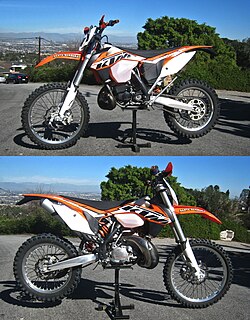
The KTM 200 EXC is one of those motorcycles that quietly built a legendary reputation without relying on flashy marketing or mainstream attention. While larger adventure bikes and high-displacement enduro machines often dominate conversations in the off-road world, the 200 EXC has always occupied a special niche: the lightweight, high-revving two-stroke enduro machine designed for riders who value agility, precision, and pure mechanical connection above all else.
For decades, KTM has been synonymous with competitive off-road performance, and the 200 EXC represents one of the most balanced and versatile expressions of that philosophy. It sits in a unique position between the ultra-light 125 cc class and the more powerful 250 cc two-strokes. This middle-ground displacement gives it a distinctive character—enough power to tackle demanding terrain, yet light enough to feel almost effortless in tight technical sections.
Unlike four-stroke enduro bikes that rely on torque and engine braking, the KTM 200 EXC delivers its performance through responsiveness, rev-happy acceleration, and a lightweight chassis that encourages constant movement and rider engagement. It rewards skill, precision, and momentum management, making it one of the most beloved bikes among experienced enduro riders and trail enthusiasts.
This article explores the history, engineering, engine characteristics, chassis design, suspension, riding experience, maintenance considerations, and long-term legacy of the KTM 200 EXC in detail, along with its technical specifications.
The Origins of the KTM 200 EXC
The KTM EXC lineup has long been a cornerstone of KTM’s off-road dominance, and the 200 EXC emerged as part of the brand’s effort to create highly capable enduro machines that could compete at the highest levels of off-road racing while remaining accessible to a broad range of riders.
During the evolution of two-stroke enduro bikes, manufacturers faced a growing challenge: balancing power output with controllability in technical terrain. The 125 cc class was extremely light but often lacked torque, making steep climbs and deep mud difficult. The 250 cc class provided more power but could become physically demanding in tight terrain. KTM identified a gap between these categories and introduced the 200 cc two-stroke as a solution.
The 200 EXC quickly became popular because it offered the best of both worlds. It retained the lightweight agility of a 125 while delivering noticeably stronger midrange torque. This made it particularly effective in European-style enduro terrain, where tight forest trails, rocky climbs, and technical sections demand both precision and usable power.
Over time, the KTM 200 EXC evolved with improvements in suspension, frame design, carburation systems, and later fuel injection developments in related models. Although it is no longer as widely produced in some markets due to emissions regulations and the shift toward four-stroke enduro bikes, it remains a highly respected machine in the off-road community.
Design Philosophy: Lightweight Precision Over Raw Power
The KTM 200 EXC was never designed to be a brute-force machine. Instead, its philosophy centers on lightweight agility, rider control, and mechanical simplicity.
Every aspect of the motorcycle reflects this approach. The chassis is extremely light, the engine is compact, and the ergonomics are optimized for constant rider movement. Unlike heavier motorcycles that rely on inertia for stability, the 200 EXC demands active rider input, making it feel almost like an extension of the rider’s body.
The bodywork is minimal and functional. Narrow plastics allow riders to shift their weight easily without obstruction. The seat is slim and firm, designed for frequent transitions between seated and standing riding positions. The fuel tank is compact but sufficient for enduro distances, keeping the overall mass low.
KTM’s signature orange frame and aggressive styling reinforce its racing heritage, but the design is ultimately driven by performance rather than aesthetics. Nothing on the motorcycle is unnecessary, and every component serves a clear purpose.
This simplicity contributes to the bike’s legendary durability and ease of maintenance, especially in demanding off-road environments.
The Heart of the Machine: 2-Stroke 200 cc Engine
At the core of the KTM 200 EXC lies its defining feature: a 2-stroke, single-cylinder, liquid-cooled engine with a displacement of approximately 200 cc.
Unlike four-stroke engines that rely on separate intake, compression, combustion, and exhaust strokes, the two-stroke engine completes a power cycle in just two piston movements. This results in a lightweight, high-revving engine that delivers rapid throttle response and explosive acceleration.
The KTM 200 EXC engine is known for its smooth power delivery compared to smaller two-strokes, making it more forgiving in technical terrain. It produces a blend of usable low-end torque and a strong midrange surge, followed by a lively top-end powerband.
Riders often describe the engine as “manageable yet exciting.” It does not overwhelm the rider with uncontrollable power, but it still delivers enough performance to tackle steep climbs, loose gravel, and technical obstacles with confidence.
One of the key advantages of the 200 cc two-stroke engine is its low weight. The engine contributes significantly less mass compared to four-stroke alternatives, which enhances handling and reduces rider fatigue during long off-road sessions.
Fuel delivery in carbureted versions is typically handled by a Keihin or Mikuni carburetor, tuned for responsive throttle behavior and consistent performance in varying altitudes and temperatures.
Power Delivery and Riding Character
The KTM 200 EXC is defined not by raw horsepower numbers but by how it delivers its power. The engine produces a smooth and progressive torque curve that transitions into a strong midrange surge, allowing riders to maintain momentum across challenging terrain.
Unlike four-stroke engines, which rely heavily on engine braking to control descent and corner entry, the two-stroke 200 EXC requires a more active riding style. Riders must use clutch control, throttle modulation, and body positioning to manage traction and maintain speed.
This creates a highly engaging riding experience that rewards skill and precision. Experienced riders often appreciate the way the engine responds instantly to throttle input, allowing quick adjustments during technical sections.
At higher RPMs, the engine delivers a characteristic two-stroke “hit,” where power builds rapidly and propels the bike forward with noticeable urgency. However, unlike more aggressive 250 cc or 300 cc two-strokes, the 200 EXC remains relatively controllable, making it suitable for riders who prefer a balanced performance envelope.
Chassis and Frame Engineering
The KTM 200 EXC features a lightweight chromoly steel frame designed to provide a balance between rigidity and flex. This allows the motorcycle to absorb impacts while maintaining stability during high-speed off-road sections.
The geometry of the frame is optimized for enduro riding, with a focus on tight maneuverability and predictable handling. The wheelbase is relatively short, which enhances agility in narrow trails and technical environments.
One of the defining characteristics of the 200 EXC chassis is its responsiveness. Small inputs from the rider result in immediate changes in direction, making it exceptionally well-suited for tight forest trails and obstacle-heavy terrain.
KTM’s engineering philosophy prioritizes feedback and control over absolute stability. As a result, the bike feels lively and responsive rather than planted and heavy.
Suspension System: Built for Technical Terrain
Suspension is one of the most critical components in any enduro motorcycle, and the KTM 200 EXC is equipped with high-quality WP suspension components designed specifically for off-road performance.
The front fork is typically a WP XPLOR or similar inverted fork system, offering excellent absorption of rocks, roots, and uneven terrain. The rear shock is fully adjustable, allowing riders to fine-tune rebound, compression, and preload according to terrain and riding style.
The suspension travel is generous enough to handle jumps, drops, and rough terrain while remaining compliant in slower technical sections.
One of the key strengths of the suspension setup is its ability to maintain traction on unpredictable surfaces. It keeps the wheels in contact with the ground as much as possible, improving stability and control.
Riders often note that the suspension feels forgiving yet precise, striking an excellent balance between comfort and performance.
Braking System and Control
The KTM 200 EXC is equipped with hydraulic disc brakes on both front and rear wheels.
The front brake provides strong and progressive stopping power, allowing precise control during steep descents and technical trail sections. The rear brake plays a crucial role in stability and cornering control, especially in loose terrain where weight transfer must be carefully managed.
Because the bike is lightweight, braking performance feels exceptionally effective even with moderate input. Riders can modulate braking force with high precision, which is essential in enduro environments.
Unlike heavier motorcycles, the 200 EXC does not require excessive braking force, making it easier to maintain control during long off-road sessions.
Riding Experience: Pure Enduro Engagement
Riding the KTM 200 EXC is an intensely engaging experience that demands active participation from the rider.
In tight forest trails, the bike feels almost weightless. It can be flicked from side to side with minimal effort, allowing rapid changes in direction.
On steep climbs, the engine provides enough torque to maintain momentum without overwhelming wheel spin when managed correctly. Riders often rely on clutch control to fine-tune power delivery in challenging sections.
On rocky or uneven terrain, the suspension and lightweight chassis work together to absorb impacts and maintain stability.
Unlike larger motorcycles that can feel cumbersome in technical terrain, the 200 EXC encourages creativity and precision. It rewards riders who maintain momentum and choose smooth lines.
At higher speeds, the bike remains stable enough for open trail riding, though its true strength lies in technical environments rather than high-speed desert racing.
Maintenance and Mechanical Simplicity
One of the most appreciated aspects of the KTM 200 EXC is its mechanical simplicity.
Two-stroke engines are inherently easier to maintain than four-stroke engines, with fewer moving parts and simpler internal mechanics.
Routine maintenance typically includes:
- Piston and ring inspection
- Air filter cleaning
- Carburetor tuning
- Chain lubrication
- Suspension servicing
- Coolant checks
Top-end rebuilds are relatively straightforward compared to four-stroke engines, making the bike popular among riders who prefer hands-on maintenance.
Fuel and oil mixing (in pre-mix systems) or oil injection systems in some versions require attention but are well understood within the enduro community.
Overall, the KTM 200 EXC is considered one of the more service-friendly performance off-road motorcycles.
Versatility in Enduro Conditions
The KTM 200 EXC performs exceptionally well across a wide range of off-road environments.
In forest trails, it excels due to its agility and lightweight construction.
In rocky terrain, its suspension and predictable power delivery help maintain control.
In muddy conditions, its narrow profile allows it to cut through challenging surfaces more effectively than heavier bikes.
On hill climbs, the engine’s torque and responsiveness make it capable of tackling steep gradients with proper technique.
While it is not designed for long highway travel or high-speed desert racing, its versatility in technical terrain is one of its greatest strengths.
Competition and Market Position
The KTM 200 EXC occupies a unique position in the off-road motorcycle market.
It competes indirectly with 125 cc and 250 cc two-stroke enduro bikes, as well as lightweight four-stroke machines.
Its closest competitors include models from Yamaha, Husqvarna (closely related to KTM engineering), and GasGas in similar displacement categories.
What sets the 200 EXC apart is its balance of power and weight. It offers more usable torque than a 125 cc bike while remaining significantly lighter and more manageable than a 250 cc machine.
This balance has earned it a loyal following among riders who value technical precision over outright power.
Legacy and Cultural Impact
The KTM 200 EXC has achieved cult status in the off-road community.
It is often regarded as one of the most “pure” enduro motorcycles ever built, embodying the essence of lightweight two-stroke performance.
Many riders describe it as the ideal training bike for technical riding skills due to its responsiveness and feedback.
Even as four-stroke engines have become more dominant in modern enduro racing, the 200 EXC remains respected for its simplicity, affordability, and engaging riding experience.
It continues to be used in enduro competitions, trail riding, and recreational off-road adventures around the world.
Conclusion
The KTM 200 EXC stands as one of the most iconic lightweight enduro motorcycles ever produced. It represents a philosophy of riding that prioritizes agility, precision, and rider engagement over brute-force power. Its two-stroke engine delivers a unique blend of responsiveness and controllability, while its lightweight chassis and premium suspension make it exceptionally capable in technical terrain.
For riders who value skill-based riding and mechanical simplicity, the 200 EXC remains a benchmark machine. It is not just a motorcycle but a tool for developing riding technique, confidence, and control in demanding off-road environments.
Even in an era dominated by four-stroke technology, the KTM 200 EXC continues to hold a special place in the hearts of enduro enthusiasts. It is a reminder that sometimes the most effective machines are not the most powerful, but the most balanced, lightweight, and connected to the rider.
KTM 200 EXC Technical Specifications
| Parameter | Specification |
|---|---|
| Manufacturer | KTM |
| Model | 200 EXC |
| Motorcycle Category | Enduro / Off-Road |
| Engine Type | 2-Stroke Single-Cylinder |
| Displacement | 193–200 cc (approx.) |
| Cooling System | Liquid-cooled |
| Fuel System | Carburetor (Keihin/Mikuni depending on model year) |
| Power Output | Approx. 25–35 hp (varies by tuning/year) |
| Torque | Approx. 20–30 Nm |
| Transmission | 6-speed manual |
| Clutch | Wet multi-plate |
| Frame | Chromoly Steel Frame |
| Front Suspension | WP Inverted Fork (XPLOR or similar) |
| Rear Suspension | WP Monoshock, fully adjustable |
| Front Brake | Hydraulic disc brake |
| Rear Brake | Hydraulic disc brake |
| Front Tire | 90/90-21 |
| Rear Tire | 120/90-18 |
| Wheelbase | ~1,470 mm |
| Seat Height | ~960 mm |
| Fuel Tank Capacity | ~9–10 liters |
| Wet Weight | ~100–105 kg |
| Starter System | Electric start (later models) |
| Final Drive | Chain |
| Cooling System | Liquid-cooled |
| Riding Use | Enduro, Trail, Technical Off-Road |
| Top Speed | ~120–130 km/h (terrain dependent) |
