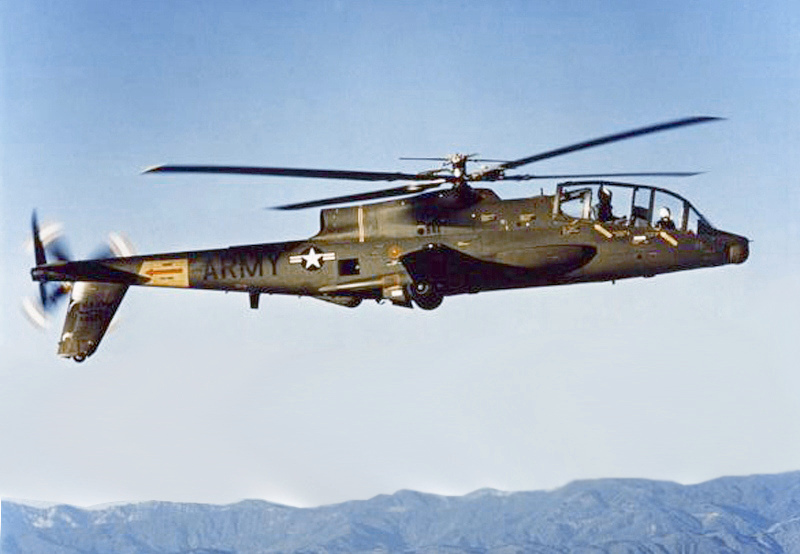
Lockheed AH-56 Cheyenne
The Lockheed AH-56 Cheyenne was a revolutionary attack helicopter developed for the United States Army during the late 1960s. Designed to meet the Army’s need for a high-speed, heavily armed helicopter capable of performing a wide range of missions, the Cheyenne represented a significant leap forward in helicopter technology. With its sleek, streamlined fuselage, tandem-seat cockpit layout, and innovative rigid rotor system, the Cheyenne was unlike any other helicopter of its time, boasting unparalleled speed, agility, and firepower.
At the heart of the AH-56 Cheyenne’s design was its groundbreaking pusher-prop configuration, which allowed it to achieve speeds approaching those of fixed-wing aircraft. Powered by a single Lycoming T55 turboshaft engine driving a rear-mounted propeller, the Cheyenne could reach speeds of over 190 miles per hour (300 kilometers per hour), making it one of the fastest helicopters ever built. This impressive speed gave the Cheyenne a distinct advantage on the battlefield, allowing it to rapidly deploy to hotspots, conduct reconnaissance missions, and engage enemy targets with precision and lethality.
Despite its revolutionary design and advanced capabilities, the Lockheed AH-56 Cheyenne program ultimately faced numerous challenges and setbacks, leading to its cancellation in 1972 before it could enter full-scale production. Technical issues, cost overruns, and changing strategic priorities within the military all contributed to the demise of the Cheyenne. However, its legacy as a pioneering and innovative aircraft endures, serving as a testament to the ingenuity and vision of those who dared to push the boundaries of helicopter technology in pursuit of military superiority.
Lockheed AH-56 Cheyenne parameters
The Lockheed AH-56 Cheyenne was a groundbreaking attack helicopter developed for the United States Army during the 1960s. Here are the parameters of the AH-56 Cheyenne:
- Dimensions:
- Length: 16.46 meters (54 feet)
- Height: 4.06 meters (13 feet 4 inches)
- Main Rotor Diameter: 16.36 meters (53 feet 8 inches)
- Weight:
- Empty Weight: Approximately 5,443 kilograms (12,000 pounds)
- Maximum Takeoff Weight: Approximately 8,618 kilograms (19,000 pounds)
- Engine:
- The AH-56 Cheyenne was powered by a single Lycoming T55-L-7C turboshaft engine.
- The engine provided approximately 3,925 shaft horsepower.
- Performance:
- Maximum Speed: Approximately 315 kilometers per hour (196 miles per hour)
- Range: Approximately 400 kilometers (250 miles)
- Service Ceiling: Approximately 4,575 meters (15,000 feet)
- Armament:
- The AH-56 Cheyenne was equipped with a diverse array of offensive weaponry, including a 30mm XM140 cannon mounted in a chin turret, as well as options for external rockets, missiles, and gun pods.
- It also had a tandem-seat cockpit layout, with the pilot seated in the rear and the co-pilot/gunner in the front.
- Avionics:
- The AH-56 Cheyenne featured advanced avionics systems for navigation, targeting, and weapon control, including a head-up display (HUD) and a fire control system.
- Operational History:
- Despite its promising capabilities, the AH-56 Cheyenne program was ultimately canceled in 1972 due to budgetary constraints and shifting priorities within the military.
- Only prototypes and pre-production models were built, and the Cheyenne never entered full-scale production or operational service with the U.S. Army.
