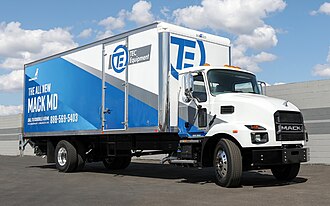
Mack MD – The Medium-Duty Truck That Reinvented Urban Vocational Transport
In the modern trucking industry, the spotlight often falls on massive highway tractors, powerful heavy-haul machines, or futuristic electric commercial vehicles. Yet some of the most important trucks in the real economy are not the giants crossing continents, but the medium-duty workhorses operating quietly in cities, industrial parks, suburbs, and regional delivery routes every single day. These trucks transport construction materials, deliver food and beverages, move municipal equipment, haul utility supplies, support landscaping companies, carry refrigerated cargo, and serve as the operational backbone of countless local businesses. Among the most significant modern entries into this category is the Mack MD.
The Mack MD represents a major strategic move for Mack Trucks, a manufacturer historically associated with heavy-duty vocational vehicles and iconic highway tractors. For decades, Mack built its reputation around severe-duty applications such as construction, refuse collection, military transport, and long-haul trucking. However, the growing demand for durable, technologically advanced medium-duty trucks created an opportunity for the company to expand into a segment that had become increasingly competitive.
When Mack introduced the MD Series, it was not merely adding another vehicle to its product range. The company was re-entering a market segment with a truck specifically engineered to combine the brand’s legendary toughness with modern urban practicality, driver comfort, operational efficiency, and vocational flexibility. The result was a truck that immediately attracted attention from municipalities, delivery companies, utility providers, regional fleets, and contractors seeking a durable but highly maneuverable platform.
What makes the Mack MD especially interesting is the way it balances traditional truck engineering with modern fleet expectations. It is rugged enough for demanding vocational work while remaining refined enough for regional delivery applications. It offers advanced safety systems and ergonomic improvements without abandoning the straightforward functionality that commercial operators depend on. In many ways, the MD reflects the broader evolution of the trucking industry itself, where reliability, technology, fuel efficiency, and driver satisfaction are becoming equally important.
The medium-duty market is one of the most diverse sectors in commercial transportation. Trucks in this category may spend one day navigating crowded urban streets and the next hauling equipment to construction sites. Some serve as box trucks for retail distribution, while others become dump trucks, flatbeds, tow trucks, utility bodies, or refrigerated delivery units. A successful medium-duty chassis must therefore be adaptable, durable, efficient, and easy to operate.
The Mack MD was designed specifically with these requirements in mind. It entered the market at a time when fleet operators were demanding more from medium-duty vehicles. Drivers wanted greater comfort and visibility. Companies wanted lower operating costs. Municipalities wanted cleaner emissions and safer trucks. Fleet managers wanted simplified maintenance and improved uptime. The MD attempted to address all these needs within a single integrated platform.
In this extensive article, we will examine the Mack MD in detail. We will explore its origins, engineering philosophy, design features, powertrain systems, vocational applications, technology integration, driver ergonomics, safety systems, fleet economics, competitive positioning, and long-term significance within the medium-duty trucking industry. Finally, we will conclude with a comprehensive technical specifications table covering the key parameters of the truck.
The Return of Mack to the Medium-Duty Market
Mack’s Historical Focus on Heavy-Duty Trucks
For much of its history, Mack Trucks focused heavily on Class 8 heavy-duty vehicles. The company became famous for trucks designed to survive the harshest operating conditions imaginable. Construction fleets, refuse operators, military organizations, logging companies, and long-haul carriers all relied on Mack products because of their durability and rugged engineering.
The iconic bulldog emblem became synonymous with toughness. Mack trucks were often viewed as overbuilt machines capable of enduring years of severe-duty operation.
However, despite its strong reputation in heavy-duty sectors, Mack was not always active in medium-duty markets. Over time, competitors established strong positions in the Class 6 and Class 7 segments. Brands such as Freightliner, International, Kenworth, Peterbilt, Isuzu, Ford, and Hino became dominant players in urban and regional vocational trucking.
As the commercial vehicle industry evolved, Mack recognized that many customers operating heavy-duty fleets also required medium-duty solutions. Fleet operators increasingly preferred purchasing from manufacturers capable of supporting multiple vehicle classes under a unified service network.
The Launch of the MD Series
The Mack MD Series officially debuted in 2020. This launch represented Mack’s formal return to the medium-duty truck market.
The timing was strategically important. Urban delivery demand was expanding rapidly due to e-commerce growth. Municipal infrastructure projects were increasing. Regional logistics operations were evolving. Construction and utility sectors required versatile vocational vehicles capable of operating efficiently in urban environments.
The MD was designed to serve this growing demand while bringing Mack’s vocational engineering philosophy into the medium-duty category.
The truck was introduced in two main classifications:
- Mack MD6 (Class 6)
- Mack MD7 (Class 7)
These configurations enabled the platform to address a broad range of applications while remaining maneuverable and practical for urban operations.
The Design Philosophy of the Mack MD
A Vocational Truck for Modern Cities
The Mack MD was engineered with a clear understanding of how medium-duty trucks are actually used in real-world environments.
Unlike long-haul highway tractors that spend most of their lives on interstates, medium-duty trucks face constant operational variability. They navigate traffic congestion, loading docks, narrow city streets, industrial facilities, construction sites, and suburban neighborhoods.
As a result, the MD’s design philosophy centered around several key priorities:
- Maneuverability
- Driver comfort
- Durability
- Visibility
- Ease of maintenance
- Vocational adaptability
- Operational efficiency
This balanced approach allowed the MD to function equally well in delivery fleets and demanding vocational applications.
The Exterior Design
One of the first things people notice about the Mack MD is its clean and modern exterior styling.
While unmistakably a Mack truck, the MD adopts a more aerodynamic and urban-focused appearance compared to the company’s larger vocational models.
The front fascia incorporates:
- A prominent Mack grille
- Integrated aerodynamic contours
- Modern headlight assemblies
- Large windshield surfaces
- Practical bumper design
The truck’s proportions were carefully optimized to improve visibility and maneuverability while maintaining a strong visual identity.
Unlike some medium-duty trucks that appear overly utilitarian, the MD projects a professional and modern image. This matters more than many people realize because trucks increasingly function as rolling brand representations for companies operating them.
Cab Layout and Accessibility
The MD uses a conventional cab layout rather than a cab-over-engine configuration. This architecture offers several advantages in medium-duty operations.
Drivers benefit from:
- Familiar ergonomics
- Improved ride quality
- Easier service access
- Strong crash protection
- Better highway stability
The cab itself was designed to reduce driver fatigue and improve usability.
Wide-opening doors, low step heights, strategically positioned grab handles, and spacious entry pathways make entering and exiting the truck easier during repeated stops.
This is especially important for delivery drivers and vocational operators who may enter and exit the vehicle dozens or even hundreds of times per shift.
Interior Comfort and Driver Experience
A Driver-Centered Cabin
One of the most significant changes in modern trucking is the industry’s growing recognition that driver comfort directly influences operational efficiency and safety.
The Mack MD reflects this trend through a driver-focused interior.
The cabin emphasizes:
- Ergonomic control placement
- Excellent outward visibility
- Reduced noise levels
- Comfortable seating
- Intuitive instrumentation
- Modern connectivity features
The driving position is upright and commanding, giving operators excellent visibility over traffic and surrounding environments.
Seating and Ergonomics
The MD offers air-suspension seating options designed to reduce fatigue during long workdays.
Commercial drivers frequently spend ten or more hours behind the wheel. Poor seating can contribute to back pain, fatigue, and reduced concentration.
Mack addressed these concerns through supportive seat designs with multiple adjustment settings.
The steering wheel position and pedal arrangement were also optimized to create a more natural driving posture.
Noise Reduction and Ride Quality
Medium-duty trucks often operate in noisy urban environments, but excessive cabin noise can increase fatigue over time.
The MD incorporates improved insulation and vibration management systems that create a quieter interior compared to many older vocational trucks.
Ride quality is also improved through suspension tuning designed specifically for medium-duty applications.
This refinement is particularly noticeable during regional delivery operations where drivers spend extended periods on rough urban roads.
Powertrain and Mechanical Engineering
Cummins B6.7 Diesel Engine
The Mack MD is powered by the Cummins B6.7 diesel engine, one of the most widely respected medium-duty commercial engines in North America.
This 6.7-liter inline-six engine has earned a strong reputation for:
- Reliability
- Fuel efficiency
- Broad service support
- Strong torque delivery
- Long operational lifespan
Depending on configuration, the engine produces between approximately 220 and 300 horsepower, with torque outputs ranging from around 560 to 660 lb-ft.
The engine’s torque characteristics are particularly well-suited to medium-duty vocational work because trucks in this segment frequently operate under varying load conditions.
Allison Automatic Transmission
The MD is commonly equipped with Allison automatic transmissions.
Automatic transmissions provide several advantages in urban and vocational applications:
- Reduced driver fatigue
- Smoother acceleration
- Easier operation in traffic
- Improved training efficiency
- Consistent performance
The Allison units are especially popular in municipal and delivery fleets because of their durability and ease of use.
Chassis Engineering
The MD chassis was engineered for vocational flexibility.
Frame rail options allow the truck to support multiple body types and vocational upfits.
Applications include:
- Box trucks
- Flatbeds
- Dump bodies
- Refrigerated trucks
- Utility service bodies
- Tow trucks
- Landscape bodies
- Stake beds
This adaptability is one of the key strengths of the platform.
Suspension Systems
The truck’s suspension configurations are designed to balance ride comfort with payload capability.
Heavy-duty springs and optional air suspension systems help the MD maintain stability under varying load conditions.
The suspension geometry also contributes to maneuverability and predictable handling.
Vocational Applications of the Mack MD
Urban Delivery Operations
One of the most common applications for the Mack MD is regional and urban delivery work.
E-commerce growth has dramatically increased demand for medium-duty delivery vehicles capable of navigating cities efficiently.
The MD’s maneuverability, visibility, and comfortable driving environment make it well-suited for these operations.
Fleet operators appreciate the truck’s combination of payload capability and urban practicality.
Construction and Contracting
The MD is also popular in construction-related industries.
Contractors require trucks capable of transporting tools, equipment, and materials while surviving demanding jobsite conditions.
The MD’s vocational durability and flexible chassis options make it an attractive choice for:
- General contractors
- Electrical contractors
- Plumbing companies
- HVAC businesses
- Roofing companies
- Landscape contractors
Municipal Applications
Municipal fleets use medium-duty trucks for a wide range of purposes.
The MD can serve as:
- Utility service truck
- Street maintenance vehicle
- Snow removal unit
- Water department truck
- Parks department vehicle
- Public works platform
Municipal operators value reliability, service support, and lifecycle durability.
Towing and Recovery
Tow truck operators also utilize the MD platform because of its strong frame construction and dependable drivetrain.
The truck’s stability and torque delivery are well-suited for recovery applications.
Safety Features and Driver Assistance Systems
Modern Safety Expectations
Commercial vehicle safety standards have evolved significantly over the past decade.
Fleet operators increasingly expect medium-duty trucks to incorporate advanced safety technologies once reserved primarily for passenger vehicles.
The Mack MD responds to these expectations with multiple safety-oriented design features.
Visibility Improvements
Visibility is essential in urban trucking environments.
The MD incorporates:
- Large windshield areas
- Wide side mirrors
- Optimized seating position
- Enhanced sightlines
- Modern lighting systems
These features reduce blind spots and improve situational awareness.
Collision Mitigation Systems
Available advanced driver assistance systems may include:
- Collision mitigation braking
- Electronic stability control
- Lane departure warnings
- Traction control
- Anti-lock braking systems
These technologies help reduce accident risk in complex urban environments.
Driver Fatigue Reduction
Safety is not only about crash prevention technologies.
Reducing fatigue through ergonomic design also contributes significantly to safer operation.
Comfortable seating, intuitive controls, and improved ride quality help drivers maintain concentration during long shifts.
Technology and Connectivity
Telematics Integration
Modern fleets increasingly depend on telematics and connected vehicle systems.
The Mack MD supports advanced fleet management capabilities that allow operators to monitor:
- Vehicle location
- Fuel consumption
- Maintenance schedules
- Driver performance
- Idle time
- Fault diagnostics
These systems improve operational efficiency and reduce downtime.
Predictive Maintenance
Predictive maintenance technologies are becoming increasingly important in commercial transportation.
By monitoring engine performance and vehicle systems in real time, fleets can identify potential issues before major failures occur.
This approach improves uptime and lowers maintenance costs.
Driver Connectivity Features
The MD also incorporates modern connectivity features that support communication and route management.
Many operators integrate these systems with dispatching software and logistics platforms.
Fuel Economy and Operational Efficiency
The Importance of Fuel Efficiency
Fuel is one of the largest operating expenses for medium-duty fleets.
Even modest improvements in fuel economy can generate substantial cost savings across large vehicle fleets.
The Mack MD addresses fuel efficiency through:
- Aerodynamic design
- Optimized drivetrain integration
- Efficient engine calibration
- Automatic transmission programming
Urban Stop-and-Go Efficiency
Medium-duty trucks operating in cities face constant stop-and-go conditions.
This environment places significant demands on the powertrain.
The MD’s transmission and engine tuning were specifically optimized for urban operational cycles.
Maintenance Accessibility
Easy maintenance access contributes directly to operational efficiency.
The MD’s hood design allows technicians to access service points quickly.
Reduced maintenance complexity lowers labor costs and minimizes downtime.
Mack MD Versus Competitors
The Competitive Medium-Duty Market
The medium-duty truck market is highly competitive.
Major competitors include:
- Freightliner M2
- International MV Series
- Kenworth T270/T370
- Peterbilt 535/536/537
- Hino XL Series
- Ford F-650/F-750
Each platform offers different strengths and operational philosophies.
Mack’s Competitive Advantage
The Mack MD differentiates itself through:
- Vocational durability
- Mack brand reputation
- Strong dealer support
- Comfortable cabin design
- Integrated safety features
- Operational versatility
Many fleets already operating Mack heavy-duty trucks appreciate the ability to maintain consistent manufacturer relationships across vehicle categories.
Brand Identity
The Mack brand itself carries significant weight within the commercial trucking industry.
Operators often associate Mack with rugged reliability and severe-duty performance.
The MD benefits from this reputation.
The Role of the MD in Modern Logistics
E-Commerce and Urban Distribution
The rise of e-commerce transformed medium-duty transportation.
Regional distribution centers require trucks capable of efficient urban delivery while maintaining substantial payload capacity.
The MD fits naturally into this operational environment.
Infrastructure Growth
Infrastructure investment also increases demand for medium-duty vocational vehicles.
Construction, utilities, telecommunications, and municipal services all rely heavily on versatile truck platforms.
Fleet Standardization
Large fleets increasingly seek standardized vehicle platforms that simplify maintenance, training, and parts management.
The MD supports these goals through consistent engineering and broad vocational adaptability.
The Future of the Mack MD
Electrification Possibilities
Although the MD currently relies primarily on diesel powertrains, the future of medium-duty trucking will likely involve increasing electrification.
Urban delivery routes are particularly well-suited to electric vehicles because they:
- Operate predictable distances
- Return to depots daily
- Benefit from regenerative braking
- Function in emissions-sensitive areas
Mack may eventually expand electric technologies into the MD platform.
Autonomous Assistance Systems
Future medium-duty trucks will likely incorporate more advanced driver assistance technologies.
Potential developments include:
- Enhanced pedestrian detection
- Adaptive cruise control
- AI-based safety monitoring
- Smart route optimization
- Semi-autonomous maneuvering systems
These technologies could improve both safety and operational efficiency.
Sustainability Trends
Environmental regulations continue tightening across many urban markets.
Medium-duty fleets increasingly prioritize:
- Lower emissions
- Reduced fuel consumption
- Noise reduction
- Sustainable fleet strategies
The MD platform is positioned to evolve alongside these changing requirements.
Why the Mack MD Matters
The Mack MD represents more than just a new medium-duty truck.
It symbolizes Mack’s strategic expansion into a critical transportation segment while preserving the brand’s traditional engineering values.
The truck demonstrates that medium-duty vehicles can combine:
- Rugged vocational durability
- Driver-focused ergonomics
- Modern safety systems
- Advanced connectivity
- Urban maneuverability
- Operational flexibility
This balance is difficult to achieve.
Many trucks excel in one area while compromising another. The MD’s strength lies in its ability to function effectively across diverse applications.
For fleet operators, this versatility translates into practical business value.
For drivers, it creates a more comfortable and manageable work environment.
For municipalities and urban operators, it supports safer and more efficient transportation operations.
Conclusion
The Mack MD arrived at an important moment in the evolution of commercial transportation.
Medium-duty trucking was becoming increasingly important due to urbanization, e-commerce growth, infrastructure expansion, and evolving fleet requirements. Operators needed trucks capable of balancing durability, efficiency, technology, safety, and driver comfort.
The MD was engineered specifically to meet those challenges.
By combining Mack’s long-standing reputation for toughness with modern ergonomic design and advanced fleet technologies, the company created a medium-duty truck capable of competing effectively in one of the industry’s most demanding segments.
Its success reflects broader trends shaping the future of commercial transportation. Fleets no longer evaluate trucks solely on raw payload capability or engine power. They increasingly consider:
- Driver retention
- Operational efficiency
- Safety performance
- Connectivity
- Lifecycle costs
- Environmental impact
The Mack MD addresses all these priorities while remaining fundamentally practical and vocationally focused.
Whether operating as a box truck in crowded city streets, serving a municipal utility department, hauling construction materials, or supporting regional delivery operations, the MD demonstrates how modern medium-duty trucks are evolving into highly refined professional tools.
For Mack Trucks, the MD is not simply a return to the medium-duty segment.
It is a statement that the future of vocational transportation belongs to vehicles that successfully integrate rugged engineering with intelligent modern design.
Technical Parameters Table – Mack MD
| Parameter | Specification |
|---|---|
| Manufacturer | Mack Trucks |
| Model | Mack MD |
| Production Start | 2020 |
| Vehicle Class | Class 6 and Class 7 |
| Variants | MD6, MD7 |
| Cab Configuration | Conventional cab |
| Primary Applications | Delivery, utility, construction, municipal, towing |
| Engine | Cummins B6.7 diesel |
| Engine Configuration | Inline 6-cylinder turbo diesel |
| Engine Displacement | 6.7 liters |
| Horsepower Range | 220–300 hp |
| Torque Range | 560–660 lb-ft |
| Transmission | Allison automatic |
| Transmission Speeds | 6-speed automatic |
| Fuel Type | Diesel |
| Front Axle Capacity | Up to 12,000 lbs |
| Rear Axle Capacity | Up to 23,000 lbs |
| GVWR MD6 | Up to 25,995 lbs |
| GVWR MD7 | Up to 33,000 lbs |
| Brake System | Hydraulic or air brakes |
| Suspension Options | Multi-leaf spring / air suspension |
| Wheelbase Options | Multiple vocational configurations |
| Cab Seating Capacity | Up to 3 occupants |
| Safety Features | ABS, stability control, collision mitigation |
| Telematics | Mack integrated connectivity systems |
| Typical Body Types | Box truck, dump, flatbed, utility, tow |
| Market Region | North America |
| Assembly Location | Roanoke Valley Operations, Virginia, USA |
Sources
Official Mack product specifications and technical information were referenced for accuracy. (macktrucks.com)
