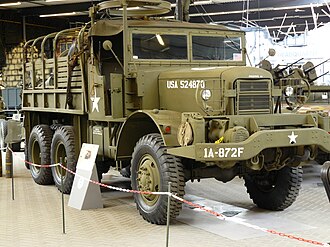
Mack NO – The Heavy Artillery Tractor That Powered Allied Firepower
The Mack NO is one of the most fascinating heavy military trucks ever produced in the United States, not because it was flashy or widely publicized, but because it fulfilled one of the most demanding roles in wartime logistics: moving heavy artillery and engineering equipment across the most difficult terrain imaginable. Developed during the early 1940s, the Mack NO was a purpose-built 6×6 artillery tractor designed to tow massive field guns and support heavy engineering operations during World War II.
It was built by Mack Trucks, a company already renowned for producing some of the most durable heavy-duty vehicles in the world. While many wartime trucks were adaptations of civilian designs, the Mack NO was different—it was engineered from the ground up for military service, specifically for the United States Army’s requirement for a high-powered artillery tractor capable of towing the heaviest field artillery pieces in its arsenal.
What makes the Mack NO particularly interesting is not just its mechanical strength, but the way it represents a transitional moment in military logistics. During the Second World War, armies were shifting from horse-drawn artillery to fully mechanized systems. The Mack NO stands at the center of that transformation, bridging old artillery doctrines and modern mechanized warfare.
Historical Context and Development of the Mack NO
The development of the Mack NO took place during a period of rapid military expansion in the United States, as global tensions escalated into what would become World War II. The U.S. Army required a new generation of vehicles capable of handling increasingly heavy artillery systems, including large-caliber field guns that could not be moved by earlier generations of trucks or half-tracks.
The contract was awarded to Mack Trucks, which already had a strong reputation for building rugged commercial and military vehicles. The result was the Mack NO series, introduced in the early 1940s and produced throughout the war years. The “NO” designation is generally understood to be a military model code rather than a descriptive acronym, part of the U.S. Army’s standardized vehicle classification system at the time.
The Mack NO was designed specifically to meet the requirements of the U.S. Army Ordnance Department for a 7½-ton artillery tractor. It had to be powerful enough to tow large artillery pieces such as the 155 mm “Long Tom” gun and other heavy field artillery systems, while also carrying ammunition and supporting personnel.
Unlike general cargo trucks, the Mack NO was not designed for versatility in transport roles. Instead, it was optimized for a singular purpose: delivering heavy firepower wherever it was needed, regardless of terrain conditions.
Design Philosophy: Built for Raw Power and Endurance
The design philosophy behind the Mack NO was centered on brute strength and mechanical reliability under extreme load conditions. The engineers at Mack Trucks understood that artillery mobility was one of the most demanding tasks in military logistics. Unlike cargo trucks that carried distributed loads, artillery tractors had to handle extreme tongue weight, sudden stress from towing uneven loads, and constant operation in off-road environments.
The Mack NO was built on a heavy-duty ladder frame chassis reinforced with thick steel members designed to withstand twisting forces caused by uneven terrain and heavy towing loads. The vehicle used a 6×6 drivetrain configuration, meaning all three axles were driven. This was essential for maintaining traction while pulling artillery pieces through mud, sand, or rocky terrain.
The cab design was functional and austere. Comfort was not a consideration; instead, visibility, durability, and ease of maintenance were prioritized. Early versions had a relatively simple enclosed cab with flat glass panels, while later wartime variants improved weather sealing but remained strictly utilitarian.
The cargo bed was often used to carry ammunition, artillery crew members, and support equipment. Unlike standard cargo trucks, the Mack NO had to function as both a towing vehicle and a mobile support platform for artillery units.
Engineering and Mechanical Architecture
At the heart of the Mack NO was its powerful gasoline engine, the Mack EY 6-cylinder engine, which was specifically tuned for high torque output rather than speed. While diesel engines were common in many heavy vehicles of the era, gasoline engines were often preferred in U.S. military artillery tractors due to their easier cold-weather starting and simpler field maintenance.
The engine produced approximately 170–185 horsepower, which may not sound exceptional by modern standards, but was substantial for a vehicle of its size and weight during the 1940s. More importantly, the engine delivered strong low-end torque, which was critical for towing heavy artillery pieces over uneven terrain.
The transmission system was a manual gearbox with multiple forward speeds and a low-range transfer case. This allowed drivers to select extremely low gear ratios for towing heavy loads at controlled speeds. The transfer case distributed power to all three axles, ensuring maximum traction even in poor ground conditions.
The suspension system used heavy-duty leaf springs, chosen for their simplicity and durability. While not providing comfort, they allowed the truck to carry extreme loads without failure. The axles were reinforced to handle both vertical load stress and horizontal twisting forces generated during towing operations.
One of the most important engineering aspects of the Mack NO was its cooling system. Artillery towing often required slow movement under heavy load, which placed continuous strain on the engine. The cooling system was therefore oversized relative to civilian trucks, ensuring that the engine could operate for long periods without overheating.
Role as an Artillery Tractor in World War II
During World War II, the Mack NO served primarily as a heavy artillery tractor in U.S. Army units. Its main role was to tow large-caliber field guns, particularly the 155 mm Long Tom and similar artillery systems that formed the backbone of long-range fire support in Allied operations.
These artillery systems were critical in both the European and Pacific theaters. In Europe, they were used to provide long-range bombardment support during the Allied advance following the D-Day landings. In the Pacific, they played a crucial role in island-hopping campaigns, where heavy artillery had to be moved across rough, undeveloped terrain.
The Mack NO’s ability to transport not only the gun itself but also its ammunition and crew made it an essential part of artillery operations. In many cases, the vehicle functioned as a mobile command and logistics center for artillery units, ensuring that guns could be rapidly repositioned as battlefield conditions changed.
Its 6×6 configuration allowed it to traverse muddy fields, temporary roads, and partially destroyed infrastructure. This mobility was crucial in fast-moving combat situations where artillery needed to keep pace with advancing infantry and armored units.
Operational Performance in Extreme Conditions
The real-world performance of the Mack NO demonstrated the importance of engineering simplicity and mechanical strength. In muddy European battlefields, the vehicle’s six-wheel-drive system provided the traction needed to pull artillery pieces through terrain that would immobilize lighter vehicles. In dry and dusty environments, such as parts of North Africa and Italy, the truck’s robust air filtration system helped prevent engine damage from fine particulate matter.
However, the Mack NO was not without limitations. Its size and weight made it relatively slow, and its gasoline engine consumed large amounts of fuel, which placed additional strain on supply lines. Despite these drawbacks, its ability to perform under continuous heavy load made it indispensable.
Field reports from wartime operators often emphasized the truck’s reliability under stress. Even when operating at or near maximum load capacity, the Mack NO was known to maintain consistent performance, provided it was properly maintained.
In many ways, it represented a trade-off: efficiency and speed were sacrificed in favor of raw pulling power and mechanical durability.
Variants and Production Differences
The Mack NO series included several variants, often designated with suffixes such as NO-1, NO-2, and NO-6, depending on production batches and specification changes. While the core design remained consistent, minor modifications were introduced over time to improve reliability, simplify manufacturing, or adapt to changing military requirements.
Some variants featured improved cab insulation or modified gear ratios, while others included reinforced towing equipment for specific artillery systems. Despite these differences, all versions shared the same fundamental architecture: a heavy-duty 6×6 chassis powered by the Mack EY engine.
Production numbers were relatively limited compared to general cargo trucks, reflecting the specialized role of the vehicle. Unlike mass-produced supply trucks, artillery tractors were built in smaller quantities due to their specific operational purpose.
Post-War Service and Civilian Use
After the end of World War II, many Mack NO trucks were gradually phased out of military service. Some were scrapped, while others were sold to civilian industries such as logging, construction, and heavy hauling.
In these civilian roles, the Mack NO continued to demonstrate its durability. Its ability to pull extremely heavy loads made it useful in industries that required large-scale material transport in undeveloped or rugged environments.
However, as newer and more efficient trucks entered the market in the post-war era, the Mack NO gradually became obsolete. Its high fuel consumption and specialized design limited its competitiveness in civilian logistics.
Today, surviving examples are rare and highly valued by collectors, museums, and military vehicle restoration enthusiasts. Restored Mack NO trucks are often displayed in historical exhibitions, where they serve as reminders of the engineering challenges faced during World War II.
Legacy of the Mack NO in Military Engineering
The legacy of the Mack NO lies in its contribution to the evolution of military logistics and artillery mobility. It demonstrated that effective battlefield support required not only firepower but also the ability to move that firepower efficiently across difficult terrain.
Its design influenced later generations of military trucks, particularly in the development of standardized 6×6 heavy-duty platforms used in post-war military logistics. The emphasis on torque, durability, and off-road capability became foundational principles in military vehicle engineering.
Built by Mack Trucks, the Mack NO stands as a testament to the importance of industrial engineering in wartime success. While it may not have the dramatic recognition of tanks or aircraft, its role in enabling artillery mobility made it a critical component of Allied military strength during World War II.
Conclusion
The Mack NO remains one of the most important heavy artillery tractors of the Second World War era. Its design reflects a time when engineering priorities were defined by necessity, durability, and raw mechanical capability rather than efficiency or comfort.
By enabling the movement of some of the heaviest artillery pieces used in Allied operations, it played a direct role in shaping battlefield outcomes across multiple theaters of war. Its combination of strength, simplicity, and reliability ensured its place in military history.
Even today, the Mack NO is remembered not as a luxury of engineering, but as a machine built for purpose—a powerful reminder that behind every successful military campaign lies a vast and often overlooked network of logistical machines working tirelessly behind the scenes.
Technical Specifications of Mack NO
| Parameter | Specification |
|---|---|
| Manufacturer | Mack Trucks |
| Vehicle type | Heavy artillery tractor |
| Configuration | 6×6 |
| Production period | Early 1940s–1945 |
| Engine | Mack EY 6-cylinder gasoline engine |
| Power output | ~170–185 hp |
| Displacement | ~707 cu in (approx. 11.6 L) |
| Fuel type | Gasoline |
| Transmission | Manual multi-speed with transfer case |
| Drive system | Full-time 6-wheel drive |
| Payload capacity | ~7.5 tons (tractor rating) |
| Primary role | Artillery towing, ammunition transport |
| Artillery compatibility | 155 mm Long Tom and similar guns |
| Suspension | Heavy-duty leaf spring |
| Maximum speed | ~45–55 km/h |
| Operational range | ~200–350 km depending on load |
| Cab type | Enclosed military cab |
| Theaters of operation | Europe, Pacific, training and logistics units |
| Primary users | United States Army |
