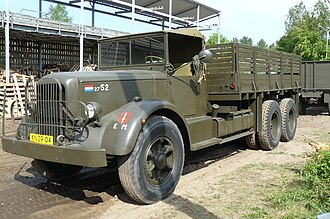
Mack NR – The Heavy-Duty Military Truck That Defined Wartime Logistics
The Mack NR is one of those military vehicles that rarely gets the same popular recognition as armored tanks or fighter aircraft, yet its contribution to wartime logistics was absolutely fundamental. Developed in the late 1930s and mass-produced during the early years of the Second World War, the Mack NR was a heavy-duty 6×4 cargo truck designed primarily for military transport under extreme conditions. It was built by Mack Trucks, a company already well established in the United States for producing rugged commercial vehicles known for durability and mechanical simplicity.
Unlike civilian trucks adapted for military use, the Mack NR was engineered from the ground up with battlefield logistics in mind. It was not designed for speed or comfort but for endurance, load capacity, and reliability across poor roads, desert terrain, and muddy supply routes. Its design reflects a period when military planners were learning that wars are often won or lost not on the front lines, but in the efficiency of supply chains that keep those fronts operational.
The Mack NR became especially important in British and Commonwealth service during World War II, where it was used extensively for transporting fuel, ammunition, engineering equipment, and general supplies. In many ways, it represents the backbone of mechanized logistics in an era when motorized transport was rapidly replacing horse-drawn supply systems.
Historical Background and Development
The origins of the Mack NR are tied closely to the rapid militarization of global industry in the late 1930s. As tensions escalated in Europe and Asia, military planners recognized a pressing need for standardized, high-capacity transport vehicles that could support large-scale mechanized warfare. The United States, even before its formal entry into World War II, began expanding production of military vehicles for Allied forces under various supply agreements.
Mack Trucks responded to these demands by developing the NR series, with “NR” generally believed to stand for “New Refinement” or a similar internal designation indicating an upgraded heavy-duty platform. The design drew on Mack’s earlier civilian heavy truck experience but introduced reinforced axles, a stronger frame, and a purpose-built military cargo body.
Production of the Mack NR began around 1940 and continued through the war years, with thousands of units produced in multiple variants. These trucks were largely exported to British and Commonwealth forces under Lend-Lease arrangements. They were particularly valued in North African campaigns, where supply lines stretched across vast desert environments that demanded vehicles capable of operating under extreme heat, sand abrasion, and long distances without maintenance infrastructure.
The NR series was not just a single truck but a family of closely related variants tailored for different logistical roles. Some were configured as general cargo carriers, while others were adapted for specialized tasks such as fuel transport or equipment hauling. This flexibility made the Mack NR a cornerstone of Allied logistical planning in multiple theaters of war.
Design Philosophy and Engineering Approach
The engineering philosophy behind the Mack NR was simple but uncompromising: reliability under stress. Military logistics in the 1940s demanded vehicles that could survive continuous operation with minimal maintenance, often in environments where spare parts and repair facilities were scarce or nonexistent.
At its core, the Mack NR was built on a heavy-duty ladder frame chassis, reinforced to handle high payloads over uneven terrain. The truck featured a 6×4 drivetrain configuration, meaning six wheels in total with four driven wheels. This setup provided a balance between traction and mechanical simplicity, avoiding the complexity of full 6×6 systems while still delivering substantial off-road capability.
One of the most important design considerations was serviceability. The vehicle was engineered so that key components—engine, transmission, axles—could be repaired or replaced in field conditions using basic tools. This was critical in wartime environments where advanced workshops were often far behind the front lines.
The cab design was utilitarian, with minimal comfort features. Early versions used open or semi-enclosed cabins, while later variants incorporated more protection from weather and dust. The cargo bed was typically wooden with steel reinforcement, designed to be quickly loaded and unloaded under operational conditions.
The philosophy was not to create a technologically advanced vehicle, but rather a dependable workhorse that could function continuously in harsh environments with minimal failure points.
Variants of the Mack NR Series
The Mack NR was produced in several variants, each adapted for specific operational requirements. While the core chassis remained consistent, differences in wheelbase, payload capacity, and body configuration created distinct models within the NR family.
The most common variants included the NR4 and NR6 configurations, though nomenclature varied depending on contract specifications and production batches. Some versions were optimized for general cargo transport, while others were designed for long-range supply missions requiring additional fuel capacity or reinforced suspension systems.
Certain NR variants were also equipped for specialized military roles such as bridging operations, engineering support, or recovery duties. These specialized configurations often included winches, modified rear frames, or reinforced towing equipment to support damaged vehicles and heavy equipment transport.
Despite these variations, all Mack NR trucks shared a common design language: robustness over refinement. The interchangeability of parts across variants was a key advantage, simplifying logistics and maintenance for military operators.
Engine and Drivetrain Characteristics
At the heart of the Mack NR was its powerful diesel engine, most commonly the Mack ENDT-673, a 6-cylinder inline diesel engine known for its durability and torque output. This engine was designed for steady, sustained performance rather than high-speed operation, making it ideal for heavy transport roles.
The ENDT-673 produced sufficient power to move fully loaded trucks over difficult terrain while maintaining mechanical reliability. Its low-revving nature meant reduced wear, which was essential in wartime conditions where engine replacement or overhaul was not always feasible.
The drivetrain included a manual transmission system with multiple gear ratios, allowing drivers to adapt to varying terrain conditions. Low gears were used for off-road movement and steep inclines, while higher gears allowed for efficient highway or desert travel when conditions permitted.
The suspension system was leaf-spring based, a common choice for military vehicles of the era due to its durability and ease of repair. While not offering the comfort of modern suspension systems, it provided the necessary strength to handle heavy payloads across uneven ground.
Fuel efficiency was not a primary design concern, but the diesel configuration offered better range and torque compared to gasoline engines, which was a decisive advantage in long-distance supply operations.
Role in Military Operations During World War II
During World War II, the Mack NR played a crucial logistical role, particularly within British and Commonwealth forces. These trucks were used extensively in North Africa, the Middle East, and parts of Europe, where their ability to transport heavy loads across difficult terrain made them indispensable.
In desert campaigns such as those in Libya and Egypt, supply lines could stretch hundreds of kilometers across sand and gravel roads. The Mack NR’s durability under abrasive conditions made it one of the preferred heavy transport vehicles. Its ability to carry fuel and ammunition directly influenced operational endurance of frontline units, effectively extending the reach of armored divisions and infantry formations.
In Europe, the Mack NR was used in the latter stages of the war to support advancing Allied forces following the D-Day landings. It transported engineering equipment for bridge-building, artillery ammunition, and general supplies necessary for sustained offensive operations.
One of its key strengths was adaptability. In wartime conditions where infrastructure was constantly being destroyed or rebuilt, the ability to rely on a single vehicle platform for multiple logistical tasks was a major advantage.
Performance in Harsh Field Conditions
The true test of any military vehicle is not its specifications on paper but its performance in the field, and the Mack NR consistently proved itself under extreme conditions. In desert environments, it demonstrated resistance to overheating and mechanical wear caused by sand infiltration. In muddy European battlefields, its strong torque and heavy chassis allowed it to navigate terrain that would immobilize lighter vehicles.
However, the truck was not without limitations. Its size and weight made it less maneuverable in narrow urban environments or heavily forested terrain. Fuel consumption was relatively high, and like all vehicles of its era, it required frequent maintenance under intensive operational use.
Despite these drawbacks, its overall reliability meant that it remained in service throughout the war and beyond in some regions. Military operators often preferred the Mack NR over more complex vehicles simply because it could be repaired quickly and returned to service with minimal downtime.
Post-War Legacy and Collector Interest
After the end of World War II, many Mack NR trucks were gradually retired from military service and either scrapped or sold into civilian use. Some found second lives in construction, forestry, and heavy transport industries, where their durability continued to be an asset.
Today, surviving Mack NR trucks are highly sought after by military vehicle collectors and restoration enthusiasts. Their historical significance, combined with their imposing physical presence, makes them popular exhibits at military museums and historical reenactments.
Restored examples often highlight the engineering simplicity that made the original design so effective. Enthusiasts appreciate not only their historical value but also the mechanical honesty of their construction—everything is functional, accessible, and built to endure.
The Mack NR stands as a reminder of an era when engineering priorities were dictated by necessity rather than convenience, and when mechanical reliability could directly influence the outcome of global events.
Comparison with Contemporary Military Trucks
When compared with other military trucks of its era, the Mack NR holds a strong position in terms of durability and payload capacity. While some European designs offered better off-road maneuverability or lighter construction, few matched the NR’s combination of load-bearing strength and mechanical reliability.
American and British military logistics increasingly relied on standardization during the war, and the Mack NR fit perfectly into this strategy. Its design philosophy aligned with other successful military transport platforms that prioritized ease of maintenance and mass production over technological sophistication.
In contrast to lighter 4×4 trucks used for reconnaissance or rapid transport, the Mack NR occupied the heavy logistics category. It was not meant for speed or tactical maneuvering but for sustaining entire armies through continuous supply flow.
Conclusion
The Mack NR remains one of the most important yet underappreciated military logistics vehicles of the Second World War. Built by Mack Trucks, it embodied the principles of strength, simplicity, and endurance at a time when global conflict demanded industrial-scale mobility.
Its contribution to Allied success in World War II cannot be measured in headlines or battlefield glory, but in the steady, uninterrupted flow of supplies that kept armies operational across multiple continents. From the deserts of North Africa to the roads of liberated Europe, the Mack NR proved that logistics is as critical to warfare as combat itself.
Even today, its legacy endures in restored vehicles, historical collections, and the continued study of military engineering. The Mack NR is not just a truck—it is a symbol of industrial resilience and the unsung machinery of victory.
Technical Specifications of Mack NR
| Parameter | Specification |
|---|---|
| Manufacturer | Mack Trucks |
| Vehicle type | Heavy military cargo truck |
| Configuration | 6×4 |
| Production period | 1940–1945 |
| Engine | Mack ENDT-673 inline 6-cylinder diesel |
| Displacement | ~11 liters (approx.) |
| Power output | ~170–200 hp (variant dependent) |
| Transmission | Manual, multi-speed (typically 5–6 forward gears) |
| Drive layout | Rear tandem drive axles |
| Payload capacity | ~6–10 tons (depending on variant) |
| Fuel type | Diesel |
| Suspension | Leaf spring |
| Maximum speed | ~50–60 km/h |
| Operational range | ~300–500 km (load dependent) |
| Wheelbase | Variant-specific (long wheelbase common) |
| Cab type | Enclosed or semi-open military cab |
| Primary use | Cargo transport, logistics, engineering support |
| Theaters of operation | Europe, North Africa, Middle East |
