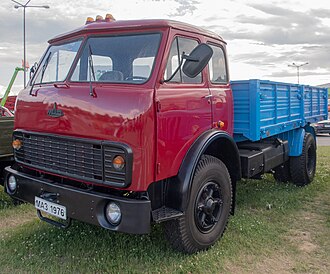
MAZ-5335: The Story, Design, and Technical Characteristics of a Soviet Heavy-Duty Truck
The MAZ-5335 is one of the most recognizable representatives of the heavy-duty truck industry developed in the Soviet Union. Built by the Minsk Automobile Plant, commonly known by its Russian abbreviation MAZ, this truck was designed to meet the demanding requirements of transportation, construction, industry, and military-related logistics. With its robust chassis, conventional cab layout, powerful diesel engine, and reputation for durability, the MAZ-5335 became an important part of the commercial vehicle landscape across the Soviet Union and in several other countries. Although modern trucks have advanced significantly in terms of comfort, fuel efficiency, electronics, and emissions technology, the MAZ-5335 remains interesting to enthusiasts, collectors, historians, and people fascinated by the engineering philosophy of heavy vehicles from the twentieth century.
Unlike many contemporary trucks that rely on sophisticated electronic control systems and highly specialized components, the MAZ-5335 represents an era in which mechanical simplicity, structural strength, and ease of maintenance were central design priorities. Its engineering was shaped by a practical understanding of the conditions in which heavy vehicles would operate: long distances, rough roads, extreme seasonal temperatures, limited workshop facilities, and the need to keep vehicles working even when replacement parts or advanced diagnostic equipment were unavailable. Understanding the MAZ-5335 therefore involves more than looking at engine power or payload figures. It also means examining the industrial history of Minsk, the evolution of Soviet truck design, and the role of dependable transportation in a large and geographically diverse country.
The History of the MAZ-5335
From the MAZ-500 to a New Generation of Trucks
The history of the MAZ-5335 is closely connected with the development of the MAZ-500 family, one of the most important truck series produced by the Minsk Automobile Plant during the Soviet period. The MAZ-500 introduced a modern approach to heavy-truck design for its time, including a forward-control cab and a diesel powertrain suitable for demanding transport duties. After years of production and continuous improvements, the basic design was updated and reorganized into a new generation of vehicles. The MAZ-5335 emerged in 1977 as part of this modernization, retaining much of the established mechanical foundation while receiving changes to its appearance and equipment. Production of the MAZ-5335 continued until 1990, making it a significant link between the earlier MAZ-500 series and the later MAZ-5336 family.
The transition from the MAZ-500 to the MAZ-5335 was not a complete departure from the past. Instead, it reflected a common approach to industrial vehicle development: preserve a proven platform while introducing changes that improve compliance, practicality, and compatibility with contemporary requirements. This strategy was especially important for a manufacturer producing large numbers of vehicles for state-owned transport companies, construction organizations, agricultural enterprises, and industrial fleets. A truck had to be dependable, familiar to mechanics, and adaptable to a wide range of operating conditions. The MAZ-5335 therefore represented an evolution of an established design rather than a radical reinvention of the heavy truck.
Identifying Features of the MAZ-5335
One of the easiest ways to distinguish the MAZ-5335 from earlier members of the MAZ-500 family is its front-end design. The truck received a revised radiator grille and headlights integrated into the front bumper. This arrangement was associated with changes in Soviet vehicle-lighting requirements and gave the truck a noticeably different appearance from the MAZ-500A. The cab itself remained closely related to the earlier design, preserving the characteristic square profile and forward-control arrangement that had become familiar on Soviet roads. These details may appear relatively modest when compared with modern vehicle redesigns, but they were meaningful improvements within the context of a mature heavy-truck platform.
The appearance of the MAZ-5335 is often described as functional rather than decorative. Its broad front, large windshield, substantial bumper, and straightforward body lines were designed around practical requirements rather than aerodynamic styling. The truck’s visual identity was shaped by the need to provide access to mechanical components, protect important systems, and accommodate a large engine and strong chassis within a relatively compact forward-control layout. The result was a vehicle that looked purposeful and industrial. Even today, the MAZ-5335 is immediately recognizable to many enthusiasts because its design reflects the unmistakable character of late Soviet commercial vehicles.
Engine and Powertrain
The YaMZ-236 Diesel Engine
The standard MAZ-5335 was equipped with the YaMZ-236 diesel engine, a six-cylinder V-type power unit manufactured by the Yaroslavl Motor Plant. This engine had a displacement of approximately 11.15 liters and was rated at around 180 horsepower in the commonly documented base configuration. Its maximum torque was approximately 667 newton-metres, allowing the truck to move substantial loads without requiring the high engine speeds associated with smaller commercial-vehicle engines. The YaMZ-236 became widely associated with Soviet heavy-duty transport because of its relatively straightforward mechanical construction, substantial low-speed pulling ability, and suitability for demanding working conditions.
The engine’s V6 configuration provided a useful balance between power, size, and serviceability. In a heavy truck such as the MAZ-5335, torque delivery was particularly important because the vehicle could be required to start from rest with a loaded platform, climb gradients, travel on poorly maintained roads, or operate in areas where speed was less important than steady traction. The YaMZ-236 was designed around these practical needs. Its mechanical fuel-injection system and conventional diesel architecture also made it familiar to technicians who worked on Soviet commercial vehicles. While it lacked the electronic management systems found in modern trucks, its comparatively uncomplicated design could be an advantage in workshops equipped for traditional mechanical repairs.
The engine’s output should be considered in relation to the period in which the MAZ-5335 was produced. A power rating of approximately 180 horsepower may seem modest by current heavy-truck standards, particularly when modern long-haul tractors can produce several times that amount. However, the MAZ-5335 was not designed around contemporary motorway speeds, automated transmissions, or the high productivity expectations of modern logistics fleets. Its powertrain was intended to provide reliable performance within the transportation infrastructure, load requirements, and operating conditions of its era.
Transmission and Driveline
Power from the YaMZ-236 was transmitted through a manual gearbox with five forward gears and one reverse gear in the standard configuration. The transmission was designed to work with the engine’s torque characteristics and to provide the driver with control over vehicle speed and pulling power. Manual gear selection was essential when operating a heavy truck on gradients, loose surfaces, or roads where maintaining momentum required careful choice of gear. The driver’s ability to select an appropriate ratio was a central part of the truck’s operating system.
The MAZ-5335 used a conventional rear-wheel-drive arrangement with a 4×2 wheel formula. This meant that the truck had two axles and that the rear axle supplied propulsion. Such a layout was well suited to general cargo transportation on established roads and industrial routes. It also helped keep the mechanical design relatively straightforward, with fewer driven components than would be required in a multi-axle all-wheel-drive vehicle. Although the MAZ-5335 was not intended to be a specialized off-road truck, its robust construction and substantial ground clearance allowed it to work on a variety of surfaces when operated within its design limits.
Chassis, Suspension, and Braking System
A Strong Foundation for Heavy Transport
The chassis of the MAZ-5335 was based on a robust frame designed to support the engine, cab, cargo body, suspension, and other equipment while carrying significant loads. A strong ladder-type frame was essential for a truck expected to operate under repeated stress, especially when carrying heavy cargo over uneven roads. The frame also provided a standardized foundation for different body configurations, making it possible to adapt the vehicle for a variety of transport and industrial purposes. The continued use of a proven chassis concept helped preserve commonality with earlier MAZ models and simplified the transition for operators and maintenance personnel.
The standard truck had a wheelbase of approximately 3,950 millimetres, a dimension that balanced cargo-carrying practicality with maneuverability for a vehicle of its size. Its substantial frame and conventional axle arrangement made it suitable for a broad range of duties, from transporting industrial materials to carrying general freight on regional routes. The design also allowed specialized versions to be developed from the same basic platform. This adaptability was an important characteristic of the MAZ family and contributed to the continued relevance of its engineering beyond the production period of the original model.
Suspension and Brakes
The MAZ-5335 used leaf-spring suspension at the front and rear. This type of suspension was widely employed on heavy commercial vehicles because of its ability to support substantial loads and withstand demanding working environments. Leaf springs are mechanically simple, relatively easy to inspect, and capable of providing both load support and a degree of axle location. They can also be repaired or replaced using established workshop procedures. The compromise is that they generally offer a firmer ride than many modern air-suspension systems, especially when a truck is lightly loaded.
Braking was provided by pneumatically operated drum brakes. The use of compressed air was consistent with the requirements of a heavy truck, where substantial braking force and reliable operation were necessary. The MAZ-5335 generation also incorporated a dual-circuit braking arrangement, separating parts of the braking system to improve safety in the event of a failure in one circuit. Compared with modern electronic braking systems, the arrangement was mechanically oriented, but it represented an important development in the safety equipment of Soviet heavy trucks.
Cab Design and Driver Environment
A Functional Working Space
The cab of the MAZ-5335 retained the basic forward-control architecture associated with the MAZ-500 family. The driver sat above and ahead of the front axle, allowing the truck to make efficient use of its overall length. This arrangement provided a practical balance between cargo-space utilization and vehicle dimensions. The cab’s large windshield and upright shape supported visibility, while the relatively simple interior reflected the expectations of the period. The cabin was primarily a workplace: a place where the driver could control the vehicle, monitor its instruments, and spend long hours operating heavy machinery.
Compared with the cabins of modern trucks, the MAZ-5335’s interior was basic. Sound insulation, seat adjustment, climate control, storage, and ergonomic features were limited by contemporary standards. Nevertheless, the cab provided the essential controls and instruments needed for operation. Its straightforward layout was familiar to drivers and mechanics, and the absence of complex electronic systems reduced the number of potential diagnostic problems. The driver’s experience depended heavily on road conditions, vehicle loading, maintenance, and personal familiarity with the truck.
The cab’s practical design also reflected the operating environment of Soviet transportation fleets. Trucks often had to function across wide geographical areas, including regions with severe winters and limited infrastructure. For that reason, the MAZ family included specialized versions intended for difficult climates. These variants demonstrate that the basic platform could be adapted to conditions that went well beyond ordinary regional freight transportation.
Variants and Specialized Versions
The MAZ-5334 and MAZ-53352
The MAZ-5335 served as the foundation for several related vehicles. The MAZ-5334, for example, was produced as a chassis-cab version intended to receive specialized bodies and equipment. This made it useful for applications such as cranes, tankers, service vehicles, and other industrial conversions. Instead of being limited to a single cargo-carrying role, the platform could be supplied to other manufacturers or organizations that needed a strong base vehicle for a particular purpose. This flexibility was an important part of the MAZ family’s industrial value.
Another important related model was the MAZ-53352, which featured a longer wheelbase and a different powertrain configuration. Commonly documented descriptions associate it with the YaMZ-238E V8 diesel engine, rated at approximately 265 horsepower, and an eight-speed manual transmission. The longer chassis and increased capacity made the 53352 suitable for applications requiring somewhat different load and operating characteristics from the standard MAZ-5335. Because specifications could vary between versions and production periods, it is important to distinguish the basic MAZ-5335 from its related derivatives when discussing engine output, payload, or dimensions.
Extreme-Climate and Other Derivatives
The MAZ-533501 was a specialized version developed for extremely cold operating conditions. Its adaptations included features such as improved insulation, double glazing, and measures intended to protect cables, hoses, and other components from severe low temperatures. Such modifications were particularly relevant to northern regions where ordinary vehicle equipment could become unreliable during winter. The existence of this variant illustrates how Soviet truck manufacturers adapted standard commercial platforms to the environmental challenges of a vast territory. (Wikipedie)
The wider MAZ-5335 family also included vehicles serving different industrial roles, including dump trucks, tractor units, and logging-related applications. These derivatives shared important elements of the underlying design but were configured for different tasks. The MAZ-5549, for instance, was a related dump-truck model, while other members of the family were developed for towing trailers or transporting specialized loads. This broad model family shows that the MAZ-5335 was not simply one isolated truck, but part of a larger industrial platform.
Applications of the MAZ-5335
Freight Transportation and Industrial Work
The principal role of the MAZ-5335 was the transportation of cargo. Its conventional flatbed configuration made it suitable for carrying machinery, building materials, agricultural products, packaged goods, and other items that could be loaded onto an open platform. The truck’s strong chassis and diesel engine allowed it to handle substantial loads over regional and intercity routes. In an era when road transportation was a major component of industrial distribution, vehicles such as the MAZ-5335 played an important role in moving goods between factories, warehouses, farms, construction sites, and transport terminals.
The open cargo platform was particularly useful because it could accommodate a wide range of loads. Bulky equipment, timber, metal products, construction supplies, and machinery could be secured directly to the platform, while removable sideboards offered additional flexibility. Depending on the configuration, a tarpaulin or other covering could be used to protect cargo from weather. This versatility was one of the main advantages of a general-purpose platform truck. Rather than requiring a specialized body for every type of freight, operators could use the same basic vehicle for numerous transport assignments.
The MAZ-5335 was also relevant to construction and infrastructure work. Heavy trucks were needed to move materials for roads, bridges, buildings, industrial installations, and utility projects. In such environments, a vehicle’s ability to operate on rough access roads and withstand repeated loading cycles could be as important as its performance on paved highways. The MAZ-5335’s conventional chassis, leaf-spring suspension, and mechanical powertrain made it appropriate for many of these duties, provided that the vehicle was operated within its rated limits.
Specialized Industrial and Service Vehicles
One of the strengths of the MAZ-5335 platform was its ability to support specialized bodies. A chassis-cab version could be adapted for use as a crane carrier, tanker, workshop vehicle, or other industrial machine. This approach allowed organizations to obtain a common vehicle foundation while tailoring the body and equipment to their particular requirements. A truck fitted with a crane, for example, could combine transportation and lifting functions, while a tanker configuration could be used for carrying liquids or supplying industrial facilities.
The MAZ family also included vehicles associated with logging, military logistics, and other specialized operations. These applications demonstrate the broad range of tasks for which heavy Soviet trucks were developed. However, it is important to distinguish the standard MAZ-5335 from its derivatives: a specialized vehicle might have a different body, axle configuration, engine, transmission, or operating weight. Technical specifications should therefore always be checked against the exact model and conversion being examined.
Maintenance and Mechanical Reliability
Designed for Practical Servicing
The MAZ-5335 belongs to a generation of trucks in which mechanical accessibility and straightforward servicing were important considerations. Its diesel engine, manual transmission, leaf-spring suspension, and pneumatic braking system were based on established technologies that could be maintained using conventional workshop tools and procedures. The truck did not depend on the complex electronic control units, computerized diagnostics, or electronically managed fuel systems found in many modern commercial vehicles. This made its maintenance requirements different from those of contemporary trucks and helped preserve its usefulness in areas where advanced servicing infrastructure was limited.
The YaMZ-236 engine was particularly important to the truck’s maintenance characteristics. Its mechanical construction was familiar to technicians throughout the former Soviet transport industry, and many workshops had experience servicing engines from the YaMZ family. Routine work could include checking and adjusting fuel-system components, replacing filters, inspecting belts and hoses, servicing lubrication systems, and maintaining cooling equipment. As with any older diesel engine, the condition of the fuel system, cooling system, and lubrication system has a major influence on reliability. A well-maintained engine can remain useful for many years, but age, wear, corrosion, and poor-quality replacement parts can significantly affect performance.
The simplicity of the design should not be confused with an absence of maintenance requirements. A heavy truck places considerable stress on its frame, axles, suspension, steering, and braking components. Regular inspection of the chassis, spring assemblies, wheel bearings, brake lines, air reservoirs, and drivetrain is essential. On an older MAZ-5335, corrosion and fatigue may be just as important as mechanical wear. Vehicles that have spent decades working in harsh climates or carrying heavy loads may require extensive restoration before they can be safely returned to regular service.
Restoration and Ownership Considerations
Today, many MAZ-5335 trucks are encountered as preserved vehicles, working survivors, or restored examples. Their condition can vary considerably. Some may retain much of their original equipment, while others may have received replacement engines, modified electrical systems, nonstandard bodywork, or components from later MAZ models. Such changes can affect the vehicle’s performance and make it difficult to assume that every truck has exactly the same specifications as a factory-original example.
For owners and collectors, restoration often involves more than repairing the engine and repainting the body. The cab, frame, suspension, wheels, braking system, electrical wiring, and interior may all require attention. Original parts can be difficult to find depending on the country and the particular production version. In some cases, compatible components from related Soviet or post-Soviet vehicles may be used, but modifications should be documented carefully. Maintaining the historical identity of the truck is especially important for collectors who want to preserve its original appearance and mechanical character.
The MAZ-5335’s straightforward construction can make it attractive to people interested in classic commercial vehicles. Nevertheless, a vehicle of this age should be assessed carefully before purchase. A truck that looks complete externally may have hidden corrosion, worn braking components, damaged frame sections, or an engine requiring major work. Proper inspection and verification of its documentation are essential, particularly when the vehicle is intended for road use rather than display.
The MAZ-5335 in Historical Perspective
An Example of Soviet Industrial Engineering
The MAZ-5335 illustrates the priorities that shaped Soviet heavy-truck production during the late twentieth century. The truck was developed around a proven platform, used a robust diesel engine, and could be adapted to numerous applications. Its engineering emphasized practical transportation capacity, mechanical durability, and the ability to function within a large industrial system. The model’s continued production through 1990 reflects the longevity of the underlying design and the importance of established truck families in the transport sector.
The truck also represents the relationship between vehicle manufacturing and the wider industrial economy. Heavy trucks were essential for delivering raw materials, moving finished products, supporting construction, and maintaining supply chains across long distances. A vehicle such as the MAZ-5335 was therefore more than a means of transportation; it was one component of a much larger network of factories, roads, depots, workshops, and logistics organizations. Its design was influenced by the demands of that network, including the need for standardized parts, familiar maintenance procedures, and compatibility with a variety of cargo bodies.
Comparison with Modern Heavy Trucks
Comparing the MAZ-5335 with a modern heavy truck reveals how much commercial-vehicle technology has changed. Contemporary trucks commonly feature turbocharged engines with sophisticated fuel-injection systems, automated or electronically controlled transmissions, advanced driver-assistance systems, improved cab insulation, air suspension, and emissions-control equipment. They are designed to deliver greater efficiency, comfort, safety, and performance while meeting modern regulatory requirements.
The MAZ-5335, by contrast, offers a more direct mechanical driving experience. The driver controls a manual transmission, the diesel engine responds through a conventional mechanical powertrain, and the vehicle’s suspension and braking systems are based on technologies that were widely used during its production era. It is generally less comfortable and less efficient than a modern truck, but its simple architecture provides a distinctive connection between the driver and the machinery. For enthusiasts, that directness is part of the vehicle’s appeal.
The comparison also highlights the importance of context. The MAZ-5335 was not designed to compete with present-day trucks in terms of fuel consumption, emissions, payload optimization, or driver comfort. Its significance lies in its historical role, its engineering approach, and its place within the development of heavy commercial vehicles. Understanding it on those terms provides a more meaningful appreciation of the model than judging it exclusively by modern standards.
Conclusion: Why the MAZ-5335 Still Matters
The MAZ-5335 remains an important model in the history of Soviet and Eastern European truck manufacturing. Developed as a modernization of the MAZ-500 family, it combined a familiar heavy-duty chassis with the YaMZ-236 diesel engine, a manual transmission, conventional suspension, and a practical cargo-carrying design. Its production from 1977 to 1990 placed it at the center of an important period in the development of Minsk-built commercial vehicles.
Its significance extends beyond its technical specifications. The MAZ-5335 demonstrates how a well-established truck platform could be adapted to changing requirements while retaining the mechanical characteristics that made it useful to transport operators. Its related versions supported specialized applications, while its straightforward design made it suitable for maintenance in a wide range of operating environments. Today, the model remains of interest to historians, truck enthusiasts, restoration specialists, and anyone interested in the engineering heritage of the former Soviet Union.
The MAZ-5335 may not offer the speed, efficiency, or comfort of a modern heavy truck, but it represents a distinctive chapter in commercial-vehicle history. Its square cab, substantial frame, mechanical diesel engine, and adaptable platform continue to make it recognizable and historically valuable. For those interested in classic trucks, the MAZ-5335 provides an excellent example of how durability, practicality, and industrial purpose shaped the design of heavy vehicles during the twentieth century.
MAZ-5335 Technical Specifications
The following table summarizes commonly documented specifications for the standard MAZ-5335 flatbed truck. Figures may vary according to production year, factory configuration, regional documentation, and subsequent modifications. In particular, published sources differ on certain weight and payload figures, so the exact vehicle’s identification plate and original technical documentation should be consulted for authoritative information.
| Technical specification | MAZ-5335 |
|---|---|
| Manufacturer | Minsk Automobile Plant, MAZ |
| Country of origin | Soviet Union |
| Production period | 1977–1990 |
| Vehicle category | Heavy-duty rigid cargo truck |
| Body configuration | Flatbed truck |
| Drive layout | Front-engine, rear-wheel drive |
| Wheel formula | 4×2 |
| Engine manufacturer | Yaroslavl Motor Plant, YaMZ |
| Engine model | YaMZ-236 |
| Engine type | V6 diesel |
| Engine displacement | Approximately 11.15 liters |
| Maximum power | Approximately 180 hp |
| Maximum torque | Approximately 667 Nm |
| Transmission | Five-speed manual |
| Reverse gears | One |
| Clutch | Dry, twin-disc type |
| Front suspension | Leaf springs |
| Rear suspension | Leaf springs |
| Braking system | Pneumatic drum brakes |
| Wheelbase | Approximately 3,950 mm |
| Overall length | Approximately 7,250 mm |
| Overall width | Approximately 2,500–2,600 mm, depending on specification |
| Overall height | Approximately 2,700–2,720 mm |
| Ground clearance | Approximately 270 mm |
| Fuel-tank capacity | Approximately 200 liters |
| Typical documented payload | Approximately 8,000–8,700 kg, depending on source and configuration |
| Documented gross vehicle weight | Approximately 14,800–14,950 kg, depending on source and configuration |
| Commonly cited maximum speed | Approximately 85 km/h |
| Predecessor | MAZ-500 family |
| Related and successor models | MAZ-5334, MAZ-53352, MAZ-5549, MAZ-5429, MAZ-5430, MAZ-5336 |
Technical references: published MAZ-5335 model histories and specifications, including documentation summarized by MAZ enthusiasts and historical truck publications.
