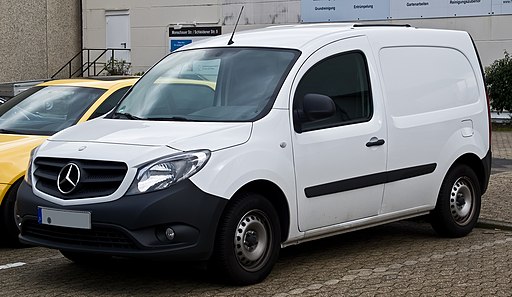
Mercedes-Benz Citan as a Used Car
The Mercedes-Benz Citan occupies an unusual position in the used-car market. It wears the three-pointed star, has the familiar Mercedes design language and benefits from the brand’s extensive commercial-vehicle experience, yet underneath the bodywork it is closely related to the Renault Kangoo. That combination makes the Citan both interesting and easy to misunderstand. It is not a small Mercedes passenger car in the traditional sense; it is a compact van designed primarily around practicality, low operating costs and commercial use. The first-generation Citan, internally known as the W415, was introduced in 2012 and remained in production until 2021, while the second-generation W420 arrived in 2021.
For a used-car buyer, however, this shared engineering is not necessarily a disadvantage. In fact, it can be one of the Citan’s greatest strengths. Parts, engines and mechanical components are based on technology that was also used elsewhere in the Renault-Nissan family, while Mercedes added its own equipment, calibration and branding. The result is a compact van that can be considerably more affordable to buy than a larger Mercedes commercial vehicle, while offering generous interior space, sliding doors and a choice of body lengths. The key to buying one successfully is to look beyond the badge and assess the individual vehicle’s history, engine, maintenance and previous workload.
The Mercedes-Benz Citan in brief
Two generations, two different characters
The first-generation Citan W415 is the model most commonly encountered on the used market. It was developed in cooperation with Renault and is closely related to the second-generation Renault Kangoo. Mercedes offered the Citan in several body lengths and configurations, including panel-van versions and passenger-oriented Kombi models. Depending on specification, buyers could choose a compact vehicle for urban deliveries, a longer version with substantially more cargo space, or a passenger version capable of carrying five or even seven occupants.
The second-generation Citan W420, introduced in 2021, moved the model considerably closer to the modern Mercedes-Benz commercial-vehicle family in terms of styling, equipment and technology. It remains closely related to the Renault Kangoo, but the newer generation feels more sophisticated and is available with newer petrol and diesel engines, automatic transmission options and, in some markets, electric propulsion. The W420 is larger than its predecessor, with a length of around 4.50 metres in one of its standard configurations and a width of approximately 1.86 metres.
For someone shopping on a limited budget, the W415 is generally the more interesting proposition because there are more examples available and depreciation has already done much of its work. Buyers who want newer safety equipment, a more modern interior and a less obviously commercial driving experience should concentrate on the W420.
What is the Citan like to drive?
The Citan is primarily a practical vehicle, and that is immediately apparent from behind the wheel. The driving position is upright, visibility is good and the relatively compact exterior dimensions make it easy to manoeuvre through narrow streets and crowded car parks. The boxy body also makes it much easier to judge the vehicle’s corners than in many modern passenger cars. These characteristics are particularly valuable if the vehicle will spend most of its life in town.
The diesel versions are generally the logical choice for drivers who regularly carry heavy loads or cover substantial annual mileage. In the W415, the 1.5-litre diesel was available in several power outputs, with the 109 CDI producing 90 hp and the 111 CDI producing 110 hp in later specifications. A 111 CDI, for example, has around 260 Nm of torque in the later Euro 6 version, giving it considerably more flexibility when accelerating with passengers or cargo on board.
The petrol alternative is less common. The W415 Citan 112 uses a 1.2-litre turbocharged petrol engine producing 114 hp, while later W420 models introduced a 1.3-litre petrol engine in the 113 version, producing 131 hp. For predominantly short urban journeys, a petrol Citan can make more sense than an older diesel, particularly where emissions restrictions and repeated short trips are concerns.
Buying a used Citan: what should you check?
Service history matters more than the badge
The most important consideration when buying a used Citan is its previous life. Many examples were purchased by tradespeople, delivery companies, rental fleets or other businesses, meaning that apparently modest mileage does not necessarily tell the whole story. A van that has spent eight years making short delivery runs may have experienced considerably more mechanical stress than a privately owned example with a higher odometer reading.
Look carefully at the service documentation and try to establish whether oil changes, filters, brakes and other scheduled maintenance were performed on time. A complete history from a commercial operator can actually be reassuring because it may show that the vehicle was maintained systematically. Conversely, a Citan with suspiciously low mileage but no supporting documentation deserves caution.
Pay particular attention to the diesel engine
The 1.5-litre diesel used in the first-generation Citan is economical and well suited to the vehicle, but it should not be treated as indestructible. The engine uses common-rail injection and turbocharging, and components such as injectors, turbocharger-related systems and the timing-belt system should be considered when evaluating a high-mileage example. Some reliability data also identifies injection, electrical systems, fuel pumps and starter batteries among areas associated with breakdowns on older Citan examples.
A cold start is particularly useful during an inspection. The engine should start cleanly and settle into a reasonably consistent idle. Excessive smoke, unusual rattling, hesitation or warning lights should not be dismissed as normal characteristics of an old commercial vehicle. A professional inspection before purchase is money well spent, especially because repairing modern diesel fuel and emissions systems can quickly eliminate the apparent bargain of a cheap used van.
Inspect the body and sliding doors carefully
The Citan’s bodywork deserves just as much attention as its engine. Commercial vehicles spend much of their lives being loaded and unloaded, parked close to other vehicles and driven in environments where scratches and dents are inevitable. Inspect the lower edges of the body, rear doors, sills, wheel arches and the area around the sliding-door mechanisms carefully.
The sliding doors themselves should operate smoothly without excessive resistance, grinding or unusual movement. Check the rails, rollers and locking mechanisms and make sure every door closes properly. A van that has been heavily used may have accumulated damage that is not immediately visible from several metres away.
Inside the cargo compartment, inspect the floor and side panels. Heavy scratches are not automatically a problem, but badly damaged flooring, bent panels or evidence of water ingress can reveal a particularly demanding working life. The condition of the driver’s seat, steering wheel, pedals and gear lever can also provide useful clues about whether the claimed mileage is plausible.
Which engine is best?
There is no single answer because the ideal engine depends heavily on how the vehicle will be used. For long-distance driving, regular motorway use and frequent loads, one of the stronger diesel versions is generally the most convincing choice. The later W415 111 CDI, with 110 hp and 260 Nm, offers a useful balance between fuel economy and performance. Official figures for a representative later 111 CDI show combined fuel consumption around 4.4–4.5 litres per 100 km, although real-world consumption will naturally depend on load, driving style and traffic.
The 109 CDI is less powerful but can be a perfectly sensible choice for urban and regional work. In later Euro 6 form it produces 90 hp and 220 Nm, and official combined consumption figures are around 4.3–4.7 litres per 100 km depending on specification.
For private users who cover relatively few kilometres, the petrol models deserve consideration. The W415 112 petrol produces 114 hp and 190 Nm, while the later W420 113 produces 131 hp and 240 Nm. The newer petrol engine therefore gives the second-generation Citan a noticeably more convincing performance potential.
Practicality is the Citan’s greatest strength
The reason to buy a Citan rather than a conventional hatchback is simple: space. The tall body provides useful headroom, the upright rear section makes loading easy and sliding side doors are extremely convenient in tight parking spaces. Depending on body style and wheelbase, the first-generation model was available in lengths ranging from roughly 3.94 to 4.71 metres, while the standard width was around 1.83 metres.
Passenger versions are especially versatile because they can combine everyday family transport with occasional load-carrying duties. Foldable or removable seating arrangements can transform the character of the vehicle, making it suitable for bicycles, tools, furniture, camping equipment or large shopping loads.
This practicality also makes the Citan attractive as an inexpensive second vehicle. A well-maintained example can serve as a work van during the week and a useful family vehicle at weekends. It will never have the refinement of a Mercedes C-Class, but that is not really the point.
Running costs and everyday ownership
Fuel economy is one of the Citan’s strongest arguments. The small diesel engines can deliver impressive consumption figures when the vehicle is lightly loaded and driven economically. The later W415 diesel versions can officially fall into the mid-four-litre-per-100-km range, although buyers should avoid treating laboratory figures as guaranteed real-world consumption.
Running costs also depend strongly on specification. Commercial vehicles can have inexpensive steel wheels and basic equipment, while higher-specification passenger versions can carry more expensive tyres, additional electronics and more complex equipment. Before purchasing, it is worth checking the condition and price of tyres, brakes, suspension components and the exhaust/emissions system rather than concentrating solely on the purchase price.
Insurance and taxation can also differ according to whether the vehicle is registered as a commercial van or passenger vehicle, so buyers should check the exact classification applicable in their country before committing to a particular example.
Is a used Mercedes-Benz Citan worth buying?
The answer is yes, provided you buy the vehicle rather than simply buying the badge. The Citan is one of those used cars where condition and history can be much more important than age. A carefully maintained example with documented servicing, a healthy engine and an undamaged cargo area can be an excellent practical purchase. An abused former delivery van with questionable maintenance can become expensive very quickly.
The first-generation W415 is particularly appealing to buyers who want maximum practicality for relatively little money. The 1.5-litre diesel versions are economical and well suited to carrying loads, while the different body lengths allow buyers to choose between urban manoeuvrability and maximum cargo capacity. The newer W420 is a better choice for those with a larger budget who value modern technology, stronger petrol performance, newer safety systems and a more contemporary driving environment.
Ultimately, the Mercedes-Benz Citan makes the most sense when its strengths match your needs. If you need a compact vehicle that can carry people, tools or cargo, fit into urban spaces and remain relatively economical, it is a compelling used vehicle. If you are primarily looking for Mercedes luxury, quietness and sophisticated passenger-car refinement, however, there are better choices in the Mercedes range.
Technical specifications
The following table gives representative specifications for commonly encountered Citan versions. Exact figures vary according to model year, body length, engine, transmission and equipment, so the individual vehicle’s registration documents should always be treated as the final authority.
| Specification | Citan W415 109 CDI | Citan W415 111 CDI | Citan W415 112 Petrol | Citan W420 113 Petrol |
|---|---|---|---|---|
| Production generation | 2012–2021 | 2015–2018 example | 2015–2018 example | From 2021 |
| Engine | 1.5-litre diesel | 1.5-litre diesel | 1.2-litre turbo petrol | 1.3-litre turbo petrol |
| Power | 90 hp / 66 kW | 110 hp / 81 kW | 114 hp / 84 kW | 131 hp / 96 kW |
| Torque | 220 Nm | 260 Nm | 190 Nm | 240 Nm |
| Transmission | 5-speed manual | 6-speed manual | 6-speed manual | Manual/automatic depending on version |
| Drive | Front-wheel drive | Front-wheel drive | Front-wheel drive | Front-wheel drive |
| Fuel | Diesel | Diesel | Petrol | Petrol |
| Emissions standard | Euro 6 | Euro 6 | Euro 6 | Euro 6d |
| Length | 4,321 mm* | 4,321 mm* | 4,321 mm* | 4,498 mm |
| Width | 1,829 mm* | 1,829 mm* | 1,829 mm* | 1,859 mm |
| Height | 1,809 mm* | 1,809 mm* | 1,809 mm* | 1,832 mm |
| Wheelbase | 2,697 mm* | 2,697 mm* | 2,697 mm* | 2,716 mm |
| Fuel tank | 60 litres* | 60 litres* | 60 litres* | approx. 54 litres |
| Official combined consumption | 4.3–4.7 l/100 km | 4.4–4.5 l/100 km | 6.2–6.4 l/100 km | approx. 6.4–7.1 l/100 km |
*Representative W415 Tourer Long figures; body dimensions and capacities vary by body length and configuration. The W415 figures are based on published specifications for the respective 109 CDI, 111 CDI and 112 versions, while W420 figures reflect published specifications for the second-generation model.
In short, the Mercedes-Benz Citan is a used vehicle that rewards sensible buying. Its biggest virtues are practicality, compact exterior dimensions, useful diesel engines and a huge amount of usable interior space. Its biggest risks come from its commercial-vehicle background: some examples have worked extremely hard before appearing on the second-hand market. A complete service history, careful inspection and a thorough test drive are therefore far more valuable than a shiny badge or an unusually low asking price. Buy a good one and the Citan can be a remarkably useful, economical and versatile companion for years to come.
_%E2%80%93_Frontansicht,_23._M%C3%A4rz_2014,_D%C3%BCsseldorf.jpg)