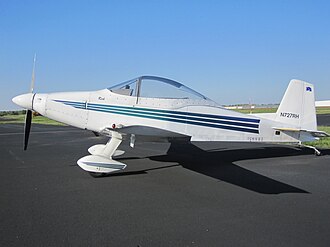
Mustang Aeronautics Mustang II: The Homebuilt That Turned Speed Into a Two-Seat Sport Aircraft
The Mustang Aeronautics Mustang II occupies an interesting place in the history of American homebuilt aviation. It is a small, fast, two-seat aircraft that emerged from the same experimental-aircraft culture that produced some of the most influential amateur-built designs of the twentieth century. Although its name can easily cause confusion with the famous North American P-51 Mustang or even the Ford Mustang II automobile, the aircraft has an entirely different story. The Mustang II was conceived as a practical high-performance homebuilt, combining an efficient all-metal airframe with a relatively powerful piston engine and a side-by-side cockpit. Its appeal came from a simple idea: give private builders a compact airplane capable of genuine cross-country speed without sacrificing the practicality of carrying two people.
The design traces its origins to Robert Bushby, who acquired the rights to the Long Midget Mustang in 1959. Bushby subsequently developed a larger, two-seat derivative, eventually creating the aircraft that became known as the Mustang II. The prototype flew in July 1966, and plans were subsequently offered to the homebuilding community. Bushby’s design proved sufficiently successful that it remained part of the experimental-aircraft world for decades. In 1992, the rights to the Midget Mustang and Mustang II were acquired by Mustang Aeronautics, which continued supporting and developing the designs.
From the Midget Mustang to the Mustang II
Robert Bushby’s Two-Seat Concept
The Mustang II did not appear from nowhere. Its roots lie in the earlier Midget Mustang, a tiny single-seat racing and sport aircraft associated with the American homebuilt movement. Bushby recognized that the basic concept could be developed into something more useful for everyday pilots. Instead of designing another single-seat racer, he created a two-seat aircraft with the occupants sitting alongside one another.
That side-by-side arrangement was an important part of the Mustang II’s character. It made the airplane considerably more useful for recreational flying, instruction, touring and sharing aviation with another person. Rather than being simply a machine for the pilot, it could function as a genuine personal aircraft. The Mustang II retained the compact proportions and aerodynamic efficiency associated with the Midget Mustang lineage while becoming large enough to accommodate two occupants and a useful quantity of fuel.
The prototype’s appearance also established the basic formula that would define the aircraft for decades: a low-mounted cantilever wing, enclosed cockpit, conventional tail, tractor-mounted engine and relatively clean aluminum fuselage. The prototype was flown in 1966, and the design soon became part of the growing plans-built aircraft movement in the United States.
A Homebuilt Designed Around Performance
The Mustang II was created during an era when amateur aircraft builders were increasingly interested in achieving performance comparable with professionally manufactured light aircraft. Builders were no longer satisfied simply to construct an airplane that could fly. They wanted speed, efficiency, attractive handling and modern construction techniques.
The Mustang II addressed those ambitions with a lightweight metal structure and a relatively powerful engine. Its low-drag configuration allowed the aircraft to make impressive use of engines in the 150-to-200-horsepower class. Depending on the individual example, Mustang IIs have been fitted with engines such as the Lycoming O-320, O-360 and IO-360. This flexibility became another important characteristic of the design because individual builders could tailor the aircraft to their own priorities.
Design and Construction
An All-Metal Airframe
One of the most significant features of the Mustang II is its riveted sheet-aluminum construction. The airframe uses a relatively straightforward metal-building philosophy, making it representative of a generation of homebuilt aircraft that demonstrated how aluminum could provide an excellent combination of strength, durability and aerodynamic smoothness.
The fuselage has relatively flat sides and bottom surfaces, while the upper portion forms a rounded turtle deck around the cockpit. This arrangement is visually distinctive and also illustrates the practical approach behind the design. The aircraft was not shaped merely for appearance; its structure was intended to be achievable by amateur builders equipped with the appropriate tools and skills.
The wing is a cantilever structure, eliminating the external bracing seen on many older light aircraft. The Mustang II’s approximately 24-foot span gives it a compact appearance while still providing a useful wing area for a two-seat aircraft. The published design uses NACA 64-series airfoils, with NACA 64A212 at the wing root transitioning to NACA 64A210 toward the tips.
This aerodynamic attention helps explain why the Mustang II can achieve surprisingly high speeds without requiring an enormous engine. Its relatively clean shape and low drag are central to the aircraft’s personality.
Conventional or Tricycle Landing Gear
Another unusual aspect of the design is its flexibility in landing-gear configuration. Mustang II examples have been built with conventional tailwheel landing gear as well as tricycle arrangements. This was particularly useful because pilots have different preferences regarding ground handling and operating characteristics.
The tricycle configuration became a notable feature of some aircraft, while tailwheel examples retained the more traditional appearance associated with many high-performance homebuilts of the period. The existence of both arrangements also demonstrates how the Mustang II evolved within the experimental-aircraft community rather than being locked into one rigid production specification.
Inside the Mustang II Cockpit
Two Seats Side by Side
The Mustang II’s cockpit is one of its most practical features. Unlike tandem-seat racers, both occupants sit beside each other beneath an enclosed canopy. This makes conversation easier and provides a much more natural environment for touring with a passenger.
The cockpit is compact, however, and the aircraft should not be confused with a large touring airplane. Its priorities are efficiency and performance rather than maximum cabin volume. Published examples give a cabin width of approximately 40 inches, while baggage capacity depends on the individual aircraft and configuration.
For a homebuilt intended to be fast, economical and relatively lightweight, that compromise makes sense. The Mustang II gives its occupants a genuine enclosed cockpit without carrying the structural and aerodynamic penalties associated with a much larger cabin.
A Builder’s Airplane
The Mustang II is perhaps best understood as a builder’s airplane. Its significance is not simply the speed of the finished machine but the fact that the owner can participate directly in creating it. That philosophy has always been central to experimental aviation.
Over the years, individual builders have installed different engines, propellers, instruments, fuel systems, canopies and landing-gear arrangements. Some examples have been optimized for cross-country travel, while others have been built with performance and appearance as their primary objectives. EAA’s records contain numerous examples of customized Mustang IIs, including aircraft with folding wings, upgraded avionics and different engine installations.
This variation means that there is no single Mustang II specification that perfectly describes every aircraft in existence. Two airplanes carrying the same name can have noticeably different empty weights, fuel capacities, cruise speeds and equipment.
Performance: Small Airframe, Serious Speed
The 150-Horsepower Mustang II
One of the most impressive characteristics of the Mustang II is the speed available from relatively modest power. EAA specifically highlights Kent Paser’s work with a 150-horsepower Mustang II, documenting extensive drag-reduction efforts that produced a cruise speed approaching 200 mph.
That figure illustrates what makes the Mustang II so interesting. Rather than relying exclusively on brute engine power, the design rewards aerodynamic cleanliness. Every reduction in unnecessary drag can translate directly into additional speed or reduced fuel consumption.
A typical 150-horsepower aircraft may not match the performance of a 200-horsepower example, but the lighter engine installation can provide its own advantages. The result is an aircraft capable of making relatively rapid cross-country journeys while remaining within the practical engine range available to homebuilders.
More Power for More Performance
Builders seeking additional performance have frequently chosen larger Lycoming engines. The O-360 and IO-360, producing around 180 and 200 horsepower respectively, can transform the character of the aircraft. A representative 200-horsepower Mustang II documented by KITPLANES had a cruise speed of about 210 mph, a climb rate around 1,900 feet per minute and a maximum gross weight of 1,887 pounds.
These figures should be regarded as representative rather than universal. Experimental aircraft are heavily influenced by propeller selection, engine condition, airframe finish, weight, wheel and gear configuration, canopy design and other modifications.
That variability is part of the Mustang II’s appeal. A builder can start with the basic airframe concept and create an airplane optimized for a particular mission. One owner might favor economical 150-horsepower touring, while another might build a 200-horsepower machine aimed at maximum speed.
Fuel Capacity and Long-Distance Potential
The standard Mustang II fuel arrangement has traditionally provided a practical fuel load for a lightweight sport aircraft, while optional systems can substantially increase capacity. Published information describes a standard capacity of approximately 25 U.S. gallons, with wet-wing installations capable of increasing capacity considerably, including configurations approaching 61 gallons.
Individual aircraft can therefore have very different endurance and range figures. A builder interested primarily in local sport flying has little reason to carry the additional weight of an extremely large fuel supply. Conversely, a Mustang II intended for long-distance travel can be configured with additional fuel.
This flexibility is typical of experimental aviation. Instead of a manufacturer dictating one standardized configuration, the aircraft can be adapted to its owner’s requirements, provided the resulting airplane remains within appropriate structural, weight and operating limitations.
Folding Wings and Practical Innovations
One particularly interesting option associated with the Mustang II is the folding wing. For owners without a conventional hangar, the ability to reduce the aircraft’s storage footprint can be extremely valuable. EAA records several Mustang II examples equipped with folding wings, demonstrating that this was more than a theoretical feature.
The folding-wing concept also reflects the practical thinking that went into the aircraft. Speed and performance are important, but a homebuilt aircraft must also fit into the owner’s real-world life. Storage, maintenance and transportation can determine whether an airplane is flown frequently or spends most of its time sitting unused.
The Mustang II in the Homebuilt Community
A Long-Lasting Design
Few homebuilt designs remain recognizable and relevant across such a long period as the Mustang II. Its prototype flew in 1966, and the aircraft continued to appear in the experimental-aircraft community for decades. Mustang Aeronautics later acquired the design rights and continued to support the aircraft and its associated kits.
The continued presence of Mustang IIs at EAA events and in aviation publications demonstrates the design’s lasting appeal. EAA’s aircraft-building resources list a long history of Mustang II coverage, including reports on performance, retractable-gear versions, folding-wing aircraft, different engines and individual builders’ projects.
The aircraft also developed a reputation for being a particularly attractive alternative for builders who wanted something faster and sleeker than a conventional trainer-style homebuilt.
The Human Side of Homebuilding
Perhaps the most interesting part of the Mustang II story is the number of individual airplanes that became reflections of their builders. Some took only a few years to complete, while others became decade-long projects. Owners have incorporated custom interiors, avionics, fuel systems, landing gear and engine installations.
One EAA-documented Mustang II, for example, was built with a folding wing, 160-horsepower engine, integral fuel tanks and modern avionics, and its owner described using it primarily for travel while also viewing it as a personal sports machine.
That combination of transportation and recreation captures the essence of the Mustang II. It is fast enough to be exciting, practical enough to travel in and sufficiently adaptable to become a personal engineering project.
Why the Mustang II Still Matters
The Mustang II represents an important period in the development of the American homebuilt aircraft. It came from a time when talented designers and amateur builders were demonstrating that an individual could create an aircraft with performance approaching that of professionally produced machines.
Its enduring appeal rests on several characteristics working together: a compact airframe, efficient aerodynamics, all-metal construction, two-seat accommodation, relatively powerful engines and extensive scope for individual modification. The design is neither a simple trainer nor a dedicated racing machine. Instead, it occupies an appealing middle ground between personal transportation and high-performance sport aviation.
More than half a century after the prototype first flew, that concept remains compelling. The Mustang II shows what can happen when a designer concentrates on aerodynamic efficiency and gives builders enough freedom to adapt the aircraft to their own requirements. It is a reminder that homebuilt aviation has never been merely about constructing inexpensive airplanes. At its best, it is about experimentation, craftsmanship and creating an aircraft that reflects the priorities of the person who built it.
Mustang Aeronautics Mustang II Technical Specifications
Because the Mustang II is an experimental homebuilt aircraft, specifications vary between individual examples. The following figures represent a representative high-performance Mustang II configuration documented by aviation sources rather than every possible version of the design.
| Specification | Mustang II |
|---|---|
| Aircraft type | Two-seat homebuilt sport aircraft |
| Designer | Robert Bushby |
| First flight | 9 July 1966 |
| Construction | Riveted aluminum |
| Configuration | Low-wing, cantilever monoplane |
| Seating | 2, side-by-side |
| Landing gear | Tailwheel or optional tricycle |
| Wingspan | Approximately 24 ft 4 in |
| Cabin width | Approximately 40 in |
| Typical empty weight | Approximately 1,177 lb |
| Maximum gross weight | Approximately 1,887 lb |
| Typical useful load | Approximately 710 lb |
| Fuel capacity | Varies; approximately 25–61 U.S. gal depending on configuration |
| Typical engine options | Lycoming O-320, O-360, IO-360 |
| Typical engine power | Approximately 150–200 hp |
| Representative cruise speed | Approximately 160–210 mph, depending on configuration |
| Representative climb rate | Up to approximately 1,900 fpm |
| Stall speed | Approximately 58 mph landing configuration in one documented example |
| Baggage capacity | Approximately 80 lb in one documented configuration |
| Wing airfoil | NACA 64A212 root / NACA 64A210 tip |
| Production status | Homebuilt / plans and kit aircraft |
| Design lineage | Developed from the Long Midget Mustang |
The Mustang Aeronautics Mustang II is ultimately more than a collection of numbers. Its importance lies in the philosophy behind those numbers: a small airframe, efficient aerodynamics, enough power to make it genuinely fast, and sufficient flexibility to let builders create highly individualized aircraft. That combination helped the Mustang II survive far beyond the era in which it was first designed, making it one of the more distinctive and enduring two-seat designs in the history of American homebuilt aviation.
