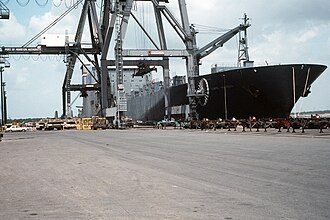
MV Cape Hudson (T-AKR-5066)
The Strategic Sealift Ship That Helped Define Modern Military Logistics
In the modern world, military power is often measured through visible instruments of force. Nations showcase aircraft carriers, stealth bombers, missile destroyers, submarines, and advanced fighter aircraft as symbols of strategic strength and technological superiority. These systems dominate media coverage and public attention because they represent the direct and dramatic side of warfare. Yet behind every combat aircraft in the sky, every armored brigade in the field, and every naval task force crossing the oceans lies a far less glamorous but fundamentally indispensable structure: logistics. Modern military operations depend not only on combat capability but also on transportation, sustainment, supply chains, fuel delivery, engineering support, maintenance infrastructure, and global mobility. Among the many ships quietly sustaining this hidden foundation of military power is the MV Cape Hudson (T-AKR-5066), a strategic roll-on/roll-off cargo vessel operating within the United States Ready Reserve Force.
Although the ship rarely appears in headlines and remains unfamiliar to much of the public, Cape Hudson performs one of the most important missions in modern defense infrastructure. The vessel serves as part of America’s strategic sealift network, a system designed to ensure that heavy military equipment can deploy rapidly across global distances during wars, humanitarian emergencies, regional crises, and large-scale military exercises. Tanks, armored vehicles, engineering systems, trucks, helicopters, fuel systems, generators, and sustainment infrastructure all require transportation before military operations can begin effectively. Strategic sealift vessels make such mobility possible.
This role becomes especially important in an era defined by expeditionary operations.
Unlike earlier military systems focused primarily on defending national borders or fixed geographic regions, modern American military doctrine emphasizes the ability to respond quickly to crises anywhere in the world. Such a strategy depends heavily on transportation capability.
Heavy equipment cannot simply appear in distant theaters overnight.
Aircraft can move personnel rapidly, but mechanized warfare still depends overwhelmingly on maritime transportation. The sheer size and weight of armored vehicles, logistical infrastructure, engineering equipment, and support systems make sealift the only practical method for large-scale strategic deployment.
Cape Hudson therefore represents much more than a cargo vessel.
The ship symbolizes the logistical architecture supporting global military reach.
Its design also reflects one of the most important innovations in modern maritime transportation: roll-on/roll-off cargo handling technology. Instead of relying entirely on cranes and labor-intensive loading systems, roll-on/roll-off vessels allow vehicles and wheeled cargo to drive directly aboard through ramps connected to internal cargo decks.
For military transportation, this innovation transformed operational efficiency.
Vehicles could be loaded faster, organized more effectively according to deployment priorities, and unloaded rapidly upon arrival. The resulting increase in mobility dramatically improved strategic responsiveness.
Cape Hudson embodies this logistical philosophy perfectly.
The vessel’s importance extends beyond military operations alone.
Strategic sealift ships support disaster relief, humanitarian assistance, multinational exercises, and emergency transportation missions. Earthquakes, hurricanes, floods, and humanitarian crises frequently damage local transportation infrastructure, making maritime logistics essential for delivering heavy equipment and relief supplies into affected regions.
The ship therefore occupies a fascinating position at the intersection of military readiness, commercial maritime technology, and humanitarian support capability.
Understanding Cape Hudson requires examining not only the ship itself but also the broader evolution of strategic sealift, military transportation doctrine, commercial shipping innovation, and the hidden logistical systems underpinning modern global operations.
The Historical Importance of Maritime Logistics
The strategic importance of maritime transportation has shaped world history for centuries.
Ancient civilizations depended heavily on sea routes for trade, communication, and military expansion. Empires capable of controlling maritime transportation often gained enormous economic and military advantages.
Yet modern strategic sealift emerged most clearly during the industrial age.
Before industrialization, military logistics remained relatively constrained by local resources and primitive transportation systems. Armies often depended on nearby supplies and struggled to sustain operations over long distances.
Industrial technology changed this dramatically.
Steamships, railroads, mechanized transport, industrial manufacturing, and modern engineering transformed both military capability and logistical complexity. Armies became larger, more mechanized, and increasingly dependent on sustained supply chains.
World War II demonstrated the decisive importance of maritime logistics on an unprecedented scale.
The Allied victory depended heavily on sealift transportation. Troops, tanks, fuel, food, ammunition, trucks, aircraft components, engineering equipment, and industrial supplies crossed oceans aboard cargo ships and troop transports in enormous quantities.
Without strategic transportation capability, global coalition warfare would have been impossible.
The Cold War preserved this emphasis on logistics.
The United States maintained overseas commitments across Europe, Asia, and other regions while relying heavily on maritime transportation to sustain military presence and alliance systems.
Yet Cold War planning often focused on relatively predictable scenarios involving NATO reinforcement and potential European conflict.
The post-Cold War era transformed strategic assumptions.
Instead of preparing primarily for one large confrontation, American planners increasingly emphasized rapid global response capability. Military crises could emerge unexpectedly in distant regions lacking permanent infrastructure.
The 1991 Gulf War reinforced the importance of strategic sealift especially clearly.
Operation Desert Shield required transporting enormous quantities of military equipment to the Middle East within a relatively short timeframe. Tanks, armored personnel carriers, engineering systems, helicopters, fuel equipment, and support vehicles all had to move rapidly across oceans.
Sealift transported the overwhelming majority of this cargo.
The Gulf War therefore confirmed a fundamental strategic reality: global military operations still depend heavily on ships.
Cape Hudson emerged within this broader environment of logistical modernization and expeditionary doctrine.
The Ready Reserve Force and National Preparedness
MV Cape Hudson operates as part of the Ready Reserve Force, commonly known as the RRF.
Managed by the United States Maritime Administration, or MARAD, the Ready Reserve Force represents one of the most important components of American strategic transportation preparedness. The RRF consists of ships maintained in reduced operating status but preserved for rapid activation during military contingencies, humanitarian emergencies, or large-scale logistical operations.
The logic behind the system reflects careful strategic planning.
Maintaining massive fleets of fully active cargo ships during peacetime would be extremely expensive and operationally inefficient. Yet attempting to build or acquire transportation capability only after crises emerge would create dangerous delays.
The Ready Reserve Force solves this challenge by preserving ships in carefully maintained readiness conditions.
Vessels undergo regular maintenance, inspections, engineering evaluations, preservation procedures, and systems testing to ensure rapid operational activation capability.
Cape Hudson therefore functions as part of a larger strategic insurance policy.
The vessel’s readiness contributes directly to national mobility capability.
Military effectiveness depends not only on weapons systems and personnel but also on transportation infrastructure capable of moving heavy equipment rapidly across global distances.
The Ready Reserve Force provides surge transportation capacity supporting this requirement.
The system also demonstrates the enduring importance of maritime transportation in the modern strategic environment.
Despite advances in aviation and digital warfare, heavy cargo transportation still depends overwhelmingly on ships.
Construction and Commercial Origins of Cape Hudson
Like many Ready Reserve Force vessels, Cape Hudson originally served within the commercial maritime industry before entering strategic reserve service.
The ship was built in Japan during the period when Japanese shipyards dominated much of the global cargo shipbuilding market. Japanese builders became internationally respected for constructing efficient, reliable cargo vessels optimized for operational endurance and transportation efficiency.
The postwar commercial shipping industry experienced enormous technological transformation.
Containerization revolutionized freight transportation worldwide. Roll-on/roll-off technology dramatically improved vehicle transport efficiency. Advances in propulsion systems, ship engineering, and cargo management technology further reshaped maritime logistics.
Cape Hudson emerged directly from this environment of innovation.
Originally intended for civilian cargo transportation, the vessel later transitioned into strategic reserve service under American control.
This transition reflected broader recognition that commercial shipping technology could support military logistics effectively.
Rather than constructing entirely new fleets of purpose-built military transport ships, planners often adapted commercial vessels capable of fulfilling strategic transportation requirements.
Roll-on/roll-off ships proved especially valuable because their internal cargo arrangements aligned naturally with military vehicle transportation needs.
Cape Hudson’s designation as T-AKR-5066 reflects its incorporation into strategic sealift structures while retaining many commercial shipping characteristics.
This hybrid identity remains typical of many strategic transportation vessels.
Roll-On/Roll-Off Technology and the Logistics Revolution
The roll-on/roll-off concept fundamentally transformed maritime cargo operations.
Traditional cargo ships often depended heavily on cranes, pallets, cargo nets, and labor-intensive loading procedures. Although functional, these systems could create major delays and operational inefficiencies.
Roll-on/roll-off vessels introduced a dramatically faster approach.
Vehicles could drive directly aboard through ramps connected to cargo decks. Internal ramps linked multiple deck levels together, allowing efficient movement throughout the ship.
This system revolutionized vehicle transportation.
For military operations, the implications were extraordinary.
Armored vehicles, engineering machinery, support trucks, trailers, fuel systems, and logistical equipment could be loaded rapidly according to deployment priorities. Upon arrival, these same vehicles could unload quickly under their own power.
Cape Hudson embodies this logistical philosophy perfectly.
Its internal cargo decks effectively function as massive floating vehicle storage systems optimized for strategic transportation.
Military planners value such capability because deployment speed strongly influences strategic flexibility.
Rapid transportation may determine whether forces arrive in time to stabilize crises, reinforce allies, deter aggression, or support humanitarian operations effectively.
The roll-on/roll-off design also improves operational resilience.
Ports lacking sophisticated cargo handling infrastructure can still support unloading operations relatively efficiently.
This capability becomes especially valuable during emergencies or deployments into austere regions.
Cape Hudson’s design therefore supports not only cargo capacity but also operational adaptability.
Engineering and Ship Architecture
MV Cape Hudson was engineered around practical transportation efficiency rather than combat operations.
Its design emphasizes cargo volume, operational reliability, endurance, and loading efficiency.
The vessel stretches hundreds of feet in length and contains enormous internal cargo spaces distributed across multiple vehicle decks. Structural engineering aboard roll-on/roll-off ships must account for concentrated vehicle weight and operational safety requirements.
Military cargo creates especially demanding engineering challenges.
Tracked armored vehicles exert immense pressure on deck surfaces, requiring substantial reinforcement and careful weight distribution planning.
Cape Hudson’s architecture reflects this engineering sophistication despite its outwardly utilitarian appearance.
The ship’s propulsion system balances operational speed with fuel economy and endurance.
Strategic sealift vessels must move large quantities of cargo across intercontinental distances relatively efficiently while maintaining adequate deployment responsiveness.
Although not designed for high-speed naval maneuvering, Cape Hudson can support strategic transportation schedules effectively.
Cargo handling infrastructure also plays major operational roles.
Vehicle securing systems, loading ramps, deck ventilation arrangements, cargo management structures, and tie-down points all contribute to transportation safety and operational efficiency.
Reliability remains critically important.
Transportation failures during military deployments can create major operational consequences. Ready Reserve Force ships therefore undergo continuous maintenance and preservation despite extended inactive periods.
Cape Hudson’s operational usefulness depends heavily on sustained technical oversight.
Strategic Mobility and Expeditionary Warfare
Modern American military doctrine depends fundamentally on strategic mobility.
Unlike geographically defensive military systems focused primarily on homeland protection, expeditionary forces require the ability to deploy rapidly across global distances.
Sealift capability forms one of the foundations of this operational model.
Cape Hudson contributes directly to this strategic framework.
Heavy military equipment remains extraordinarily difficult to transport by air in large quantities. Tanks, engineering systems, support vehicles, helicopters, fuel apparatus, and logistical infrastructure require immense cargo capacity.
Maritime transportation provides this capability far more efficiently than alternative systems.
The vessel therefore supports the practical realities of global force projection.
During overseas deployments, strategic sealift ships often determine when heavy military formations become operational within a theater.
Combat aircraft may arrive rapidly, but sustained operations require enormous logistical support structures.
Cape Hudson helps transport these structures.
The ship also supports multinational exercises, alliance cooperation, and deterrence missions.
Joint training operations frequently require transportation of vehicles and support systems between continents.
Strategic sealift therefore contributes to geopolitical stability even during peacetime.
Humanitarian Assistance and Disaster Relief
Although strategic sealift systems exist primarily for military readiness, they also possess major humanitarian value.
Natural disasters frequently destroy roads, ports, bridges, airports, and local infrastructure, making maritime logistics critically important for relief operations.
Earthquakes, hurricanes, floods, tsunamis, and regional crises often create urgent requirements for engineering machinery, generators, medical systems, fuel supplies, trucks, and temporary shelters.
Roll-on/roll-off ships like Cape Hudson can transport these resources efficiently across long distances.
The vessel’s cargo architecture allows rapid unloading of wheeled vehicles and heavy equipment even in regions lacking advanced cargo handling capability.
Military transportation systems therefore often support humanitarian operations directly.
Strategic mobility becomes humanitarian mobility during emergencies.
This dual-use role adds another layer of significance to Cape Hudson’s mission.
Crew Life and Operational Culture
Life aboard strategic sealift vessels differs substantially from service aboard frontline naval combatants.
Ready Reserve Force ships typically operate with civilian mariner crews possessing expertise in engineering, navigation, cargo handling, maintenance, and maritime logistics.
Operational culture aboard such vessels emphasizes professionalism, reliability, technical competence, and transportation efficiency.
When activated, Cape Hudson’s operations focus heavily on cargo movement and logistical coordination.
Loading military vehicles requires careful planning, operational precision, and strict safety procedures.
Heavy cargo movement aboard ships involves considerable technical complexity.
Crew members therefore combine maritime operational skills with sophisticated logistical expertise.
Extended transoceanic voyages also shape shipboard life significantly.
Sealift crews may spend long periods transporting equipment between continents under demanding deployment schedules.
Although less publicly visible than combat deployments, these missions remain critically important to military effectiveness.
The Economics of Strategic Sealift
Strategic sealift also reflects important economic realities.
Transporting heavy military equipment by air remains extremely expensive and constrained by cargo aircraft capacity. Maritime transportation provides vastly greater carrying capability at lower cost for large-scale deployments.
Cape Hudson exemplifies this efficiency.
A single strategic sealift vessel can transport cargo quantities impossible for most airlift systems to replicate economically.
This capability becomes especially important during sustained overseas operations involving mechanized forces and continuous logistical support.
Sealift therefore contributes not only to operational capability but also to strategic sustainability.
Military planners must balance readiness, speed, transportation capacity, and economic efficiency simultaneously.
Ships like Cape Hudson help achieve this balance.
Sealift in the Twenty-First Century Strategic Environment
The strategic importance of sealift continues evolving in the modern geopolitical environment.
Global operations increasingly involve distributed deployments, alliance coordination, and rapid response across enormous distances.
The Indo-Pacific region especially presents extraordinary logistical challenges because of its geographic scale.
Transporting heavy military reinforcement across such distances depends fundamentally on maritime transportation capability.
Cape Hudson contributes directly to this broader mobility network.
The vessel’s readiness supports deterrence because transportation capability enables operational reinforcement during crises.
Strategic mobility therefore influences geopolitical calculations even during peacetime.
Potential adversaries understand that military power depends not only on combat systems but also on sustainment and reinforcement capability.
The Hidden Foundation of Military Power
One reason ships like Cape Hudson remain relatively unknown involves the hidden nature of logistics itself.
Combat systems attract attention because they visibly project force. Logistics systems usually operate quietly in the background.
Yet operational capability depends fundamentally on transportation infrastructure.
Military history repeatedly demonstrates that logistical failure often determines strategic outcomes more decisively than battlefield tactics alone.
Fuel shortages, transportation bottlenecks, supply interruptions, and mobility limitations can cripple even technologically advanced military forces rapidly.
Cape Hudson therefore performs a mission simultaneously understated and indispensable.
Its contribution may rarely appear in headlines, but modern expeditionary warfare would be impossible without strategic transportation vessels of this type.
Conclusion
MV Cape Hudson (T-AKR-5066) stands as an important example of the hidden logistical infrastructure supporting modern military readiness and global mobility. Operating within the United States Ready Reserve Force, the vessel helps ensure that heavy military equipment, vehicles, engineering systems, and logistical support infrastructure can deploy rapidly across oceans whenever crises emerge.
Although lacking the visibility associated with frontline combat warships, Cape Hudson performs a mission fundamentally essential to strategic operations. Its roll-on/roll-off design, large cargo capacity, and readiness status make it a critical component of American strategic sealift capability.
The ship also symbolizes the broader relationship between commercial maritime technology and national security infrastructure. Originally constructed for civilian cargo transportation, Cape Hudson now supports military readiness while retaining many characteristics associated with commercial shipping.
Its mission extends beyond warfare itself.
Humanitarian assistance, disaster relief, multinational exercises, and emergency transportation operations all benefit from strategic sealift capability.
Ultimately, Cape Hudson demonstrates a central truth about modern power projection: military effectiveness depends not only on combat systems and weapons but also on the ability to move equipment, supplies, and infrastructure efficiently across global distances.
Without ships like MV Cape Hudson, modern expeditionary operations would simply not be sustainable.
Technical Parameters of MV Cape Hudson (T-AKR-5066)
| Parameter | Specification |
|---|---|
| Vessel Name | MV Cape Hudson |
| Hull Classification | T-AKR-5066 |
| Vessel Type | Roll-on/Roll-off Cargo Ship |
| Fleet Assignment | Ready Reserve Force |
| Managing Agency | U.S. Maritime Administration (MARAD) |
| Operational Role | Strategic sealift support |
| Original Function | Commercial cargo transportation |
| Builder | Kawasaki Heavy Industries |
| Construction Location | Japan |
| Year Built | 1973 |
| Length | Approximately 634 ft (193.2 m) |
| Beam | Approximately 84 ft (25.6 m) |
| Draft | Approximately 30 ft (9.1 m) |
| Gross Tonnage | Approximately 22,561 GT |
| Deadweight Tonnage | Approximately 26,000 tons |
| Propulsion System | Steam turbine |
| Propeller Configuration | Single screw |
| Maximum Speed | Approximately 18 knots |
| Cargo Configuration | Roll-on/Roll-off vehicle decks |
| Cargo Access | Stern ramp loading system |
| Cargo Capacity | Heavy military vehicles and wheeled cargo |
| Typical Cargo | Trucks, armored vehicles, engineering systems |
| Crew Type | Civilian mariners |
| Readiness Status | Maintained for rapid activation |
| Primary Mission | Strategic military transportation |
| Secondary Mission | Humanitarian and disaster relief support |
| Operational Range | Global deployment capability |
| Ownership | United States Government |
| Key Capability | Rapid deployment support for military logistics |
Sources used for factual verification: (en.wikipedia.org)
