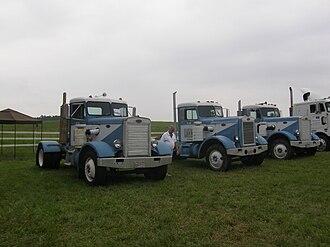
The history of heavy-duty trucking is filled with remarkable machines that transformed transportation, logistics, and the very image of life on the open road. Among these legendary vehicles, few trucks have earned the level of admiration enjoyed by the Peterbilt 281. Produced during one of the most important periods in American trucking history, the Peterbilt 281 represented durability, innovation, and craftsmanship at a time when long-distance freight transportation was rapidly expanding across North America.
Although thousands of commercial trucks have come and gone over the decades, the Peterbilt 281 continues to capture the imagination of truck enthusiasts, collectors, historians, and classic vehicle restorers alike. Its unmistakable butterfly hood, rounded styling, and unmistakable silhouette remain instantly recognizable even to people who know little about heavy-duty trucks. The truck also gained worldwide fame through popular culture, cementing its place as one of the most iconic American vehicles ever built.
Yet the Peterbilt 281 deserves recognition for far more than its cinematic fame. It was a hardworking machine that hauled freight through deserts, climbed mountain passes, crossed frozen highways, and served industries ranging from logging and construction to fuel transportation and agriculture. Thousands of drivers trusted the model every day to earn their living, often putting hundreds of thousands of miles on these durable workhorses.
This article explores the complete story of the Peterbilt 281, examining its origins, engineering, mechanical design, performance, daily operation, historical importance, restoration, collectability, and enduring legacy.
The Origins of Peterbilt
Before understanding the Peterbilt 281 itself, it is worth looking at the company responsible for creating it.
Peterbilt Motors Company traces its roots back to the 1930s, when entrepreneur T.A. Peterman purchased the assets of the Fageol Motor Company. Peterman recognized the growing demand for rugged logging trucks capable of surviving the difficult roads of the American West. Rather than settling for standard commercial vehicles, he envisioned premium trucks built with exceptional attention to quality.
From the beginning, Peterbilt emphasized several core principles:
- Lightweight aluminum construction
- Custom-built configurations
- Durable heavy-duty frames
- Driver comfort
- High-quality craftsmanship
These characteristics distinguished Peterbilt from many competitors. Instead of producing purely standardized vehicles, Peterbilt became known for building trucks tailored to individual customer requirements.
By the 1950s, the company had become one of America’s most respected heavy truck manufacturers, laying the foundation for the arrival of one of its most famous models.
The Birth of the Peterbilt 281
The Peterbilt 281 entered production during the mid-1950s, replacing earlier conventional truck designs while introducing several important engineering improvements.
Unlike many trucks of the era, the 281 featured an aluminum cab, helping reduce vehicle weight without sacrificing strength. This lighter construction allowed operators to maximize payload while improving fuel efficiency—an increasingly important factor as freight demand grew.
Perhaps the most striking visual characteristic of the truck was its butterfly hood. Instead of lifting forward as on modern conventional trucks, the hood opened from both sides, creating two large access panels. This unusual arrangement provided mechanics with excellent access to the engine while contributing to the truck’s unique appearance.
The truck was available in numerous axle configurations, wheelbases, and drivetrain combinations, making it suitable for virtually every heavy-duty application imaginable.
Exterior Design That Defined an Era
One reason the Peterbilt 281 remains instantly recognizable decades after production ended is its timeless styling.
The truck reflected an era when commercial vehicles combined utility with elegant industrial design. Every component appeared purposeful while maintaining clean proportions.
Major exterior features included:
The Butterfly Hood
The butterfly hood became the truck’s defining visual feature.
Instead of a single tilting hood, two large panels opened outward from the center hinge. This allowed technicians to reach nearly every side of the engine without climbing over fenders or removing major body panels.
The design also created the truck’s famous profile, making it unlike nearly every other conventional truck ever produced.
Rounded Front Fenders
Large rounded fenders blended smoothly into the hood, producing flowing body lines uncommon in heavy-duty trucks.
These curves reflected automotive styling trends of the 1950s while remaining highly functional.
Large Chrome Grille
The front grille featured substantial vertical bars finished in chrome, projecting both strength and sophistication.
Combined with large circular headlights, the grille gave the truck a confident appearance.
Aluminum Cab Construction
Peterbilt’s extensive use of aluminum was revolutionary.
Benefits included:
- Lower curb weight
- Better corrosion resistance
- Longer service life
- Higher payload capacity
- Improved fuel economy
Even decades later, many original aluminum cabs remain remarkably well preserved.
Engineering Philosophy
The Peterbilt 281 was designed around practical engineering rather than unnecessary complexity.
Its components emphasized:
- Ease of maintenance
- Mechanical reliability
- Long operational life
- Adaptability
- Serviceability in remote locations
During the 1950s and 1960s, trucks frequently operated in isolated regions where dealer support could be hundreds of miles away.
As a result, simplicity was a major advantage.
Many repairs could be completed with ordinary mechanical tools.
Engine Options
The Peterbilt 281 was never tied to a single engine.
Instead, customers could choose from several manufacturers depending on their operational needs.
Popular engines included:
Cummins Diesel Engines
Cummins engines became some of the most common choices.
Known for:
- Outstanding durability
- Excellent fuel economy
- Strong low-speed torque
- Long overhaul intervals
Cummins powerplants proved especially popular with long-haul operators.
Caterpillar Engines
Many vocational operators preferred Caterpillar engines.
Advantages included:
- Exceptional pulling power
- Heavy-duty construction
- Strong reputation in mining and construction
- Excellent reliability
Detroit Diesel
Detroit Diesel engines also appeared in some Peterbilt 281 configurations.
Their two-stroke diesel design delivered high power output relative to engine size.
Transmission Choices
Heavy hauling demanded robust transmissions.
Operators could select:
- Five-speed manual
- Ten-speed manual
- Auxiliary transmissions
- Two-stick shifting arrangements
Many experienced drivers mastered complex gear combinations that modern automated transmissions have largely replaced.
Driving a fully loaded Peterbilt 281 required genuine skill, particularly when climbing steep grades or descending mountain roads.
Performance on the Highway
Although modern trucks are faster, quieter, and more efficient, the Peterbilt 281 earned tremendous respect for its capabilities.
Typical strengths included:
Excellent Pulling Power
Large-displacement diesel engines generated enormous torque.
This allowed the truck to haul:
- Heavy machinery
- Timber
- Fuel
- Agricultural products
- Construction materials
Stability
Its long wheelbase and robust suspension created stable handling under heavy loads.
Durability
Many trucks accumulated over one million miles with proper maintenance.
Such longevity became a hallmark of Peterbilt engineering.
Driver Experience
Life behind the wheel of a Peterbilt 281 differed dramatically from today’s trucking experience.
There were:
- No digital displays
- No electronic stability systems
- No adaptive cruise control
- No automatic transmissions
Instead, drivers relied on mechanical understanding and experience.
Operating the truck successfully required:
- Careful gear selection
- Double-clutching
- Monitoring engine temperature
- Listening for drivetrain issues
- Understanding engine RPM
Experienced drivers often described becoming “one with the truck,” learning to recognize subtle changes in engine sound and vibration.
Cab Comfort
Although primitive by modern standards, the Peterbilt 281 represented a premium truck during its era.
Cab features often included:
- Adjustable driver’s seat
- Large steering wheel
- Excellent forward visibility
- Durable dashboard controls
- Effective ventilation
Some long-wheelbase models offered sleeper compartments for long-distance drivers.
Maintenance and Reliability
One of the greatest strengths of the Peterbilt 281 was maintainability.
Unlike many modern electronically controlled trucks, nearly every system was mechanical.
Routine maintenance included:
- Oil changes
- Valve adjustments
- Fuel filter replacement
- Brake inspection
- Clutch servicing
- Suspension lubrication
Because of straightforward engineering, owner-operators often performed much of this work themselves.
The Peterbilt 281 in American Industry
The truck served numerous industries throughout North America.
Logging
Its origins in the Pacific Northwest made it especially popular among logging companies.
Construction
Construction firms relied on the truck for transporting heavy equipment and building materials.
Fuel Transport
Tanker operators appreciated its reliability and pulling power.
Agriculture
Farmers and grain haulers found the truck dependable during harvest seasons.
Long-Haul Freight
Many freight companies used the Peterbilt 281 for interstate transportation before more aerodynamic truck designs emerged.
Fuel Economy
Fuel efficiency was respectable for its time.
Several factors influenced consumption:
- Engine choice
- Vehicle weight
- Terrain
- Driver skill
- Transmission configuration
While modern aerodynamic tractors achieve significantly better fuel economy, the Peterbilt 281 balanced performance with reasonable operating costs for its era.
The Peterbilt 281 in Popular Culture
The truck’s greatest leap into worldwide recognition came through its appearance in Steven Spielberg’s acclaimed television film Duel (1971), based on a story by Richard Matheson.
In the film, a weathered Peterbilt 281 becomes far more than a commercial vehicle. It serves as the mysterious antagonist, relentlessly pursuing an unsuspecting motorist across isolated desert highways. The truck itself is presented almost as a living creature, with its battered bodywork, growling engine, and imposing grille creating an unforgettable sense of menace.
The production team deliberately aged and distressed the truck to make it appear intimidating, adding mismatched license plates, grime, and signs of years of hard use. This visual treatment became so iconic that many people today immediately associate the Peterbilt 281 with Duel.
The film elevated the truck from a respected work vehicle to a cultural icon. Even viewers with no interest in trucking came to recognize its distinctive butterfly hood and unmistakable profile. As a result, surviving examples of the model gained renewed attention from collectors and enthusiasts, ensuring that the Peterbilt 281 would be remembered long after it disappeared from commercial fleets.
Collecting the Peterbilt 281 Today
Original Peterbilt 281 trucks have become highly desirable collector vehicles.
Restored examples frequently appear at:
- Truck shows
- Historical exhibitions
- Vintage transportation museums
- Classic vehicle auctions
Collectors value originality above all else.
Important considerations include:
- Original aluminum cab
- Factory drivetrain
- Authentic paint
- Correct interior
- Matching identification plates
Because relatively few examples survive in original condition, authentic restorations can require years of work.
Restoration Challenges
Restoring a Peterbilt 281 presents several unique challenges.
Replacement body panels are scarce.
Original trim pieces may require custom fabrication.
Engine rebuilding can become expensive due to the age of many components.
Nevertheless, a dedicated restoration community continues to preserve these remarkable trucks.
Specialized suppliers reproduce certain parts, while experienced craftsmen fabricate components no longer available.
Comparison with Modern Trucks
Comparing the Peterbilt 281 to today’s highway tractors highlights how dramatically commercial vehicle technology has evolved.
Modern trucks feature electronically controlled engines, automated manual transmissions, sophisticated emissions systems, air-ride suspensions, integrated telematics, advanced driver-assistance technologies, climate-controlled sleepers, and digital dashboards. These improvements provide higher efficiency, lower emissions, greater comfort, and enhanced safety.
By contrast, the Peterbilt 281 relied almost entirely on mechanical systems. There were no engine control modules, touchscreens, or computerized diagnostics. Drivers were expected to understand the machinery intimately, often diagnosing problems by listening to the engine or feeling subtle changes in vibration.
Despite these differences, many enthusiasts argue that the Peterbilt 281 possesses qualities modern trucks cannot replicate. Its handcrafted construction, straightforward engineering, and unmistakable character create an emotional connection that extends beyond transportation. While today’s tractors excel in productivity and operating costs, the 281 represents an era when craftsmanship and individuality played a larger role in commercial vehicle design.
Legacy of the Peterbilt 281
The Peterbilt 281 occupies a unique place in trucking history.
It demonstrated that heavy-duty commercial vehicles could combine durability, functionality, and distinctive styling without compromising performance. The truck helped reinforce Peterbilt’s reputation as a builder of premium heavy-duty vehicles, a reputation the company continues to enjoy today.
More importantly, the 281 symbolizes an era when trucking demanded exceptional mechanical skill, patience, and determination. Drivers navigated challenging roads with minimal assistance, relying on experience and careful judgment rather than electronic systems.
Today, the Peterbilt 281 stands as a reminder of those pioneering decades. Whether admired at a classic truck show, preserved in a museum, or remembered through its unforgettable appearance on screen, it continues to inspire admiration among enthusiasts around the world. Its combination of rugged engineering, timeless styling, and historical significance ensures that the Peterbilt 281 will remain one of the greatest classic trucks ever built.
Technical Specifications
| Parameter | Specification |
|---|---|
| Manufacturer | Peterbilt Motors Company |
| Model | Peterbilt 281 |
| Production period | Mid-1950s to mid-1960s (various configurations) |
| Vehicle class | Heavy-duty conventional truck |
| Cab construction | Aluminum |
| Hood type | Butterfly (dual-opening) hood |
| Drive configurations | 4×2, 6×4 and other custom configurations |
| Engine options | Cummins, Caterpillar, Detroit Diesel (various models) |
| Fuel type | Diesel |
| Transmission | Manual (5-, 10-, and multi-speed options with auxiliary gearboxes available) |
| Steering | Manual power-assisted steering depending on configuration |
| Brake system | Air brakes |
| Suspension | Heavy-duty leaf spring suspension |
| Frame | Heavy-duty steel ladder frame |
| Front axle | Solid beam axle |
| Rear axle | Single or tandem drive axles |
| Wheelbase | Numerous customer-specified configurations |
| Sleeper availability | Optional on selected long-haul models |
| Typical applications | Long-haul freight, logging, fuel transport, construction, agriculture, heavy hauling |
| Construction philosophy | Lightweight aluminum cab with durable heavy-duty chassis |
| Distinguishing feature | Iconic butterfly hood and rounded classic styling |
| Historical significance | One of the best-known classic American heavy-duty trucks and a cultural icon through its appearance in Duel (1971) |
