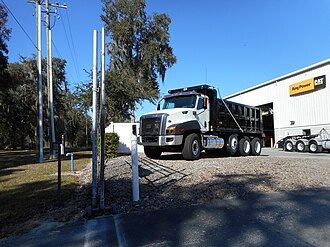
When people hear the name Caterpillar, they immediately think of massive bulldozers, excavators, wheel loaders, mining trucks, and other machines that have shaped construction sites around the world for nearly a century. For decades, Caterpillar built a reputation as one of the world’s leading manufacturers of heavy equipment and diesel engines, supplying industries ranging from mining and construction to energy production and agriculture. Yet for many years, the company remained absent from one important segment of commercial transportation—the North American heavy-duty truck market.
That changed dramatically with the introduction of the Cat CT660, a vocational truck designed specifically for demanding work environments where durability, reliability, and performance mattered far more than luxury or aerodynamic efficiency. Rather than targeting long-haul trucking companies, Caterpillar focused on customers operating in construction, aggregate hauling, refuse collection, concrete transportation, oil and gas operations, logging, and other industries where trucks spend much of their lives away from interstate highways.
The Cat CT660 represented an ambitious step for Caterpillar. Instead of merely supplying engines to truck manufacturers—as it had done successfully for decades—the company sought to establish its own presence in the Class 8 truck market. Leveraging its engineering expertise, global dealer network, and reputation for building machines capable of surviving the world’s harshest environments, Caterpillar introduced a truck that reflected the same philosophy found in its yellow construction equipment: build it strong, build it to last, and build it for work rather than appearances.
Although the CT660 remained in production for only a relatively short period, it left a lasting impression among vocational fleet operators and Caterpillar enthusiasts. Its rugged construction, distinctive styling, comfortable cab, and practical engineering continue to attract interest years after production ended.
This article explores the complete story of the Cat CT660, including its development, engineering, drivetrain, cab design, driving characteristics, maintenance, applications, strengths, weaknesses, market reception, and lasting legacy.
Caterpillar’s Long History Before Building Trucks
Before launching the CT660, Caterpillar had already established itself as one of the most respected industrial manufacturers in the world.
Founded in 1925 through the merger of the Holt Manufacturing Company and the C.L. Best Tractor Company, Caterpillar became synonymous with heavy equipment. Over the decades, its machines helped construct highways, airports, dams, bridges, pipelines, mines, and countless infrastructure projects across every continent.
Alongside its machinery, Caterpillar also became one of the largest producers of industrial diesel engines. Cat engines powered everything from generators and marine vessels to locomotives, mining equipment, and heavy trucks produced by other manufacturers.
For many years, Caterpillar diesel engines could be found in trucks built by companies such as Peterbilt, Kenworth, Freightliner, Western Star, and Sterling. Drivers appreciated their durability, high torque output, and ability to perform under severe operating conditions.
However, increasingly strict emissions regulations eventually led Caterpillar to withdraw from the on-highway engine market in 2010. Rather than abandoning highway transportation entirely, the company decided to pursue a different strategy—building complete trucks under the Caterpillar brand.
The Development of the Cat CT660
The CT660 emerged from a collaboration between Caterpillar and Navistar International, one of North America’s largest truck manufacturers.
Rather than designing an entirely new truck from the ground up, Caterpillar partnered with Navistar to develop a vocational vehicle based on proven truck architecture while incorporating Caterpillar’s design philosophy, branding, dealer support, and customer-focused engineering.
The result debuted in 2011 as the Cat CT660.
Instead of competing directly against aerodynamic highway tractors designed for cross-country freight hauling, Caterpillar intentionally targeted vocational customers operating in demanding environments.
These industries included:
- Construction
- Mining support
- Concrete delivery
- Aggregate hauling
- Refuse collection
- Municipal services
- Heavy equipment transportation
- Oil field operations
- Logging
- Utility companies
The truck was intended to withstand constant exposure to rough terrain, uneven job sites, heavy loads, and frequent stop-and-go driving.
Exterior Design with Caterpillar Identity
Although much of the CT660’s engineering shared components with Navistar products, Caterpillar ensured the truck possessed its own unmistakable identity.
The first thing most people noticed was the distinctive front grille featuring Caterpillar’s familiar black-and-yellow branding.
Unlike sleek aerodynamic highway tractors, the CT660 embraced a bold and muscular appearance.
The hood featured clean, squared lines that projected strength rather than elegance. Large headlights provided excellent illumination while remaining easy to replace if damaged on construction sites.
The bumper was designed to withstand harsh working environments, and many customers selected heavy-duty steel bumpers for additional protection against impacts and debris.
Numerous optional accessories included:
- Chrome trim
- Work lights
- Air horns
- Tow hooks
- Aluminum wheels
- Exterior grab handles
- Engine protection packages
The overall appearance successfully blended modern truck styling with Caterpillar’s industrial heritage.
Built for Vocational Work
One of the defining characteristics of the CT660 was its focus on vocational applications rather than highway efficiency.
Unlike long-haul tractors that spend most of their time cruising at constant highway speeds, vocational trucks operate under much harsher conditions.
Typical daily duties might include:
- Driving over gravel roads
- Backing into construction sites
- Hauling fully loaded dump trailers
- Climbing steep grades
- Operating in mud
- Making frequent stops
- Idling for extended periods
Every component of the CT660 reflected these realities.
The truck featured a robust ladder-frame chassis capable of supporting heavy payloads while resisting twisting forces encountered on uneven terrain.
Heavy-duty suspension systems provided durability under constant loading and unloading.
Ground clearance was carefully balanced to allow off-road capability without sacrificing highway stability.
Powertrain Options
One of the most interesting aspects of the CT660 involved its engines.
Since Caterpillar had exited the on-highway diesel engine market before the truck entered production, the CT660 did not use a Caterpillar-branded engine.
Instead, it relied primarily on engines supplied by Navistar.
MaxxForce Engines
Most CT660 trucks were equipped with Navistar MaxxForce diesel engines.
These included several displacement options designed to meet varying vocational requirements.
Features generally included:
- Turbocharging
- Electronic fuel injection
- High torque output
- Modern emissions controls
- Strong low-speed performance
Power ratings varied depending on customer configuration and intended application.
Typical horsepower ranged from approximately 330 to over 475 horsepower.
Torque outputs commonly exceeded 1,250 lb-ft in higher-output versions.
Performance Characteristics
Rather than emphasizing top speed, the engines focused on usable torque.
This allowed operators to:
- Pull heavy loads from a standstill
- Maintain traction on rough terrain
- Operate efficiently under constant load
- Reduce shifting frequency
These characteristics were particularly valuable for dump trucks and mixer trucks.
Transmission Choices
The CT660 offered multiple transmission options depending on customer needs.
Popular configurations included manual transmissions from Eaton Fuller as well as automated manual transmissions.
Automatic Allison transmissions were also available for vocational applications requiring frequent starts and stops.
Different transmission options allowed fleets to optimize performance for:
- Dump operations
- Municipal work
- Refuse collection
- Concrete mixers
- Construction hauling
The availability of automatic transmissions significantly reduced driver fatigue during urban operations.
Chassis and Frame Strength
Perhaps the CT660’s greatest engineering strength was its chassis.
The heavy-duty steel frame was designed to accommodate numerous body configurations while resisting years of demanding service.
Customers could specify:
- Single rear axle
- Tandem rear axles
- Lift axles
- Reinforced frame rails
- Heavy-duty crossmembers
Wheelbase options varied considerably depending on body style and intended application.
Frame strength allowed installation of numerous vocational bodies without compromising structural integrity.
Suspension Systems
Vocational trucks encounter conditions far more severe than highway tractors.
To address this, the CT660 employed heavy-duty suspension systems engineered for constant loading.
Available suspension options included:
Mechanical Leaf Spring Suspension
Known for simplicity and durability.
Ideal for:
- Dump trucks
- Construction
- Logging
- Heavy hauling
Air Suspension
Air suspension offered improved ride quality while protecting sensitive cargo.
This configuration proved popular for:
- Tank trucks
- Municipal fleets
- Utility vehicles
Cab Design
Although designed primarily as a work truck, the CT660 provided a surprisingly comfortable driving environment.
The cab featured a spacious layout with good visibility in every direction.
Large windows reduced blind spots while improving safety around construction equipment and job sites.
The dashboard emphasized functionality.
Controls were logically arranged to minimize driver distraction.
Large analog gauges remained easy to read even under bright sunlight.
Storage compartments provided space for paperwork, tools, safety equipment, and personal belongings.
Durable materials throughout the cab prioritized longevity over luxury.
Driver Comfort During Long Workdays
Vocational drivers often spend ten to twelve hours behind the wheel.
Recognizing this reality, Caterpillar incorporated several comfort features.
The driver’s seat offered multiple adjustments to reduce fatigue.
Effective climate control systems helped maintain comfortable temperatures in both summer and winter.
Cab insulation reduced engine noise compared to many older vocational trucks.
Optional air-ride seating further improved ride comfort when operating over rough terrain.
These features contributed to increased productivity while reducing physical strain.
Safety Features
Safety represented another important design priority.
Standard and optional features included:
- Air brakes
- Anti-lock braking systems
- Wide-angle mirrors
- Bright work lighting
- Excellent forward visibility
- High-strength cab construction
Many vocational fleets also equipped their trucks with backup cameras and additional warning lights depending on local regulations.
Maintenance Philosophy
Caterpillar understood that downtime directly affects profitability.
Accordingly, the CT660 emphasized serviceability.
Routine maintenance points remained easily accessible.
Large hood openings simplified engine inspections.
Fluid reservoirs were positioned for straightforward servicing.
Fleet maintenance departments appreciated the truck’s relatively logical component layout.
In addition, Caterpillar’s extensive dealer network provided service support throughout North America.
Many customers valued having access to technicians already experienced with heavy equipment maintenance.
Typical Applications
The versatility of the CT660 made it suitable for numerous vocational roles.
Dump Trucks
One of the most common configurations.
The truck handled aggregate, gravel, sand, asphalt, and demolition debris with ease.
Concrete Mixers
The robust frame supported heavy rotating mixer bodies while maintaining stability.
Refuse Collection
Municipal waste companies appreciated the truck’s durability during frequent stop-and-go routes.
Crane Trucks
The reinforced chassis accommodated cranes used by utility companies and construction contractors.
Tank Trucks
Fuel and water transport companies employed CT660 chassis for tanker applications.
Utility Vehicles
Electricity, telecommunications, and public works departments adapted the truck for specialized maintenance equipment.
Driving Characteristics
The CT660 delivered predictable handling despite its size.
The steering system offered sufficient feedback while remaining manageable in urban environments.
The truck performed particularly well under heavy loads, where its suspension and chassis stability became evident.
Although not intended for high-speed highway cruising, it remained comfortable during regional transport between job sites.
Drivers praised:
- Stable cornering
- Strong braking performance
- Comfortable seating
- Excellent visibility
- Good maneuverability for its class
Fuel Economy
Fuel economy was naturally secondary to durability and capability.
Consumption depended heavily on:
- Vehicle weight
- Engine selection
- Terrain
- Idle time
- PTO operation
- Body configuration
Because vocational trucks frequently operate under heavy load and low speeds, fuel efficiency varied considerably.
Nevertheless, operators generally found the CT660 competitive with other vocational trucks in its segment.
Challenges and Market Reception
Despite its strengths, the CT660 faced several challenges.
The largest issue involved the emissions systems used in certain MaxxForce engines. Like many manufacturers during the transition to stricter emissions standards, Navistar experienced reliability concerns with some engine configurations. These issues affected customer confidence, even though many trucks performed satisfactorily when properly maintained.
The truck also entered a highly competitive vocational market already dominated by established manufacturers with loyal customer bases. Convincing fleets to adopt a new brand proved difficult despite Caterpillar’s outstanding reputation in heavy equipment.
Additionally, Caterpillar’s decision to exit the on-highway truck business only a few years after launching the CT660 limited the model’s long-term commercial success. Production ended before the truck had the opportunity to establish the decades-long reputation enjoyed by competitors.
Even so, many operators praised the CT660 for its solid construction, comfortable cab, and practical vocational design, and those qualities continue to be appreciated by owners who maintain these trucks today.
Ownership Experience Today
Years after production ceased, the CT660 remains in service across North America.
Owners often appreciate:
- Strong chassis durability
- Comfortable driving position
- Excellent visibility
- Rugged vocational capability
- Caterpillar styling
- Availability of many mechanical components shared with Navistar platforms
Maintenance requirements largely resemble those of other heavy vocational trucks from the same era, with careful attention to engine and emissions-system servicing being especially important.
Because the CT660 was produced in relatively limited numbers compared with mainstream vocational models, it has also developed a niche following among Caterpillar enthusiasts who appreciate its unique place in the company’s history.
The Legacy of the Cat CT660
Although the Cat CT660 enjoyed only a brief production run, its significance extends beyond sales figures. It represented Caterpillar’s ambitious attempt to transform decades of expertise in construction equipment into a complete heavy-duty vocational truck. In doing so, the company demonstrated that its engineering philosophy—focused on durability, serviceability, and dependable performance—could successfully translate from earthmoving machinery to commercial transportation.
The CT660 also marked the final chapter in Caterpillar’s direct involvement in the North American on-highway truck market. While the company ultimately chose to concentrate on its core businesses of construction equipment, mining machinery, power systems, and industrial engines, the CT660 remains a fascinating reminder of what might have become a much larger truck lineup.
Today, surviving examples continue to work on construction sites, in municipal fleets, and within specialized industries, proving that the truck was engineered for the demanding environments it was created to serve. Collectors and Caterpillar enthusiasts increasingly recognize the CT660 as a distinctive piece of modern commercial vehicle history. Its bold styling, vocational capability, and connection to one of the world’s most respected industrial manufacturers ensure that it will remain an interesting and memorable chapter in the evolution of heavy-duty trucks.
Technical Specifications
| Parameter | Specification |
|---|---|
| Manufacturer | Caterpillar (Cat Trucks) |
| Model | Cat CT660 |
| Production period | 2011–2016 |
| Vehicle class | Class 8 heavy-duty vocational truck |
| Platform | Developed in collaboration with Navistar International |
| Cab configuration | Conventional cab |
| Primary applications | Construction, dump truck, concrete mixer, refuse, tanker, utility, logging, municipal services |
| Drive configurations | 4×2, 6×4, and vocational chassis variants |
| Frame | Heavy-duty steel ladder frame |
| Engine options | Navistar MaxxForce diesel engines (various displacements) |
| Horsepower | Approximately 330–475 hp (configuration dependent) |
| Maximum torque | Up to approximately 1,750 lb-ft (engine dependent) |
| Fuel type | Diesel |
| Emissions compliance | EPA-compliant emissions systems for production years |
| Transmission options | Eaton Fuller manual, automated manual, Allison automatic |
| Brake system | Full air brakes with ABS |
| Steering | Hydraulic power steering |
| Front suspension | Heavy-duty leaf spring |
| Rear suspension | Mechanical leaf spring or air suspension (application dependent) |
| Axle configurations | Single or tandem drive axles; optional lift axles |
| Wheelbase | Multiple vocational configurations available |
| Cab features | Air conditioning, ergonomic dashboard, optional air-ride seats, multiple storage compartments |
| PTO compatibility | Yes, suitable for numerous vocational body applications |
| Typical GVWR | Up to approximately 66,000 lb (configuration dependent) |
| Typical GCWR | Up to approximately 140,000 lb (configuration dependent) |
| Distinguishing feature | Caterpillar styling combined with a purpose-built vocational chassis and extensive customization options |
| Current status | Discontinued; many examples remain in vocational service |
