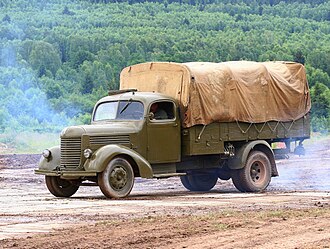
Praga RN: The Story of Czechoslovakia’s “Rapid Truck”
The Praga RN occupies an important place in the history of Czechoslovak commercial vehicles. Known by its Czech designation Rychlý Nákladní, meaning “Rapid Truck,” the RN was a medium-duty truck developed by Praga during the 1930s and subsequently produced for many years in a variety of forms. It became a familiar sight on civilian roads, in industrial operations, in municipal fleets and in military service, while its versatile chassis also provided the basis for buses, fire engines, ambulances, tankers, dump trucks and other specialist vehicles. Production of the RN in Czechoslovakia continued from 1933 until 1953, while the closely related diesel RND remained in production until 1955.
What makes the Praga RN especially interesting today is not simply its age or historical appearance. The truck represented an approach to vehicle engineering in which a sturdy frame, conventional rear-wheel drive, relatively simple mechanical systems and a flexible chassis were combined into a platform capable of serving many different purposes. Its career also extended beyond Czechoslovakia: the RN became important in Yugoslavia, where it was manufactured under licence and contributed to the development of local commercial-vehicle production. Praga itself records that the RN won a competition for a medium truck suitable for Yugoslav conditions, eventually leading to substantial licensed production there.
The Origins of the Praga RN
The RN appeared at a time when Czechoslovakia had developed a strong domestic automotive industry, with manufacturers such as Praga, Tatra and Škoda producing vehicles for both civilian and government customers. Praga had already built considerable experience with trucks before the RN, and the new model was conceived as a medium-duty road vehicle rather than an extreme off-road machine. Its fundamental layout was conventional for its period: a front-mounted engine, a separate frame, rigid axles and rear-wheel drive.
The designation RN reflected the vehicle’s intended character. Rychlý Nákladní literally translates as “Rapid Freight” or “Rapid Truck,” distinguishing the model from heavier or differently configured commercial vehicles. The first RN vehicles entered production in 1933, and the design subsequently underwent evolutionary improvements rather than being repeatedly replaced by entirely new models. According to Praga’s historical information, almost 24,000 RN vehicles were manufactured, illustrating the importance the model achieved within the company’s commercial-vehicle range.
The vehicle was constructed around a conventional ladder-type chassis. This arrangement had a major practical advantage: the chassis could support different bodies without fundamentally changing the mechanical platform. A flatbed could therefore be replaced by a bus body, fire-fighting equipment or another specialist installation, allowing customers and public authorities to adapt the vehicle to particular requirements.
Engine and Mechanical Construction
The Six-Cylinder Petrol Engine
The RN’s most characteristic power unit was a water-cooled inline six-cylinder petrol engine with side-valve, or SV, distribution. A documented 1938 specification gives the engine a displacement of 3,468 cm³, with an 80 mm bore and 115 mm stroke. In that specification, output reached approximately 72 horsepower at 3,000 rpm.
The engine’s relatively modest specific output was consistent with the engineering priorities of the period. Rather than being designed for high-revving performance, it was intended to provide dependable propulsion for a working vehicle. The long-stroke configuration also suited the requirements of a truck expected to carry substantial loads. According to the Vojenský historický ústav, the RN engine produced 53 kW, or 72 hp, and was positioned above the front axle.
Over the course of production, the engine and carburetion evolved. Historical specifications show that earlier examples produced less power, while later versions benefited from improvements including a larger carburettor. One account of the 1937 update records an increase from roughly 38 kW to more than 50 kW, accompanied by an increase in payload capacity.
Four-Speed Manual Transmission
Power was transmitted through a four-speed manual gearbox to the rear axle. The transmission was a relatively straightforward mechanical unit, appropriate to a commercial vehicle designed for durability and ease of servicing rather than refinement. The documented 1938 RN specification lists four forward speeds plus reverse.
The drivetrain used a conventional propeller shaft between the gearbox and rear differential. This arrangement was mechanically uncomplicated and familiar to workshops of the time. It also made the RN comparatively straightforward to maintain, an important consideration for commercial operators who depended on their trucks for everyday work.
Chassis, Suspension and Load-Carrying Ability
The RN used rigid front and rear axles suspended on longitudinal leaf springs. Such a design may appear basic compared with modern independent suspension systems, but it was extremely well suited to a truck expected to operate with varying loads. Leaf springs were durable, relatively easy to repair and capable of handling the considerable forces generated when carrying cargo over imperfect roads.
A 1938 technical specification gives the RN a 2,500 kg payload, with short- and long-wheelbase versions having wheelbases of approximately 3,900 and 4,200 mm respectively. The same source lists a chassis weight of about 2,040 kg for the short version and 2,075 kg for the longer version.
The payload was significant for a vehicle of this period and helped establish the RN as a practical medium truck rather than simply a light commercial vehicle. Its combination of relatively compact dimensions and useful carrying capacity made it suitable for businesses that needed a dependable general-purpose truck without moving into the much larger heavy-truck category.
Evolution of the RN Design
The Pre-War Years
The earliest RNs had a noticeably upright and utilitarian appearance. The cab incorporated a wooden structural framework covered by sheet metal, a construction method that was common in commercial vehicles of the era. The basic chassis and mechanical layout were retained while the bodywork evolved.
By the late 1930s, Praga introduced a more modern-looking cab and front-end treatment. The later design featured a rounded radiator grille and more streamlined front wings, giving the RN a substantially different appearance from the earliest examples. The industrial museum at Mladějov notes that pre-war examples had more angular bodywork, while later vehicles received rounded front fenders and a rounder bonnet grille.
This evolution is important because “Praga RN” does not necessarily mean that every surviving example looks identical. Production extended through changing political and economic circumstances, and the vehicle received visual and mechanical updates while retaining its underlying identity.
Wartime and Post-War Production
The RN’s long production life meant that the model survived one of the most turbulent periods in European history. Its basic utility made it relevant to military and government organizations as well as civilian operators. After the Second World War, production continued, and the RN remained part of Czechoslovakia’s commercial-vehicle landscape until 1953.
Post-war RNs could therefore look considerably different from the earliest trucks while retaining the fundamental mechanical architecture. This continuity was one of the model’s strengths: operators were not necessarily dealing with an entirely new design every few years, and the established platform could continue to perform familiar duties.
The Praga RND Diesel
Why Praga Developed the RND
The RN’s petrol engine was effective, but fuel economy was an important consideration for commercial operators. Praga therefore developed the RND, with the “D” identifying the diesel-powered derivative. Development work on diesel versions began during the mid-1930s, and the RND eventually became an important model in its own right.
The RND used a diesel engine with a different architecture from the petrol RN. Historical references identify a 4.5-litre four-cylinder diesel, while the Mladějov industrial museum records a 4,500 cm³ engine producing approximately 44.1 kW, or 60 hp, in the example it preserves. Its listed fuel consumption is around 15 litres per 100 km, considerably lower than the approximately 25 litres per 100 km given for the petrol RN.
The diesel version remained in production beyond the RN, continuing until 1955. Praga’s own history describes the RND as a derivative that proved attractive because of its lower fuel consumption, and records almost 17,000 RND vehicles produced.
The RN as a Multi-Purpose Vehicle
One of the strongest features of the Praga RN was the variety of bodies that could be installed on its chassis. The truck was produced as a conventional flatbed, but its platform was also used for military vehicles, ambulances, vans, tankers and dump trucks. Praga’s historical records specifically mention mobile workshops among the various versions.
This versatility explains why the RN became much more than a single truck model. For a municipality, the chassis could support specialist equipment. For the military, it could transport personnel or supplies. For emergency services, the same basic mechanical platform could become a fire engine or ambulance. For commercial users, the straightforward flatbed provided a practical means of moving goods.
The chassis was therefore the common element connecting many different vehicles. This approach also helped manufacturers achieve economies of scale: rather than developing an entirely separate mechanical system for every application, one established truck platform could be adapted to multiple roles.
Military Service
The RN was also used by Czechoslovak military organizations, where its conventional design and load-carrying ability made it useful for transport duties. A preserved military RN documented by the Vojenský historický ústav is described as a two-axle, frame-construction flatbed truck with a wooden cargo platform and folding side panels. The institute identifies its six-cylinder petrol engine, four-speed transmission and rear-wheel-drive arrangement.
Military service placed different demands on a truck than civilian freight operations, but the RN’s basic construction was well suited to both. Its ladder frame, rigid axles and leaf springs were straightforward to understand and repair, while the relatively generous cargo platform made it useful for carrying personnel, equipment and supplies.
The RN should not, however, be confused with later specialist Czechoslovak all-terrain trucks such as the Praga V3S. The RN was fundamentally a road-oriented medium truck, and its significance lies in its general-purpose transport role rather than extreme off-road capability.
Praga RN in Yugoslavia
The international story of the RN is one of the most interesting aspects of the model. During the 1930s, a Yugoslav manufacturer was looking for a medium truck suitable for local conditions. Praga’s RN successfully competed against other manufacturers, leading to licensed production.
Praga’s own history states that more than 50,000 vehicles were eventually produced under the RN-TP designation in Yugoslav factories at Rakovica and Maribor, while another historical source gives approximately 17,146 RN-TP and TAM Pionir vehicles in the relevant production history. The precise totals depend on how the licensed derivatives and production periods are counted, but there is no doubt that the RN concept achieved a substantial international production presence.
This licensing arrangement demonstrates that the RN was not simply a successful domestic Czechoslovak product. Its underlying engineering was considered suitable for manufacture and operation in another country’s industrial environment, giving the design a considerably longer legacy than its original Czechoslovak production numbers alone suggest.
Driving the Praga RN Today
For a modern enthusiast, driving an RN is an experience that is fundamentally different from operating a contemporary truck. The engine, manual transmission, steering, brakes and suspension all require a more mechanical approach from the driver. There is little of the isolation or electronic assistance that characterizes modern commercial vehicles.
The relatively high steering effort, non-synchronized gearbox characteristics on some examples and substantial vehicle dimensions demand anticipation rather than quick corrections. The driver needs to think ahead, select the appropriate gear and understand how the vehicle responds to load. This is part of the RN’s historical character: it is a machine that makes the driver feel connected to its mechanical systems.
The petrol engine also comes with a notable appetite for fuel. The preserved RN specifications published by the Mladějov industrial museum give approximately 25 litres per 100 km, compared with about 15 litres per 100 km for the RND diesel.
Why the Praga RN Still Matters
The Praga RN is significant because it represents an important stage in the development of Czechoslovak commercial transportation. It was neither an experimental curiosity nor a short-lived specialist truck. Instead, it became a long-running production vehicle that could be adapted to numerous applications and exported beyond its home market.
Its engineering was conventional, but that was precisely the point. A sturdy frame, rigid axles, leaf springs, rear-wheel drive and a relatively simple engine created a platform that could be understood, repaired and adapted by the workshops of its era. The nearly 24,000 RN vehicles produced in Czechoslovakia demonstrate the scale of its success, while its licensed production in Yugoslavia further expanded its influence.
For today’s historic-vehicle enthusiast, the RN offers a fascinating glimpse into an era when a truck’s value was measured primarily by its ability to work. It could carry a load, tow where appropriate, operate in military or civilian service and accept a remarkable range of body types without abandoning its fundamental mechanical simplicity. That combination helped make the “Erena,” as it was popularly known, one of the memorable working vehicles of Czechoslovak automotive history.
Praga RN Technical Specifications
The figures below summarize a documented later RN specification; exact dimensions and output can vary according to production series, wheelbase and body configuration.
| Specification | Praga RN |
|---|---|
| Manufacturer | Praga |
| Model | RN |
| Meaning of RN | Rychlý Nákladní (“Rapid Truck”) |
| Production | 1933–1953 |
| Vehicle class | Medium-duty truck |
| Engine | Praga inline six-cylinder petrol |
| Engine configuration | Water-cooled, four-stroke, SV |
| Displacement | 3,468 cm³ |
| Bore × stroke | 80 × 115 mm |
| Maximum power | 53 kW / 72 hp |
| Rated engine speed | 3,000 rpm |
| Fuel system | Solex carburettor |
| Transmission | 4-speed manual + reverse |
| Drivetrain | 4×2, rear-wheel drive |
| Front suspension | Rigid axle, longitudinal leaf springs |
| Rear suspension | Rigid axle, longitudinal leaf springs |
| Payload | Up to approximately 2,500 kg |
| Wheelbase | Approximately 3,900–4,200 mm |
| Overall length | Approximately 6,780 mm for flatbed configuration |
| Overall width | Approximately 2,200 mm |
| Maximum speed | Approximately 80 km/h |
| Tyres | 7.00–20 |
| Typical fuel consumption | Approximately 25 l/100 km |
| Related diesel model | Praga RND |
| RND production | 1934–1955 |
Specifications vary between production series and body styles, so the table should be regarded as a representative RN specification rather than a universal specification for every surviving vehicle.
Final Thoughts
The Praga RN was a product of an era when successful truck design depended on finding the right balance between durability, carrying capacity, simplicity and adaptability. Its 3.5-litre six-cylinder petrol engine was not particularly sophisticated by modern standards, yet it provided the power required for a medium-duty truck whose real strength was the complete package. The separate chassis could accept numerous bodies, the rigid axles and leaf springs tolerated working conditions, and the rear-wheel-drive layout kept the mechanical design straightforward.
Its long production run, military and civilian applications, diesel derivative and international licensed production all contributed to the RN’s historical importance. Today, surviving examples offer more than a reminder of old-fashioned transportation: they demonstrate how a carefully conceived commercial-vehicle platform could remain useful through changing decades, industries and political circumstances. For anyone interested in the history of Czech and Czechoslovak automotive engineering, the Praga RN deserves its reputation as one of the country’s defining pre-war and post-war medium trucks.
