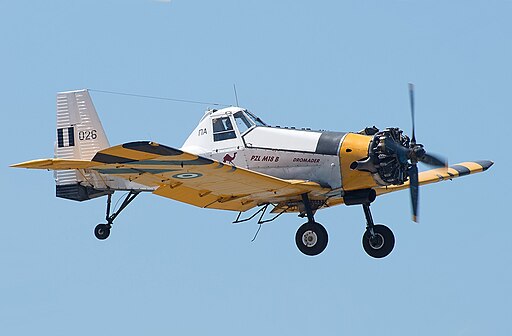
The PZL-Mielec M-18 Dromader is a robust and versatile agricultural aircraft developed in Poland during the 1970s. Designed specifically for aerial application tasks such as crop dusting, firefighting, and spraying, the M-18 quickly became a workhorse in agricultural aviation worldwide. Known for its rugged construction, high payload capacity, and reliable performance, the Dromader is a quintessential example of an aircraft engineered to meet the demanding conditions of low-altitude flying over farmland and forests.
Design and Structural Characteristics
The M-18 Dromader is a single-engine, low-wing monoplane featuring a conventional tailplane and fixed landing gear. The airframe is predominantly constructed from metal, with aluminum alloys providing a balance of strength and durability necessary for agricultural operations. The fuselage is designed to accommodate a large chemical hopper centrally located for optimal weight distribution, while the cockpit is positioned forward, giving the pilot excellent visibility during low-level flight maneuvers.
The wing design incorporates a straight, rectangular planform with a slight dihedral to enhance stability. The wings are fitted with large flaps and ailerons, enabling effective control at low speeds, which is crucial during precise aerial application work. The fixed tailwheel undercarriage is rugged and optimized for operation from unprepared fields and rough airstrips, emphasizing reliability and ease of maintenance over complex retractable systems.
Aerodynamics and Flight Characteristics
The Dromader’s aerodynamic design prioritizes stability and control at low speeds, enabling the aircraft to safely operate at heights as low as 10 meters above crops. The wing’s airfoil section is tailored to provide high lift coefficients, facilitating short takeoff and landing distances. The aircraft’s relatively large wing area aids in reducing stall speed and improving handling during heavily loaded flights.
Control surfaces, including ailerons, rudder, and elevators, are appropriately sized to ensure responsive handling. The inclusion of full-span flaps further increases lift during takeoff and landing phases. The robust design also ensures resilience to turbulence and gusts common in low-level flight environments.
Powerplant and Performance
The powerplant of the PZL-Mielec M-18 Dromader is a reliable radial engine, typically the Shvetsov ASh-62IR, a nine-cylinder air-cooled radial producing approximately 1,000 horsepower. This engine choice delivers substantial power and torque, essential for carrying heavy chemical loads and operating under demanding conditions.
The propeller is a variable-pitch, three-blade design optimized for maximizing thrust across different phases of flight, particularly during takeoff with a full payload. Fuel capacity is tailored to support extended operational endurance, often including auxiliary tanks to extend range and operational flexibility.
Technical Specifications
-
Crew: 1 (pilot)
-
Length: Approximately 11.0 meters
-
Wingspan: Around 15.5 meters
-
Height: About 4.0 meters
-
Wing area: Roughly 33.5 square meters
-
Empty weight: Approximately 3,000 kilograms
-
Maximum takeoff weight: Up to 5,400 kilograms
-
Engine: Shvetsov ASh-62IR radial engine, 1,000 HP
-
Maximum speed: Around 220 km/h
-
Cruising speed: Approximately 190 km/h
-
Stall speed: Close to 95 km/h
-
Range: Up to 850 km
-
Service ceiling: Approximately 3,500 meters
-
Rate of climb: Around 5 meters per second
-
Payload capacity: Up to 1,500 kilograms of chemicals or fire retardant
Operational Role and Applications
The M-18 Dromader is primarily designed for agricultural spraying and dusting, capable of carrying large volumes of fertilizers, pesticides, or herbicides. Its hopper system can be quickly filled and emptied, ensuring efficient turnaround times for multiple sorties in a single day. Additionally, the aircraft is widely employed in aerial firefighting missions, equipped with tanks to drop fire retardants or water on wildfires.
Beyond agricultural and firefighting roles, the M-18 has seen use in other utility applications, such as cargo transport in remote regions, surveillance, and environmental monitoring, owing to its ruggedness and ability to operate from short, unimproved airstrips.
Cockpit and Avionics
The pilot’s cockpit in the M-18 Dromader is designed with functionality and safety in mind. The instrumentation panel includes essential flight instruments such as airspeed indicator, altimeter, vertical speed indicator, and engine monitoring gauges. Agricultural mission-specific equipment includes controls for chemical release systems and spray booms.
The avionics suite may vary depending on the operator’s needs, with some versions fitted with radios for communication, GPS navigation systems, and basic autopilot features. Visibility from the cockpit is excellent, a critical factor for precise low-level flying over fields or forests.
Maintenance and Durability
The M-18 Dromader’s design emphasizes ease of maintenance and operational longevity. The air-cooled radial engine is well-known for its reliability and ease of servicing, even in remote or less-equipped environments. The fixed landing gear reduces mechanical complexity, lowering maintenance demands and downtime.
The airframe’s metal construction resists corrosion and structural fatigue, allowing the aircraft to endure harsh operating conditions such as exposure to chemicals and frequent low-altitude flight stresses. Operators typically conduct regular inspections focusing on wing spars, control surfaces, and engine condition to maintain airworthiness.
Legacy and Current Use
Since its introduction, the PZL-Mielec M-18 Dromader has become a staple in agricultural aviation fleets around the world, particularly in Eastern Europe, Asia, and Africa. Its combination of power, payload capacity, and reliability has cemented its reputation as one of the most effective aircraft for crop spraying and firefighting missions.
Many units remain in active service decades after their manufacture, supported by continuous spare parts production and modernization programs that include engine upgrades, avionics improvements, and airframe refurbishments. Its enduring presence underscores the success of its original design principles.
Conclusion
The PZL-Mielec M-18 Dromader is a quintessential agricultural aircraft that expertly balances power, payload, and durability. Its robust radial engine, rugged airframe, and specialized design features make it ideally suited for the demanding roles of crop dusting and firefighting. Decades of reliable operation across diverse climates and terrains stand as a testament to its enduring engineering excellence and adaptability in specialized aviation sectors.
.jpg)