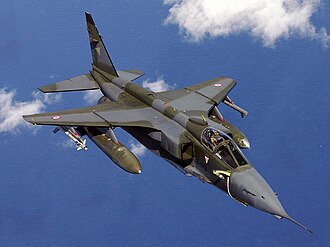
SEPECAT Jaguar: The Anglo-French Strike Aircraft That Became a Cold War Classic
The SEPECAT Jaguar occupies an unusual place in the history of military aviation. It was conceived at a time when Britain and France were looking for an economical way to develop an advanced jet trainer, yet it ultimately became one of the most capable low-level strike and tactical-support aircraft of its generation. Rather than emerging from a single nation’s requirement, the Jaguar was shaped by changing strategic priorities, industrial cooperation and the very different expectations of the Royal Air Force and French Air Force. The result was a compact, twin-engine aircraft that combined supersonic performance with a strong emphasis on ground attack, reconnaissance and operations at low altitude. Its first flight took place at Istres on 8 September 1968, and the programme eventually produced 573 aircraft for Britain, France and several export customers.
Origins of the SEPECAT Jaguar
An Anglo-French answer to two different requirements
The story of the Jaguar began in the early 1960s, when both Britain and France were considering replacements for older training and combat aircraft. The French requirement called for an affordable aircraft capable of advanced training as well as tactical support and light attack. Britain, meanwhile, was interested in a more ambitious supersonic trainer to replace aircraft such as the Folland Gnat and Hawker Hunter. Although the requirements were not identical, both governments recognised that cooperation could reduce development and production costs.
In May 1965, Britain and France signed an agreement to collaborate on the aircraft. Breguet’s Br.121 design provided the initial foundation, but the Jaguar that eventually emerged was substantially more sophisticated than that original concept. Breguet and the British Aircraft Corporation formed SEPECAT, the Société Européenne de Production de l’Avion d’École de Combat et d’Appui Tactique, specifically to manage development and production. Components were divided between the two countries, with Breguet responsible for major sections including the nose, centre fuselage and undercarriage, while BAC manufactured the wings, tail unit, rear fuselage and air intakes. Final assembly took place on production lines in both countries.
The Jaguar’s development was also closely connected to the changing procurement environment of the 1960s. Britain’s cancellation of major aircraft projects, including the TSR-2, created a significant gap in the RAF’s future strike capability. As a result, Britain’s requirement for the Jaguar evolved considerably. What had begun principally as a trainer became an important tactical strike aircraft, with increasingly sophisticated navigation, attack and targeting equipment. The RAF eventually settled on a force dominated by single-seat strike aircraft rather than the large trainer fleet originally envisaged.
Design and Engineering
A compact aircraft built for low-level attack
The Jaguar was a relatively small aircraft, with a wingspan of about 8.69 metres and a length of roughly 16.8 metres in RAF configuration. Its compact dimensions, swept wings and twin-engine layout gave it a distinctive appearance, while the design philosophy placed much greater emphasis on low-level attack than on traditional air-superiority fighter performance. The aircraft was not intended to out-turn dedicated fighters; instead, it was designed to penetrate hostile airspace at low altitude, deliver weapons accurately and return to base.
One of the most important engineering choices was the use of two Rolls-Royce/Turbomeca Adour afterburning turbofan engines. The Adour was itself a product of Anglo-French industrial cooperation and became one of the programme’s most important technological achievements. In Jaguar GR.1 configuration, each Adour Mk.102 produced approximately 22.75 kN of dry thrust and 32.5 kN with afterburner. The twin-engine arrangement provided useful redundancy for a tactical aircraft operating at low altitude and also gave the Jaguar enough power to reach supersonic speed under appropriate conditions.
The aircraft’s performance was particularly well suited to the strike mission. Sources commonly give a maximum speed of approximately Mach 1.6 at altitude, while the aircraft could also exceed the speed of sound at sea level. That combination mattered because the Jaguar’s operational concept was not simply to fly as fast as possible at high altitude. Its real strength was the ability to operate close to the ground, where terrain masking could reduce exposure to enemy radar and air defences.
Avionics and navigation
For its era, the Jaguar incorporated an impressive collection of navigation and attack technology. RAF versions included a central computer, head-up display, navigation and attack systems, laser range-finding and targeting equipment, and a projected moving-map display. These systems helped transform the Jaguar from a relatively straightforward strike aircraft into a much more capable precision-navigation platform.
This equipment was particularly important for the aircraft’s low-level mission. At high speed and low altitude, a pilot has little time to identify targets, calculate an attack and make corrections. Accurate navigation and attack systems therefore provided a substantial operational advantage. Later upgrades further improved the Jaguar’s ability to operate with modern weapons and targeting systems, extending the useful life of an airframe whose basic design dated from the 1960s.
Armament and Combat Role
Built around the strike mission
The Jaguar was fundamentally a ground-attack aircraft, and its weapons configuration reflected that priority. RAF Jaguars were equipped with two 30 mm DEFA cannons, each capable of carrying up to 150 rounds. These guns provided a powerful close-range weapon for attacking ground targets and could supplement the aircraft’s external stores.
More importantly, the Jaguar could carry a substantial range of external weapons and fuel tanks. Its multiple hardpoints allowed it to carry combinations of bombs, rockets, air-to-ground weapons, reconnaissance equipment and air-to-air missiles for self-defence, depending on the operator and mission. This flexibility helped the aircraft perform several related tasks, including tactical strike, close air support and reconnaissance.
The French and British versions were not identical. Each nation incorporated equipment and weapons reflecting its own operational requirements, and the British Jaguar in particular received a more advanced navigation and attack suite. The major variants included the French single-seat Jaguar A, French two-seat Jaguar E, British single-seat Jaguar S and British two-seat Jaguar B. A proposed naval Jaguar M was also developed and tested for French carrier operations, but the project was ultimately abandoned.
Service with Britain and France
The Jaguar in RAF service
The RAF began receiving Jaguars in the 1970s, and the type became an important component of Britain’s Cold War tactical strike capability. The RAF Museum describes the Jaguar as a major element of RAF Germany’s air capability before the Tornado replaced it in the strike role during the 1980s. Of the 400 Jaguars built for Britain and France, 203 were delivered to the RAF.
The aircraft was particularly well suited to the Cold War environment in Europe. Its mission demanded rapid, low-level sorties against battlefield and tactical targets, and its relatively compact size made it practical for dispersed operations. Although its reputation was sometimes affected by criticism of its limited engine power and modest manoeuvrability compared with dedicated fighters, those characteristics should be considered in the context of its intended mission. The Jaguar was not designed to be an air-superiority fighter; it was a strike aircraft designed to put weapons onto ground targets quickly and accurately.
France also operated the Jaguar extensively. French aircraft fulfilled tactical support and attack missions, and the type remained an important part of French combat aviation for decades. French Jaguars were retired in 2005, while RAF Jaguars continued slightly longer, with the final British aircraft leaving service in April 2007.
The Jaguar in Combat
Operation Desert Storm
One of the Jaguar’s most famous operational chapters came during the 1991 Gulf War. RAF Jaguars deployed to the Middle East and flew combat missions against Iraqi forces during Operation Granby and the wider coalition air campaign. Their ability to deliver attacks against ground targets made them a natural fit for the campaign, although the intense air-defence environment also demonstrated the risks associated with low-level strike operations.
The Jaguar was used against targets including artillery and missile positions. Individual aircraft flew repeated missions in a demanding environment where navigation, threat awareness and weapons delivery were critical. The operational record helped reinforce the aircraft’s reputation as a dependable tactical strike platform rather than merely a Cold War training or secondary-support aircraft.
Operations over the Balkans
The Jaguar also saw service during operations connected with the conflicts in the former Yugoslavia. RAF Jaguars participated in ground-attack and reconnaissance missions enforcing the United Nations no-fly zone. Reconnaissance photographs obtained by Jaguars were used in planning strikes, demonstrating how the aircraft’s roles could extend beyond conventional bombing. RAF Museum material records that Jaguars took part in the NATO strike against Udbina airfield in Croatia.
These missions illustrated another strength of the design: adaptability. The same basic aircraft could be configured for attack, reconnaissance and tactical support, allowing operators to retain a useful capability even as the nature of post-Cold War conflicts changed.
International Operators and Legacy
Beyond Britain and France
The Jaguar was not limited to its two countries of origin. India became its most significant export operator, eventually acquiring 116 aircraft, including examples produced under licence. Oman, Ecuador and Nigeria also operated the aircraft. Dassault Aviation records a total production figure of 573 Jaguars, including aircraft for Britain, France, India and other export customers.
India’s adoption of the Jaguar was particularly significant because it demonstrated the design’s value well beyond the European Cold War environment. The Indian aircraft became an important strike platform, and licensed production helped establish a long-term industrial relationship around the type. The Jaguar’s relatively conventional design, twin-engine configuration and capacity for upgrades made it an attractive foundation for continued service.
Why the Jaguar mattered
The SEPECAT Jaguar is important not because it was the fastest, most heavily armed or most technologically revolutionary combat aircraft of its era, but because it successfully balanced several demanding requirements. It was fast enough for supersonic operations, rugged enough for repeated low-level sorties, compact enough to operate as a tactical strike aircraft and sophisticated enough to accommodate increasingly capable navigation and attack systems.
Perhaps equally important was the industrial lesson represented by the programme. Jaguar was one of the earliest major examples of successful Anglo-French military aircraft cooperation. Its production involved Breguet, BAC, Rolls-Royce and Turbomeca, with responsibilities distributed between national industries. The programme demonstrated both the advantages and difficulties of multinational defence development, while establishing a model that would become increasingly familiar in European aerospace projects.
Technical Specifications
Exact figures vary according to the Jaguar variant, equipment fit and source, so the following table gives representative figures for the aircraft rather than implying that every Jaguar had identical specifications. The RAF GR.1/GR.3 family is used where a specific configuration is required.
| Specification | SEPECAT Jaguar |
|---|---|
| Type | Twin-engine supersonic ground-attack / tactical strike aircraft |
| Origin | United Kingdom and France |
| Manufacturer | SEPECAT; Breguet/BAC |
| First flight | 8 September 1968 |
| Crew | 1 in single-seat strike versions; 2 in trainer versions |
| Length | Approximately 16.8 m (55 ft 2 in) |
| Wingspan | Approximately 8.69 m (28 ft 6 in) |
| Wing area | Approximately 24 m² |
| Engines | 2 × Rolls-Royce/Turbomeca Adour afterburning turbofans |
| Adour Mk.102 thrust | Approximately 22.75 kN dry / 32.5 kN with afterburner per engine |
| Maximum speed | Approximately Mach 1.6 at altitude; about Mach 1.1 at sea level |
| Typical combat range | Approximately 575–815 km depending on profile and fuel configuration |
| Ferry range | Approximately 1,900 km with internal and external fuel |
| Maximum take-off weight | Approximately 15,700 kg, depending on variant |
| Internal armament | 2 × 30 mm DEFA cannons on applicable versions |
| External stores | Multiple hardpoints for bombs, missiles, tanks and mission equipment |
| Primary missions | Ground attack, tactical strike, close air support and reconnaissance |
| Total production | 573 aircraft |
| Major operators | France, United Kingdom, India, Oman, Ecuador and Nigeria |
Representative performance and dimensions are supported by museum and manufacturer data; individual figures differ between national and upgraded variants.
Conclusion
The SEPECAT Jaguar began as a compromise between two nations seeking a relatively affordable advanced trainer, but changing strategic circumstances transformed it into a dedicated tactical combat aircraft. Its development illustrates how military aircraft often evolve in response to geopolitical events rather than following the neat requirements established at the beginning of a programme. Britain’s changing strike requirements, France’s tactical-support needs and the availability of Anglo-French industrial expertise all helped shape the final machine.
In service, the Jaguar earned its reputation through persistence rather than spectacle. It was a low-level strike aircraft built for demanding missions, equipped with increasingly sophisticated navigation and attack systems and powered by a pair of dependable Adour engines. From Cold War Europe to the Gulf War and operations over the Balkans, Jaguars demonstrated that a relatively compact aircraft could remain relevant across changing strategic circumstances.
More than half a century after its first flight, the Jaguar remains a fascinating example of Cold War aviation design. It was not conceived as an iconic fighter, yet it became an enduring combat aircraft whose international production, operational history and adaptability gave it a significance far greater than its modest dimensions might suggest. The Jaguar’s legacy is therefore not simply that of an Anglo-French attack aircraft; it is the story of how cooperation, changing requirements and practical engineering produced one of the most recognisable tactical strike aircraft of the late twentieth century.
.jpg)