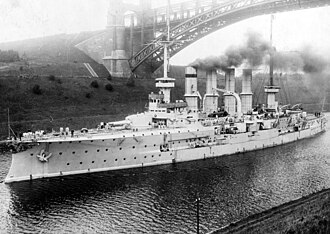
SMS Yorck was an armored cruiser of the Imperial German Navy whose career reflected both the ambitions and the vulnerabilities of Germany’s naval expansion in the years before the First World War. Named after Prussian general Ludwig Yorck von Wartenburg, the ship belonged to the Roon class, a pair of large armored cruisers developed at a time when European naval powers were competing to build increasingly powerful warships capable of operating far from their home ports, protecting maritime interests, and confronting enemy cruisers in the event of war. Commissioned in the early twentieth century, Yorck combined substantial armor protection, a heavy main battery, and the speed needed for the scouting and supporting duties expected of an armored cruiser. Yet her historical significance ultimately rests less on a celebrated naval victory than on a disastrous accident in the North Sea in November 1914, when she struck mines after leaving Wilhelmshaven in poor weather and sank with heavy loss of life. Her fate illustrates the dangers of wartime navigation, the limitations of early twentieth-century naval technology, and the extraordinary risks faced by warships operating in waters crowded with mines, patrols, and poorly understood tactical conditions.
The history of Yorck is also the story of a transitional period in naval warfare. When she was designed, armored cruisers were regarded as valuable multipurpose combatants, combining the endurance and protection of a cruiser with armament that could threaten many ships of comparable size. However, the rapid development of all-big-gun battleships, battlecruisers, improved naval artillery, and more sophisticated reconnaissance methods was already changing the strategic environment in which such vessels operated. By the outbreak of the First World War, ships such as Yorck remained useful for patrol, scouting, and supporting operations, but they faced an increasingly dangerous combination of modern enemy forces and new defensive technologies. Her loss in 1914, only months after the beginning of the war, serves as a reminder that a warship’s effectiveness depended not only on the strength of its guns and armor but also on accurate intelligence, reliable navigation, disciplined command, and a clear understanding of the maritime environment in which it sailed.
The Historical Background of SMS Yorck
Germany’s Naval Ambitions at the Turn of the Century
The construction of Yorck must be understood within the wider transformation of Germany into a major industrial and military power during the late nineteenth and early twentieth centuries. Following German unification in 1871, the country developed a powerful manufacturing economy, expanded its overseas interests, and increasingly sought a navy capable of protecting commerce, supporting colonial ambitions, and challenging the maritime dominance of established naval powers. The Imperial German Navy underwent substantial expansion under the influence of naval planners and political leaders who believed that a modern fleet could increase Germany’s international prestige and strengthen its strategic position. The Naval Laws introduced during the tenure of Grand Admiral Alfred von Tirpitz established a framework for sustained fleet development, encouraging the construction of battleships, cruisers, and other warships designed to operate as part of a growing national naval force.
Within this program, armored cruisers occupied an important position because they offered a compromise between combat power, cruising endurance, and operational flexibility. They could undertake overseas deployments, protect maritime routes, perform reconnaissance, and reinforce larger fleet formations when required. Unlike lightly protected cruisers, armored cruisers possessed significant armor intended to protect vital machinery spaces, magazines, and other essential components against enemy gunfire. Their larger displacement also allowed them to carry heavier artillery and more extensive coal supplies than many smaller cruisers. Nevertheless, their designs involved difficult compromises: increasing armor and weapon weight could reduce speed or endurance, while improvements in propulsion and armament often made a ship obsolete sooner than its designers had anticipated. The Roon class, to which Yorck belonged, emerged from this competitive environment, representing a German effort to refine the armored cruiser into a versatile and credible instrument of naval power.
The Development of the Roon Class
SMS Yorck was the second ship of the Roon class, following her sister ship SMS Roon. The class developed from the earlier Prinz Adalbert class and reflected the Imperial German Navy’s continuing efforts to improve the protection, speed, and offensive strength of its armored cruisers. The ships were designed to perform reconnaissance and independent cruising duties while retaining enough combat power to challenge enemy cruisers and contribute to fleet operations. Their designers had to balance the requirements of armor, artillery, machinery, range, and seakeeping within the constraints of the period’s shipbuilding technology. Although later armored cruisers would introduce further refinements, the Roon class represented a significant stage in the evolution of German cruiser design before the emergence of the battlecruiser.
The class consisted of two ships, Roon and Yorck, both named in honor of prominent Prussian military figures. Albrecht von Roon was a Prussian statesman and military reformer, while Ludwig Yorck von Wartenburg was a Prussian general remembered for his role during the Napoleonic Wars, particularly his convention with Russian forces at Tauroggen in 1812. Such names reflected the Imperial Navy’s close relationship with Prussian military tradition and the broader national narrative of German unification and power. The choice of a military hero’s name was more than a ceremonial detail: it connected a modern steel warship to an established historical identity, presenting the vessel as part of a continuous tradition of service, discipline, and national defense. In practice, however, the fate of Yorck would be determined not by the reputation of the figure whose name she carried but by the hazards of modern naval warfare.
Construction and Commissioning
Building a Modern Armored Cruiser
SMS Yorck was built at the Blohm & Voss shipyard in Hamburg, one of the leading German shipbuilding companies of the period. Her construction took place during an era in which industrial shipyards were increasingly capable of assembling large steel warships equipped with complex propulsion systems, heavy artillery, electrical equipment, and extensive protective structures. The construction of an armored cruiser required close coordination between the shipyard, naval engineers, armor manufacturers, artillery specialists, and machinery suppliers. The hull had to provide sufficient strength and buoyancy to support heavy guns and armor while maintaining acceptable speed and stability, and the internal arrangement needed to protect ammunition magazines, boilers, engines, and other critical spaces. These requirements made warship construction a demanding engineering undertaking, particularly as naval designs grew more complicated and the pace of technological development accelerated.
Yorck was laid down in 1903, launched on 14 May 1904, and commissioned into the Imperial German Navy on 21 November 1905. Her relatively short interval between launch and commissioning reflected the increasingly organized industrial capacity of German naval construction, although a launched hull still required extensive fitting-out, machinery installation, trials, and operational preparation before it could enter service. Once commissioned, the cruiser had to undergo evaluations of her engines, steering, weapons, communications equipment, and general seaworthiness. Such trials were essential because the practical behavior of a large warship at sea could differ from what its designers expected on paper. Speed, stability, maneuverability, fuel consumption, and the operation of onboard systems all influenced the vessel’s eventual usefulness. Commissioning marked the beginning of Yorck‘s operational life, but it also placed her within a fleet whose ships had to be continuously maintained, modernized, and prepared for the possibility of conflict.
Entering Service with the Imperial German Navy
When Yorck entered service in November 1905, the naval balance of power was changing rapidly. Germany was expanding its fleet, Britain was closely monitoring continental naval developments, and the introduction of increasingly powerful battleships was beginning to transform the standards by which warship strength was judged. The armored cruiser still had important duties, particularly in scouting and overseas operations, but its place within the battle fleet was becoming more complicated. A cruiser needed enough speed to gather information and withdraw when confronted by superior forces, while its weapons and armor had to be sufficient to deter or defeat enemy vessels that might attempt to interfere with its mission. In theory, Yorck combined these qualities in a single hull, giving the Imperial Navy a vessel capable of performing a range of missions without requiring the resources of a full battleship.
The years before the First World War were characterized by frequent naval exercises, tactical experimentation, and the development of increasingly sophisticated fleet procedures. German warships trained in formation maneuvering, gunnery, signaling, and coordinated operations, because success in a major fleet engagement would depend on more than the technical specifications of individual ships. Commanders needed to interpret signals correctly, maintain station in changing weather, estimate enemy positions, and coordinate movements among vessels traveling at high speed. These demands made professional training and organizational discipline essential elements of naval readiness. Yorck served in this environment as part of the Imperial Navy’s cruiser force, and her prewar career unfolded during a period in which the German fleet was preparing for a potential conflict even as the precise character of that conflict remained uncertain.
Technical Design and Engineering Characteristics
Hull, Displacement, and Dimensions
As an armored cruiser of the Roon class, Yorck was a substantial steel warship designed to combine protection and endurance with a respectable level of speed. Her reported standard displacement was approximately 9,533 metric tonnes, rising to roughly 10,266 tonnes at full load, depending on the loading condition and the reference used. She measured approximately 127.8 metres in overall length, with a beam of about 20.2 metres and a maximum draught of roughly 7.76 metres. These dimensions gave the ship a broad and comparatively stable platform for her main artillery, armor protection, and machinery, while providing enough internal volume for coal bunkers, crew accommodation, ammunition storage, and the equipment necessary for extended service. The hull’s proportions reflected the priorities of armored cruiser design: the vessel had to be large enough to carry heavy weapons and armor, but not so large that its cost and operating requirements undermined the strategic advantages of cruiser operations.
The ship’s displacement was not simply a measure of size; it represented the combined demands imposed by every major system aboard. Armor plating, gun mounts, ammunition hoists, boilers, engines, shafts, and coal supplies all contributed to the ship’s weight, while the hull had to maintain adequate buoyancy and reserve stability under different loading conditions. Adding coal and ammunition increased the vessel’s operational endurance but also altered her draught and performance. In the same way, protective measures that improved survivability could reduce the weight available for other equipment or affect the ship’s handling characteristics. These competing requirements meant that an armored cruiser was an exercise in compromise, and the finished vessel embodied the naval architects’ judgment about which capabilities mattered most in the expected operational environment.
Armor Protection and Survivability
Armor was one of the defining characteristics of an armored cruiser, separating ships such as Yorck from more lightly protected cruisers that depended primarily on speed, maneuverability, and distance to avoid serious damage. The Roon class used a combination of side armor, protective deck plating, and local protection around important components to reduce the risk posed by enemy shells. The principal armored belt protected sections of the hull around the machinery and magazines, while deck armor was intended to reduce the danger of shells descending at a steep angle or fragments penetrating from above. Additional protection around gun positions and other vulnerable areas helped shield crews and essential equipment during combat. The thickness and arrangement of armor varied across different parts of the ship because not every compartment required the same level of protection, and armor had to be distributed according to the threat posed by different types of ammunition and impact angles.
However, armor did not make a warship invulnerable. Protection systems were designed primarily to reduce the probability that enemy gunfire would destroy vital machinery, ignite ammunition, or cause catastrophic flooding, and their effectiveness depended on the distance, angle, velocity, and type of incoming projectile. Armor also did little to protect a vessel against every possible maritime hazard. Naval mines, in particular, attacked a ship below the waterline, where an underwater explosion could rupture the hull, damage machinery, compromise watertight compartments, and trigger flooding that spread beyond the initial point of impact. The sinking of Yorck therefore highlights a crucial distinction between combat protection and general safety at sea: a warship could possess formidable armor against gunfire and still be fatally vulnerable to a mine strike, especially when damage control was complicated by poor visibility, uncertain navigation, and the need to react quickly to a sudden emergency.
Main and Secondary Armament
The principal offensive strength of Yorck lay in her heavy artillery. Her main battery consisted of four 21-centimetre guns, mounted in two twin turrets, one forward and one aft. These weapons gave the cruiser the ability to deliver heavy shells against enemy warships at ranges relevant to early twentieth-century naval engagements. The arrangement placed a substantial portion of the main battery on the ship’s centreline, allowing the forward and aft turrets to engage targets over wide arcs while preserving a balanced distribution of weight. Twin turrets also concentrated firepower in a smaller number of protected installations, although they required complicated loading equipment, ammunition handling systems, and trained crews. Effective gunnery depended on far more than the nominal calibre of the guns: range estimation, observation, firing discipline, shell supply, and coordination among the bridge, gun crews, and fire-control personnel all influenced the probability of a hit.
The main guns were supported by a secondary battery of ten 15-centimetre guns, intended to engage smaller enemy warships and supplement the heavier artillery when circumstances permitted. In addition, the cruiser carried light guns for close-range defense and a torpedo armament that provided another potential means of attacking enemy vessels. Torpedoes were particularly important in an era when naval officers increasingly recognized that a relatively compact weapon could threaten even a much larger armored ship if it struck in a vulnerable location. Nevertheless, torpedo attacks required favorable conditions and careful positioning, while the lighter guns had limited value against heavily armored opponents. The overall armament reflected the cruiser concept: Yorck was expected to be versatile enough to fight a variety of opponents, but her weapons could not compensate for every disadvantage in speed, protection, visibility, or tactical position.
Propulsion and Speed
Yorck was powered by three vertical four-cylinder triple-expansion steam engines driving three propeller shafts. Steam was supplied by coal-fired boilers, and the machinery was designed to produce a maximum output of approximately 19,000 indicated horsepower. Under suitable trial conditions, the ship could attain a speed of around 21.4 knots, a figure that made her a fast warship by the standards of many battleships of her era. Her three-shaft arrangement provided the propulsion power needed to move a large armored hull at high speed, while the triple-expansion engines extracted energy from steam through successive cylinders to improve efficiency compared with less advanced arrangements. As with other early twentieth-century warships, however, the relationship between machinery output, fuel consumption, and operational speed was complex. A vessel could achieve a high speed during trials but would not necessarily sustain it during long deployments, particularly when carrying heavy stores, operating in rough seas, or relying on machinery that had accumulated wear.
Coal-fired propulsion imposed its own practical limitations. Coal had to be stored in large quantities, transported into the bunkers by labor-intensive processes, and burned to generate the steam required by the engines. The consumption of fuel varied considerably according to speed, weather, machinery condition, and the amount of time spent maneuvering. At economical cruising speeds, Yorck could travel much farther than she could at maximum power, but the difference between cruising and maximum speed was operationally significant. The ship’s engineering department therefore played a central role in determining how long she could remain at sea, how quickly she could respond to orders, and how much flexibility her commander possessed during an operation. Her machinery represented the advanced industrial engineering of the period, yet it also belonged to a transitional era before oil-fired boilers and steam turbines became more widely established in major warship designs.
Crew, Communications, and Life Aboard
A warship of Yorck‘s size required a large crew to operate its engines, maintain its weapons, handle ammunition, navigate, communicate with other vessels, and keep essential systems functioning around the clock. The crew numbered approximately 633 officers and enlisted personnel in typical references, although actual strength could vary according to operational circumstances and the date being considered. Each sailor formed part of a highly specialized organization in which the performance of one department could affect the safety and effectiveness of the entire ship. Engineers monitored boilers and machinery; gunnery crews maintained and operated the artillery; signal personnel transmitted messages; navigators plotted the vessel’s position; and damage-control teams were expected to respond rapidly to flooding, fire, or structural damage. Even routine cruising demanded coordinated work, because a large warship depended on continuous maintenance and careful management of fuel, ammunition, food, water, and other supplies.
Life aboard an armored cruiser was physically demanding and often uncomfortable by modern standards. Machinery spaces were hot and noisy, accommodation was crowded, and the handling of coal created persistent dust and grime throughout the ship. The demands of watches and drills interrupted normal sleeping patterns, while gunnery practice and engineering exercises required the crew to maintain a high level of readiness. Communication was also more difficult than it would become in later decades, as commanders relied on visual signaling, flags, signal lamps, and the wireless technology available at the time. In poor weather, darkness, or conditions of reduced visibility, transmitting and interpreting messages could become challenging, and a misunderstanding might have serious consequences. The crew’s professional competence was therefore a fundamental part of the ship’s combat value, but even well-trained sailors could be placed in an extremely difficult situation when an unexpected accident unfolded in darkness or heavy weather.
The Prewar Career of SMS Yorck
Training, Exercises, and Fleet Readiness
During her peacetime service, Yorck participated in the routine activities through which the Imperial German Navy prepared its personnel and ships for a possible major conflict. Fleet exercises were designed to test maneuvering, communications, gunnery, reconnaissance, and the ability of different classes of vessel to operate together. For an armored cruiser, such training could include scouting ahead of a larger formation, screening battleships from enemy cruisers, maintaining contact with opposing forces during exercises, and practicing the transition from independent cruising to coordinated fleet action. These tasks required officers to balance initiative with obedience to command, because a scouting ship might need to act quickly on incomplete information while still remaining within the broader objectives established by fleet headquarters. The ability to collect and transmit accurate information was especially important, since the main battle fleet could only make sound decisions when its commanders possessed a reliable understanding of the enemy’s position and movements.
Training also exposed the limitations of the ship and its equipment. Repeated engine trials could reveal mechanical weaknesses, gunnery practice could identify problems in loading or fire coordination, and navigation exercises could improve officers’ familiarity with coastal waters and established routes. Warships were not static machines that remained equally effective throughout their service lives; their condition depended on maintenance, repairs, modernization, and the quality of the personnel assigned to them. By the time the First World War began, naval technology was changing so quickly that ships designed only a decade earlier could already be at a disadvantage against newer opponents. Nevertheless, experienced crews and sound tactical employment could still make older ships valuable, particularly in missions that did not require them to confront the newest enemy capital ships directly.
The Changing Role of Armored Cruisers
The appearance of HMS Dreadnought in 1906 and the subsequent development of battlecruisers altered the strategic context in which Yorck and her contemporaries operated. Dreadnought popularized a battleship design centered on a uniform battery of heavy guns and turbine propulsion, while battlecruisers sought to combine capital-ship firepower with substantially greater speed, often by accepting reduced armor protection compared with contemporary battleships. These developments challenged the older armored cruiser concept because newer ships could carry more powerful artillery or move faster while offering a different balance of protection and offensive capability. Although armored cruisers did not immediately become useless, their position in the hierarchy of naval combatants weakened as new designs expanded the gap between cruisers and capital ships. The rapid pace of development also meant that construction decisions made in one decade could have unexpectedly limited value by the next.
For Yorck, the changing naval environment meant that her value depended increasingly on the mission assigned to her rather than on any assumption that she could defeat every opponent of comparable displacement. She remained a substantial and well-armed vessel, but her design belonged to a generation of ships conceived before the full implications of dreadnought battleships and battlecruisers had become apparent. The outbreak of war would further change the role of the cruiser, as mines, submarines, wireless intelligence, coastal defenses, and increasingly complex operational plans made naval service more dangerous. A ship might be lost without ever entering a traditional gun duel, and strategic success could depend on reconnaissance, navigation, and risk management as much as on firepower. The fate of Yorck would become one of the clearest illustrations of this reality.
SMS Yorck During the First World War
The Outbreak of War in 1914
The First World War began in August 1914 after years of diplomatic tension, military competition, alliance commitments, and increasingly rigid mobilization plans. The Imperial German Navy now faced a strategic problem: it had to threaten British naval power while avoiding a decisive engagement under unfavorable conditions, particularly because the Royal Navy possessed a larger overall fleet. German naval operations consequently involved a combination of reconnaissance, patrols, mine warfare, defensive deployments, and attempts to influence British fleet movements. The North Sea became a critical theater of operations, with German and British forces operating in waters that were geographically confined, heavily monitored, and increasingly dangerous because of defensive minefields. For a ship operating in this environment, accurate knowledge of friendly and enemy mine positions was essential, but such knowledge was not always complete or reliably communicated.
The opening months of the war demonstrated that naval danger extended well beyond direct combat. Warships could be threatened by mines laid to protect ports or obstruct enemy approaches, while submarines and surface raiders created additional uncertainties about the location of hostile forces. Weather could conceal movements, interfere with visual signaling, and make navigation more difficult precisely when commanders needed the clearest possible picture of their surroundings. The concentration of naval forces also increased the consequences of navigational mistakes, because a vessel might encounter hazards laid by friendly forces as well as those placed by the enemy. In this atmosphere, Yorck continued to serve as part of the German naval establishment, but her operational life was approaching a sudden and disastrous end.
The North Sea and the Dangers of Mine Warfare
Naval mines were among the most consequential weapons of the First World War because they offered a relatively inexpensive way to threaten warships without requiring a surface fleet to win a direct engagement. A mine could be anchored below the water’s surface and triggered by contact with a passing hull, allowing it to attack a ship at or below the waterline. Depending on the explosion’s location and the vessel’s construction, the resulting damage could range from localized flooding to severe structural rupture affecting machinery spaces and other compartments. Mines were particularly dangerous in approaches to naval bases, narrow passages, and heavily trafficked waters, where warships had limited room to maneuver and often needed to follow established routes. Their effectiveness depended on careful placement, but their danger could persist even when the forces that laid them were no longer nearby.
Mine warfare created a difficult problem for naval commanders because the precise location of every hazard was not always known, and the information that did exist could become outdated as new minefields were established. Friendly minefields were not automatically safe: their locations had to be accurately charted, their boundaries clearly marked in operational records, and their positions understood by ships navigating in the area. In poor visibility, darkness, or bad weather, a commander might have difficulty confirming the ship’s exact position relative to a safe channel. A vessel could also be forced to change course unexpectedly, while the urgency of a mission might encourage officers to accept navigational risks that would be avoided under peacetime conditions. These hazards made mine warfare a contest of intelligence, chart accuracy, communication, and discipline as much as a technical contest between weapons and armor.
The Sinking of SMS Yorck
The Fatal Departure from Wilhelmshaven
On 4 November 1914, SMS Yorck was lost after leaving Wilhelmshaven, Germany’s principal North Sea naval base. Accounts of the disaster describe the cruiser departing in poor weather and entering waters where German minefields presented a lethal hazard. The exact sequence of navigational decisions and movements has been described differently in historical summaries, so the incident should not be reduced to an oversimplified claim that a single individual or mistake alone caused the loss. What is clear is that the ship entered a dangerous area and struck mines, demonstrating the grave risks involved in navigating the North Sea during the opening months of the war. In conditions where visibility was limited and navigational information was critical, the distinction between a safe route and a lethal one could be extremely narrow.
The circumstances surrounding Yorck‘s departure also illustrate the pressures faced by a navy operating from a major base during wartime. Ships needed to move in response to orders, operational requirements, and changing assessments of the enemy, but every movement outside a protected harbor exposed them to hazards that were not always visible from the bridge. Even a well-armed vessel could not fight an underwater mine, and the ship’s heavy guns offered no practical defense against an explosive charge hidden beneath the surface. Once the cruiser struck the mines, the priority shifted from navigation and combat readiness to damage control and survival. The incident became a grim example of how a warship could be lost without exchanging fire with an enemy vessel, simply because the environment through which it moved had become a weapon in its own right.
The Explosion and the Loss of the Ship
The mine explosions inflicted catastrophic damage on Yorck, and the cruiser sank with heavy loss of life. Accounts commonly place the number of fatalities at approximately 336, although historical casualty figures should be checked against specialist naval records when exact totals are required. The loss of so many men was a severe human tragedy, particularly because the disaster occurred during a navigational movement rather than a major fleet engagement in which the crew would have knowingly faced enemy fire. In a sudden underwater explosion, sailors could find themselves confronted by flooding, damaged machinery, disrupted electrical systems, and the loss of normal access routes through the ship. Compartmentation and watertight bulkheads could delay the spread of water, but they could not guarantee survival when damage was extensive or when multiple critical areas were affected.
The sinking also demonstrated the limitations of damage-control systems in the early twentieth century. A ship’s survival depended on the location and extent of the damage, the ability of the crew to isolate flooded spaces, the availability of working pumps, and the speed with which officers could understand what had happened. If machinery spaces or important passageways became inaccessible, the crew might struggle to maintain power or move personnel to safer parts of the vessel. The time available for evacuation could be extremely short, particularly if the ship developed a dangerous list or lost stability as water entered the hull. The loss of Yorck therefore represented not simply the destruction of an expensive warship but the collapse of a complex system on which hundreds of men depended for their survival.
Why the Loss Was So Significant
The destruction of Yorck was strategically significant because it removed a substantial armored cruiser from the Imperial German Navy at a time when every operational vessel contributed to the fleet’s ability to patrol, scout, and respond to enemy movements. Germany could not easily replace experienced crews and large warships once the war began, especially when shipbuilding resources were already committed to an expanding program of naval construction and wartime repairs. The loss also imposed an indirect cost by forcing naval authorities to examine the circumstances of the disaster, reconsider navigational procedures, and account for the hazards posed by minefields in the approaches to major bases. Even when a ship was lost without enemy gunfire, the consequences could influence operational planning and the willingness of commanders to undertake future movements under uncertain conditions.
At the same time, Yorck‘s sinking should not be treated as an isolated accident detached from the broader character of the war. Minefields, poor weather, crowded operational waters, incomplete information, and the limitations of contemporary navigation formed a combination that could threaten any vessel operating under similar circumstances. The incident underscored the need for accurate charts, effective communications, disciplined passage planning, and a clear understanding of friendly defensive measures. It also highlighted a fundamental truth about naval warfare: the power of a warship cannot be measured solely by its displacement, armor thickness, or gun calibre. Operational reliability, situational awareness, and the ability to avoid hazards can be equally important, and a failure in any of these areas may negate the advantages created by years of industrial investment and technical development.
The Legacy of SMS Yorck
A Warship Caught Between Two Naval Eras
SMS Yorck occupies an interesting place in naval history because she represented an established form of warship that was already being overtaken by rapid technological change when she entered service. Her design embodied the armored cruiser concept at a time when such ships were regarded as powerful and flexible instruments of national policy. Yet the years between her commissioning in 1905 and her loss in 1914 witnessed major developments in battleship design, propulsion, artillery, reconnaissance, and mine warfare. The appearance of dreadnought battleships and battlecruisers altered expectations of what a major warship could achieve, while the First World War demonstrated that a vessel’s most serious threats might come from weapons that were difficult to detect and impossible to defeat through conventional gunfire. Yorck thus provides a useful case study of how quickly military technology can transform the role and relative value of a ship.
Her fate also helps explain why naval historians study accidents and operational losses alongside famous battles. A ship’s history is not limited to its victories, and the absence of a dramatic combat record does not make its service irrelevant. The loss of Yorck reveals the relationship between technology and organization, showing how a vessel’s safety depended on navigation, intelligence, communication, and command decisions as well as engineering quality. It also reminds us that technological sophistication cannot eliminate risk when information is incomplete and the operating environment is hostile. In this respect, Yorck‘s story remains relevant to the study of naval operations well beyond the specific period in which she served.
Remembering the Men Who Served Aboard
Behind every technical specification of Yorck lay a crew of hundreds of men who worked, trained, and lived together aboard a large and complicated machine. They were responsible for operating the engines, loading and maintaining the guns, keeping watch, navigating dangerous waters, transmitting signals, preparing food, and carrying out the countless routine tasks that made the ship functional. Their lives were shaped by strict discipline, demanding schedules, the physical discomfort of coal-fired machinery, and the constant need to remain ready for orders or emergencies. When the cruiser sank in November 1914, the loss was therefore measured not only in steel, artillery, and naval expenditure but also in families, friendships, and the sudden destruction of a community formed by life at sea.
The human cost of Yorck‘s loss is especially important because the ship was destroyed by mines rather than in a celebrated surface engagement. Such disasters could be overlooked in popular accounts of the First World War, which often concentrate on major battles, famous admirals, and dramatic exchanges of gunfire. Yet the daily dangers faced by naval crews included mechanical failures, fires, collisions, navigational errors, and the invisible threats of underwater weapons. The men aboard Yorck experienced one of the harshest outcomes of those risks. Remembering their fate adds a human dimension to the study of warship history and prevents the vessel from becoming merely a collection of dimensions, weapons, and performance figures.
Conclusion: The Enduring Historical Importance of SMS Yorck
SMS Yorck was a product of Germany’s ambitious naval expansion, a large armored cruiser designed to combine heavy artillery, substantial protection, and the speed needed for scouting and fleet support. Built at Blohm & Voss in Hamburg and commissioned in November 1905, she entered service during a period of intense technological competition that was already reshaping the world’s major navies. Her dimensions, coal-fired propulsion, triple-expansion engines, and mixed-calibre armament reflected the engineering priorities of the pre-dreadnought era, while her service connected the traditions of the Imperial German Navy with the emerging realities of industrialized warfare. Although her operational career was relatively brief, it provides an illuminating example of the demands placed on warships during a period when naval technology and strategy were changing at extraordinary speed.
The loss of Yorck on 4 November 1914 remains the defining event of her history. Striking mines after leaving Wilhelmshaven, the cruiser sank with the deaths of hundreds of her crew, demonstrating that armor and artillery offered little protection against every danger a ship might encounter at sea. Her destruction highlighted the importance of navigation, minefield intelligence, communications, and operational discipline, while revealing the vulnerability of even a powerful warship to hazards that could remain hidden beneath the water. Today, the story of SMS Yorck serves as a reminder that naval history is shaped not only by the outcome of battles but also by engineering choices, strategic decisions, environmental conditions, and human loss. Her legacy lies in what her career reveals about the promises and limitations of the armored cruiser, the dangers of the North Sea in the First World War, and the enduring importance of understanding the full range of risks involved in maritime operations.
Technical Specifications of SMS Yorck
The following table summarizes the principal characteristics commonly associated with SMS Yorck. Figures are approximate where historical references differ, and displacement values depend on the loading condition.
| Specification | Details |
|---|---|
| Ship name | SMS Yorck |
| Ship type | Armored cruiser |
| Class | Roon class |
| Country | German Empire |
| Navy | Imperial German Navy (Kaiserliche Marine) |
| Builder | Blohm & Voss, Hamburg, Germany |
| Laid down | 1903 |
| Launched | 14 May 1904 |
| Commissioned | 21 November 1905 |
| Lost | 4 November 1914 |
| Standard displacement | Approximately 9,533 metric tonnes |
| Full-load displacement | Approximately 10,266 metric tonnes |
| Length overall | Approximately 127.8 m |
| Beam | Approximately 20.2 m |
| Draught | Approximately 7.76 m |
| Propulsion | Three vertical four-cylinder triple-expansion steam engines |
| Boilers | Coal-fired steam boilers |
| Propellers | Three shafts |
| Maximum engine output | Approximately 19,000 indicated horsepower |
| Maximum speed | Approximately 21.4 knots |
| Main armament | 4 × 21 cm guns in two twin turrets |
| Secondary armament | 10 × 15 cm guns |
| Light armament | Smaller-calibre guns for close-range defense; configuration varied by reference |
| Torpedo armament | Torpedo tubes; details should be checked against a specialist ship reference |
| Armor | Armored belt, protective deck, and local armor around key positions |
| Crew | Approximately 633 officers and enlisted personnel |
| Operational theater | Primarily German home waters and the North Sea |
| Cause of loss | Mine explosions after departing Wilhelmshaven |
| Reported fatalities | Approximately 336 |
Final Historical Assessment
SMS Yorck was neither the most famous nor the most technologically advanced warship of the Imperial German Navy, but her story captures an important aspect of naval history: the difference between a vessel’s designed capabilities and its real-world vulnerability. Her engineering represented a serious attempt to balance firepower, armor, speed, and endurance, while her loss demonstrated that no combination of these features could guarantee survival in an environment shaped by mines, uncertain navigation, and wartime pressures. For readers interested in the evolution of German naval power, the armored cruiser era, or the dangers of the First World War at sea, Yorck remains a compelling example of the strengths and limitations of early twentieth-century warship design.
