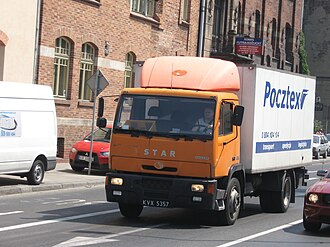
Star 12.157: The Polish Medium-Duty Truck That Bridged Star and MAN
The Star 12.157 is one of the most interesting trucks to emerge from the final chapter of the Star brand in Poland. Built during a period when the historic Star manufacturer was undergoing a profound technical and corporate transformation, the 12.157 combined the industrial heritage of Starachowice with technology derived from MAN’s L2000 family. The result was a medium-duty truck that looked and felt like a Star, but whose engineering increasingly reflected the influence of a much larger European manufacturer. Today, the model is particularly recognizable through its continued use as a platform for specialist vehicles, especially fire engines, and surviving examples demonstrate how durable the underlying chassis could be. Historical references place the Star 12.157 within the Star S2000 family, a range based heavily on the MAN L2000 concept.
The History of the Star 12.157
A Truck Born During Star’s Transformation
The story of the Star 12.157 cannot really be separated from the difficult transformation of FSC Star during the late 1990s. Star had been one of Poland’s best-known truck manufacturers for decades, producing vehicles that became familiar throughout the country’s transport, construction and public-service sectors. However, by the 1990s, the European commercial-vehicle market was changing rapidly. Western manufacturers were offering increasingly sophisticated trucks, while older domestic designs were becoming harder to compete with in terms of performance, emissions, comfort and overall technology. Star’s cooperation with MAN, formalized in 1998, was therefore a major turning point. One historical account describes the subsequent appearance of the Star 8.125 and then the Star 12.157 as part of this transition toward MAN-based technology.
The 12.157 represented a larger and more capable step than the 8.125. It was positioned in the approximately 12-tonne class and used a MAN diesel engine, while the drivetrain incorporated a six-speed ZF gearbox. This combination gave the truck a much more international technical character than earlier Star designs. The model was consequently not merely an update to an aging Polish truck; it was part of a broader attempt to create a modern medium-duty vehicle capable of competing in a changing European market. Wikimedia’s documentation of the Star S2000 family specifically lists the 12.157 among models based on the MAN L2000 platform.
The Star S2000 Connection
The Star 12.157 is commonly associated with the Star S2000 family, a group of trucks that included models such as the 8.117, 10.157, 12.157, 12.227, 13.227, 14.227 and 15.227. The family illustrates the extent to which MAN technology influenced the final generation of Star commercial vehicles.
This relationship is important because it explains why the 12.157 can appear surprisingly familiar to people who know MAN trucks from the same era. The cab and general vehicle architecture belong to the period when the L2000 concept was becoming a significant part of the Star range. At the same time, the Star identity remained important, particularly in the Polish market, where the brand had a long-established reputation and an extensive service and user community.
Engine and Drivetrain
MAN Diesel Power
The number 157 in the model designation reflects the truck’s approximate power class. Contemporary vehicle documentation and surviving fire-service examples consistently identify the Star 12.157 with approximately 157 horsepower, or around 115–116 kW. A documented 2002 Star 12.157, for example, is specified at 157 hp, while another documented example from 2007 lists 157 hp and 116 kW.
Parts-catalogue information also connects the Star 12.157 with the MAN D0824 LFL09 engine family. The catalogue lists the 12.157 from January 1998 and gives an engine output range associated with the D0824 LFL09, reinforcing the connection between the Star truck and MAN’s engine technology.
For a medium-duty truck, this power output was aimed at practical transportation rather than high-speed performance. The engine had to provide enough pulling ability for a vehicle operating around the 12-tonne gross-weight class, while remaining compact enough for a cab-over-engine chassis. In applications such as municipal work and emergency services, predictable power delivery was more important than outright acceleration. The 12.157’s power rating therefore made it a sensible compromise between operating economy, mechanical simplicity and the ability to move a heavily equipped truck.
Six-Speed ZF Transmission
The drivetrain was complemented by a six-speed manual ZF gearbox, another component that demonstrates the international character of the truck. Historical descriptions of the model specifically identify the six-speed ZF transmission and a hypoid final drive.
The choice of six forward gears was well suited to a medium-duty vehicle. Lower ratios could provide the leverage required when moving away with a heavy load, while the higher gears allowed more relaxed operation when travelling between towns or on faster roads. For operators accustomed to traditional manual commercial vehicles, this arrangement was also straightforward and familiar.
The mechanical philosophy of the Star 12.157 is therefore quite different from that of a modern truck. Contemporary vehicles increasingly depend on automated transmissions, electronic engine management and extensive integrated control systems. The Star 12.157 comes from a period when a driver remained much more directly involved in managing the drivetrain. For enthusiasts and restorers, this mechanical character is part of the vehicle’s appeal.
Chassis and Construction
A 12-Tonne-Class Workhorse
The Star 12.157 was conceived as a medium-duty chassis with a gross vehicle weight around 12,000 kg. Surviving examples used in the Polish fire service confirm this specification. A documented Star 12.157 produced in 2001 is listed with a DMC of 12,000 kg, while another 2007 example is similarly described as a 12,000 kg vehicle.
This weight class made the truck considerably more versatile than a small distribution vehicle while keeping it substantially more compact than a heavy three-axle truck. Operators could use the chassis for a wide range of bodies, including conventional cargo bodies, municipal equipment, recovery vehicles and emergency-service superstructures. The vehicle’s adaptability is particularly apparent from the large number of Star 12.157 fire engines that continued operating in Poland long after the model itself had become obsolete as a new commercial product.
The chassis also benefited from a 4×2 configuration in many documented examples. Fire-service versions, for instance, are repeatedly recorded with two axles and rear-wheel drive. This arrangement was appropriate for road-oriented applications where maximum off-road traction was not the primary requirement.
Suspension, Braking and Road Behaviour
The Star 12.157 belonged to a generation in which manufacturers were placing increasing emphasis on more modern European braking and chassis technology. Historical material describes the vehicle as using disc brakes on all wheels, while also identifying the hypoid final drive.
For a truck operating at approximately 12 tonnes, effective braking is critical, especially when the chassis is carrying water, equipment or a substantial cargo body. The all-disc arrangement represented an important modernization compared with older commercial vehicles that relied more heavily on drum brakes. It also helped align the truck with the technological expectations of the European market at the time.
The road-going 4×2 layout meant that the 12.157 was particularly well suited to paved roads, urban streets and regional transport. In specialist applications such as firefighting, however, its capabilities depended heavily on the bodybuilder’s configuration and the operating environment. A road-oriented 4×2 fire engine could be extremely effective for urban and suburban response even though it was not intended to provide the deep off-road performance of a dedicated 4×4 rescue vehicle.
The Cab and Driver’s Environment
MAN L2000 Influence
One of the defining characteristics of the Star S2000 generation is its relationship with MAN’s L2000 architecture. The connection gave the Star 12.157 a modern appearance and a cab design considerably removed from the traditional Star trucks that had preceded it. Wikimedia’s documentation explicitly describes the Star S2000 family as being based on the MAN L2000.
This was more than a cosmetic change. The cab is one of the most important parts of a commercial vehicle because it determines visibility, access, driver comfort and the overall working environment. By adopting a design connected to MAN’s contemporary medium-duty range, Star could offer customers a truck that felt substantially more modern while still being assembled under the Star name.
Fire-service examples also show that the cab could be configured for crews rather than simply a driver and passenger. A documented 2002 Star 12.157 used by a Polish fire service had a four-door cab with seating for six people in a 1+1+4 arrangement. This demonstrates the flexibility of the basic chassis and the extent to which bodybuilders could adapt it for specialist purposes.
The Star 12.157 as a Fire Engine
An Especially Successful Specialist Platform
Perhaps the strongest evidence of the Star 12.157’s practical usefulness is the number of Polish emergency-service vehicles built on its chassis. Numerous documented examples were equipped as GBA 2.5/16 or GBA 2.5/20 medium fire engines by Stolarczyk. The basic formula typically included a 2,500-litre water tank, a 250-litre foam-agent tank and a crew capacity of six.
The firefighting configuration made excellent use of the 12-tonne chassis. A vehicle carrying several firefighters, a large quantity of water, pumps, hoses, breathing apparatus, rescue equipment and generators needs both payload capacity and predictable road handling. The Star 12.157 offered a useful balance between those requirements without becoming excessively large for urban fire stations.
Pump specifications varied according to the individual body and configuration. One documented Stolarczyk vehicle is equipped with a pump rated at 1,600 litres per minute at 8 bar, with high-pressure operation listed at 300 litres per minute at 40 bar. Another, later configuration is documented with a 2,150-litre-per-minute pump at 8 bar and 400 litres per minute at 40 bar. These differences are important because they demonstrate that the truck itself should not be confused with the specialist body installed on it.
Long Service Lives
The longevity of these fire engines is particularly revealing. Individual Star 12.157 vehicles remained in Polish public-service and volunteer-fire-service use for many years after their original production. One documented vehicle produced in 2002 later continued to be recorded in fire-service inventories, while another 12.157 originally operated by the Polish State Fire Service was subsequently transferred to a volunteer fire brigade.
This extended service life reflects the underlying durability of the platform, but it also reflects the economic logic of public-sector fleets. A well-maintained medium truck can remain perfectly useful for many years when its basic mechanical systems are sound. For a volunteer fire brigade, acquiring a proven used vehicle can provide a major increase in capability without the cost of a new emergency vehicle.
Why the Star 12.157 Is Historically Important
The End of the Traditional Star Era
The Star 12.157 is historically significant because it belongs to the period immediately before the Star name ceased to represent an independent truck manufacturer in the traditional sense. The cooperation with MAN and subsequent corporate integration transformed the Star factory and its products. The 12.157 therefore represents one of the final stages in a long Polish truck-building story that had begun decades earlier.
The model’s hybrid identity is what makes it especially interesting. It retained the Star badge and connection to Starachowice while incorporating major components and engineering concepts from MAN and other European suppliers. The ZF transmission and MAN engine are good examples of how international the supply chain had become by the end of the 1990s.
A Truck Worth Remembering
For modern enthusiasts, the Star 12.157 may not have the visual fame of some older Star models, but its historical importance is arguably greater than its relatively modest profile suggests. It represents a decisive change in Polish commercial-vehicle manufacturing: the point at which domestic truck production became closely intertwined with the engineering, technology and corporate structure of a major European manufacturer.
Its continued appearance in fire-service fleets also gives the model an unusual second life. Rather than disappearing immediately after its commercial career, many 12.157 chassis were preserved through specialist applications. Their red-painted bodies, large equipment compartments and distinctive Star/MAN cabs have consequently become familiar sights in Polish firefighting history.
Technical Specifications of the Star 12.157
The following table summarizes the principal specifications that can be established from available technical references and documented surviving vehicles. Exact details can vary according to production year, chassis configuration and specialist bodywork, so figures such as pump capacity describe individual conversions rather than the base truck itself.
| Specification | Star 12.157 |
|---|---|
| Manufacturer | FSC Star / Star |
| Model | Star 12.157 |
| Model family | Star S2000 |
| Platform influence | MAN L2000 |
| Vehicle class | Medium-duty truck |
| Production era | Late 1990s / early 2000s |
| Engine | MAN D0824 LFL09 family |
| Engine type | Diesel |
| Engine configuration | 4-cylinder |
| Power | Approx. 157 hp |
| Power in kW | Approx. 115–116 kW |
| Transmission | 6-speed manual |
| Gearbox | ZF |
| Final drive | Hypoid |
| Brakes | Disc brakes |
| Typical drive configuration | 4×2 |
| Number of axles | 2 |
| Gross vehicle weight | Approx. 12,000 kg |
| Cab | MAN L2000-influenced |
| Typical fire-service crew | 6 |
| Typical fire-engine water tank | 2,500 litres |
| Typical foam tank | 250 litres |
| Example pump capacity | 1,600–2,150 l/min, depending on body |
| Typical high-pressure pump output | Approx. 300–400 l/min at 40 bar |
| Common specialist bodybuilder | Stolarczyk |
| Common specialist application | Fire and rescue vehicle |
Conclusion
The Star 12.157 occupies a fascinating position in the history of Polish trucks. It was created at a moment when the traditional Star engineering philosophy was being reshaped by international cooperation, and its MAN-derived technology helped produce a vehicle far more closely aligned with contemporary European medium-duty trucks. The four-cylinder MAN diesel, six-speed ZF transmission, disc-brake system, 4×2 configuration and approximately 12-tonne gross-weight class gave it a practical combination of capacity and relatively compact dimensions.
Its greatest legacy, however, may be found in the specialist vehicles that continued to work long after the model had ceased to be a current product. Fire-service examples equipped by Stolarczyk demonstrate just how versatile the chassis was, with six-person crews, substantial water and foam capacity and sophisticated firefighting equipment carried within a medium-duty package. Some of these trucks remained in service for decades and were subsequently passed from professional fire services to volunteer organizations, giving the Star 12.157 a working life far longer than its position in the new-truck market might suggest.
Ultimately, the Star 12.157 should be remembered as more than simply another Polish truck from the late 1990s. It was one of the vehicles that embodied Star’s transition into the MAN era. Its technology, its cab and its drivetrain demonstrate the growing internationalization of Polish truck production, while its long service in demanding applications demonstrates that this transition produced a genuinely capable working vehicle. For enthusiasts interested in Polish automotive history, European commercial vehicles or the evolution of MAN’s influence in Central European truck manufacturing, the Star 12.157 remains a particularly worthwhile model to study.
