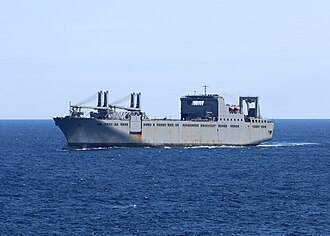
A Strategic Ship Built for Global Mobility
When people think about naval power, they often imagine aircraft carriers, destroyers, submarines, and amphibious assault ships. However, modern military operations depend on another category of vessel that receives far less public attention but is equally essential: strategic sealift ships. These vessels do not usually participate in direct combat, yet they make large-scale military operations possible by transporting the enormous quantities of equipment, vehicles, supplies, and personnel required to sustain forces around the world. Among these important logistical assets was USNS Mendonca (T-AKR-303), a Bob Hope-class Large, Medium-Speed Roll-on/Roll-off (LMSR) vessel operated by the U.S. Navy’s Military Sealift Command (MSC).
USNS Mendonca represented a major evolution in American military transportation capability. Designed during the post-Cold War period, when rapid deployment and global expeditionary operations became central strategic requirements, the ship combined enormous cargo capacity with high speed and advanced vehicle-handling systems. Unlike traditional cargo ships that require cranes and extensive dockside infrastructure, Mendonca was designed around the principle of moving military vehicles quickly and efficiently through roll-on/roll-off operations. Tanks, trucks, helicopters, engineering equipment, and other heavy military assets could be driven directly onto the vessel, secured for transport, and unloaded with minimal delay.
The ship’s name honored Sergeant Leroy A. Mendonca, a U.S. Army soldier and Korean War Medal of Honor recipient. His actions during combat near Chich-on, Korea, on 4 July 1951 became the inspiration for naming the vessel. During that engagement, Mendonca remained behind to cover his platoon’s withdrawal despite overwhelming enemy pressure, sacrificing his life while preventing further casualties among his fellow soldiers. The ship carrying his name reflected the Navy’s tradition of preserving the memory of individuals whose courage represented the highest ideals of military service.
Although USNS Mendonca was not a warship in the traditional sense, her contribution to national defense was substantial. In conflicts and humanitarian operations alike, the ability to move large amounts of equipment across oceans is a decisive strategic advantage. A military force cannot operate effectively overseas without fuel, vehicles, spare parts, weapons systems, and logistical infrastructure. Ships like Mendonca served as the bridge between American industrial capacity and deployed forces around the globe.
The Development of the Bob Hope-Class LMSR Program
Meeting the Need for Faster Strategic Sealift
The creation of the Bob Hope-class LMSR ships was driven by lessons learned from previous military operations. During major deployments such as the Gulf War, the United States discovered that existing sealift capacity was often insufficient for rapidly moving heavy military equipment over long distances. Large numbers of commercial vessels had to be chartered, and unloading operations could become a limiting factor.
To address these challenges, the Department of Defense invested in a new generation of purpose-built military cargo ships. The objective was not simply to create larger freighters but to develop vessels optimized for rapid deployment. The resulting LMSR program produced ships capable of carrying enormous quantities of Army equipment while maintaining speeds comparable to much smaller commercial vessels.
USNS Mendonca belonged to this new generation. The Bob Hope class was designed around operational flexibility: ships needed to be fast enough to move quickly during crises, large enough to carry heavy brigade equipment, and capable of operating in situations where port facilities might be damaged or unavailable.
Construction and Entry Into Service
Mendonca was built by Avondale Shipyard in New Orleans, Louisiana. Her keel was laid on 3 November 1997, and the vessel was launched on 25 May 1999. After completion, she entered service with Military Sealift Command on 30 January 2001. Unlike commissioned U.S. Navy combatants, USNS vessels operate under the Military Sealift Command system and generally use civilian mariners for ship operations, with military personnel assigned when required for specific missions.
The ship was designated T-AKR-303, where the “T” prefix indicates a U.S. Naval Ship operated by Military Sealift Command rather than a commissioned USS vessel. The “AKR” designation identifies a vehicle cargo ship capable of transporting military vehicles and related equipment. Her primary mission was strategic sealift: ensuring that Army heavy brigade equipment could be transported quickly from the United States to overseas operational areas.
Design and Engineering: Built to Move an Army
A Ship Designed Around Cargo Efficiency
The defining characteristic of USNS Mendonca was her enormous cargo-handling capability. As a roll-on/roll-off vessel, she was built with extensive internal vehicle decks connected by ramps and access points. This allowed military vehicles to be driven aboard rather than lifted individually by cranes.
This design offered several advantages. First, it dramatically reduced loading and unloading time. Second, it allowed sensitive military vehicles to remain operational and ready for immediate use after arrival. Third, it reduced dependence on specialized port infrastructure. In a crisis scenario where a harbor might be damaged by conflict or natural disaster, the ability to transfer equipment efficiently became extremely valuable.
The ship could carry hundreds of thousands of square feet of cargo space, making her capable of transporting the equipment required for a large military formation. Her cargo mission included tanks, armored vehicles, trucks, construction equipment, helicopters, and other heavy assets.
Propulsion and Speed
For a vessel of her size, Mendonca possessed impressive speed. She was powered by four Colt-Pielstick diesel engines producing approximately 65,160 horsepower. This propulsion system allowed the ship to reach speeds of about 24 knots, significantly faster than many conventional cargo ships. (Navsea)
Speed was not merely a convenience; it was a strategic requirement. Military planners needed sealift ships that could respond quickly during emergencies. A ship capable of moving thousands of miles while maintaining high speed could significantly shorten deployment timelines.
The combination of size, speed, and cargo capacity made Mendonca a unique asset. She was essentially a floating military warehouse capable of moving an entire logistical package across an ocean.
Operational Role in U.S. Military Strategy
Supporting Overseas Deployments
The primary mission of USNS Mendonca was strategic mobility. The vessel was assigned to the MSC Atlantic surge force, a group of ships maintained for rapid activation during military contingencies. These ships were kept in reduced operating status but could be brought into action when national requirements demanded additional sealift capacity.
Strategic sealift ships are especially important because modern armies require enormous amounts of equipment before combat operations can begin. A brigade combat team may require thousands of vehicles, large quantities of spare parts, maintenance equipment, communications systems, and support vehicles. Air transport can move personnel quickly, but heavy equipment generally requires maritime transportation.
Mendonca’s mission was therefore closely connected to the concept of prepositioning and rapid reinforcement. By maintaining ships capable of quickly transporting equipment, the United States could respond more effectively to conflicts, crises, and humanitarian emergencies.
Role During the Global War on Terrorism Era
During the early 2000s, LMSR ships became especially important during military operations connected with the Global War on Terrorism. The surge sealift fleet transported millions of square feet of cargo during large-scale deployments, including support for Operation Iraqi Freedom. According to naval historical records, LMSRs played a major role in moving Army equipment because of their combination of speed and cargo volume.
These operations demonstrated the value of purpose-built military cargo ships. Instead of relying entirely on commercial shipping availability, the Department of Defense had dedicated vessels ready to transport critical equipment when required.
The importance of these ships was not always visible to the public because their work occurred behind the scenes. While combat ships received media attention, logistics vessels quietly enabled the movement of the forces that conducted military operations.
Humanitarian Missions and Global Logistics Exercises
Although USNS Mendonca was primarily designed for military transportation, ships of her class also represented an important humanitarian capability. Large-scale disasters, whether caused by earthquakes, hurricanes, conflicts, or other emergencies, often require the movement of enormous amounts of equipment and supplies. The same characteristics that made Mendonca valuable for military deployments—large cargo capacity, rapid loading systems, and the ability to transport heavy vehicles—also made ships like her useful for disaster-response planning.
Strategic sealift vessels can transport engineering equipment, construction machinery, medical supplies, vehicles, and relief materials that cannot easily be moved by air. In humanitarian situations, the ability to deliver heavy equipment quickly can determine how effectively a response effort begins. Bulldozers, generators, water purification systems, emergency vehicles, and mobile facilities all require significant transportation capacity.
One of the most important concepts associated with LMSR ships was their ability to support operations where conventional port infrastructure might not be available. Through techniques such as Joint Logistics Over-the-Shore (JLOTS), military forces can transfer cargo from ships to shore without relying entirely on established commercial ports. These operations involve coordination between naval, military, and civilian organizations and demonstrate the flexibility of large vehicle cargo ships.
For a vessel like Mendonca, this meant that her value extended beyond traditional warfare scenarios. Her ability to transport large amounts of equipment contributed to national emergency preparedness and global humanitarian response capabilities.
Life Aboard USNS Mendonca
Operating Under Military Sealift Command
Unlike commissioned U.S. Navy warships, USNS Mendonca operated as a Military Sealift Command vessel. This distinction affected nearly every aspect of daily life aboard the ship. Instead of a traditional naval crew, the vessel was operated primarily by civilian mariners working under MSC contracts.
Military Sealift Command maintains a fleet of ships that support the U.S. Navy and Department of Defense worldwide. These vessels provide fuel, transportation, maintenance support, oceanographic services, and logistics assistance. While some MSC ships carry military detachments depending on their mission, the core operation of many vessels is performed by professional civilian crews.
The environment aboard Mendonca was therefore different from that of a destroyer or aircraft carrier. The ship’s crew focused heavily on navigation, engineering, cargo operations, maintenance, and ensuring that the vessel remained ready for activation.
Keeping a ship of this size operational required extensive technical expertise. Engineers maintained the powerful diesel propulsion system, electrical systems, auxiliary machinery, and damage-control equipment. Deck personnel managed navigation, mooring operations, cargo security, and vehicle-loading procedures.
Cargo Operations: Turning a Ship Into a Floating Military Warehouse
The Roll-on/Roll-off Advantage
The greatest strength of USNS Mendonca was her ability to transport wheeled and tracked vehicles efficiently. Traditional cargo ships often require cranes to load heavy equipment, which can be time-consuming and dependent on port facilities. Roll-on/roll-off vessels solve this problem by allowing vehicles to be driven directly onto the ship.
Mendonca’s internal design included multiple vehicle decks connected by ramps. Military vehicles could enter through stern or side openings and be positioned throughout the ship’s cargo spaces. Once loaded, vehicles were secured using specialized systems designed to withstand ocean conditions.
This approach was especially useful for military equipment because it minimized handling. A tank, armored vehicle, or truck could be loaded, transported thousands of miles, and unloaded ready for movement. The process reduced the risk of damage and improved deployment speed.
The vessel’s cargo decks were designed to accommodate a wide variety of military equipment. Depending on mission requirements, Mendonca could carry combinations of:
- Main battle tanks
- Armored personnel carriers
- Tactical vehicles
- Fuel trucks
- Engineering equipment
- Helicopters
- Spare parts and support equipment
- Mobile command and communications systems
The ship’s flexibility allowed military planners to configure cargo loads according to operational requirements.
The Strategic Importance of Heavy Sealift
Why Ships Like Mendonca Matter
Military strength depends not only on combat capability but also on the ability to sustain operations. A nation may possess advanced aircraft, armored vehicles, and highly trained personnel, but without transportation systems those resources cannot be effectively deployed.
This is where strategic sealift becomes essential. Moving an armored brigade across an ocean requires thousands of tons of equipment. Aircraft can transport personnel and urgent supplies, but ships remain the most efficient method for moving heavy military assets.
USNS Mendonca represented this strategic reality. She was not designed to fight enemy ships or launch weapons systems. Instead, her contribution came from enabling other military forces to operate.
The ability to rapidly transport equipment provides military planners with greater flexibility. A crisis occurring thousands of miles from the United States may require immediate reinforcement. A fleet of LMSR ships gives decision-makers options that would not exist otherwise.
During periods of heightened tension, these vessels could be activated and prepared for deployment. Their readiness provided an important element of deterrence because potential adversaries understood that the United States possessed the ability to move substantial forces globally.
The Legacy of Sergeant Leroy A. Mendonca
Honoring a Medal of Honor Recipient
The name of USNS Mendonca carried a connection to one of the most respected traditions of the U.S. military: honoring individuals whose actions demonstrated extraordinary courage.
Sergeant Leroy A. Mendonca served in the U.S. Army during the Korean War. During a battle near Chich-on, Korea, in July 1951, Mendonca’s unit faced a heavily armed enemy force. When his platoon came under attack and withdrawal became necessary, he remained behind to provide covering fire. His actions allowed his fellow soldiers to retreat safely, but he was killed during the engagement.
For his actions, Mendonca was posthumously awarded the Medal of Honor, the highest military decoration awarded by the United States for acts of valor above and beyond the call of duty.
Naming a major logistics vessel after Mendonca connected modern strategic mobility with the personal sacrifices of American service members. Although the ship’s mission involved transportation rather than combat, its name reflected the idea that every military capability ultimately supports the people who serve.
Deactivation and Final Years
Changing Requirements in Military Sealift
As military requirements evolved, the United States periodically adjusted the size and composition of its strategic sealift fleet. Maintaining large specialized ships requires significant financial resources, and decisions about fleet size must consider changing threats, budgets, and operational priorities.
USNS Mendonca was eventually removed from active service as part of broader changes to the Military Sealift Command inventory. The Navy evaluated older LMSR vessels based on factors such as maintenance costs, readiness requirements, and future sealift needs.
Large ships require substantial upkeep throughout their service lives. Hull maintenance, machinery modernization, crew requirements, and regulatory compliance all contribute to operating costs. As newer concepts for military logistics developed, some older vessels reached the point where continued operation was no longer considered the most efficient option.
Despite leaving active service, Mendonca remained an example of the importance of strategic transportation capability. Her service period demonstrated how specialized logistics ships contribute directly to national security.
Technical Specifications of USNS Mendonca (T-AKR-303)
The following table summarizes the major known specifications of USNS Mendonca. Values may vary slightly depending on configuration, operational status, and published sources.
| Specification | Details |
|---|---|
| Ship Name | USNS Mendonca |
| Hull Number | T-AKR-303 |
| Class | Bob Hope-class Large, Medium-Speed Roll-on/Roll-off Ship (LMSR) |
| Operator | Military Sealift Command (MSC), U.S. Navy |
| Vessel Type | Strategic sealift / vehicle cargo ship |
| Builder | Avondale Shipyard, New Orleans, Louisiana |
| Keel Laid | 3 November 1997 |
| Launched | 25 May 1999 |
| Entered Service | 30 January 2001 |
| Displacement | Approximately 62,000 tons full load |
| Length | Approximately 950 feet (289.6 meters) |
| Beam | Approximately 106 feet (32.3 meters) |
| Draft | Approximately 33 feet (10 meters) |
| Propulsion | Four Colt-Pielstick diesel engines |
| Propulsion Power | Approximately 65,160 horsepower |
| Speed | Approximately 24 knots |
| Crew | Civilian mariners under Military Sealift Command |
| Primary Mission | Strategic transportation of military vehicles and equipment |
| Cargo Type | Tanks, armored vehicles, trucks, helicopters, engineering equipment, military supplies |
| Cargo Capacity | More than 300,000 square feet of cargo space |
| Cargo Handling System | Roll-on/roll-off vehicle ramps and internal decks |
| Design Purpose | Rapid global movement of heavy military equipment |
| Ship Prefix | USNS (United States Naval Ship) |
| Classification | T-AKR (Auxiliary Vehicle Cargo Ship) |
| Named For | Sergeant Leroy A. Mendonca, Medal of Honor recipient |
Conclusion: A Quiet but Essential Element of American Military Power
USNS Mendonca (T-AKR-303) represented a category of naval capability that often operates outside the spotlight but remains fundamental to modern defense strategy. She was not equipped with missiles or designed for direct combat, yet her ability to transport thousands of tons of military equipment made her a critical component of American global mobility.
The Bob Hope-class LMSR ships changed the way the United States approached strategic transportation by combining speed, massive cargo capacity, and specialized vehicle-handling systems. Mendonca embodied this philosophy by providing a reliable method for moving heavy forces across oceans quickly.
Her service demonstrated that military effectiveness depends on much more than frontline weapons systems. Behind every deployed force is a network of logistics, transportation, maintenance, and supply capabilities. Ships like Mendonca ensured that soldiers, vehicles, and equipment could reach distant locations when needed.
The legacy of USNS Mendonca is therefore not only the story of a large cargo ship. It is the story of strategic readiness, global commitment, and the often-unseen maritime infrastructure that supports national defense. By carrying the name of Sergeant Leroy A. Mendonca, the ship also preserved the memory of individual courage while performing a mission dedicated to supporting those who serve.
_underway_in_the_North_Atlantic_Ocean_on_24_September_2019_(190924-N-OH262-0556).JPG)