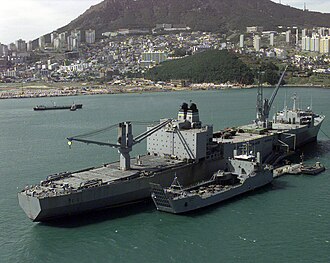
USNS Pollux (T-AK-290): The High-Speed Military Cargo Ship That Redefined Strategic Sealift
When discussing the vessels that support modern military operations, attention often goes to aircraft carriers, submarines, destroyers, and amphibious assault ships. However, behind every successful overseas deployment is an enormous logistical effort requiring ships capable of moving thousands of tons of equipment, vehicles, supplies, and personnel across the globe. One of the most remarkable examples of this capability was USNS Pollux (T-AK-290), a high-speed cargo vessel that combined commercial shipbuilding technology with military transportation requirements. Originally constructed as a commercial container ship, Pollux became one of the United States Navy’s most important fast sealift assets and demonstrated the value of speed, flexibility, and strategic mobility during periods of crisis.
The story of USNS Pollux is unusual because she was not designed from the beginning as a naval auxiliary. Instead, she began life as the commercial container ship SS Sea-Land Market, built during the era when containerization was transforming global shipping. After being acquired by the U.S. Navy in the early 1980s, she was converted into a Military Sealift Command vessel and later became part of the Fast Sealift Ship program. Her career represents an innovative approach to naval logistics: rather than constructing entirely new military transports, the United States adapted existing high-performance commercial ships to meet defense needs.
Named after Pollux, the bright star that forms part of the Gemini constellation alongside Castor, the ship followed the naming tradition of the Algol-class fast sealift ships, which were named after prominent stars. These vessels were among the fastest large cargo ships ever operated by the United States government, capable of reaching speeds normally associated with much smaller combatants. Pollux’s ability to transport hundreds of military vehicles while traveling at speeds exceeding many conventional cargo ships made her a unique strategic asset.
The Origins of USNS Pollux: From Commercial Container Ship to Military Transport
USNS Pollux began construction in West Germany at the A.G. Weser shipyard in Bremen, one of Europe’s major shipbuilding centers. Launched on May 1, 1973, the ship was completed later that year and delivered on September 1, 1973, as SS Sea-Land Market for Sea-Land Service, Inc. The ship represented a new generation of high-speed container vessels built during the expansion of international container shipping. Unlike traditional cargo ships that relied on slower speeds and long port stays, these new vessels were designed to move large amounts of cargo quickly between major ports.
Although the commercial shipping industry valued speed and capacity, the operating costs of the Sea-Land Market proved challenging. High fuel consumption and expensive operation limited her commercial profitability. This situation created an opportunity for the U.S. government, which recognized that the vessel’s exceptional speed and cargo capability could provide significant military advantages. On November 16, 1981, the United States Navy acquired the ship and transferred her into service under the Military Sealift Command (MSC).
The Military Sealift Command operates vessels that support the U.S. Navy and Department of Defense without being traditional commissioned warships. Ships in this category usually carry civilian mariners, supported by military personnel when required. This arrangement allows the Navy to maintain a large global logistics capability while reducing the personnel requirements associated with fully commissioned naval vessels. Pollux became part of this system, providing transportation capacity that could be rapidly activated during military operations.
The Algol-Class Fast Sealift Concept
Why Speed Mattered in Military Logistics
The Algol-class fast sealift ships were created around a simple but strategically important idea: military equipment is only useful if it can reach the battlefield quickly. During the Cold War, NATO planners understood that a major conflict in Europe or another region would require enormous quantities of armored vehicles, aircraft, engineering equipment, ammunition, and supplies to be transported from the United States. Traditional cargo ships could carry large loads but often required weeks to cross oceans. Fast sealift ships changed that equation by combining enormous cargo capacity with speeds approaching those of naval combat support vessels.
Pollux could carry more than 700 military vehicles, including heavy trucks, armored vehicles, and helicopters. Her roll-on/roll-off capability allowed vehicles to be driven directly onto and off the ship rather than requiring extensive crane operations. This reduced loading and unloading time and made the vessel especially valuable during rapid-response operations.
The ship’s performance was extraordinary for a vessel of her size. At nearly 950 feet in length and displacing tens of thousands of tons, Pollux could reach approximately 33 knots. This was possible because she retained a powerful steam propulsion system originally designed for high-speed commercial service. Her propulsion plant delivered approximately 120,000 shaft horsepower through twin General Electric steam turbines driving two propeller shafts.
Conversion Into a Military Sealift Ship
After acquisition, the former Sea-Land Market was renamed USNS Pollux and assigned the hull designation T-AK-290. Unlike a commissioned Navy ship, the prefix “USNS” indicated that she was operated by the United States Navy through the Military Sealift Command but was not part of the commissioned fleet. Her primary mission was transportation rather than combat, and she carried no traditional offensive weapons.
The ship’s design allowed her to function as a massive floating transportation platform. Internal spaces were optimized for military cargo, with extensive vehicle decks and systems designed to move heavy equipment efficiently. The vessel also included facilities for helicopter operations, giving commanders additional flexibility when moving personnel or supplies.
Operational History and Military Importance
Throughout her service career, Pollux contributed to the United States’ ability to respond quickly to international crises. Her role was not to fight directly but to provide the logistical foundation required for combat forces to operate. Military operations depend on enormous quantities of equipment, and fast sealift ships like Pollux ensured that armies and Marine units could receive the vehicles and supplies needed after deployment.
One of the most important periods of her service came during the Gulf War era. The United States and its allies required a massive transportation effort to move personnel, vehicles, and equipment to the Middle East during Operations Desert Shield and Desert Storm. Fast sealift ships were critical components of that effort because they could transport large amounts of equipment from American bases to overseas theaters much faster than conventional cargo vessels. Pollux received recognition connected with this period, including campaign-related honors associated with the Gulf War.
The vessel also supported numerous exercises and contingency missions during the post-Cold War period. Her ability to move armored vehicles and heavy equipment made her particularly useful in regions where port infrastructure was limited or where rapid reinforcement was required. During exercises in the Pacific, for example, ships like Pollux demonstrated the ability to deliver vehicles and supplies closer to operational areas, reducing dependence on slower transportation networks.
USNS Pollux (T-AKR-290): Evolution, Missions, and Legacy
From Cargo Ship to Strategic Asset: The Redesignation of USNS Pollux
Although USNS Pollux initially entered Military Sealift Command service under the designation T-AK-290, her role evolved as the U.S. Navy refined its approach to strategic transportation. The designation “AK” traditionally referred to a general cargo ship, but Pollux and her sister ships were much more specialized. They were not simply carrying crates and supplies; they were designed to move complete military formations, including armored vehicles, engineering equipment, helicopters, and other large assets required to establish and sustain overseas operations. Because of this specialized mission, the ship was later redesignated as T-AKR-290, identifying her as a fast sealift ship rather than a conventional cargo vessel.
The change reflected a broader transformation in military logistics. During the Cold War, American defense planners recognized that mobility would be one of the decisive factors in any major conflict. The United States maintained military forces around the world, but many of the heaviest and most difficult-to-transport items remained based in North America. Tanks, armored personnel carriers, trucks, construction equipment, and aircraft support systems could not simply be flown overseas in large quantities. Strategic sealift ships filled this gap by providing the ability to rapidly move heavy military assets across oceans.
Pollux became part of a specialized group of vessels that represented one of the most ambitious sealift concepts ever developed by the United States. The Algol-class ships were unique because they combined commercial efficiency with military requirements. Their commercial origins gave them exceptional speed and large internal volume, while their military modifications allowed them to support large-scale deployments. The result was a class of ships that could transport cargo faster than nearly any other large logistics vessel in service.
The Role of Pollux in U.S. Military Logistics
Supporting Rapid Deployment Operations
The importance of USNS Pollux was closely connected to the concept of rapid deployment. Modern military operations require more than combat forces; they require a complete network of transportation, fuel, maintenance, communications, medical support, and supplies. A military unit arriving in a foreign country without its vehicles and equipment cannot operate effectively. Fast sealift ships solved this problem by delivering the heavy equipment necessary to transform deployed personnel into fully operational forces.
Unlike aircraft, which can move personnel and smaller equipment quickly, ships remain the most practical method for transporting large quantities of heavy cargo. A single Pollux voyage could replace hundreds of aircraft sorties while carrying vehicles and equipment that could not realistically be moved by air. Her roll-on/roll-off configuration meant that vehicles could be loaded directly onto internal decks, secured for ocean transit, and unloaded rapidly when they reached their destination.
This capability became especially valuable during emergencies when the United States needed to reinforce allies or respond to unexpected conflicts. The ability to move a large quantity of military hardware quickly gave American commanders greater flexibility. Instead of relying solely on equipment already stationed overseas, the United States could reposition forces from the continental United States and transport their supporting equipment using ships such as Pollux.
Operations Desert Shield and Desert Storm
One of the defining moments in the history of USNS Pollux was her participation in the massive logistics effort associated with the Gulf War. When Iraq invaded Kuwait in August 1990, the United States began one of the largest overseas military deployments since World War II. The operation required moving hundreds of thousands of personnel and enormous quantities of military equipment to the Middle East.
Fast sealift ships were among the most important vessels involved in this movement. The distances involved were considerable, and military planners needed ships capable of transporting equipment quickly enough to support operational timelines. Pollux and other Algol-class ships transported critical vehicles and supplies, helping establish the infrastructure required for coalition forces preparing for combat operations.
The Gulf War demonstrated the strategic value of maritime logistics. While aircraft and naval combat ships received significant public attention, sealift vessels quietly performed one of the most essential missions of the conflict. Without ships capable of transporting heavy equipment, deployed forces would have lacked many of the vehicles and systems needed for sustained operations.
Life and Operations Aboard USNS Pollux
Civilian Mariners and Military Support Personnel
As a Military Sealift Command vessel, USNS Pollux operated differently from commissioned U.S. Navy warships. The ship was primarily crewed by civilian mariners employed by the government through the Military Sealift Command. These professional sailors were responsible for navigation, engineering, maintenance, cargo handling, and the daily operation of the vessel.
The use of civilian crews allowed the Navy to maintain a large transportation capability without requiring the same personnel structure as a combat vessel. The ship’s mission was centered on transportation efficiency rather than combat operations. During deployments, however, military personnel could embark aboard the ship to manage cargo, coordinate logistics, or support specific missions.
Operating a vessel of Pollux’s size required extensive coordination. Engineers maintained the ship’s powerful steam propulsion system, which was far more complex than the diesel engines commonly found on modern commercial cargo ships. Deck crews managed vehicle loading, cargo security, and unloading operations, while navigation teams ensured safe passage during long ocean voyages.
The Challenges of Operating a High-Speed Sealift Ship
Although Pollux provided unmatched speed and cargo capacity, maintaining such a vessel presented significant challenges. Her steam propulsion system was extremely powerful but required specialized knowledge and extensive maintenance. By the late twentieth and early twenty-first centuries, many commercial vessels had transitioned to more efficient diesel propulsion systems, making high-speed steamships increasingly unusual.
Fuel consumption was another major concern. Achieving speeds above 30 knots required enormous amounts of energy, and operating at maximum speed was expensive. However, the military value of rapid transportation often justified these costs. The purpose of the Fast Sealift Ship program was not to provide the cheapest transportation possible but to provide transportation capability when time was critical.
The ships also required specialized infrastructure. Their size meant that not every port could accommodate them, and loading military vehicles required suitable facilities. Nevertheless, their advantages outweighed these limitations because they provided a capability that few other vessels could match.
USNS Pollux and the Future of Strategic Sealift
The Changing Nature of Military Transportation
By the early twenty-first century, the role of fast sealift ships began changing as military transportation concepts evolved. Advances in airlift capability, prepositioning strategies, and newer logistics vessels altered the way the Department of Defense approached global mobility. Instead of relying exclusively on high-speed cargo ships, planners increasingly combined multiple transportation methods to create flexible logistics networks.
Despite these changes, the fundamental need for strategic sealift remained. Heavy military equipment still required ships, and large-scale conflicts still demanded enormous transportation capacity. The experience gained from operating Pollux and her sister ships influenced later sealift planning and demonstrated the importance of maintaining specialized transportation assets.
The Algol-class ships were eventually recognized as aging platforms. Their commercial origins, while beneficial in terms of speed and capacity, also meant that they were built using technologies from an earlier era. Rising maintenance costs, limited availability of replacement parts, and changing operational requirements contributed to their eventual retirement from active service.
The Legacy of USNS Pollux
USNS Pollux occupies an important place in the history of American naval logistics. She was not a warship in the traditional sense, but her contribution to military operations was significant. Combat power depends on logistics, and Pollux represented the ability to move that logistical foundation rapidly across the world.
The ship demonstrated that commercial technology could be adapted successfully for national defense purposes. Her transformation from a container ship into a strategic military transport showed how existing maritime capabilities could be integrated into defense planning. The lessons learned from the Algol-class program continue to influence modern approaches to military mobility.
Pollux also represented a period when speed was considered one of the most valuable characteristics of strategic transportation. Few ships of her size could match her ability to carry massive quantities of equipment while traveling at speeds normally associated with naval vessels. This combination made her a remarkable example of engineering and strategic planning.
Although USNS Pollux is no longer an active participant in American sealift operations, her service history remains a reminder that military effectiveness depends on much more than frontline weapons systems. Ships like Pollux ensured that those weapons, vehicles, and personnel could reach the places where they were needed.
Technical Specifications of USNS Pollux (T-AKR-290)
| Specification | Details |
|---|---|
| Ship Name | USNS Pollux |
| Hull Number | T-AKR-290 |
| Former Name | SS Sea-Land Market |
| Class | Algol-class Fast Sealift Ship |
| Type | Fast roll-on/roll-off cargo transport |
| Builder | A.G. Weser Shipyard, Bremen, West Germany |
| Launched | May 1, 1973 |
| Entered Service | 1973 (commercial); 1981 (Military Sealift Command) |
| Operator | United States Navy Military Sealift Command |
| Length | Approximately 946 feet (288 meters) |
| Beam | Approximately 106 feet (32 meters) |
| Displacement | Approximately 55,000 tons full load |
| Propulsion | Two General Electric steam turbines |
| Propulsion Power | Approximately 120,000 shaft horsepower |
| Shafts | Two propeller shafts |
| Maximum Speed | Approximately 33 knots |
| Cargo Capacity | More than 700 military vehicles |
| Cargo Handling | Roll-on/roll-off vehicle decks and cargo systems |
| Primary Mission | Rapid transportation of military vehicles, equipment, and supplies |
| Crew | Civilian mariners under Military Sealift Command |
| Military Role | Strategic sealift and rapid deployment support |
USNS Pollux remains one of the most distinctive logistics ships ever operated by the United States. Her unusual combination of commercial origins, exceptional speed, and military utility made her a valuable strategic asset for more than two decades. While modern sealift concepts continue to evolve, the legacy of Pollux demonstrates a timeless principle of military planning: the ability to move forces and equipment quickly can be just as important as the forces themselves.
_anchored_in_the_harbor_off_the_Port_of_Pusan,_Republic_of_Korea_-_19_Oct._1998.jpg)