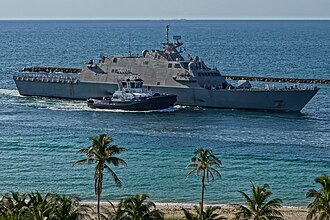
USS Detroit (LCS-7): The Evolution of Modern Naval Warfare Through a Freedom-Class Littoral Combat Ship
The United States Navy has long been recognized as one of the world’s most technologically advanced maritime forces, constantly adapting its fleet to address emerging threats and changing operational environments. One of the most ambitious naval modernization efforts of the twenty-first century has been the Littoral Combat Ship (LCS) program, which sought to create highly flexible warships capable of operating close to shore while maintaining the speed, versatility, and technological sophistication expected of a modern naval platform. Among these vessels, USS Detroit (LCS-7) occupies an important place as one of the Freedom-class ships designed to demonstrate how modular systems, advanced sensors, and high-speed maneuverability could redefine naval operations in coastal regions. Named after the historic city of Detroit, Michigan, the vessel represents not only engineering innovation but also the enduring connection between American industrial heritage and naval power. Throughout its service, USS Detroit has participated in training exercises, deployments, multinational operations, and technological evaluations that have contributed to the continuing evolution of the United States Navy’s surface fleet.
The Origins of the Littoral Combat Ship Program
To fully appreciate the significance of USS Detroit, it is necessary to understand the broader strategic context that led to the creation of the Littoral Combat Ship program. During the late twentieth century and the beginning of the twenty-first century, military planners recognized that future conflicts would increasingly occur near coastlines rather than exclusively on the open ocean. Traditional destroyers and cruisers possessed immense firepower but were expensive to operate and not always optimized for shallow-water missions. Meanwhile, asymmetric threats such as fast attack craft, naval mines, diesel-electric submarines, and maritime terrorism required vessels capable of rapid response and flexible mission adaptation. The LCS concept emerged as an innovative solution that emphasized speed, modular mission packages, reduced crew requirements, and advanced automation. Instead of building specialized ships for every mission profile, naval planners envisioned a platform that could rapidly change its operational focus by exchanging mission modules, allowing the same hull to conduct surface warfare, anti-submarine warfare, or mine countermeasure operations with minimal structural modifications.
USS Detroit belongs to the Freedom-class variant of the Littoral Combat Ship family, which features a conventional monohull design developed by a team led by Lockheed Martin. Alongside the Independence-class trimaran design, the Freedom class represented one of two competing approaches to achieving the Navy’s operational objectives. While debate has continued regarding the strengths and limitations of the LCS program, there is little doubt that these ships introduced numerous technological innovations that have influenced subsequent naval development.
Why the Ship Was Named Detroit
The city of Detroit has long been associated with American manufacturing, innovation, transportation, and industrial achievement. Known worldwide as the center of the automotive industry, Detroit has also contributed significantly to national defense production during periods of conflict. During World War II, its factories earned the nickname “Arsenal of Democracy” by producing enormous quantities of military vehicles, aircraft engines, tanks, and equipment that supported Allied victory. Naming USS Detroit after the city honored this legacy while continuing a naval tradition of recognizing communities that have played important roles in the nation’s history.
The name USS Detroit also carries historical continuity within the United States Navy. Several previous vessels have borne the Detroit name, including cruisers that served with distinction during earlier eras of naval history. By assigning the name to LCS-7, the Navy linked a new generation of technologically advanced warships with the traditions established by earlier ships that represented American maritime strength during different historical periods.
Design Philosophy and Engineering Innovation
USS Detroit embodies a design philosophy that differs considerably from conventional surface combatants. Rather than emphasizing heavy armor or massive missile batteries, the ship focuses on operational flexibility, high sprint speed, and modular capability. The vessel’s steel hull combined with an aluminum superstructure reflects efforts to reduce weight while maintaining structural integrity. Every aspect of the ship was engineered with automation in mind, allowing a much smaller crew than similarly sized combatants. Advanced monitoring systems continuously oversee propulsion, electrical generation, damage control, and navigation functions, reducing the manpower required for routine operations and enabling sailors to concentrate on mission execution.
The Freedom-class hull incorporates stealth-oriented design principles intended to reduce radar cross-section. Angled surfaces, enclosed equipment, and carefully integrated sensor placement contribute to a lower observable profile compared to older ship designs. Although not invisible to radar, these measures complicate enemy detection and targeting, particularly when operating in cluttered coastal environments where numerous civilian vessels and shoreline structures already create complex sensor conditions.
Internal spaces are arranged to maximize adaptability. Large mission bays permit the embarkation of specialized equipment, unmanned systems, and containerized mission modules that can transform the ship’s operational role. Aviation facilities support helicopters and unmanned aerial vehicles, significantly extending surveillance range, anti-submarine capability, and search-and-rescue operations.
Construction and Commissioning
USS Detroit was constructed at the Marinette Marine shipyard in Wisconsin, one of the primary facilities responsible for building Freedom-class Littoral Combat Ships. The construction process involved advanced modular manufacturing techniques in which major sections of the vessel were assembled separately before being integrated into the completed hull. This approach sought to improve efficiency while reducing production timelines, although the broader LCS program encountered various challenges related to cost growth, engineering modifications, and evolving Navy requirements.
Following launch and extensive sea trials, USS Detroit underwent rigorous testing to validate propulsion performance, combat systems integration, navigation equipment, aviation facilities, and survivability standards. These evaluations included high-speed maneuvering, weapons testing, communications validation, and damage control exercises designed to ensure readiness before entering operational service. The ship was officially commissioned into the United States Navy in 2016, marking the beginning of its active career.
Propulsion and Remarkable Speed
One of USS Detroit’s defining characteristics is its extraordinary speed. Unlike many larger combatants that prioritize endurance over acceleration, the Freedom-class utilizes a Combined Diesel and Gas (CODAG) propulsion arrangement coupled with waterjets that enable rapid maneuvering. Diesel engines provide efficient cruising performance, while gas turbines generate immense power for high-speed operations when required. Waterjet propulsion offers excellent agility, particularly in shallow coastal waters where traditional propellers may be less effective or more vulnerable to damage.
This propulsion system allows USS Detroit to exceed forty knots under favorable conditions, making it one of the fastest combat ships in the United States Navy. Such speed provides tactical advantages including rapid response to emerging threats, interception of suspicious vessels, quick repositioning during exercises, and enhanced survivability through maneuverability. In littoral environments where operational distances may be relatively short but reaction time is critical, high speed becomes a significant force multiplier.
Combat Systems and Weapons
Although smaller than destroyers or cruisers, USS Detroit carries a carefully selected suite of weapons appropriate for its intended missions. The ship’s primary gun is the versatile 57 mm Mk 110 naval gun, capable of engaging surface targets, small boats, and limited aerial threats. Its high rate of fire makes it particularly effective against fast-moving attack craft that may attempt swarm tactics in confined coastal waters.
Additional defensive capability comes from remotely operated .50 caliber machine guns and other crew-served weapons positioned around the ship to provide comprehensive coverage against asymmetric threats. The ship is also equipped with Rolling Airframe Missile (RAM) launchers that offer close-in defense against incoming anti-ship missiles and hostile aircraft. While these defensive systems are not intended to replace the extensive layered air defense available on larger warships, they provide essential protection during independent operations.
The modular mission package concept originally envisioned a flexible approach whereby different equipment could be installed depending on operational requirements. These mission packages included specialized sensors, unmanned vehicles, helicopters, mine-hunting systems, and anti-submarine technologies. Although implementation of the modular concept evolved over time, the underlying philosophy of adaptable capability remains central to understanding the ship’s operational role.
Aviation Facilities and Unmanned Systems
The aviation capability of USS Detroit significantly expands its operational reach beyond the limitations imposed by the ship’s own sensors. A spacious flight deck and enclosed hangar support helicopters such as the MH-60R Seahawk, which can perform anti-submarine warfare, surveillance, logistics support, search and rescue, medical evacuation, and surface attack missions. Helicopters effectively multiply the ship’s situational awareness by extending sensor coverage many miles beyond the horizon.
In addition to manned aviation assets, USS Detroit can support unmanned aerial systems that provide persistent intelligence, reconnaissance, and target identification. These drones allow commanders to monitor maritime traffic, inspect suspicious vessels, observe coastal activity, and gather operational information without placing aircrew at unnecessary risk. The integration of manned and unmanned aviation represents one of the defining features of modern naval operations.
Crew Life and Automation
Compared with traditional frigates or destroyers, USS Detroit operates with a remarkably small core crew. Advanced automation reduces manpower requirements while increasing efficiency in engineering management, navigation, communications, and maintenance monitoring. Digital control systems continuously collect performance data from machinery throughout the vessel, allowing personnel to identify emerging maintenance needs before they become serious operational problems.
Life aboard USS Detroit nevertheless remains demanding. Sailors perform multiple responsibilities that might otherwise be divided among larger crews. Cross-training is therefore essential, enabling personnel to contribute across several operational disciplines. Crew members participate in navigation watches, engineering oversight, combat systems management, aviation support, maintenance, logistics, and emergency response while maintaining readiness for extended deployments. Modern accommodations provide improved habitability compared with many older warships, reflecting recognition that crew welfare contributes directly to operational effectiveness.
Operational Deployments and International Cooperation
Since entering active service, USS Detroit has participated in numerous exercises and deployments designed to strengthen naval readiness and reinforce international partnerships. Exercises with allied navies provide opportunities to practice coordinated maritime security operations, anti-submarine warfare, communication interoperability, search-and-rescue procedures, and tactical maneuvering. These multinational activities strengthen collective security while ensuring participating forces can effectively cooperate during humanitarian crises or military contingencies.
Operational deployments have demonstrated the ship’s ability to conduct maritime patrols, support regional security initiatives, and contribute to broader fleet operations. Although the precise details of deployments vary depending upon strategic priorities, vessels such as USS Detroit routinely operate alongside destroyers, amphibious ships, aircraft carriers, and allied naval units in support of global maritime stability.
Challenges Faced by the Freedom-Class
No discussion of USS Detroit would be complete without acknowledging the challenges encountered by the Freedom-class program. Throughout its development and operational service, the class experienced engineering issues, maintenance concerns, and evolving mission requirements. Some propulsion components required redesign, while the Navy reassessed aspects of the modular mission package concept after gaining operational experience. These challenges prompted technical improvements, revised maintenance practices, and broader discussions regarding the optimal balance between flexibility, survivability, and cost.
Despite criticism directed toward certain aspects of the Littoral Combat Ship program, the vessels have also provided valuable lessons that continue to influence future naval shipbuilding. Experience gained from Freedom-class operations has informed the development of subsequent frigate programs and contributed to a deeper understanding of automation, modularity, and distributed maritime operations.
Technology and Digital Integration
USS Detroit exemplifies the increasing digitization of naval warfare. Modern combat management systems integrate radar data, electronic surveillance, navigation information, weapons status, communications networks, and intelligence feeds into unified displays that support rapid decision-making. High-capacity computer networks enable commanders to coordinate with other ships, aircraft, headquarters, and coalition partners across vast distances while maintaining situational awareness.
Cybersecurity has become an equally important component of modern warship design. Protecting digital infrastructure from unauthorized access, electronic attack, or malicious software is now considered as essential as defending the ship against physical threats. Continuous software updates, network monitoring, and information assurance measures contribute to maintaining operational integrity throughout deployments.
The Strategic Importance of Littoral Warfare
The strategic environment facing modern navies increasingly emphasizes contested coastal regions where commercial shipping, civilian populations, strategic infrastructure, and military forces operate in close proximity. Littoral zones present unique operational challenges due to shallow waters, complex geography, dense maritime traffic, and numerous opportunities for asymmetric attacks. Ships like USS Detroit were specifically conceived to address these demanding environments by combining speed, maneuverability, advanced sensors, aviation capability, and adaptable mission systems.
Whether conducting maritime security patrols, supporting humanitarian assistance, protecting sea lines of communication, or participating in multinational exercises, the ship contributes to broader naval objectives that extend beyond traditional high-intensity warfare. Its versatility reflects the reality that modern naval operations frequently involve diplomacy, deterrence, disaster response, counter-smuggling efforts, and freedom of navigation missions alongside conventional combat readiness.
Legacy and Future Relevance
USS Detroit represents an important chapter in the continuing evolution of naval technology. While debates surrounding the Littoral Combat Ship program have generated differing opinions regarding procurement strategies and operational concepts, the vessel remains an example of the Navy’s willingness to experiment with new approaches to maritime warfare. Automation, modular mission systems, high-speed propulsion, digital integration, and unmanned systems all represent trends that continue to shape future surface combatants.
The experience gained through operating USS Detroit and its sister ships has influenced broader fleet modernization efforts. Lessons regarding maintenance planning, crew organization, mission flexibility, engineering reliability, and combat system integration provide valuable knowledge that extends well beyond the LCS program itself. As naval warfare continues to evolve amid rapidly changing technological and geopolitical conditions, ships like USS Detroit serve as both operational assets and platforms for innovation.
Ultimately, USS Detroit embodies the intersection of tradition and modernization. Bearing the name of one of America’s most historically significant industrial cities, the ship honors the nation’s manufacturing heritage while demonstrating advanced engineering and digital technology. Its service reflects the constant process of adaptation that defines successful naval organizations, reminding observers that innovation often involves experimentation, refinement, and continuous learning. Regardless of future fleet structures, USS Detroit will remain part of the story of how the United States Navy sought to prepare for the complex maritime challenges of the twenty-first century.
Technical Specifications Summary
| Specification | Details |
|---|---|
| Ship Name | USS Detroit (LCS-7) |
| Class | Freedom-class Littoral Combat Ship |
| Type | Littoral Combat Ship |
| Operator | United States Navy |
| Builder | Marinette Marine, Marinette, Wisconsin |
| Commissioned | 2016 |
| Displacement | Approximately 3,500 metric tons (full load) |
| Length | 378 ft (115.3 m) |
| Beam | 57.4 ft (17.5 m) |
| Draft | Approximately 14 ft (4.3 m) |
| Propulsion | Combined Diesel and Gas (CODAG) with waterjets |
| Maximum Speed | Over 40 knots |
| Range | Approximately 3,500 nautical miles at economical speed |
| Crew | Core crew of approximately 50 sailors, plus aviation and mission personnel |
| Main Gun | 1 × 57 mm Mk 110 naval gun |
| Missile Defense | Rolling Airframe Missile (RAM) launcher |
| Additional Armament | .50 caliber machine guns and other crew-served weapons |
| Aircraft | MH-60R Seahawk helicopter and unmanned aerial systems |
| Mission Capabilities | Surface warfare, mine countermeasures, anti-submarine warfare, maritime security, reconnaissance |
| Notable Feature | Modular mission systems with high-speed littoral operations capability |
.jpg)