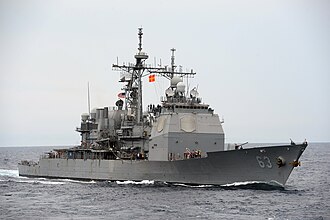
A Ticonderoga-Class Cruiser with a Remarkable Career
The USS Cowpens (CG-63) stands as one of the most recognizable guided missile cruisers of the United States Navy’s post–Cold War era. Commissioned in 1991, the ship became part of the powerful Ticonderoga-class cruiser fleet, a group of warships that transformed naval warfare by introducing the revolutionary Aegis Combat System to the U.S. Navy’s surface forces. Named after the Battle of Cowpens, a decisive American victory during the Revolutionary War, the cruiser carried forward a legacy of determination, flexibility, and combat readiness.
Known informally by the nickname “Mighty Moo,” USS Cowpens earned a reputation as a highly capable multi-mission warship. Throughout more than three decades of service, the cruiser operated across the world’s oceans, participated in major military exercises, supported combat operations, defended aircraft carrier strike groups, and contributed to maritime security missions. From the Persian Gulf to the Western Pacific, Cowpens demonstrated the strategic importance of guided missile cruisers in modern naval operations.
Unlike older cruisers that specialized primarily in a single mission, USS Cowpens was designed as a versatile platform capable of performing air defense, surface warfare, anti-submarine warfare, strike warfare, and command-and-control functions. Its combination of advanced radar systems, vertical launch missiles, powerful sensors, and aviation capabilities allowed it to serve as both a shield for other naval forces and a significant offensive weapon in its own right.
This article explores the history, design, technology, operational career, and lasting importance of USS Cowpens (CG-63), one of the most capable warships of the U.S. Navy’s late twentieth- and early twenty-first-century fleet.
The Origins of USS Cowpens and the Ticonderoga-Class Cruiser Program
The Need for a New Generation of Guided Missile Cruisers
During the Cold War, the U.S. Navy faced an increasingly sophisticated Soviet naval threat. The Soviet Union invested heavily in long-range aircraft, submarines, and anti-ship missiles designed to challenge American carrier battle groups. To counter these threats, the United States developed new generations of naval sensors and weapons systems.
The solution came in the form of the Aegis Combat System, an integrated naval warfare system designed around powerful radar technology and computerized command systems. Unlike previous naval combat systems that relied heavily on separate sensors and weapons, Aegis created a networked environment where radar information, threat evaluation, and weapons employment could occur rapidly and automatically.
The first ships equipped with Aegis were the Ticonderoga-class cruisers. Originally planned as a derivative of the Spruance-class destroyer design, the Ticonderoga class evolved into a new category of warship because of the importance of its combat system. These ships became some of the most advanced surface combatants in the world.
USS Cowpens was the 17th ship of the Ticonderoga class and one of the later vessels built with the improved design featuring the Vertical Launch System (VLS). This system greatly increased the ship’s flexibility by allowing it to carry a wide variety of missiles ready for immediate launch.
Naming the Ship: Honoring the Battle of Cowpens
A Revolutionary War Legacy
USS Cowpens received its name from the Battle of Cowpens, fought on January 17, 1781, during the American Revolutionary War. The battle took place in South Carolina and resulted in a major victory for American forces under Brigadier General Daniel Morgan.
The battle was significant because American troops used disciplined tactics and battlefield deception to defeat a larger British force commanded by Lieutenant Colonel Banastre Tarleton. The victory helped weaken British operations in the Southern colonies and contributed to the eventual American success in the Revolutionary War.
The Navy had previously honored the battle with the aircraft carrier USS Cowpens (CV-25), which served during World War II. The guided missile cruiser continued this tradition, carrying the name into the era of advanced naval technology.
The ship’s motto, “Superstition, Courage, Victory,” reflected both the historical significance of Cowpens and the fighting spirit expected of a U.S. Navy warship.
Construction and Commissioning of USS Cowpens
Building a Modern Guided Missile Cruiser
USS Cowpens was constructed by Bath Iron Works in Maine. Her keel was laid down on December 23, 1987, marking the beginning of construction. After years of assembly, testing, and outfitting, the ship was launched on March 11, 1989.
The cruiser was sponsored by Barbara Bush, wife of then-Vice President George H. W. Bush. Following extensive sea trials and crew training, USS Cowpens was commissioned into the U.S. Navy on March 9, 1991.
At commissioning, the ship represented the cutting edge of naval warfare. The collapse of the Soviet Union occurred during the same period, changing the global strategic environment. Although the Cold War had ended, the Navy continued to require flexible warships capable of responding to regional conflicts, emerging threats, and global maritime challenges.
USS Cowpens quickly became an important member of the Pacific Fleet.
Design and Engineering of USS Cowpens
A Powerful Platform Built for Multiple Missions
USS Cowpens was built around the Ticonderoga-class concept of creating a highly capable surface combatant able to perform multiple roles simultaneously. The ship displaced approximately 9,600 tons when fully loaded and measured more than 567 feet in length.
The cruiser’s design incorporated lessons from earlier naval vessels while introducing technologies that greatly improved combat effectiveness. Its hull was based on the Spruance-class destroyer design, giving it excellent seaworthiness and endurance. However, the addition of the Aegis system and advanced missile capability transformed it into a far more powerful warship.
The ship’s propulsion system consisted of four General Electric LM2500 gas turbine engines. These engines provided the speed necessary to operate with carrier strike groups and respond quickly to changing tactical situations.
USS Cowpens could travel at speeds exceeding 30 knots, allowing it to maneuver rapidly during both combat operations and peacetime deployments.
The Aegis Combat System: The Heart of USS Cowpens
Revolutionary Radar and Battle Management Technology
The defining feature of USS Cowpens was its Aegis Combat System. At the center of this system was the AN/SPY-1 passive electronically scanned array radar.
Unlike traditional rotating radar systems, the SPY-1 radar used multiple fixed arrays mounted around the ship’s superstructure. This allowed the cruiser to track numerous targets simultaneously across a wide area.
The system could detect aircraft, missiles, and surface threats while automatically assisting operators in evaluating and responding to potential dangers. This capability was particularly important during carrier strike group operations, where a cruiser might be responsible for defending multiple ships against missile attacks.
The Aegis system allowed USS Cowpens to function as an air defense command center, coordinating responses against enemy aircraft and missile threats.
Over the years, the ship received multiple upgrades to maintain combat relevance, including improvements to radar processing, missile capability, communications systems, and electronic warfare equipment.
Weapons Systems and Combat Capability
Missile Power Through the Vertical Launch System
One of the greatest advantages of USS Cowpens was its Mk 41 Vertical Launch System. Unlike older missile launchers that required mechanical loading and limited firing angles, the VLS allowed missiles to be stored vertically in individual launch cells.
This arrangement provided several advantages:
- Faster missile launches
- Greater weapon flexibility
- Improved reliability
- Ability to fire multiple missile types
USS Cowpens carried a variety of missiles, including:
- Standard surface-to-air missiles for air defense
- Tomahawk cruise missiles for long-range strikes
- Anti-submarine rockets such as ASROC variants
The ship’s missile arsenal allowed it to defend friendly forces while also contributing offensive firepower during combat operations.
Close-In Defense and Naval Guns
For short-range threats, USS Cowpens carried the Phalanx Close-In Weapon System. This radar-controlled gun system was designed to provide last-resort defense against incoming missiles.
The ship also carried a 5-inch Mark 45 naval gun capable of engaging surface targets, supporting amphibious operations, and providing naval gunfire support when required.
Aviation Capability
Helicopters and Maritime Operations
Although USS Cowpens did not operate aircraft like an aircraft carrier, it carried helicopters that greatly expanded its capabilities.
The cruiser was equipped to operate SH-60 Seahawk helicopters, which supported:
- Anti-submarine warfare
- Surface surveillance
- Search and rescue operations
- Over-the-horizon targeting
The combination of ship sensors and helicopter operations allowed USS Cowpens to detect and respond to threats beyond the immediate range of its own systems.
Operational History and Major Deployments
Early Service in the Pacific Fleet
After commissioning, USS Cowpens joined the Pacific Fleet and became based in San Diego, California. The ship quickly integrated into carrier strike group operations and participated in training exercises designed to prepare naval forces for global missions.
The cruiser’s early years were shaped by the changing security environment after the Cold War. Rather than focusing exclusively on a single major adversary, the Navy increasingly emphasized flexibility and rapid response.
USS Cowpens became a valuable asset for missions ranging from regional security operations to multinational exercises.
Supporting Operations in the Middle East
Like many U.S. Navy surface combatants, USS Cowpens participated in operations connected to maintaining security in the Persian Gulf region.
The ship’s missile capability made it suitable for missions involving maritime protection, air defense, and support of coalition operations.
Its ability to launch Tomahawk cruise missiles also provided commanders with a long-range strike option when required.
Service in the Western Pacific
USS Cowpens spent much of its career operating in the Indo-Pacific region, one of the most strategically important maritime areas in the world.
The cruiser conducted operations with allied navies, participated in multinational exercises, and supported freedom of navigation missions.
The ship’s presence in the region demonstrated the U.S. Navy’s commitment to maintaining maritime stability and protecting international sea lanes.
The 2014 Incident in the South China Sea
One of USS Cowpens’ most discussed moments occurred in December 2013, when the cruiser operated near the Chinese aircraft carrier Liaoning during exercises in the South China Sea.
The encounter attracted international attention because Chinese naval forces were conducting operations around the carrier, and USS Cowpens maneuvered in the area. The event highlighted the increasingly complex naval environment in the Western Pacific and the importance of careful maritime communication between major powers.
The incident demonstrated how modern naval operations require not only technological capability but also diplomatic awareness and professional seamanship.
Life Aboard USS Cowpens
The Sailors Behind the Ship
A warship’s effectiveness depends on the people who operate it. USS Cowpens typically carried hundreds of officers and enlisted sailors responsible for maintaining propulsion systems, weapons, sensors, navigation equipment, communications networks, and daily ship operations.
Life aboard a guided missile cruiser required discipline, teamwork, and technical expertise. Sailors worked around the clock to ensure the ship remained ready for combat operations.
The cruiser’s crew maintained traditions associated with naval service while operating some of the most advanced military technology available.
The nickname “Mighty Moo” reflected the crew’s pride and connection with their ship. Like many Navy vessels, USS Cowpens developed its own identity beyond its technical specifications.
Decommissioning and Legacy
The End of an Era
After more than three decades of service, USS Cowpens was decommissioned in 2025 as part of the U.S. Navy’s efforts to modernize its surface fleet and transition toward newer platforms.
The retirement of Ticonderoga-class cruisers marked the conclusion of an important chapter in naval history. These ships served as the backbone of American air defense for decades and played a central role in carrier strike group operations.
USS Cowpens represented the peak of traditional guided missile cruiser design. While newer ships continue many of its missions, the Ticonderoga class remains remembered for introducing a new standard of naval warfare.
The cruiser’s legacy lies not only in its technology but also in the thousands of sailors who served aboard it and carried out missions around the world.
Technical Specifications of USS Cowpens (CG-63)
| Specification | Details |
|---|---|
| Ship Name | USS Cowpens |
| Hull Number | CG-63 |
| Class | Ticonderoga-class guided missile cruiser |
| Builder | Bath Iron Works |
| Laid Down | December 23, 1987 |
| Launched | March 11, 1989 |
| Commissioned | March 9, 1991 |
| Decommissioned | 2025 |
| Displacement | Approximately 9,600 tons full load |
| Length | 567 feet (172.8 meters) |
| Beam | 55 feet (16.8 meters) |
| Draft | Approximately 33 feet (10 meters) |
| Propulsion | Four General Electric LM2500 gas turbine engines |
| Propulsion Type | COGAG (Combined Gas or Gas) |
| Maximum Speed | More than 30 knots |
| Crew | Approximately 330 sailors |
| Combat System | Aegis Combat System |
| Main Radar | AN/SPY-1 passive electronically scanned array radar |
| Missile System | Mk 41 Vertical Launch System |
| Surface-to-Air Missiles | Standard Missile family |
| Strike Weapons | Tomahawk cruise missiles |
| Anti-Submarine Weapons | ASROC systems and helicopters |
| Main Gun | One 5-inch/54 caliber Mark 45 gun |
| Close Defense | Phalanx CIWS |
| Aircraft Support | SH-60 Seahawk helicopters |
| Primary Missions | Air defense, strike warfare, anti-submarine warfare, surface warfare, command and control |
| Fleet Assignment | U.S. Pacific Fleet |
Conclusion: Remembering the “Mighty Moo”
USS Cowpens (CG-63) represented the capabilities, ambitions, and technological achievements of the modern U.S. Navy. Built during the final years of the Cold War and serving through decades of global change, the cruiser adapted to new missions and new strategic challenges.
From protecting aircraft carriers to conducting maritime security operations, USS Cowpens demonstrated the value of a versatile guided missile cruiser. Its Aegis system, missile arsenal, and highly trained crews made it one of the most capable surface combatants of its generation.
Although the ship has left active service, the legacy of USS Cowpens continues through the sailors who served aboard her, the missions she completed, and the role she played in shaping naval operations in the twenty-first century. The “Mighty Moo” remains a symbol of American naval engineering, teamwork, and readiness across the world’s oceans.
