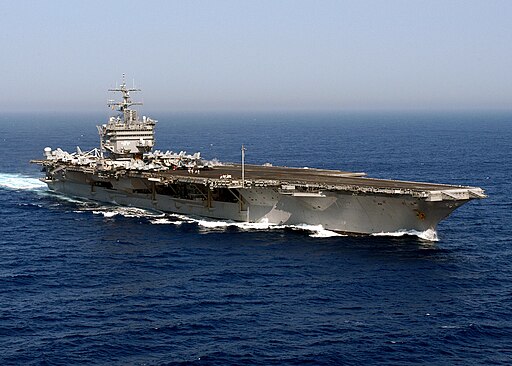
USS Enterprise (CVN-65)
The USS Enterprise (CVN-65) stands as a legendary symbol of American naval power, innovation, and perseverance. Commissioned in 1961 as the world’s first nuclear-powered aircraft carrier, the USS Enterprise represented a monumental leap forward in naval technology and capabilities. With its iconic design and cutting-edge propulsion system, the “Big E” quickly earned a reputation as the flagship of the United States Navy’s fleet, playing a central role in projecting American military might across the globe for over five decades.
Throughout its illustrious career, the USS Enterprise served on the front lines of some of the most pivotal moments in modern naval history. From the Cuban Missile Crisis to the Vietnam War, Operation Enduring Freedom, and Operation Iraqi Freedom, the “Big E” participated in a wide range of combat operations, humanitarian missions, and strategic deterrent patrols. Its formidable air wing, consisting of fighter jets, reconnaissance aircraft, and helicopters, provided unparalleled air support and strike capability, making the USS Enterprise a formidable force in any theater of operations.
In addition to its military prowess, the USS Enterprise served as a symbol of American resilience and resolve. Despite facing numerous challenges and threats over the years, including mechanical failures, fires, and collisions, the “Big E” persevered, undergoing extensive repairs and upgrades to remain operational and ready for action. Its legacy as the longest-serving nuclear-powered aircraft carrier in history is a testament to the dedication and professionalism of the thousands of sailors who served aboard the USS Enterprise, ensuring its continued success as a vital asset in America’s defense arsenal.
Armament of USS Enterprise (CVN-65)
As an aircraft carrier, the USS Enterprise (CVN-65) did not carry traditional armaments like guns or torpedoes. Instead, its primary armament was its embarked air wing, which consisted of various types of aircraft capable of engaging targets both in the air and on the surface. Here is a list of the main components of the USS Enterprise’s armament:
- Aircraft: The USS Enterprise could carry a large complement of aircraft, including fighter jets such as F-14 Tomcats, F/A-18 Hornets, and A-6 Intruders for air-to-air combat, air-to-ground strikes, and reconnaissance missions. It also carried E-2 Hawkeye airborne early warning aircraft, EA-6B Prowler electronic warfare aircraft, and helicopters for surveillance, search and rescue, and anti-submarine warfare.
- Surface-to-Air Missiles (SAMs): Aircraft carriers like the USS Enterprise were equipped with surface-to-air missile systems for defense against airborne threats. These systems typically included RIM-7 Sea Sparrow missiles launched from vertical launch systems (VLS) and Phalanx Close-In Weapon Systems (CIWS) for short-range defense against missiles and aircraft.
- Electronic Warfare Systems: The USS Enterprise was equipped with advanced electronic warfare systems to detect, jam, and disrupt enemy radar and communication systems. These systems provided protection against incoming threats by interfering with enemy targeting and navigation.
- Countermeasures: The USS Enterprise carried countermeasures such as chaff and flares to confuse and divert incoming missiles. Chaff consists of small aluminum strips released into the air to reflect radar signals, while flares emit heat to decoy infrared-guided missiles away from the ship.
Overall, the armament of the USS Enterprise was centered around its embarked aircraft and defensive systems, allowing it to project power and protect itself and its strike group from aerial and surface threats.
Dimensions of USS Enterprise (CVN-65)
Here are the approximate dimensions of the USS Enterprise (CVN-65):
- Length: The USS Enterprise had a length of about 1,123 feet (342 meters) from bow to stern.
- Beam: The beam, or width, of the USS Enterprise was approximately 132 feet (40 meters).
- Draft: The draft, which refers to the depth of the ship’s hull below the waterline, of the USS Enterprise was approximately 39 feet (12 meters).
These dimensions made the USS Enterprise one of the largest warships ever built, capable of carrying and launching a large complement of aircraft while providing essential support functions to sustain its crew and air wing during extended deployments. As the first nuclear-powered aircraft carrier, the USS Enterprise represented a significant leap forward in naval technology and capabilities, enabling it to project American military power across the world’s oceans for over five decades.
_underway_in_the_Atlantic_Ocean_on_14_June_2004_(040614-N-0119G-020).jpg)