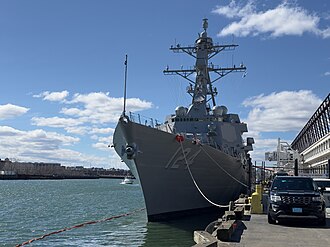
USS Harvey C. Barnum Jr. (DDG-124): The Arleigh Burke-Class Destroyer Honoring a Medal of Honor Legacy
A Warship Named for Courage and Leadership
The USS Harvey C. Barnum Jr. (DDG-124) represents the continuation of one of the U.S. Navy’s most successful surface combatant programs while also serving as a floating tribute to extraordinary courage under fire. As an Arleigh Burke-class guided-missile destroyer, the ship combines advanced sensors, powerful weapons systems, and multi-mission capabilities designed for modern naval warfare. More importantly, the vessel carries the name of a Marine whose actions during the Vietnam War became a lasting example of leadership, determination, and selfless service.
Named after retired U.S. Marine Corps Colonel Harvey Curtiss “Barney” Barnum Jr., DDG-124 is the first U.S. Navy ship to bear his name. Barnum received the Medal of Honor for his actions on December 18, 1965, when, as a young Marine officer, he assumed command of his company after its commander was mortally wounded during intense combat in Vietnam. His ability to organize a defense, coordinate supporting fires, and inspire his Marines under extreme conditions became the defining legacy that the ship now carries into the fleet.
The destroyer continues the long tradition of the U.S. Navy naming warships after individuals whose service reflects the values expected of American sailors. With its advanced combat systems and connection to a remarkable military career, USS Harvey C. Barnum Jr. combines technological capability with a powerful historical identity.
The Namesake: Colonel Harvey C. Barnum Jr.
A Marine Hero of the Vietnam War
Harvey C. Barnum Jr. joined the U.S. Marine Corps and served as an artillery officer during the Vietnam War. His moment of greatest distinction came during Operation Harvest Moon in the Quế Sơn Valley of South Vietnam. On that day, then-First Lieutenant Barnum found his unit under heavy enemy fire, with casualties mounting and key leaders lost. Rather than withdrawing, he moved forward, took command, reorganized the surviving Marines, and directed the battle while exposed to significant danger.
Barnum’s actions earned him the Medal of Honor, the highest military decoration awarded by the United States for valor in combat. His citation recognized not only his personal bravery but also his ability to restore order and effectiveness to a unit facing overwhelming pressure. His leadership demonstrated a central principle of military command: the ability to make clear decisions and motivate others when circumstances are at their most difficult.
After his combat service, Barnum continued serving the nation in various military and government roles. His career included work as Assistant Secretary of the Navy for Manpower and Reserve Affairs, further connecting his legacy to the naval service. The decision to name a destroyer after him reflects both his battlefield heroism and his broader contributions to American defense.
Construction and Entry Into Service
Building the Future USS Harvey C. Barnum Jr.
USS Harvey C. Barnum Jr. was constructed by General Dynamics Bath Iron Works in Bath, Maine, one of the United States’ premier naval shipbuilding facilities. The ship belongs to the Arleigh Burke-class family, a class that has become the backbone of the Navy’s surface combatant fleet due to its flexibility, survivability, and ability to perform a wide range of missions.
The ship’s keel was ceremonially laid on April 6, 2023, marking an important milestone in the construction process. The vessel was later christened on July 29, 2023, continuing the traditional naval practice of officially naming and blessing a new warship before it enters service.
As a Flight IIA Technology Insertion variant, DDG-124 incorporates improvements beyond earlier Arleigh Burke-class ships. This design approach allows the Navy to integrate newer technologies while maintaining the proven hull and combat architecture of the class. The result is a destroyer capable of meeting modern threats while benefiting from decades of operational experience.
Design and Capabilities
The Arleigh Burke-Class Foundation
The Arleigh Burke-class destroyer is one of the most recognizable warship designs in the world. Originally developed as an air-defense platform centered around the Aegis combat system, the class has evolved into a highly versatile surface combatant capable of air defense, ballistic missile defense, anti-submarine warfare, surface warfare, and precision strike missions.
USS Harvey C. Barnum Jr. follows this tradition by serving as a multi-role combatant rather than a ship designed for only one mission. Its combination of radar systems, missile capability, electronic warfare equipment, sonar technology, and aviation facilities allows it to operate independently or as part of a larger naval task force.
The destroyer’s Aegis combat system provides the ship with advanced command-and-control capabilities, allowing it to rapidly detect, track, and respond to threats. Through integration with other Navy assets, DDG-124 can contribute to coordinated fleet operations across multiple domains.
Sensors and Combat Systems
One of the most important features of USS Harvey C. Barnum Jr. is its sophisticated sensor and combat architecture. Modern naval warfare depends heavily on information superiority, and destroyers like DDG-124 are designed to gather, process, and distribute battlefield information quickly.
The ship’s Aegis system integrates radar information with weapons and command networks, allowing sailors to make decisions based on a comprehensive picture of the surrounding environment. This capability is especially important in modern conflicts involving aircraft, missiles, drones, submarines, and surface vessels.
The Flight IIA Technology Insertion configuration also includes improvements associated with later Arleigh Burke designs, including upgraded computing systems and enhanced combat capabilities. These improvements help extend the operational relevance of the ship throughout its expected service life.
Weapons and Mission Roles
A Multi-Mission Guided-Missile Destroyer
USS Harvey C. Barnum Jr. is designed to perform numerous missions rather than focus on a single combat role. Its weapons systems allow it to defend naval forces, strike targets, and support joint military operations.
The ship’s vertical launch system provides the ability to employ a variety of missiles, including weapons for air defense, anti-submarine warfare, and surface strike missions. This flexibility is one of the defining characteristics of the Arleigh Burke-class design.
The destroyer also carries a naval gun system for surface engagements and defensive operations, along with close-in defensive weapons designed to protect the ship from nearby threats. Helicopter facilities further expand its capabilities by allowing aviation assets to support surveillance, anti-submarine operations, and other missions.
Together, these systems make DDG-124 capable of operating in complex environments ranging from open-ocean warfare to integrated fleet operations.
The Importance of DDG-124 in the U.S. Navy
Strengthening the Surface Fleet
The addition of USS Harvey C. Barnum Jr. reinforces the Navy’s emphasis on maintaining a capable and adaptable surface fleet. Arleigh Burke-class destroyers remain central to naval operations because they provide a combination of endurance, firepower, and flexibility.
The ship’s commissioning adds another advanced destroyer to a class that has served as a key element of American maritime power for decades. Its ability to conduct air defense, missile defense, and strike missions makes it valuable in both peacetime operations and potential conflicts.
Beyond its technical capabilities, the ship also represents the Navy’s connection between history and future operations. Every sailor serving aboard DDG-124 carries forward the example set by Colonel Barnum: courage, responsibility, and commitment to teammates.
Technical Specifications of USS Harvey C. Barnum Jr. (DDG-124)
| Specification | Details |
|---|---|
| Ship Name | USS Harvey C. Barnum Jr. |
| Hull Number | DDG-124 |
| Class | Arleigh Burke-class guided-missile destroyer |
| Variant | Flight IIA Technology Insertion |
| Builder | General Dynamics Bath Iron Works |
| Length | Approximately 509–513 feet |
| Beam (Width) | Approximately 66 feet |
| Displacement | Approximately 9,200 tons |
| Crew | Approximately 300+ sailors (about 304 personnel) |
| Propulsion | Gas turbine propulsion plant with Integrated Power System |
| Speed | More than 30 knots |
| Combat System | Aegis Combat System |
| Primary Missions | Air defense, missile defense, anti-submarine warfare, surface warfare, strike operations |
| Aircraft Support | Helicopter aviation facilities |
| Homeport | Naval Station Norfolk, Virginia |
| Namesake | Colonel Harvey C. Barnum Jr., Medal of Honor recipient |
| Builder Location | Bath, Maine, United States |
Conclusion: A Ship That Carries a Legacy Forward
USS Harvey C. Barnum Jr. is more than another addition to the Arleigh Burke-class destroyer fleet. It is a symbol of how naval technology and human courage remain connected across generations. The ship’s advanced sensors, powerful weapons, and adaptable design represent the future of maritime warfare, while its name preserves the memory of one individual’s extraordinary actions in battle.
As DDG-124 begins its service life, the crew inherits a responsibility that extends beyond operating a sophisticated warship. They carry forward the example of Colonel Harvey Barnum Jr.—a leader who demonstrated courage when circumstances demanded it most. Through this combination of advanced capability and historic inspiration, USS Harvey C. Barnum Jr. stands as both a modern naval asset and a lasting tribute to service and sacrifice. (usff.navy.mil)
