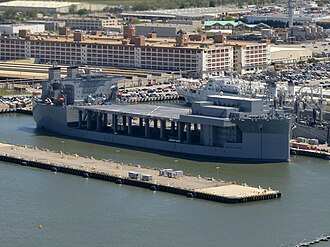
USS Hector A. Cafferata Jr. (ESB-8): The U.S. Navy’s Next Expeditionary Sea Base Honoring a Korean War Hero
Modern naval warfare is no longer defined solely by aircraft carriers, destroyers, and submarines. Today’s military operations demand flexibility, rapid deployment, and the ability to sustain forces far from established bases. To meet these challenges, the United States Navy has invested heavily in expeditionary support vessels capable of operating wherever they are needed. Among the newest additions to this growing fleet is USS (future USNS) Hector A. Cafferata Jr. (ESB-8), a Lewis B. Puller-class Expeditionary Sea Base (ESB) named in honor of one of the most courageous Marines in American history. Although the vessel was still progressing through construction and sea trials before entering operational service, it already represents the culmination of years of innovation in naval logistics and expeditionary warfare. More than simply another support ship, ESB-8 symbolizes the Navy’s continued transition toward distributed maritime operations, where mobility, adaptability, and endurance are just as important as firepower.
The Hero Behind the Ship’s Name
Every U.S. Navy vessel carries a story, and ESB-8 bears the name of Marine Corps Private First Class Hector A. Cafferata Jr., a Medal of Honor recipient whose bravery during the Korean War has become legendary. During the Battle of Chosin Reservoir in November 1950, Cafferata found himself defending his position against overwhelming Chinese forces after many of his fellow Marines had been killed or wounded. Despite suffering severe injuries, he repeatedly exposed himself to enemy fire while protecting his comrades, reportedly killing or wounding dozens of attackers and helping prevent his unit from being overrun. For these extraordinary actions, he received the Medal of Honor, becoming one of the most celebrated Marines of the Korean War. The Navy officially announced in 2023 that the sixth and final Expeditionary Sea Base in the Lewis B. Puller class would carry his name, ensuring that future generations of sailors and Marines would remember his courage and sacrifice.
What Is an Expeditionary Sea Base?
Unlike traditional warships designed primarily for combat, Expeditionary Sea Bases function as enormous floating support platforms capable of enabling a wide variety of military operations. The concept emerged from the realization that modern conflicts often occur in regions lacking friendly ports or permanent infrastructure. Rather than relying entirely on land bases, the Navy can position an ESB offshore, creating a mobile logistics hub that supports helicopters, special operations forces, unmanned systems, mine countermeasure units, humanitarian missions, and maritime security operations.
The Lewis B. Puller class evolved from the Expeditionary Transfer Dock design but incorporates significant modifications that transform the ships into true floating bases. Their expansive flight deck, large mission spaces, extensive fuel storage, maintenance facilities, command-and-control systems, and accommodations allow them to remain deployed for extended periods while supporting multiple mission types simultaneously. This flexibility has made previous ESBs valuable assets in regions such as the Middle East, where they have supported special operations forces, mine countermeasure activities, and maritime security patrols. ESB-8 continues this successful design philosophy while benefiting from years of operational experience gathered from earlier ships in the class.
Construction and Development
Construction of the future USNS Hector A. Cafferata Jr. officially began in August 2023 at General Dynamics NASSCO’s shipyard in San Diego, California, one of America’s leading naval shipbuilders. The ceremonial first steel cutting marked the beginning of a complex construction process involving thousands of workers, engineers, and suppliers responsible for assembling one of the Navy’s largest auxiliary vessels. Less than a year later, in April 2024, the keel was authenticated during a traditional ceremony symbolizing the formal birth of the ship. The event honored both naval tradition and the Marine whose name the vessel would carry.
Construction continued steadily through 2024 and 2025 before reaching another major milestone in March 2026, when the vessel was officially christened. During the ceremony, members of the Cafferata family participated as sponsors, preserving a longstanding naval tradition by breaking a ceremonial bottle across the ship’s bow. The christening also marked the completion of the Expeditionary Sea Base production program, making ESB-8 the sixth and final ship of its class.
Design Features That Set ESB-8 Apart
A Massive Mobile Base at Sea
At first glance, the ship’s appearance differs dramatically from that of conventional naval vessels. Instead of emphasizing speed or heavy armament, the design prioritizes space, stability, and versatility. Measuring approximately 785 feet (239 meters) in length and displacing roughly 90,000 tons when fully loaded, ESB-8 is among the largest vessels operated in support of the U.S. Navy. Its wide beam provides exceptional stability even in rough seas, creating a safe operating environment for helicopters and other aviation assets.
The enormous flight deck serves as the ship’s defining feature. Multiple helicopters can operate simultaneously, allowing rapid transportation of personnel, equipment, medical supplies, and special operations teams. Hangar facilities permit aircraft maintenance while underway, greatly extending operational endurance.
Flexible Mission Spaces
Beneath the flight deck lies an expansive mission area capable of supporting a remarkable variety of military activities. Rather than being permanently configured for one specific mission, the spaces can be adapted to accommodate different equipment packages depending on operational requirements. This modular approach allows commanders to tailor the ship for disaster relief, maritime security, mine countermeasures, unmanned system operations, or special forces support without requiring extensive structural modifications.
Long-Term Deployment Capability
Another major advantage is endurance. Expeditionary Sea Bases are designed to remain deployed for lengthy periods, minimizing the need for frequent port visits. Extensive fuel capacity, repair facilities, storage areas, and accommodations enable sustained operations in remote regions where shore infrastructure may be unavailable or politically inaccessible. This capability significantly expands the Navy’s operational reach while reducing dependence on foreign ports.
Operational Roles
Supporting Special Operations Forces
One of the ship’s primary missions involves supporting special operations units. Helicopters can launch directly from the vessel while command centers coordinate complex missions over large geographic areas. Small boats may also deploy from the ship to insert personnel into coastal environments where conventional warships cannot operate effectively.
Mine Countermeasure Operations
Naval mines remain a significant threat in many strategically important waterways. Expeditionary Sea Bases provide an ideal platform for mine countermeasure helicopters, unmanned underwater vehicles, and explosive ordnance disposal teams tasked with locating and neutralizing these hazards. By serving as an offshore support hub, ESBs reduce reliance on nearby ports while increasing operational flexibility.
Humanitarian Assistance and Disaster Relief
Military capability is only one aspect of the ESB’s mission profile. Following natural disasters, ports and airports are often damaged or destroyed, making relief operations extremely difficult. An Expeditionary Sea Base can arrive offshore carrying helicopters, medical teams, engineers, heavy equipment, fuel, food, and emergency supplies. Its large flight deck and extensive storage capacity enable continuous humanitarian operations until permanent infrastructure is restored.
Maritime Security Operations
In areas affected by piracy, smuggling, or regional instability, ESB-8 can support multinational maritime security operations by serving as a floating headquarters. Its command-and-control facilities allow coordination between naval forces, coast guards, and allied partners operating across vast maritime regions.
Strategic Importance in Modern Naval Warfare
The emergence of Expeditionary Sea Bases reflects a broader transformation in naval strategy. Rather than concentrating all capabilities aboard a handful of large combatants, the U.S. Navy increasingly emphasizes distributed maritime operations in which numerous specialized vessels work together across wide areas. In this environment, logistics becomes as important as combat power. Aircraft require fuel, helicopters require maintenance, special forces require staging areas, and unmanned systems require support facilities. ESB-8 exists precisely to provide these capabilities wherever they are needed.
This flexibility is particularly valuable in the Indo-Pacific region, where enormous distances separate friendly ports and where access to land bases cannot always be guaranteed. By operating as a mobile sea base, ESB-8 allows military forces to remain agile, reducing vulnerability while extending operational endurance across contested waters.
The Final Ship of an Innovative Class
Being the sixth and final vessel of the Lewis B. Puller class gives Hector A. Cafferata Jr. a unique place in U.S. naval history. Rather than serving as a prototype, it represents the culmination of years of operational experience and engineering improvements gained from earlier ships. Lessons learned throughout the program have helped refine construction techniques, mission capabilities, and onboard systems, ensuring that ESB-8 enters service as the most mature version of the class.
Its completion also closes an important chapter in one of the Navy’s most innovative auxiliary shipbuilding programs. While future expeditionary support vessels may eventually incorporate new technologies or different designs, the Lewis B. Puller class has already demonstrated the tremendous value of flexible sea-based logistics in both combat and humanitarian operations.
Conclusion
USS (future USNS) Hector A. Cafferata Jr. (ESB-8) represents far more than another support vessel entering the U.S. Navy. It embodies a new philosophy of naval operations in which mobility, adaptability, and logistics form the foundation of global maritime power. Named after a Marine whose extraordinary courage inspired generations, the ship carries forward a legacy of determination while providing cutting-edge capabilities for twenty-first-century military operations. Whether supporting special operations forces, clearing naval mines, delivering humanitarian assistance, or serving as a floating command center, ESB-8 will play an essential role in extending American naval presence across the world’s oceans. As the final member of the Lewis B. Puller-class Expeditionary Sea Base program, it stands as both a tribute to past heroism and a powerful investment in the future of expeditionary warfare.
Technical Specifications
| Specification | Details |
|---|---|
| Ship Name | USS (future USNS) Hector A. Cafferata Jr. (ESB-8) |
| Class | Lewis B. Puller-class Expeditionary Sea Base |
| Hull Number | ESB-8 |
| Builder | General Dynamics NASSCO, San Diego |
| Ordered | 2022 |
| Construction Began | August 2023 |
| Keel Laid | April 25, 2024 |
| Christened | March 7, 2026 |
| Length | Approximately 785 ft (239 m) |
| Beam | Approximately 164 ft (50 m) |
| Full-Load Displacement | Approximately 90,000 tons |
| Draft | About 34.4 ft (10.5 m) |
| Propulsion | Commercial diesel-electric system |
| Maximum Speed | Approximately 15 knots |
| Range | About 9,500 nautical miles |
| Crew | Around 34 civilian mariners plus mission personnel (up to approximately 250 military personnel depending on assignment) |
| Flight Deck | Four helicopter landing spots with hangar facilities |
| Primary Missions | Special operations support, mine countermeasures, aviation support, humanitarian assistance, logistics, maritime security, command and control |
_at_Naval_Station_Norfolk_on_20_April_2016.JPG)