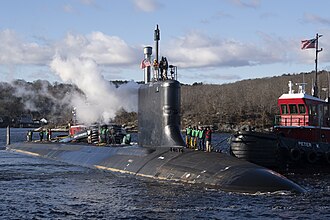
USS Iowa (SSN-797): A New Generation of Silent Strength Beneath the Waves
Few military platforms command as much respect while remaining almost entirely invisible as a nuclear-powered attack submarine. Operating silently beneath the surface for months at a time, these vessels represent the cutting edge of naval technology and serve as one of the most effective instruments of deterrence, intelligence gathering, and precision strike capability. Among the newest additions to the United States Navy’s undersea fleet is USS Iowa (SSN-797), a Virginia-class fast-attack submarine that combines decades of engineering experience with advanced combat systems, exceptional stealth, and virtually unlimited operational endurance. Although it bears the name of a state best known for its fertile farmland rather than its coastline, USS Iowa continues a proud naval tradition while demonstrating how every corner of the United States contributes to the nation’s maritime security.
As strategic competition increasingly shifts toward the world’s oceans, attack submarines have become even more important than during the Cold War. Their ability to monitor adversaries without detection, escort carrier strike groups, strike land targets with precision-guided missiles, support special operations forces, and hunt hostile submarines makes them indispensable assets in both peacetime and conflict. USS Iowa enters service during an era of rapidly evolving technology and changing geopolitical realities, ensuring that it will play a significant role in protecting American interests for decades to come.
Continuing the Legacy of the Name Iowa
USS Iowa (SSN-797) is the fourth U.S. Navy vessel to carry the name of the Hawkeye State, following a distinguished line of predecessors that served across more than a century of naval history. The most famous was undoubtedly the battleship USS Iowa (BB-61), commissioned during World War II and later becoming one of the most recognizable warships ever built. That legendary battleship participated in the Pacific campaign, the Korean War, the Cold War, and even returned to active service during the 1980s before eventually becoming a museum ship.
By assigning the name Iowa to a Virginia-class attack submarine, the Navy connects two very different eras of naval warfare. While the massive battleship relied on armor and enormous guns to dominate the seas, the modern submarine depends on stealth, sophisticated sensors, precision weapons, and advanced computing systems. Both ships, however, share the same mission of protecting American interests while representing the technological excellence of their respective generations.
For the people of Iowa, the submarine symbolizes a lasting relationship between the state and the U.S. Navy. Throughout the construction and commissioning process, civic leaders, veterans, schools, and community organizations participated in ceremonies that strengthened this connection and highlighted the national importance of the submarine force.
Construction and Development
Building at General Dynamics Electric Boat
USS Iowa was constructed by General Dynamics Electric Boat, the historic Connecticut-based shipbuilder that has produced many of America’s most advanced submarines for more than a century. Construction also involved extensive collaboration with HII Newport News Shipbuilding, reflecting the highly integrated industrial base responsible for producing the Virginia-class fleet.
Building a nuclear-powered submarine ranks among the most demanding engineering projects undertaken anywhere in the world. Every pressure hull section, reactor component, electrical system, sonar array, propulsion element, and combat system must be manufactured and assembled to exceptionally strict standards. Even minor imperfections could affect safety, reliability, or stealth, requiring extensive inspections throughout every stage of construction.
Thousands of highly trained workers contributed to the submarine’s assembly, including naval architects, engineers, welders, electricians, pipefitters, software specialists, and quality-control experts. Their combined expertise produced a vessel capable of operating safely in one of the most challenging environments on Earth.
Christening and Commissioning
USS Iowa was christened in June 2023 during a ceremony celebrating both the submarine and the naval heritage associated with its name. Following extensive sea trials and operational evaluations, the submarine was officially commissioned on April 6, 2024, becoming an active member of the United States Navy. Commissioning marked the transition from construction to operational service and formally placed the submarine under the command of its first commanding officer and crew.
Following commissioning, USS Iowa continued training, certification, and readiness exercises before preparing for future deployments that could take it to virtually any ocean in the world.
The Virginia-Class: Designed for Modern Warfare
USS Iowa belongs to the Virginia class, the U.S. Navy’s premier fast-attack submarine design and the successor to the highly successful Los Angeles class. Since entering service in the early twenty-first century, Virginia-class submarines have become the backbone of America’s attack submarine fleet thanks to their versatility, advanced technology, and adaptability.
Unlike submarines developed primarily for Cold War anti-submarine warfare, the Virginia class was designed from the outset to perform a broad spectrum of missions. These include anti-submarine warfare, anti-surface warfare, land attack, intelligence gathering, surveillance, reconnaissance, mine warfare, support for special operations forces, and protection of carrier strike groups. This flexibility enables commanders to deploy a single submarine across a wide variety of operational scenarios without sacrificing effectiveness.
USS Iowa is part of the Block IV production series, which introduced engineering improvements intended to reduce maintenance requirements while increasing the number of deployments each submarine can complete during its operational lifetime. These refinements enhance fleet readiness while lowering long-term operating costs.
Nuclear Propulsion and Exceptional Endurance
A Reactor Built for Life
At the heart of USS Iowa lies the S9G nuclear reactor, one of the most advanced naval propulsion systems ever developed. Unlike conventional submarines that depend on diesel engines and batteries, a nuclear-powered submarine can remain submerged almost indefinitely without requiring atmospheric oxygen.
The reactor generates heat that produces steam, driving turbines connected to the propulsion system and electrical generators. Remarkably, the reactor core is designed to last for the submarine’s entire planned service life of more than three decades without requiring refueling. This eliminates one of the most time-consuming maintenance tasks traditionally associated with nuclear-powered vessels.
Because fuel is effectively unlimited, the submarine’s operational endurance depends primarily on food supplies and crew sustainability rather than propulsion requirements. This capability allows USS Iowa to remain deployed for months while operating thousands of miles from friendly ports.
Silent Propulsion
Stealth remains the defining characteristic of every attack submarine, and the Virginia class incorporates numerous innovations to minimize acoustic signatures. USS Iowa uses a pump-jet propulsor instead of a traditional propeller, reducing cavitation and underwater noise while improving efficiency across a broad range of speeds.
Additional noise reduction measures include vibration isolation, precision machinery mounting, advanced hull coatings, carefully designed internal systems, and computerized monitoring that minimizes unnecessary mechanical activity. Collectively, these features make USS Iowa exceptionally difficult to detect using modern sonar systems.
Combat Systems and Weapons
Advanced Sonar Technology
The submarine’s sophisticated sonar suite provides comprehensive underwater awareness by integrating multiple passive and active sonar arrays. These systems continuously analyze sounds produced by ships, submarines, marine life, and environmental conditions, allowing operators to identify and track contacts over considerable distances.
High-speed data processing enables rapid threat evaluation while maintaining the stealth that defines submarine operations.
Tomahawk Cruise Missiles
USS Iowa is capable of launching Tomahawk Land Attack Missiles, giving commanders the ability to conduct highly accurate strikes against targets located hundreds of miles inland. These precision-guided weapons have proven their effectiveness during numerous military operations and allow submarines to influence events far beyond the maritime domain.
Launching cruise missiles from an undetected submarine provides considerable tactical flexibility while complicating an adversary’s defensive planning.
Mk 48 Heavyweight Torpedoes
The submarine also carries Mk 48 Advanced Capability (ADCAP) heavyweight torpedoes, designed to engage both enemy submarines and surface warships. These sophisticated weapons employ advanced guidance systems, powerful propulsion, and highly effective warheads capable of neutralizing even heavily defended naval targets.
The combination of torpedoes and cruise missiles enables USS Iowa to respond effectively across a wide range of operational scenarios.
Intelligence, Surveillance, and Reconnaissance
One of USS Iowa‘s most important missions involves gathering intelligence in regions where other military assets may face significant risks. By operating quietly beneath the ocean’s surface, the submarine can monitor naval movements, observe military exercises, collect electronic intelligence, and track foreign submarines without revealing its presence.
This intelligence contributes directly to national decision-making by providing military planners with timely information about developing situations around the world. Although these operations rarely receive public attention, they represent one of the most valuable contributions made by the modern submarine force.
Because many submarine missions remain classified for decades, much of USS Iowa‘s operational history will likely remain unknown until long after its service has concluded.
Supporting Special Operations Forces
Virginia-class submarines are also designed to support special operations missions requiring exceptional secrecy. USS Iowa can deploy specially trained personnel, divers, and specialized equipment while remaining concealed beneath the surface.
These capabilities support missions ranging from reconnaissance and intelligence collection to coastal surveillance and personnel recovery. The submarine’s ability to approach hostile coastlines without detection provides unique operational options unavailable to most other naval platforms.
As global security challenges increasingly involve irregular warfare and precision operations, this flexibility has become even more valuable.
Life Aboard USS Iowa
Serving aboard a fast-attack submarine requires extraordinary discipline, technical expertise, and teamwork. The crew lives in a highly confined environment where every available space must be carefully utilized for equipment, supplies, and operational systems.
Submariners rotate through demanding watch schedules while maintaining propulsion systems, combat equipment, communications, navigation, and life-support systems around the clock. Extensive training ensures that every crew member understands multiple areas of responsibility, creating resilience during extended deployments.
Although deployments can last several months without direct contact with family members, submarine crews develop exceptionally strong bonds built on trust, professionalism, and shared responsibility. This unique culture has long distinguished the Silent Service from every other branch of naval operations.
Strategic Importance in an Era of Great-Power Competition
The return of strategic competition among major naval powers has significantly increased the importance of nuclear-powered attack submarines. Large ocean regions such as the Indo-Pacific require platforms capable of operating independently across vast distances while remaining extremely difficult to detect.
USS Iowa is ideally suited for these challenges. Its combination of stealth, endurance, intelligence capabilities, advanced sensors, and precision weapons allows it to deter aggression, reassure allies, protect sea lanes, and maintain undersea superiority in strategically vital regions.
Whether shadowing foreign submarines, protecting carrier strike groups, gathering intelligence, or preparing for potential combat operations, the submarine contributes directly to maintaining regional stability while preserving freedom of navigation.
Looking Toward the Future
USS Iowa is expected to remain in service well into the 2050s, during which time it will receive periodic modernization upgrades incorporating improved software, communications systems, sensors, electronic warfare capabilities, and next-generation weapons. The Virginia-class design was intentionally developed with sufficient flexibility to accommodate evolving technologies throughout its lengthy operational life.
While future submarine programs such as the SSN(X) are already under development, the Virginia class will remain the backbone of America’s attack submarine fleet for decades. USS Iowa therefore represents not only today’s technological achievements but also a long-term investment in maintaining undersea dominance in an increasingly complex strategic environment.
Conclusion
USS Iowa (SSN-797) represents the latest chapter in a proud naval tradition associated with one of the most recognizable names in American maritime history. Although dramatically different from the famous battleship that previously carried the name, the modern submarine reflects the same commitment to technological excellence, operational readiness, and national defense.
With its advanced nuclear propulsion system, world-class stealth, sophisticated sonar, versatile weapons, and exceptional operational flexibility, USS Iowa is prepared to perform some of the Navy’s most demanding missions beneath the world’s oceans. Whether collecting intelligence, supporting special operations, deterring adversaries, protecting carrier strike groups, or conducting precision strikes, it exemplifies the capabilities that define modern undersea warfare. As global maritime competition continues to evolve, USS Iowa will remain a vital component of the United States Navy’s undersea force for many years to come.
Technical Specifications
| Specification | Details |
|---|---|
| Ship Name | USS Iowa (SSN-797) |
| Class | Virginia-class fast-attack submarine (Block IV) |
| Hull Number | SSN-797 |
| Builder | General Dynamics Electric Boat |
| Construction Partner | HII Newport News Shipbuilding |
| Keel Laid | August 20, 2019 |
| Launched | November 5, 2022 |
| Christened | June 17, 2023 |
| Commissioned | April 6, 2024 |
| Length | 377 ft (115 m) |
| Beam | 34 ft (10.4 m) |
| Draft | Approximately 32 ft (9.8 m) |
| Displacement | Approximately 7,800 tons submerged |
| Propulsion | One S9G nuclear reactor, steam turbines, pump-jet propulsor |
| Speed | Over 25 knots submerged |
| Operating Depth | Classified |
| Crew | Approximately 135 officers and enlisted personnel |
| Armament | Mk 48 ADCAP torpedoes, Tomahawk cruise missiles, naval mines |
| Primary Missions | Anti-submarine warfare, anti-surface warfare, intelligence gathering, surveillance, land attack, special operations support |
| Reactor Life | Approximately 33 years without refueling |
| Expected Service Life | More than 30 years |
_delivery.jpg)