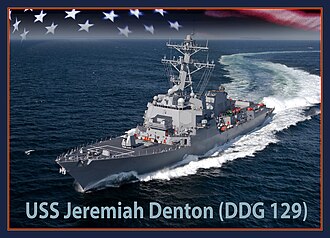
USS Jeremiah Denton (DDG-129): Honoring an American Hero Through the Next Generation of Naval Power
The United States Navy has always recognized extraordinary service by naming its ships after individuals whose courage, sacrifice, and leadership left a lasting impact on the nation. Among the newest vessels to carry such a legacy into the future is USS Jeremiah Denton (DDG-129), an Arleigh Burke-class guided-missile destroyer that commemorates one of the most remarkable figures in modern American military history. Combining advanced radar systems, powerful missile defenses, anti-submarine capabilities, and network-centric warfare technologies, the destroyer represents the continuing evolution of one of the world’s most successful surface combatant designs. While its namesake became famous for displaying extraordinary resilience during years of captivity in North Vietnam, the ship that bears his name is preparing to serve as a symbol of endurance, innovation, and American naval strength well into the middle of the twenty-first century.
As geopolitical competition increasingly shifts toward the world’s oceans, guided-missile destroyers remain among the most versatile and heavily employed ships in the U.S. Navy. They protect aircraft carriers, defend against ballistic missiles, hunt submarines, engage hostile surface vessels, conduct precision land strikes, escort merchant shipping, participate in humanitarian operations, and operate alongside allied navies across every major maritime region. USS Jeremiah Denton continues this tradition while benefiting from decades of technological improvements incorporated into the latest Flight III variant of the Arleigh Burke class.
The Extraordinary Man Behind the Name
Unlike many naval vessels named after admirals or famous battles, USS Jeremiah Denton honors an individual whose legacy extends far beyond traditional military leadership. Admiral Jeremiah Andrew Denton Jr. was born in 1924 and graduated from the United States Naval Academy before serving as a naval aviator. During the Vietnam War, then-Commander Denton flew combat missions over North Vietnam until his aircraft was shot down in July 1965.
Captured by North Vietnamese forces, Denton endured nearly eight years as a prisoner of war under extremely harsh conditions. During his captivity, he became internationally recognized for an extraordinary act of courage during a televised propaganda interview in 1966. While appearing to answer questions from his captors, Denton deliberately blinked the word “TORTURE” in Morse code, secretly informing U.S. intelligence that American prisoners were being abused. The message became one of the most famous acts of resistance in military history and demonstrated remarkable composure under unimaginable pressure.
Following his release during Operation Homecoming in 1973, Denton continued serving in the Navy, eventually retiring with the rank of rear admiral. He later entered public service as a United States senator representing Alabama while remaining a respected advocate for military personnel and former prisoners of war. Naming DDG-129 in his honor ensures that future generations of sailors remember both his military service and his extraordinary personal courage.
The Arleigh Burke Legacy
USS Jeremiah Denton belongs to the legendary Arleigh Burke class, one of the most successful destroyer programs ever undertaken. Since the commissioning of USS Arleigh Burke (DDG-51) in 1991, the class has continuously evolved to address emerging threats while maintaining exceptional flexibility across a broad spectrum of missions.
Unlike specialized warships optimized for only one role, Arleigh Burke-class destroyers perform virtually every major surface combat mission. They defend carrier strike groups against aircraft and missiles, intercept ballistic missile threats, hunt hostile submarines, engage enemy warships, conduct long-range land attacks using cruise missiles, enforce maritime security, escort convoys, participate in humanitarian assistance missions, and integrate seamlessly with joint and allied forces.
The longevity of the Arleigh Burke design reflects its adaptability. Continuous modernization has allowed successive flights of the class to incorporate increasingly sophisticated sensors, computing systems, communications equipment, and weapons without requiring an entirely new hull design. USS Jeremiah Denton, as a Flight III destroyer, represents the most advanced version of this highly successful platform.
Construction and Development
Built by General Dynamics Bath Iron Works
Construction of USS Jeremiah Denton is taking place at General Dynamics Bath Iron Works in Bath, Maine, one of America’s premier naval shipbuilders. For generations, Bath Iron Works has produced many of the Navy’s most capable surface combatants, earning a reputation for precision craftsmanship and engineering excellence.
Building a modern guided-missile destroyer requires extraordinary coordination among thousands of workers representing dozens of technical disciplines. Naval architects, structural engineers, electricians, pipefitters, welders, systems integrators, software specialists, and quality-control inspectors collaborate throughout a multi-year construction process to assemble millions of individual components into a fully operational warship.
The ship’s modular construction approach allows large sections of the vessel to be fabricated separately before being joined together in dry dock. This method improves construction efficiency while maintaining the exceptionally high quality standards required for frontline naval combatants.
From Keel Laying to Commissioning
Following contract award and initial fabrication, USS Jeremiah Denton progressed through keel laying, hull assembly, systems installation, outfitting, dock trials, sea trials, and acceptance testing. Each stage involves extensive inspections and evaluations to verify that propulsion systems, combat equipment, sensors, communications, navigation systems, and damage-control capabilities meet demanding Navy requirements before the ship joins the fleet.
Once commissioned, DDG-129 will become an active unit of the U.S. Navy, beginning decades of operational service that may extend well beyond the middle of this century.
Flight III: A New Standard for Destroyers
SPY-6 Air and Missile Defense Radar
Perhaps the most significant advancement aboard USS Jeremiah Denton is the incorporation of the AN/SPY-6(V)1 Air and Missile Defense Radar, one of the most capable naval radar systems ever developed. This advanced active electronically scanned array radar dramatically improves the ship’s ability to detect, track, and engage aircraft, cruise missiles, ballistic missiles, and other aerial threats.
Compared with earlier radar systems, SPY-6 offers substantially greater sensitivity, enabling it to detect smaller and more distant targets while simultaneously tracking significantly larger numbers of objects. These capabilities are increasingly important as potential adversaries field more sophisticated missile systems, hypersonic weapons, and complex coordinated attacks.
The Aegis Combat System
The destroyer’s radar works in conjunction with the renowned Aegis Combat System, integrating sensors, weapons, and command networks into a unified defensive architecture. Advanced computers continuously analyze incoming data, prioritize threats, recommend engagement options, and coordinate defensive responses in fractions of a second.
This high degree of automation enables the ship to respond rapidly to fast-moving threats while coordinating with other ships, aircraft, satellites, and allied forces participating in the same operation.
Firepower and Weapons Systems
USS Jeremiah Denton possesses one of the most versatile weapons inventories carried by any surface combatant.
Vertical Launch System
At the center of the ship’s offensive and defensive capability is the Mk 41 Vertical Launch System (VLS), consisting of 96 missile cells capable of carrying multiple weapon types depending on mission requirements. This flexibility allows commanders to tailor the ship’s missile loadout for specific operational needs.
The VLS can launch Standard Missiles for fleet air defense and ballistic missile interception, Tomahawk cruise missiles for precision land attack, Vertical Launch Anti-Submarine Rockets (ASROC), and Evolved Sea Sparrow Missiles for point defense against incoming aircraft and missiles.
Naval Gun and Close-In Defense
Supporting the missile battery is a 5-inch (127 mm) Mk 45 naval gun capable of engaging surface targets, coastal installations, and aerial threats while also providing naval gunfire support during amphibious operations.
For close-range defense, the destroyer employs the Phalanx Close-In Weapon System (CIWS), a radar-guided rapid-fire weapon designed to intercept incoming missiles that penetrate outer defensive layers. Additional protection comes from electronic warfare systems, decoys, and countermeasures intended to confuse or divert enemy weapons.
Anti-Submarine and Anti-Surface Warfare
Although destroyers are often associated with air defense, anti-submarine warfare remains one of their most important missions. USS Jeremiah Denton carries advanced hull-mounted sonar, a towed sonar array, and sophisticated underwater combat systems capable of detecting and tracking submarines operating at considerable distances.
The destroyer also operates MH-60R Seahawk helicopters equipped with dipping sonar, sonobuoys, torpedoes, and surveillance equipment. These helicopters significantly extend the ship’s ability to locate and engage underwater threats beyond the range of onboard sensors.
Against surface targets, the destroyer combines missiles, naval gunfire, helicopters, and sophisticated targeting systems to engage hostile warships or asymmetric threats such as fast attack craft.
Ballistic Missile Defense
One of the defining missions of modern Flight III destroyers is ballistic missile defense. USS Jeremiah Denton can integrate into the Navy’s broader missile defense architecture, helping protect military forces, allied nations, and critical infrastructure from short-, medium-, and intermediate-range ballistic missiles.
By combining SPY-6 radar with advanced Standard Missile interceptors, the ship can detect, track, and engage ballistic missile threats during various phases of flight. This capability has become increasingly important as missile proliferation continues across multiple regions.
Life Aboard the Destroyer
Operating one of the Navy’s most advanced warships requires a highly trained crew consisting of approximately 330 officers and enlisted sailors. Life aboard a guided-missile destroyer demands technical expertise, discipline, and teamwork as personnel maintain propulsion systems, combat equipment, radar arrays, communications networks, electrical systems, and damage-control readiness around the clock.
Modern accommodations offer improvements over earlier generations of destroyers, but life at sea remains challenging. Long deployments, continuous watch rotations, and demanding operational schedules require resilience and professionalism. Despite these challenges, crews develop strong bonds through shared responsibility and extensive training, creating cohesive teams capable of responding effectively under pressure.
Strategic Importance in the Twenty-First Century
The global security environment continues to evolve as emerging technologies reshape naval warfare. Hypersonic weapons, advanced submarines, long-range precision missiles, unmanned systems, cyber operations, and electronic warfare all present new challenges for modern fleets.
USS Jeremiah Denton is specifically designed to address many of these threats. Its advanced sensors, integrated combat systems, powerful missile battery, and networked communications allow it to operate as part of distributed naval forces across contested maritime regions.
Whether deployed in the Atlantic, Pacific, Mediterranean, or Middle East, the destroyer will contribute to deterrence, freedom of navigation, alliance commitments, humanitarian assistance, maritime security, and crisis response operations. Its versatility ensures that commanders can employ it across an exceptionally wide range of missions without significant modification.
Looking Toward the Future
USS Jeremiah Denton is expected to remain in service for approximately 35 to 40 years. Throughout that time, periodic modernization programs will introduce upgraded software, improved electronic warfare systems, enhanced communications, new missile variants, and evolving combat capabilities designed to counter emerging threats.
The flexibility built into the Flight III design ensures that the destroyer can continue adapting as technology evolves. This long-term adaptability has been one of the defining strengths of the Arleigh Burke class and remains a key reason the Navy continues building new ships based on this proven platform.
Conclusion
USS Jeremiah Denton (DDG-129) represents both a tribute to extraordinary personal courage and a powerful example of modern American naval capability. Named after a naval aviator whose resilience under captivity inspired an entire nation, the destroyer carries forward a legacy of service, honor, and determination.
At the same time, its advanced Flight III design demonstrates how the U.S. Navy continues preparing for future maritime challenges through constant technological innovation. Equipped with the SPY-6 radar, the Aegis Combat System, a versatile missile battery, sophisticated anti-submarine capabilities, and integrated command-and-control systems, USS Jeremiah Denton is prepared to protect American interests across the world’s oceans for decades to come. As one of the newest members of the Arleigh Burke family, it stands as both a memorial to an American hero and a cornerstone of the Navy’s future surface fleet.
Technical Specifications
| Specification | Details |
|---|---|
| Ship Name | USS Jeremiah Denton (DDG-129) |
| Class | Arleigh Burke-class guided-missile destroyer |
| Flight | Flight III |
| Hull Number | DDG-129 |
| Builder | General Dynamics Bath Iron Works, Bath, Maine |
| Ordered | Fiscal Year 2023 procurement |
| Keel Laid | 2025 (construction phase) |
| Status | Under construction |
| Length | 509.5 ft (155.3 m) |
| Beam | 66 ft (20.1 m) |
| Draft | Approximately 31 ft (9.4 m) |
| Full-Load Displacement | Approximately 9,700–9,900 tons |
| Propulsion | 4 × General Electric LM2500 gas turbines, 2 shafts |
| Power Output | 100,000 shp (75 MW) |
| Maximum Speed | More than 30 knots (56+ km/h) |
| Range | Approximately 4,400 nautical miles at 20 knots |
| Crew | Approximately 330 officers and enlisted personnel |
| Radar | AN/SPY-6(V)1 Air and Missile Defense Radar |
| Combat System | Aegis Combat System Baseline 10 |
| Vertical Launch System | 96-cell Mk 41 VLS |
| Main Gun | 1 × 5-inch (127 mm) Mk 45 Mod 4 naval gun |
| Close-In Defense | Phalanx CIWS, electronic warfare systems, decoys |
| Aviation Facilities | Flight deck and hangar for 2 × MH-60R Seahawk helicopters |
| Primary Missions | Air defense, ballistic missile defense, anti-submarine warfare, anti-surface warfare, land attack, maritime security, escort operations |
| Expected Service Life | Approximately 35–40 years |
_artist_depiction.jpg)