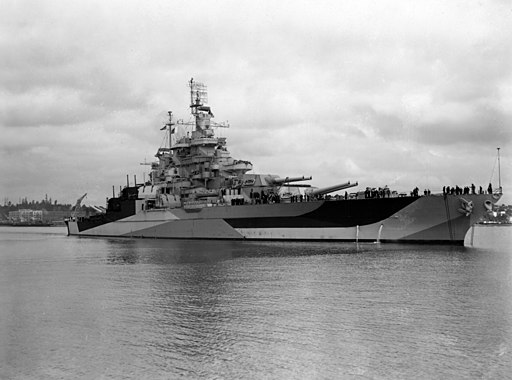
USS West Virginia (BB-48)
USS West Virginia (BB-48), a Colorado-class battleship, played a significant role in the United States Navy during World War II. Commissioned in 1923, the ship participated in various naval exercises and maneuvers before finding itself at the heart of the Pearl Harbor attack on December 7, 1941. Suffering extensive damage during the assault, including multiple torpedo hits and bomb strikes, USS West Virginia eventually sank to the harbor bottom. However, the vessel was salvaged, repaired, and modernized in the following years, returning to active duty in the Pacific Theater.
Rejoining the fight, USS West Virginia made significant contributions to Allied victories in the Pacific, participating in crucial battles such as the Battle of Leyte Gulf and the Okinawa Campaign. Renowned for its resilience and firepower, the battleship became a symbol of American strength and determination in the face of adversity. After the war, USS West Virginia was decommissioned and eventually sold for scrap in 1959, but its legacy lives on as a testament to the bravery of its crew and the enduring spirit of the United States Navy.
Armament of USS West Virginia (BB-48)
USS West Virginia (BB-48), a Colorado-class battleship, was armed with a formidable array of guns and weaponry, providing significant offensive and defensive capabilities. Here is a list of its main armament:
- Eight 16-inch/45 caliber Mark 1 guns: These were the battleship’s primary armament, housed in four twin-gun turrets (two forward and two aft). Each gun was capable of firing high-explosive or armor-piercing shells at long ranges with devastating impact.
- Twelve 5-inch/51 caliber guns: The secondary battery consisted of dual-purpose guns, used for both anti-ship and anti-aircraft defense. These guns were mounted in six twin-gun turrets, with three turrets positioned on each side of the superstructure.
- Eight 3-inch/50 caliber guns: These guns were primarily used for close-range anti-aircraft defense. They were mounted in four twin-gun mounts, with two mounts positioned on each side of the ship.
- Two 21-inch (533 mm) torpedo tubes: USS West Virginia was equipped with torpedo tubes for launching torpedoes, providing an additional offensive capability against enemy vessels.
The armament of USS West Virginia represented a balance between firepower and versatility, allowing the battleship to engage enemy surface vessels, aircraft, and shore installations effectively during its service.
Dimensions of USS West Virginia (BB-48)
USS West Virginia (BB-48), a Colorado-class battleship, had the following dimensions:
- Length: 624 feet 3 inches (190.2 meters)
- Beam (width): 97 feet 5 inches (29.7 meters)
- Draft (maximum depth of ship below waterline): 30 feet 6 inches (9.3 meters)
- Displacement (full load): Approximately 32,600 long tons (33,100 metric tons)
- Height (from keel to masthead): Approximately 120 feet (36.6 meters)
These dimensions provided USS West Virginia with a substantial size and presence, making it one of the significant battleships of its era. Its length and beam accommodated its armament and facilities while ensuring stability and maneuverability in various sea conditions. The battleship’s draft allowed it to navigate coastal areas and open ocean environments effectively, contributing to its versatility in naval operations. Overall, USS West Virginia’s dimensions played a crucial role in shaping its performance and effectiveness as a naval vessel during its service.
