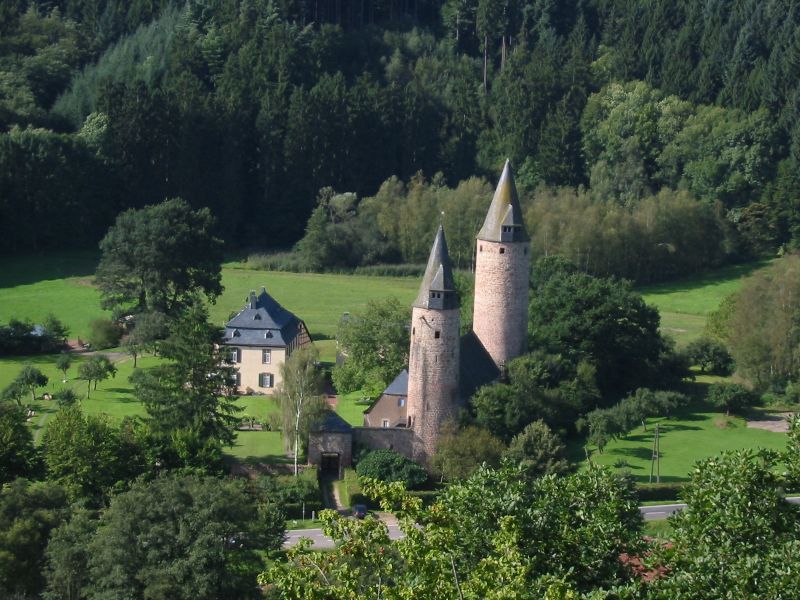
Nestled in the quiet surroundings of the Eifel region in Germany lies the historic water-castle known as Wasserburg Bruch. This remarkable structure stands near the village of Bruch (Eifel) in the district of Bernkastel‑Wittlich, Rhineland-Palatinate. The castle is not only an architectural gem but also a witness to centuries of regional history, shifting allegiances and changing functions.
Location and Setting
The castle occupies a low-lying position – a “Niederungsburg” – in the landscape, in the little valley carved by the river Salm in the Eifel highlands. It sits at roughly 190 metres above sea level. Bruch itself lies about ten kilometres west of the larger town of Wittlich and is part of the Verbandsgemeinde Wittlich-Land.
The setting is characterised by dense forested slopes, streams and the modest valley that hosts the castle’s water features. In earlier times, these water features would have played both aesthetic and defensive roles, giving the castle the designation “Wasserburg” (water castle).
Historical Origins and Development
The origins of Wasserburg Bruch date back to the 14th century, with construction of key parts of the structure taking place during this period. The first known lords associated with the place were the Herren von Bruch (the lords of Bruch), a regional noble family documented from the 12th century onwards. Over time the property passed through various feudal relationships: at one point it was held as a fief by the Herren von Daun, and subsequently returned to the jurisdiction of the Electorate of Trier (“Kurtrier”) in 1539.
Architecture and Features
The surviving elements of Wasserburg Bruch reflect its medieval origins and adaptations over time. The entrance side of the castle – including the gate-house (Torhaus) – dates to the 14th century. Also from that era are a five-storey corner tower and a round tower at the opposite end of the site. These significant structural components have endured through the centuries.
Because of its water-castle character, it is plausible that moats or water-filled channels once surrounded parts of the castle, integrating natural streams or diverted watercourses as defensive features. The combination of towers, gatehouse, water features and valley location makes it a fine example of a lowland fortress adapted to its environment.
Ownership, Use and Modern Era
Over time, the castle transitioned from a purely defensive or noble residence to more varied uses. Today it is privately owned. An interesting modern chapter: in the courtyard of the castle a beer garden has recently been opened, giving the site a social and public dimension beyond its purely heritage value. Additionally, the castle’s website mentions that beyond the restaurant and beer garden there are accommodations (overnight stays) and opportunities to host celebrations such as birthdays or weddings.
Cultural and Heritage Status
The castle is recognised as a listed monument in Germany, reflecting both its architectural importance and historical significance. Its location in the Eifel region makes it part of a network of castles, fortresses and historic sites that trace the medieval and early modern political landscape of what is now Rhineland-Pfalz. Visitors interested in castle architecture and regional history will find in Wasserburg Bruch a compact but evocative example.
Visiting and Experience
For visitors, the setting offers a blend of natural beauty and historic atmosphere. Approaching the castle through the wooded slopes and valley gives a hint of how the environment would have complemented its defensive position. Given that the castle is currently in private hands but does host public uses (beer garden, restaurant, events), there is an opportunity to combine historical sightseeing with leisure.
It’s advisable to check current opening hours for the beer garden or restaurant ahead of time (for example, the castle’s own site gives its schedule). Burg Bruch The architecture invites examination of the medieval towers and gate, and many parts of the structure remain in visibly original condition.
Significance in Regional History
Wasserburg Bruch illustrates several themes in the region’s past. It shows how noble families such as the Herren von Bruch asserted control in the Eifel zone; how feudal relations shaped possession (the transition to the von Daun and then to the Electorate of Trier); and how water-fortifications were adapted to the lowland valley context rather than the classic hill-top fortress.
Furthermore, in the context of the Eifel’s rich heritage of volcanoes, maars, castles and historic villages, Wasserburg Bruch contributes to the layered history of settlement, defence, nobility and adaptation. The fact that it is still operational (in a new way) shows how historic sites can be adapted for contemporary cultural and social use, thereby preserving relevance.
Challenges and Preservation
As with many historic buildings, especially castles, preservation involves balancing structural integrity, historical authenticity and modern use. Given that Wasserburg Bruch retains original masonry from the 14th century (tower, gatehouse) this adds to the challenge of maintaining old stonework, addresses water drainage (especially given its low-lying, water-adjacent position), and adapting to current building-regulation standards while retaining character.
Being in private ownership may limit full public access, but also offers opportunities for private investment in restoration and adaptive reuse (as shown by the hospitality functions present today). From a heritage perspective, the castle’s listing as a monument provides some protection and recognition, but ongoing care, funding and community interest remain vital.
Conclusion
Wasserburg Bruch may not be among the most famous castles in Germany, but it represents a finely preserved example of a water castle with deep roots in the medieval landscape of the Eifel. Its setting in a valley, its medieval architecture, its enduring towers and gatehouse, and its evolving modern role combine to make it a site of interest for historians, architecture enthusiasts, nature-lovers and casual visitors alike.
Visiting the castle allows for a tangible connection to the feudal past, and the adaptation of the site for hospitality adds a lively dimension to the historic ambience. In the broader tapestry of Rhineland-Palatinate’s castles and historic homes, Wasserburg Bruch stands as a quietly effective gem.
